Vajad kellegagi rääkida?
Küsi julgelt abi LasteAbi
Logi sisse

Hitler- early years (0)

5 VÄGA HEA
Punktid

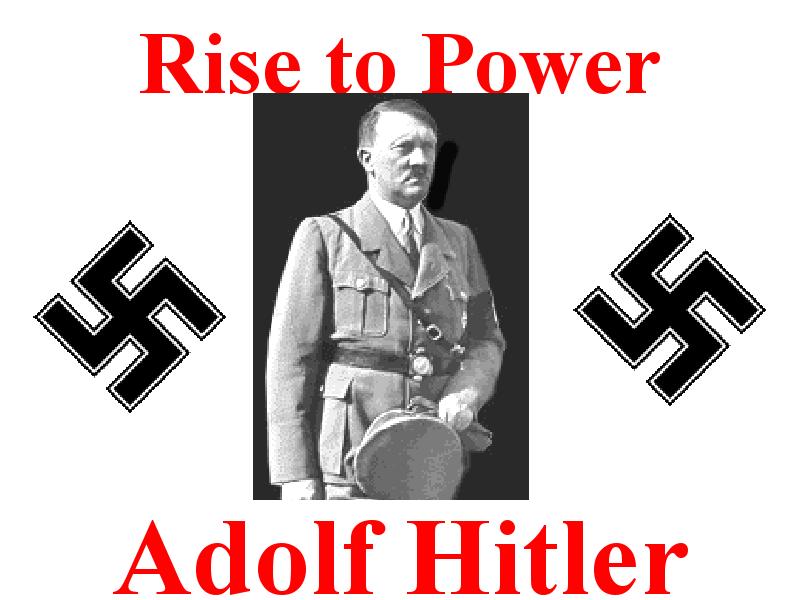
Rise to Power
 
 
Adolf  Hitler
Objectives:
• The  objective  of this presentation is to give  
students  an  understanding  of Adolf  Hitler ’s 
early , pre- adult   years .
• Students will also become familiar with 
how this seemingly unimportant Austrian 
rose to power in post World War I Germany .
 
 
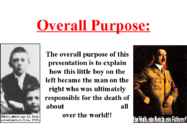
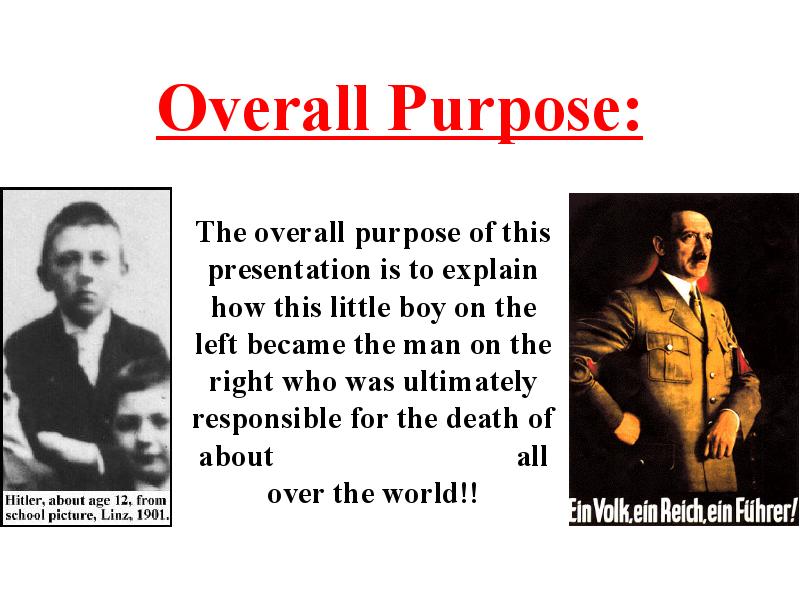
Overall Purpose :
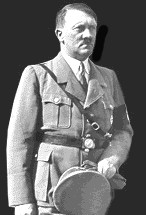
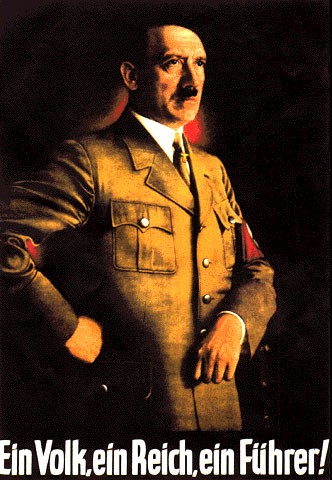
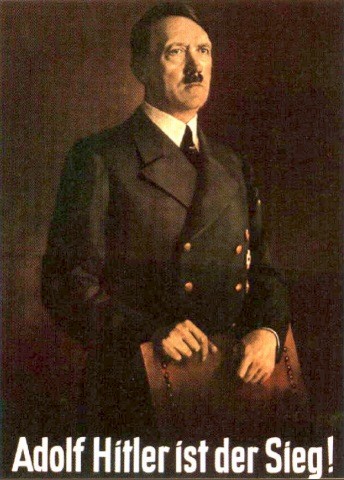
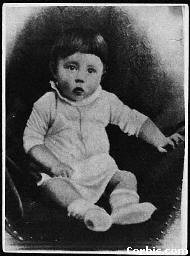
The overall purpose of this 
presentation is to explain 
how this little boy on the 
left   became the man on the 
right who was ultimately 
responsible  for the  death  of 
about 50 million people all 
over the world!!
 
 
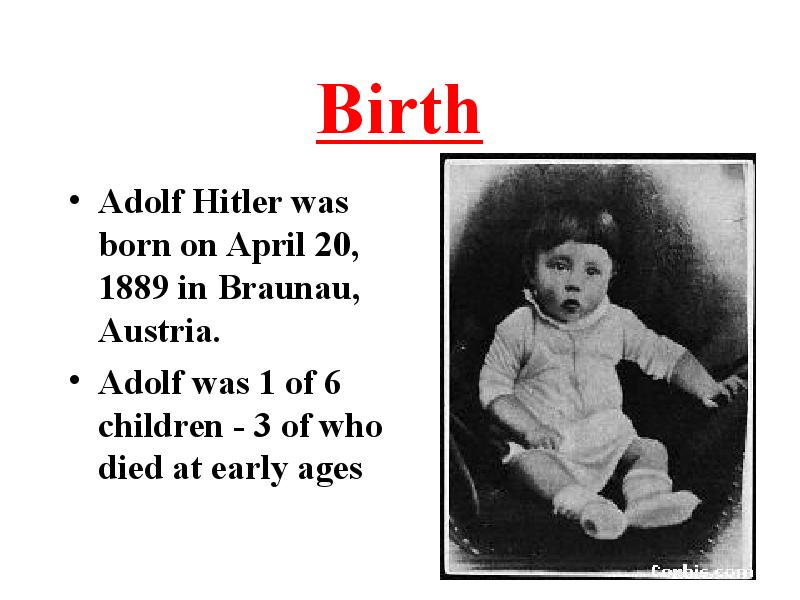
Birth
• Adolf Hitler was 
born on April 20, 
1889 in Braunau, 
Austria.

• Adolf was 1 of 6 
children  - 3 of who 
died at early ages


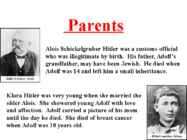
 Parents
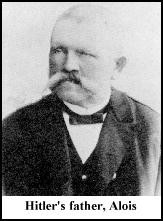
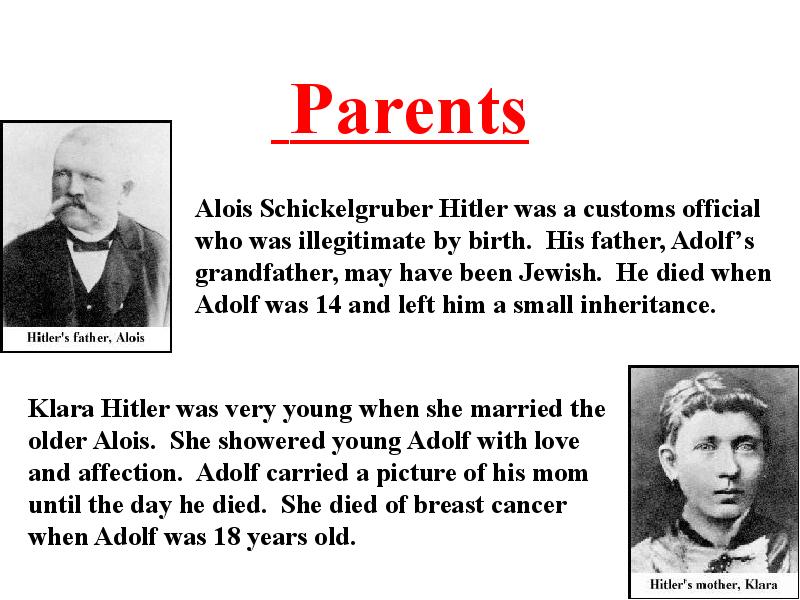
Alois  Schickelgruber Hitler was a customs  official  
who was illegitimate by birth.  His  father , Adolf’s 
grandfather, may have been Jewish.  He died when 
Adolf was 14 and left him a small inheritance.

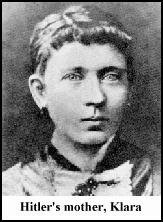
Klara Hitler was very young when she  married  the 
older Alois.  She showered young Adolf with love 
and affection.  Adolf carried a picture of his mom 
until  the day he died.  She died of breast cancer 
when Adolf was 18 years old.


Education
• Attended a Benedictine monastery school where he 
took  part  in the choir.
• When it was time to choose a secondary school, Adolf 
wanted to become an artist.
• His father wanted him to become a civil servant, but 
after his father died, he dropped out of high school 
and attempted to get into the  Vienna   Academy  of 
Fine Arts - he failed.

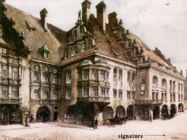
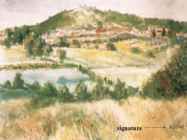
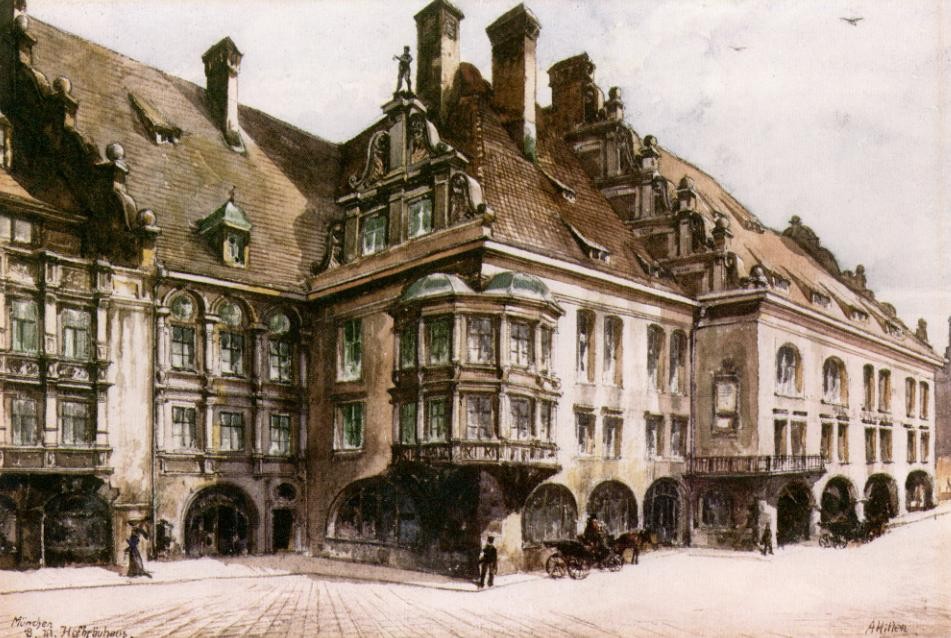
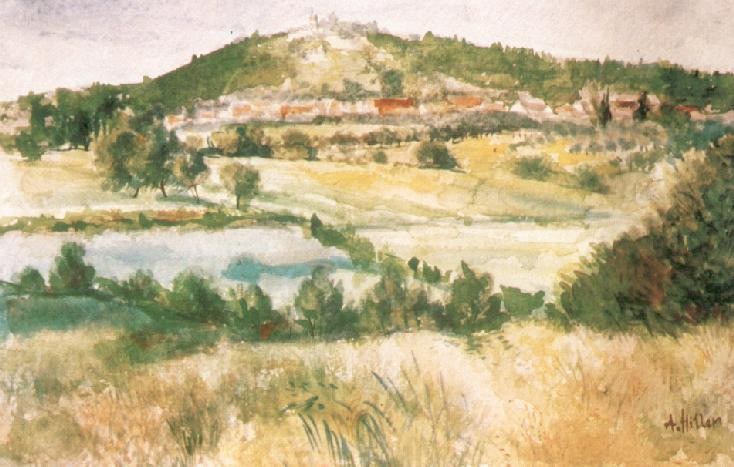
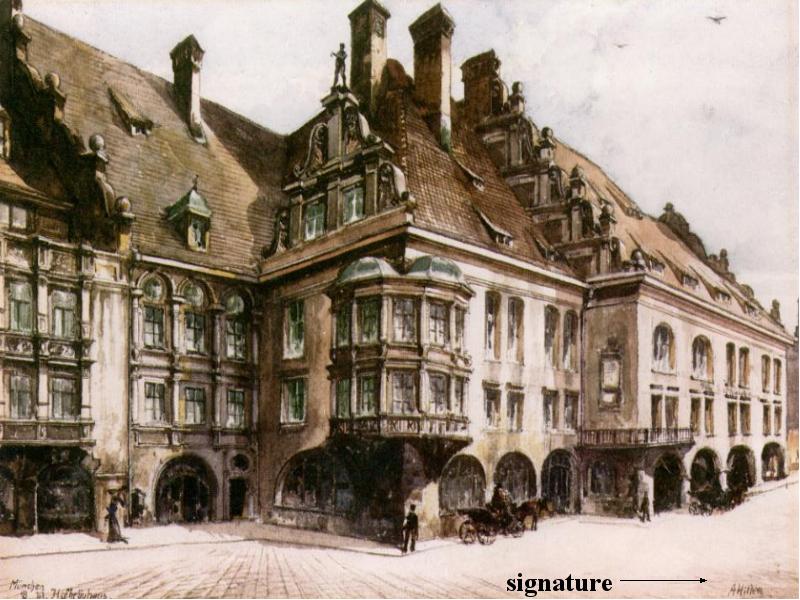
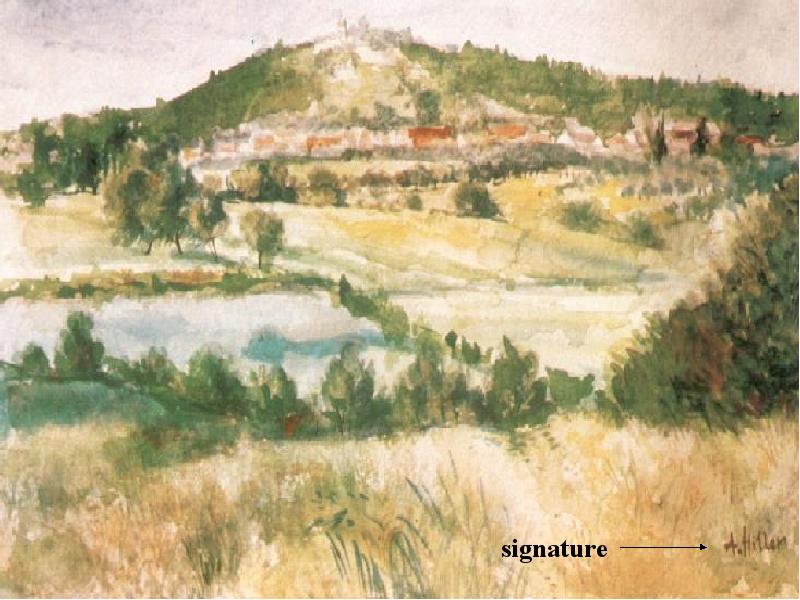
• The following  slides are examples of Adolf’s artwork.


 signature
signature
 
 
Years in Vienna
• After his mother  died, Adolf (now 18) decided to 
move  to Austria to pursue his dream of becoming a 
great artist.
•  Again  he failed to  gain  entrance into the Academy
• He eventually  sold  all his possessions and became a 
homeless drifter who slept on park benches and ate 
at  soup  kitchens throughout Vienna (age 19)
• Adolf did manage to sell some  paintings  and 
postcards, but remained impoverished
 
 
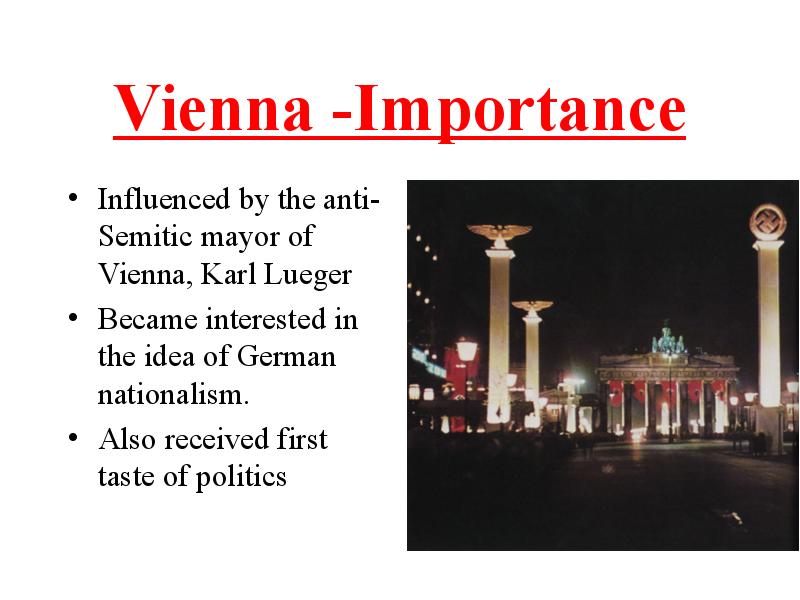
Vienna - Importance
• Influenced by the anti-
Semitic mayor of 
Vienna, Karl Lueger
• Became interested in 
the idea of  German  
nationalism.
• Also  received first  
taste of  politics  
 
 
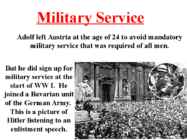
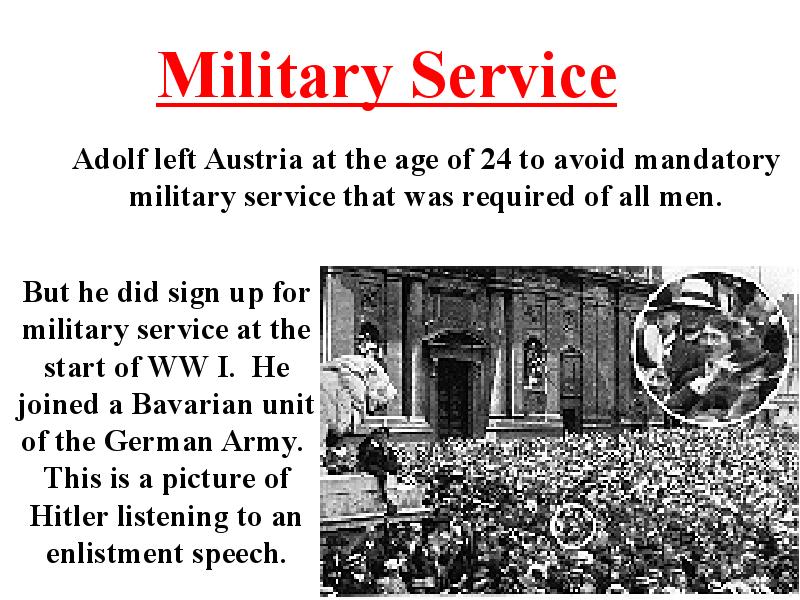
Military   Service
Adolf left Austria at the age of 24 to  avoid mandatory 
military service that was required of all men.
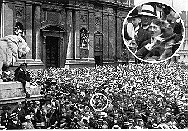
But he did sign  up for 
military service at the 

start of WW I.  He 
joined a Bavarian  unit  
of the German  Army .  
This is a picture of 
Hitler  listening  to an 
enlistment speech.
 
 
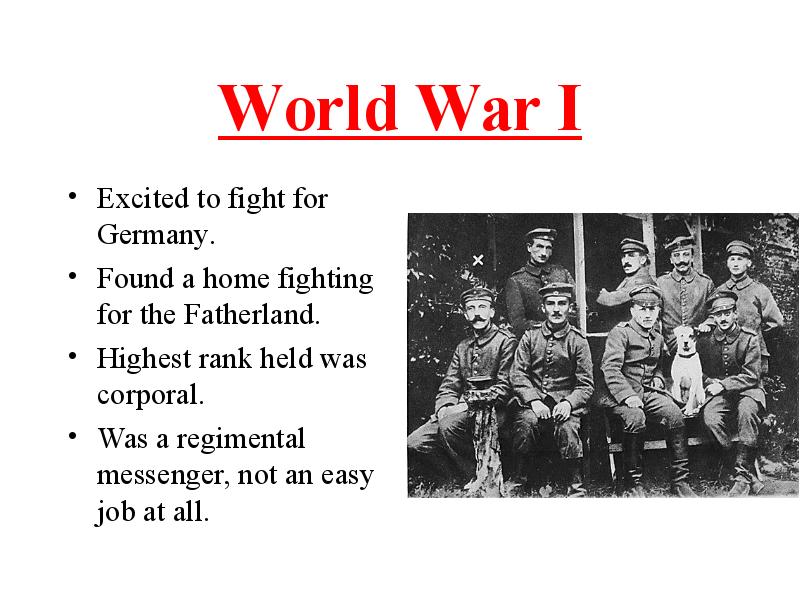
World War I
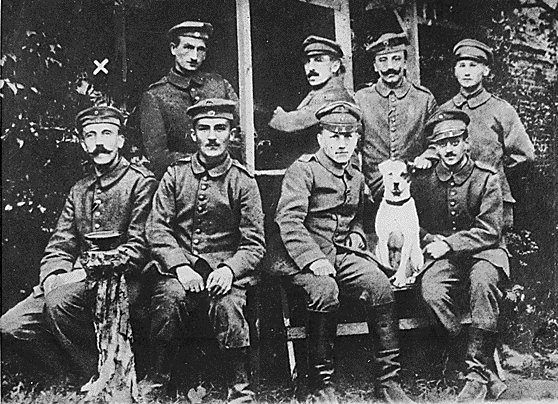
• Excited to fight for 
Germany.
•  Found  a home fighting 
for the Fatherland.
•  Highest  rank  held  was 
corporal.
• Was a regimental 
messenger, not an  easy  
job at all.
 
 
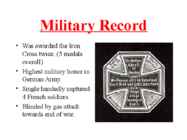
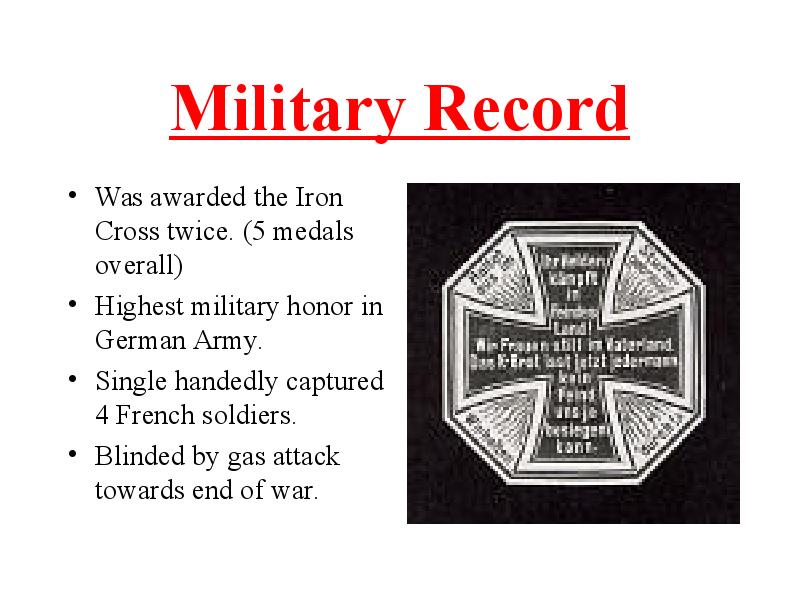
Military  Record
• Was awarded the Iron 
Cross twice. (5 medals 
overall)
• Highest military honor in 
German Army.
•  Single  handedly captured 
4 French soldiers.
• Blinded by gas attack 
towards end of war.
 
 
German Loss in WW I
• Hitler was devastated when he heard the news of 
the German surrender.
• He was appalled at the anti-war sentiment among 
the German civilians.
• Believed  there  was an anti-war conspiracy that 
involved the  Jews  and Marxists.
• Also, felt that the German military did not lose the 
war, but that the politicians (mostly Jews) at home 
were responsible for the defeat.
 
 
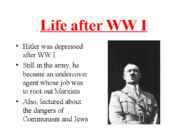
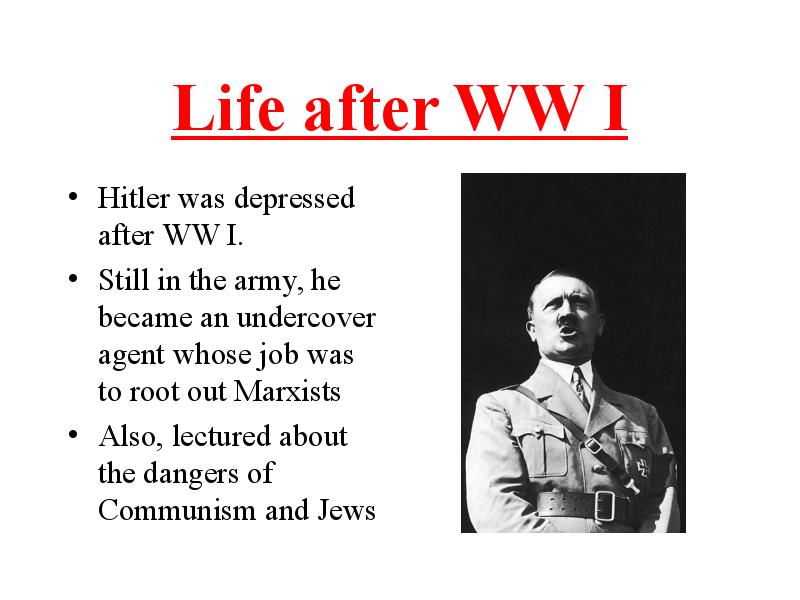
Life after WW I
• Hitler was depressed 
after WW I.
•  Still  in the army, he 
became an undercover 
agent whose job was 
to  root  out Marxists
• Also, lectured about 
the dangers of 
Communism and Jews
 
 
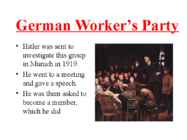
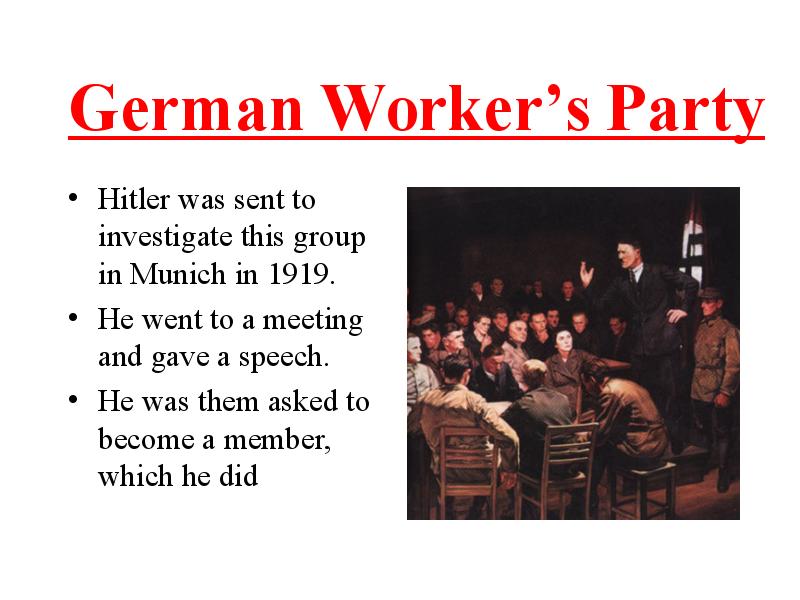
German  Worker ’s  Party
• Hitler was sent  to 
investigate this group 
in Munich in 1919.
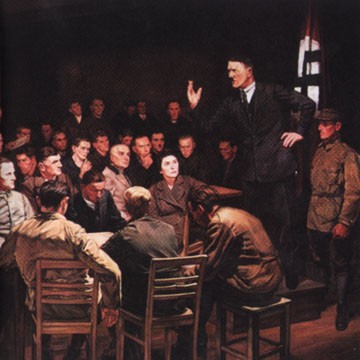
• He went to a meeting  
and gave a speech.
• He was them asked to 
become a member, 
which he did
 
 
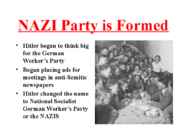
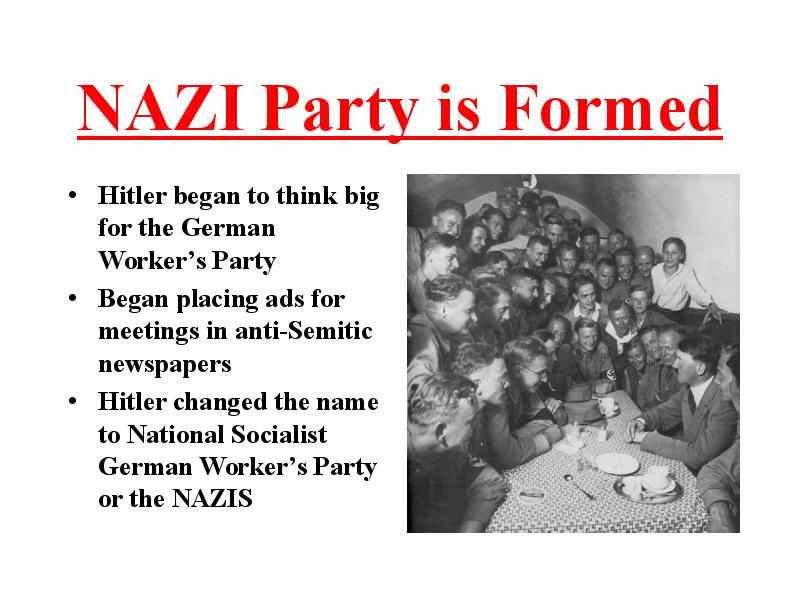
NAZI  Party is Formed
• Hitler began to think big 
for the German 
Worker’s Party

• Began placing ads for 
meetings in anti-Semitic 
newspapers

• Hitler changed the name 
to National Socialist 
German Worker’s Party 
or the NAZIS


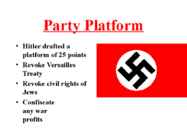
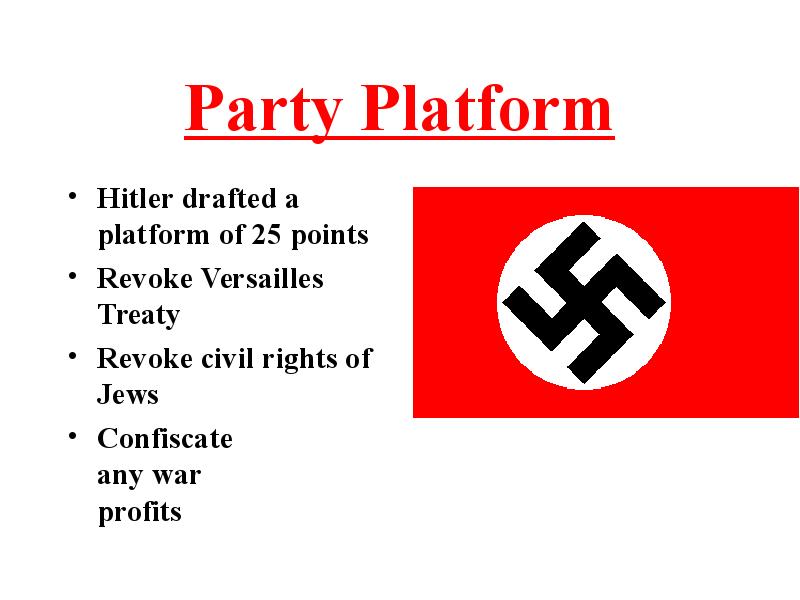
Party  Platform
• Hitler drafted a 
platform of 25  points
• Revoke  Versailles  
Treaty
• Revoke civil  rights  of 
Jews
• Confiscate              
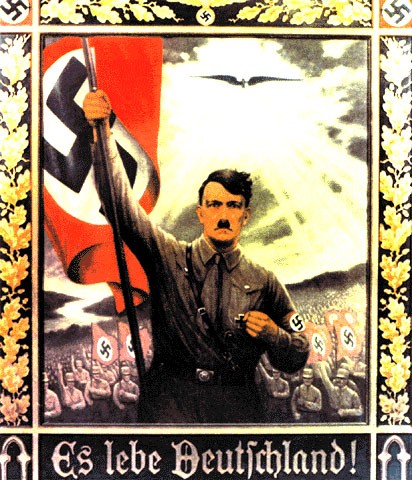
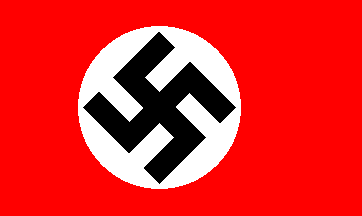
any war             Besides  changing the party name, the 
profits

red flag with the SWASTIKA was 
adopted as the party symbol
 
 
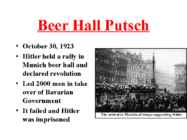
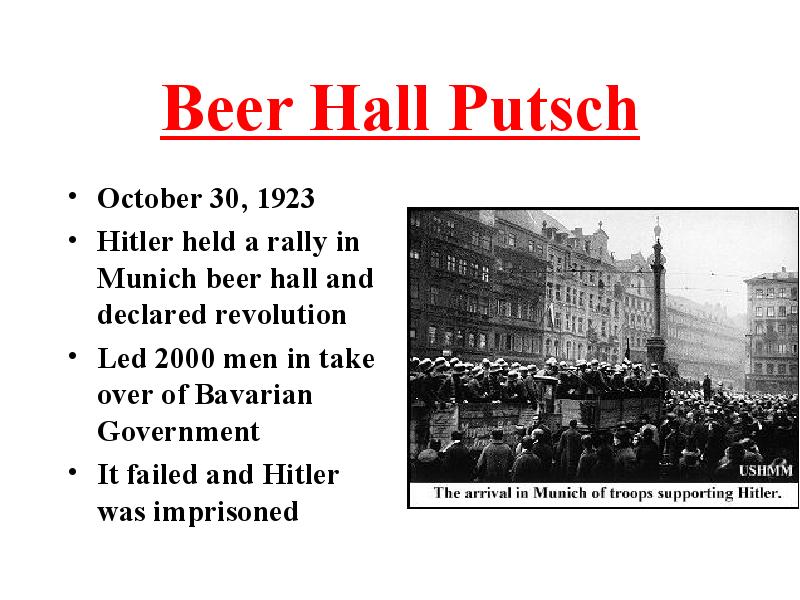
Beer  Hall Putsch
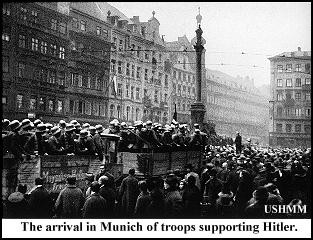
• October 30, 1923
• Hitler held a rally in 
Munich beer hall and 
declared  revolution

• Led 2000 men in take 
over of Bavarian 
Government

• It failed and Hitler 
was imprisoned
 
 
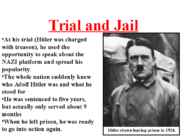
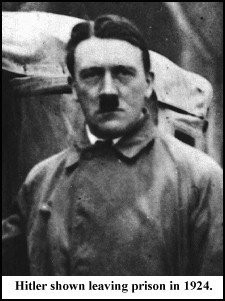
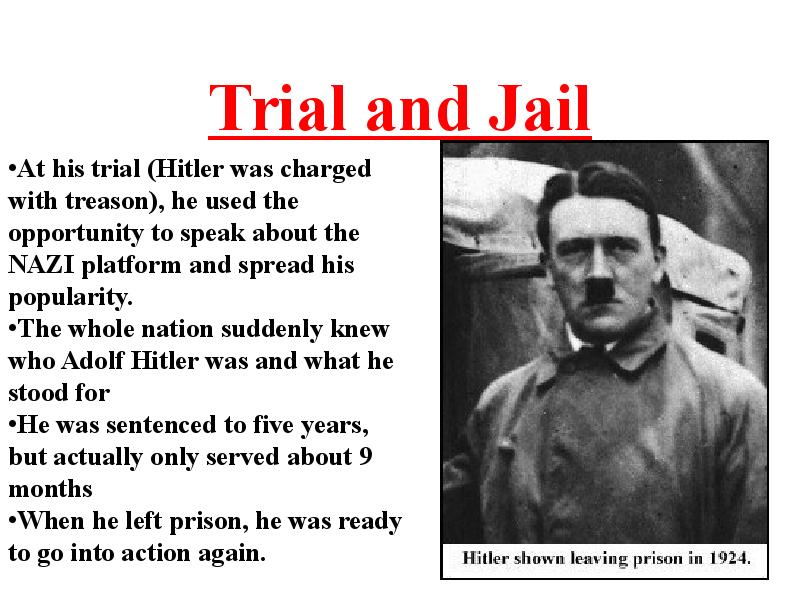
Trial and  Jail
At his trial (Hitler was charged 
with treason), he used the 
opportunity to speak about the 
NAZI platform and  spread  his 
popularity .
The  whole   nation  suddenly knew 
who Adolf Hitler was and what he 
stood for
He was sentenced to five years, 
but actually only served about 9 
months
When he left prison, he was ready 
to go into action  again.


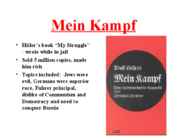
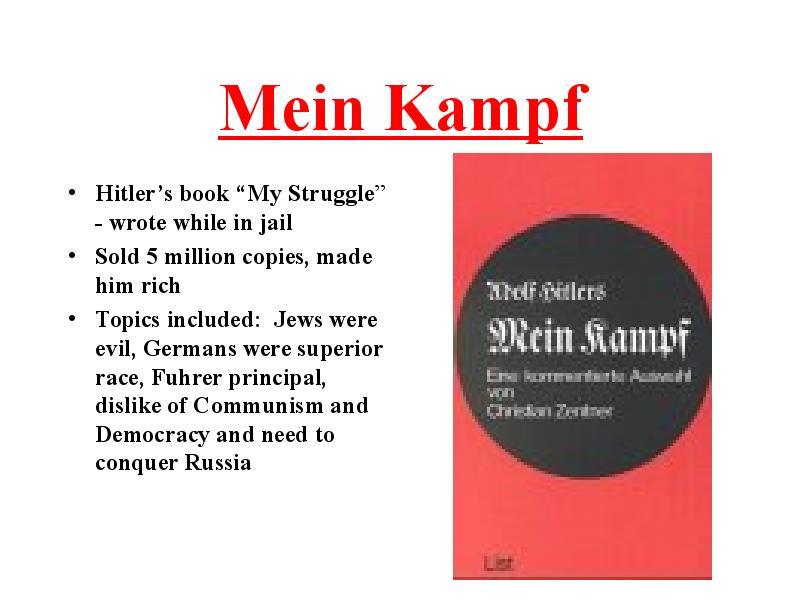
Mein  Kampf
• Hitler’s book “My Struggle 
- wrote  while  in jail
• Sold 5 million copies, made 
him  rich
• Topics included:  Jews were 
evil, Germans were superior 
race, Fuhrer principal, 
dislike of Communism and 
Democracy  and need to 
conquer  Russia


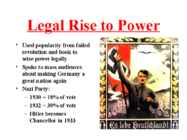
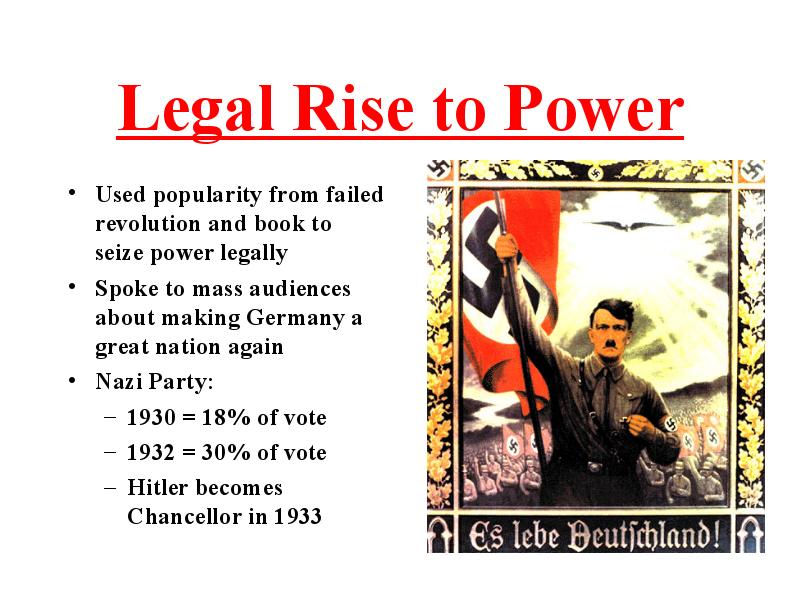
Legal Rise to Power
• Used popularity from failed 
revolution and book to 
seize power legally

• Spoke to mass audiences 
about making  Germany a 
great nation again

• Nazi Party:
– 1930 = 18% of  vote
– 1932 = 30% of vote
– Hitler becomes 
Chancellor in 1933
 
 
Appeal of Hitler
• Germany was in the midst of an economic 
depression  with  hyper -inflation
• Hitler was a WW I  hero  who talked about 
bringing glory  back  to the “Fatherland”
• He promised the rich industrialists that he would 
end any communist threat in Germany
• Constantly blamed Jews for Germany’s problems, 
not the German people.
• Hitler was an excellent public speaker.
 
 
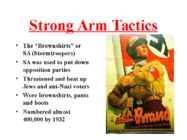
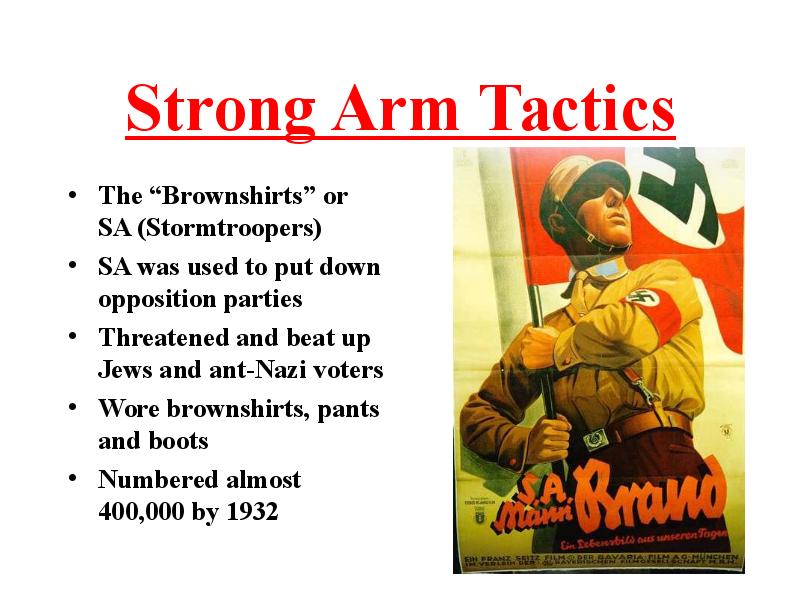
Strong  Arm Tactics
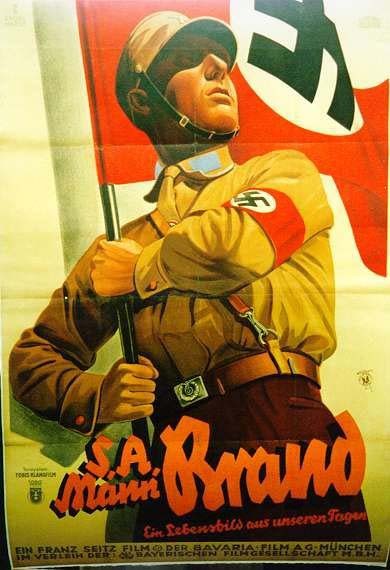
• The “Brownshirts” or 
SA (Stormtroopers)
• SA was used to put down 
opposition  parties
• Threatened and beat up 
Jews and ant-Nazi voters
• Wore brownshirts, pants 
and boots
• Numbered  almost  
400,000 by 1932
 
 
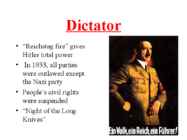
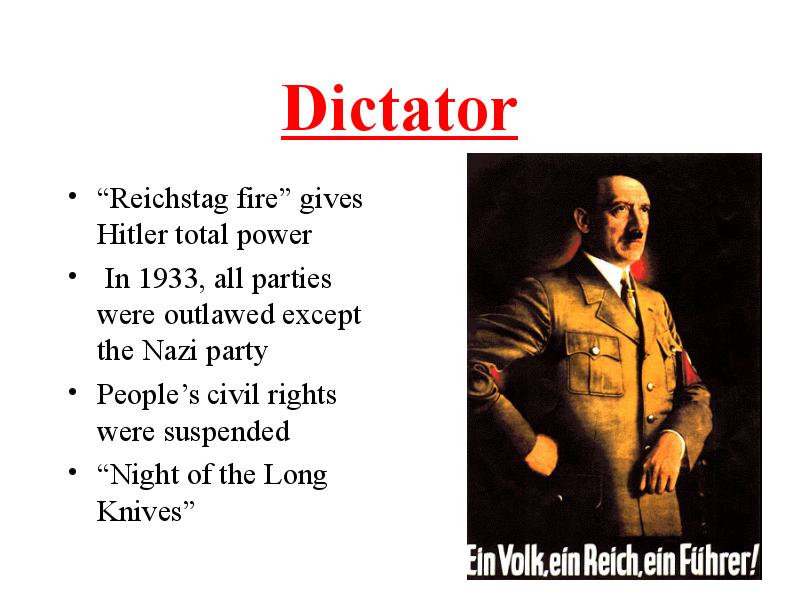
Dictator
• “Reichstag fire” gives 
Hitler  total  power
•  In 1933, all parties 
were outlawed except 
the Nazi party
• People’s civil rights 
were suspended
• “ Night  of the Long 
Knives”
 
 
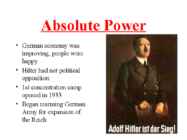
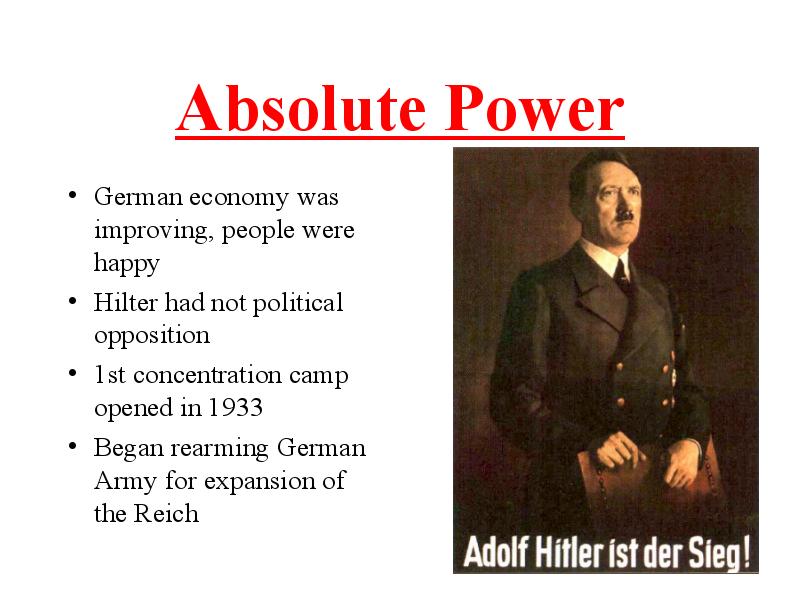
Absolute Power
• German  economy  was 
improving, people were 
happy
• Hilter had not  political  
opposition
• 1st  concentration  camp 
opened in 1933
• Began rearming German 
Army for expansion of 
the  Reich
 
 
THE
END
.......................Until the start of World War II


Document Outline

  • Adolf Hitler
  • Objectives:
  • Overall Purpose:
  • Birth
  • Parents
  • Education
  • Slide 7
  • Slide 8
  • Years in Vienna
  • Vienna -Importance
  • Military Service
  • World War I
  • Military Record
  • German Loss in WW I
  • Life after WW I
  • German Worker’s Party
  • NAZI Party is Formed
  • Party Platform
  • Beer Hall Putsch
  • Trial and Jail
  • Mein Kampf
  • Legal Rise to Power
  • Appeal of Hitler
  • Strong Arm Tactics
  • Dictator
  • Absolute Power
  • Slide 27
Vasakule Paremale
Hitler- early years #1 Hitler- early years #2 Hitler- early years #3 Hitler- early years #4 Hitler- early years #5 Hitler- early years #6 Hitler- early years #7 Hitler- early years #8 Hitler- early years #9 Hitler- early years #10 Hitler- early years #11 Hitler- early years #12 Hitler- early years #13 Hitler- early years #14 Hitler- early years #15 Hitler- early years #16 Hitler- early years #17 Hitler- early years #18 Hitler- early years #19 Hitler- early years #20 Hitler- early years #21 Hitler- early years #22 Hitler- early years #23 Hitler- early years #24 Hitler- early years #25 Hitler- early years #26 Hitler- early years #27
Punktid 50 punkti Autor soovib selle materjali allalaadimise eest saada 50 punkti.
Leheküljed ~ 27 lehte Lehekülgede arv dokumendis
Aeg2017-02-11 Kuupäev, millal dokument üles laeti
Allalaadimisi 1 laadimist Kokku alla laetud
Kommentaarid 0 arvamust Teiste kasutajate poolt lisatud kommentaarid
Autor rauno.t Õppematerjali autor
Alois Schickelgruber Hitler was a customs official who was illegitimate by birth. His father, Adolf’s grandfather, may have been Jewish. He died when Adolf was 14 and left him a small inheritance.Klara Hitler was very young when she married the older Alois. She showered young Adolf with love and affection. Adolf carried a picture of his mom until the day he died. She died of breast cancer when Adolf was 18 years old.

Sarnased õppematerjalid

Inglise keelt kõnelevate maade ajalugu lühikonspekt
168
odp

Inglise keelt kõnelevate maade ajalugu lühikonspekt

Stonehenge One of the best known ancient wonders of the world, 5000 years old Megalith monument, built by western mediterraneans during 3000-1600 BC Circular structure, large standing stones, aligned with rising sun at teh solstice Attlers and bones were sued to dig pits that hold the stones The Celts in Britain and their legacy 700-200 BC celts invade Britain Gaels or Goehls(Ireland and Scotland),Cymri(Wales) and Brythons(gave name to Brittany) Fierce fighters,superb horsemen.Most of them farmers, lived in thatched houses

Inglise keel
Inglise keelt kõnelevate maade ajaloo eksamiküsimused
28
doc

Inglise keelt kõnelevate maade ajaloo eksamiküsimused

Roman introduced theire measurements, Christianity, reading and writing. Also, many words in English and Welsh have been borrowed from the Latin language. An important legacy of the Romans was its roads, agriculture and cities. In the Roman times the land was dominated by rules and reguations. *Christianity in Roman Britain ­ The Roman authorities were suspicious of Christianity because followers of Jesus Christ refused to take an oath of loyalty to the Roman emperor. For this reason the early Christians were regarded as dangerous enemies of the Empire. That ceased when the emperor Constantine converted to Christianity. Christianity became the official state religion of the Roman Empire in the early fourth century A.D. As the century progressed Christianity spread very quickly. Despite official recognition there was no mass conversion to Christianity; worship of the pagan gods and goddesses was not even formally banned until late in the fourth century.

Inglise keel kõnelevate maade ajalugu
Adolf Hitler
2
pdf

Adolf Hitler

National Socialist German Workers Party (NSDAP) leader (1921-1945). Between 1934-1945, he was the dictator of Germany the official title of the German Chancellor (1933-1945) and the title of the head of state ("Führer and Chancellor"; 1934-1945). Adolf was born on April 20, 1889 a. Braunau am Inn, Austria-Hungary, a customs official Alois h ​ otly excit​Hitler (1837-1903) and his wife Klara six children fourth. Only the children reached adulthood, he and his sister Paula. 1906. Hitler visited Vienna and ended up in a hotly excited waxed city buildings, art galleries and operas.His new ambition was to take the Vienna Academy of Fine Arts. Further, he served as illustrator, often painted pictures and postcards for sale in stores.He knew how to influence people in such a way that no other head of state had failed before. Desperate was susceptible to all kinds ässitustele of the people and the promises he talked about what the people wanted to hear!

Ajalugu
Public International Law is a system of law
47
docx

Public International Law is a system of law

E.g. Panama channel, Suess channel, Bosporus and Dardanelles straits, straits between Sweden and Denmark, Danube river, river Nile Lecture 4 Antarctica Antarctica's unique regime was established by the Antarctic Treaty (Washington, 1 December 1959). Originally signed by 12 countries which were not far from Antarctica or had some explorations there (UK, Japan, South-Africa etc). Initially concluded for 30 years, then prolonged. Some scholars consider the treaty's principles as norms of customary international law. The unique feature of Antarctic is that it comprises of all territories that go under the south latitude 60 (includes all ice shelves, doesn't prohibit using rights under IL concerning high seas). So Antarctic was an international territory. So it is a common heritage of mankind.

Inglise keel
Britain history
6
doc

Britain history.

Britain History Pre-Norman Britain The Iberians brought their metal-working skills and the first real civilization to Britain in the third millennium B.C and were overrun by various Celtic invasions that began in the 8th century. The Celts introduced their tribal organization and an early form of agriculture before they were forced westward by the Roman invasion. Forms of Celtic language are still spoken in Britain. Romans (with Julius Caesar in the head of them) first tried to occupy Britain in 55 B.C., but there was a rebellion in Gaul so they had to leave to fight against it. Next time they came in 43 A.D. and their leader was Emperor Claudius. Romans brought a lot with them.

Inglise keel
Notes-Jews in the USSR-1917-2000
11
docx

Notes, Jews in the USSR, 1917-2000

Jonathan Dekel-Chen lectures, Jews in the USSR, 1917-2000 1937 census didn't get published. 1939, pretty accurate for Js. 3.1 mill Js in pre- Molotov-Ribbentrop area. 1939, 2.2 mill. Js not shy about declaring Jewishness. Inherits 1.3 mill in Poland. Similar # annexed by Germ. 250,000 in Lithuania. 330,000 Bessarabia. Back to pre-1917 #s of Sov Jewry. 5 ½ mill of pre-war levels. Pre-mature deaths during famine of '21-'22, '31-'33, 7 years of war, emigration up to 1924 (vast majority to West, 3rd and 4th aliyahs). J pop growth still significant, high birth rates, but pop static. Grows more in SU than anywhere else ­ few leaving, pop growth significant. Vast majority in W borderlands. Very few emigrate during year and a half from annexed areas. Germans occupied Leningrad-Moscow-Stalingrad, all and more of former Pale. 1939, started evacuating. Stalin thought 43-44, war. Purges, Winter War, military needed

Inglise keel
TheCodeBreakers
946
pdf

TheCodeBreakers

S.A. SIGNET, SIGNET CLASSICS, SIGNETTE, MENTOR AND PLUME BOOKS are published by The New American Library, Inc., 1301 Avenue of the Americas, New York, New York 10019 FIRST PRINTING, FEBRUARY, 1973 PRINTED IN THE UNITED STATES OF AMERICA To my Parents and my Grandmother Contents A Note on the Abridged Version Preface A Few Words 1. One Day of Magic: I 2. One Day of Magic: II 3. The First 3,000 Years 4. The Rise of the West 5. On the Origin of a Species 6. The Era of the Black Chambers 7. The Contribution of the Dilettantes 8. Room 40 9. A War of Intercepts 10. Two Americans 11. Secrecy for Sale 12. Duel in the Ether: I 13. Duel in the Ether: II 14. Censors, Scramblers, and Spies 15. The Scrutable Orientals 16. PYCCKAJI Kranrojioras 17. N.S.A. 18. Heterogeneous Impulses 19. Ciphers in the Past Tense 20. The Anatomy of Cryptology Suggestions for Further Reading Index

krüptograafia
Cold war
3
doc

Cold war

The Troubled Peace 1 a) The Nazis didn't care for any other nationalities, they used people who weren't German only for ''slave work'' . Germanys only concern was to keep themselves happy and powerful. They wanted to make themselves the superior race. Hitlers idea of the perfect race, the Aryan race also didn't help, because the Aryan race should have people with light eyes,hair and skin, they should be tall and powerful. He didn't care for people who didn't meet his expectations of the perfect race. In his eyes all other groups of people like the Russians, Jews and just crazy, crippled or diseased people were worthless and didn't have any other use than for slave work or just killing. b) After the war twenty-four major political and military leaders of Nazi Germany, indicted for aggressive war, war crimes, and crimes against humanity, were brought to trial before the British, French, Russian and American judges. More than 100 additional def

Ajalugu


Meedia

Kommentaarid (0)

Kommentaarid sellele materjalile puuduvad. Ole esimene ja kommenteeri


Sellel veebilehel kasutatakse küpsiseid. Kasutamist jätkates nõustute küpsiste ja veebilehe üldtingimustega Nõustun