Leidsid 33 sarnast õppematerjali, mis on seotud failiga "Hitler- early years". Need materjalid aitavad sul teemat sügavamalt mõista.
hitler, german, part, party, jews, power, germany, father, military, nazi, vienna, sent, years, left, became, civil, failed, gain, army, nation, overall, again, sold, service, sign, worker, platform, trial, vote, rise, objective, students, early, purpose, responsible, birth, alois, picture, until, wanted, academy, unit, speech, fight, highest, heldPrasutagus(ruler) was first allowed to rule when romans conquered England, after his death, romans decided to rule Iceni and flogged Boudicca and raped her daughters 60-62 AD Iceni rebelled, Boudicca´s warriors defeated Roman Ninth Legion, destroied capital-Colchester Finally Boudicca was defetated, she poisoned herself to avoid capture Hadrian´s wall A defensive barrier builtin 122 AD by Roman emperor Hadrian to guard the northern part of Britain against barbarian invaders Most imposing frontier of Roman Empire, controlling peoples mobements Building took several years, builders kept changing minds about the size 119 km lenght, 5m high, 3m deep The Picts, Caledonia The painted ones, northern tribes, part of the Scots Inhabited an area known as eastern and th western Scotland, until 10 c Mysteriously disappeared Constantly fought with Romans
banned until late in the fourth century. *Boadicea/Boudica At his death bed, Boudica's husband left half his possession to the emperor, expecting that this would protect his family. However, his property was confiscated. When Boudica, the queen of the Celts, protested, she was flogged and her daughters were raped. She swept trough Southern Britain with her tribe and tortured every Roman she met. A women having power seemed unnatural to the Romans. She fought back for 2 years, but finally took poison and died. *Hadrian's Wall It was built by the emperor Hadrian and it marked the Northen border of the Roman empire. Hadrian's Wall was built, beginning in 122, to keep Roman Britain safe from hostile attacks from the Picts. The wall stretched from the North Sea to the Irish Sea. In addition to the wall, the Romans built a system of small forts called milecastles. Sixteen larger
Adolf Hitler German politician from Austria National Socialist German Workers Party (NSDAP) leader (1921-1945). Between 1934-1945, he was the dictator of Germany the official title of the German Chancellor (1933-1945) and the title of the head of state ("Führer and Chancellor"; 1934-1945). Adolf was born on April 20, 1889 a. Braunau am Inn, Austria-Hungary, a customs official Alois h otly excitHitler (1837-1903) and his wife Klara six children fourth. Only the children reached adulthood, he and his sister Paula. 1906. Hitler visited Vienna and ended up in a hotly excited waxed city buildings, art galleries and operas
7. Universal respect for, and observance of, human rights and fundamental freedoms for all (environmental norms Lege ferenda norm which is in the process of establishment) To use war as a legal object to resolve conflict, there has to be either self-defence or the agreement of the security council of UN (if there's a threat to peace etc). State (def) "Inter-American convention on the rights and Duties of States!" (Montevideo 26.12.1933) A permanent population biggest part are citizens of the state, + citizens of other states, who have a residence permit, stateless person (apatrid), people with multiple citizenships (bipatrid). How to get citizenship by birth: lex sanguinis blood principle, by birth, given to the child according to the citizenship of the parents (if parents are citizens of different countries different
managing to unite the Anglo-Saxons and Danes at the beginning of 11th century. Medieval England After defeating the Anglo-Saxon King Harold at the Battle of Hastings in 1066, William of Normandy (who became William I, also called William the Conqueror) introduced the Norman feudal system, rewarding his French-speaking followers with land in return for their continued support. French remained the language of the upper classes and administration until the 14th century. The power of these Norman Barons gradually increased and during the reign of the Plantagenets began the challenge the King's absolute power, which resulted in King John being forced to sign Magna Carta in 1215. It consisted of long list of limitations to the King's power and it gave more power to the origins of Parliament. The origins of Parliament are to be found in the reign of John's successor, Henry III. It
to 1924 (vast majority to West, 3rd and 4th aliyahs). J pop growth still significant, high birth rates, but pop static. Grows more in SU than anywhere else few leaving, pop growth significant. Vast majority in W borderlands. Very few emigrate during year and a half from annexed areas. Germans occupied Leningrad-Moscow-Stalingrad, all and more of former Pale. 1939, started evacuating. Stalin thought 43-44, war. Purges, Winter War, military needed improvement, military industrial complex and factories and personnel moved E. Disassemble, move by rail beginning 1939. They know what happened in Spain, total war. Disproportionate # of Js in SU industry, moved E. Js involved in evacuation because of potential for betraying, wealthy capitalists? Crimean factories moved on kurdish straits. Uk factories not moved, Ger war too fast. Month and a half, most J kolkhozes moved. Also evacuated govt officials, those at risk. Also unorganized
Some of the things you will learn in THE CODEBREAKERS • How secret Japanese messages were decoded in Washington hours before Pearl Harbor. • How German codebreakers helped usher in the Russian Revolution. • How John F. Kennedy escaped capture in the Pacific because the Japanese failed to solve a simple cipher. • How codebreaking determined a presidential election, convicted an underworld syndicate head, won the battle of Midway, led to cruel Allied defeats in North Africa, and broke up a vast Nazi spy ring. • How one American became the world's most famous codebreaker, and another became the world's greatest.
The Troubled Peace 1 a) The Nazis didn't care for any other nationalities, they used people who weren't German only for ''slave work'' . Germanys only concern was to keep themselves happy and powerful. They wanted to make themselves the superior race. Hitlers idea of the perfect race, the Aryan race also didn't help, because the Aryan race should have people with light eyes,hair and skin, they should be tall and powerful. He didn't care for people who didn't meet his expectations of the perfect race. In his eyes all other groups of people like the Russians, Jews and just crazy, crippled or diseased
Historical records beyond the initial invasion are sparse, although many Roman historians mention the province in passing. Most of the knowledge of the period stems from archaeological investigations and especially epigraphic evidence. The invasion force in AD 43 was led by Aulus Plautius.It is not known how many Roman legions were sent; only one legion, the II Augusta, commanded by the future emperor Vespasian, is directly attested to have taken part. The IX Hispana,the XIV Gemina (later styled Martia Victrix) and the XX are attested in 60/61 during the Boudican Revolt, and are likely to have been there since the initial invasion. However, the Roman army was flexible, with units being used and moved whenever necessary, so this is not certain. Only the Legio IX Hispana is likely to have stayed there, as it is attested to being in residence at Eburacum (York) in AD 71 and on a building inscription there dated AD 108, before its
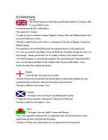
started during the days of the Industrial Revolution * the flag is of Wales bears a Red Dragon (it is not represented on the Union Jack) Northern Ireland: * the capital city is Belfast * 54% of people regard themselves as Protestants and 42% as Roman Catholics * the flag is called the Saint Patrick's Cross 2) History Prehistoric Britain, Roman Britain, Anglo-Saxon, Danish, Norman invasions (...-1066): Britain was part of the European land mass until the end of the last Ice Age. It became an island by about 6000 BC. From about 3000 to 2000 BC the British Isles were inhabited by a group of people called the Iberians. These Stone Age people lived in limestone caves, they used stone axes and fashioned antlers and bones into leather-working tools. Later groups of people from what are now Germany, the Netherlands and Brittany also settled in Briton.
established the relationships between Estonia, Livonia and the Russian Empire. The Baltic Landesstaat reached its full development. The freedom of action in the new provinces was naturally granted to one of the most firm ideological pillars of the tsarist empire -- the Russian orthodox church; though as the Landeskirche in the Estonian and Livonian territories, the Lutheran church long maintained a de facto predominance. The most important organ of Baltic German local government was the Diet, consisting of all the noble families who had been `selected' in a list of the eligible. Although jealously guarding their privileges, the knighthoods still never became entirely closed. Between sessions of a Diet, the legislative power of the knighthoods belonged to the Council of the Diet. The towns were governed by the Town Councils, which supplemented their ranks from among the representatives of merchants and lawyers. The
[22] Towards the end of his stay at the school, it was decided that he lacked the academic ability to get into Oxford University on a scholarship[22] and his parents lacked the wherewithal to finance him; [16] consequently, Lockwood Kipling obtained a job for his son in Lahore (now in Pakistan), where Lockwood was now Principal of the Mayo College of Art and Curator of the Lahore Museum. Kipling was to be assistant editor of a small local newspaper, the Civil & Military Gazette. He sailed for India on 20 September 1882 and arrived in Bombay on 18 October 1882. This arrival changed Kipling, as he explains, "There were yet three or four days' rail to Lahore, where my people lived. After these, my English years fell away, nor ever, I think, came back in full strength". Travels & First writings During the summer of 1883, Kipling visited Simla (now Shimla), well-known hill station and summer capital of British India
Medieval England 1066-1485 Eva Asper Anna Pohlak 11.c The Norman Dynasty The Norman Conquest In the 11th century, Normans conquered England - The Battle of Hastings 14.10.1066 The Anglo-Saxon forces had more soldiers but the Normans had better military tactics and won in the end thanks to a clever strategy William I, also known as William the Conqueror, replaced King Harold on the throne The invasion was completed by 1071 - The Norman invasion is depicted on the Bayeux Tapestry a long embroidered cloth The death of King Harold embroidered on the Bayeux Tapestry The Norman England William I ensured his power by dividing the land into parts and making 1/7 of it a royal domain
Introduction The aim of this research is to get know more about the Netherlands history and its geographical facts. This report is describing one of most the most beautiful countries in the Europe - Netherlands. Netherlands is famous for its windmills and flowers. Netherlands is also known unofficially as Holland. Government is constitutional monarchy of north-western Europe. Netherlands is bordered on the north and west by the North Sea, on the east by Germany and on the south by Belgium. The European portion of the Netherlands has a total area of 41,528 sq km of which 33,939 sq km is land surface. Country's capital and largest city is Amsterdam. Population is about 16 million. 3 Chapter 1 The Netherlands 1.1 Mainly about the Netherlands Netherlands is also known unofficially as Holland. Netherlands is bordered on the north and
Seems to be against all forms of governments, comes to conclusion that the republicans way is the best. He finds communism helpful. The question is wheter bloodshed is justified and humane. Unlike earlier hemingway heroes Jordan is an intellectual. Jordan is against suicide, which is major theme in the novel, because Jordan's father commited suicide. Falls in love with Maria, daughter of republican mayor. Three days of love bring him back to life. Maria was raped by facists and her father was killed by facists, disturbed girl. Secondary characters are rememorable. Men and women act differently to war. Men are carried away by war propaganda, women are shown to be wised and appreciate life more than political parties. Men think on taking sides but women value life more. Jordan is an idealist. He is willing to give his life for this cause. But Maria's first loyalty is to her lover, jordan. She places love above war, politics. Pablo is another type, he is a moral coward, he is
In the 9th century they conquered and settled the islands around Scotland and some coastal regions of Ireland. Their conquest of England was halted when they were defeated by King Alfred of the Saxon kingdom of Wessex. As a result, the settlement was confined mostly to the north and east of the country. 11. The Norman Conquest. The successful Norman invasion of England in 1066 brought Britain into the mainstream of western European culture. Unlike the German invasions, the Norman invasion was small-scale. On 14 October 1066, an invading army from Normandy defeated the English at the Battle of Hastings. The battle was close and extremely bloody. At the end of it, most of the best warriors in England were dead, including their leader, King Harold. On Christmas Day that year, the Norman leader, Duke William of Normandy, was crowned king of England. He is known in popular history as “William the
Filmikunsti ajalugu 31.01.12 The age of pioneers: the early history of film How the horses helped to ivent the cinema. Cinema was invented by accident. 1872, west coast: leland standford, party, rich people, end of the 19 century, bored. Stanfrod talks friends about horses: problem: question is, what happens with the hooves while its moving, running. Bet, with eyes, can't settle this. Cannot ever see if the hooves touch the ground. Stanford has enough money, hires most famous photographer. Eadwerd muybridge, comes to usa. Tells him to settle this with photography. That time with photography you cannot get any informatio either. Started to install boxes, in each box, there was a camera
Winston Churchill (1874 - 1965) Winston Leonard Spencer Churchill was born on 30 November 1874 at Blenheim Palace in Oxfordshire. His father was the prominent Tory politician, Lord Randolph Churchill. Churchill attended the Royal Military College, Sandhurst, before embarking on an army career. He saw action on the North West Frontier of India and in the Sudan. While working as a journalist during the Boer War he was captured and made a prisoner-of-war before escaping. In 1900, Churchill became Conservative member of parliament for Oldham. But he became disaffected with his party and in 1904 joined the Liberal Party. When the Liberals won the 1905 election, Churchill was appointed undersecretary at the Colonial Office
had grown themselves. That day became known as the Thanksgiving, and is celebrated every year in America. INDEPENDENCE WAR By the end of the 18th century, the whole of the Eastern coast of North America had been colonized, largely by the British, but also French and Spanish. There were very high taxes and people in Boston refused to pay them. So when the first cargoes of tea reached to Boston harbour, in 1773, all the tea was thrown into the water. It is known as Boston Tea Party. The British government was very angry and they began the war with the colonies. A farmer from Virginia, George Washington, became the leader of the American army. And later he became the first president of USA. The colonies got their independence in 1776, when Thomas Jefferson wrote the famous "Declaration of Independence". The day it was written is celebrated annualy on July 4. the americans finally won the war in 1781 and two years after they were free to govern themselves.
7.The Anglo-Saxon Chronicle The Anglo-Saxon Chronicle is a collection of annals in Old English chronicling the history of the Anglo-Saxons. The annals were initially created late in the 9th century, probably in Wessex, during the reign of Alfred the Great. Multiple manuscript copies were made and distributed to monasteries across England and were independently updated. In one case, the chronicle was still being actively updated in 1154. Nine manuscripts survive in whole or in part, though not all are of equal historical value and none of them are the original version. 8. Beowulf Beowulf is the most famous heroic poem (written down 8-9cc) Beowulf is a war-leader from Scandinavia.He rescued the land of the Danes from a man-like monster Grendel. The monster kills the hero.The poet describes the funeral and how warriors mourned their king. 9. The Vikings, their way of life. Sutton Hoo
established the first global empire, becoming one of the world's major economic, political and military powers. In addition, the Portuguese Empire was the longest-lived of the modern European colonial empires, spanning almost 600 years, from the capture of Ceuta in 1415 to the handover of Macau in 1999 and grant of sovereignty to East Timor in 2002. The empire spread throughout a vast number of territories that are now part of 53 different sovereign states. However, the country's international status was greatly reduced during the 19th century, especially following the Independence of Brazil, its largest colony. After the 1910 revolution deposed the monarchy, the democratic but unstable Portuguese First Republic was established, itself being superseded by the "Estado Novo" authoritarian regime. Democracy was restored after the Portuguese Colonia l War and the Carnation Revolution in 1974. POPULATION
They were primitive hunters- gatherers, farmers. Some Celtic words are still used in modern English, however they are used mostly in place names. For example: · avon river · cumb valley · ford shallow place in the river Ancient Britons had their own religion and priests or druids and temples. In the year 55 BC Britain became a Roman province. Romans were highly developed and had their own language latin, which has also greatly influenced English. The military occupation of the Isles ended in 410 AD. The Romans eventually brought Christianity to Britain. Hadrian's wall on the border of Scotland and England. It began construction in 122 AD. An Anglo-Saxon attack on Rome forced the Romans to leave The British Isles. They were replaced by Germanic tribes Angles, Jutes and Saxons, who drove the Celts to the north (Scotland) and west (Wales). They came from the North and Baltic Seas. Along with them came
of the 17th century; afterward the influence reversed, leading to corruption of liturgical texts. The political reforms of Peter the Great ( , Pyótr Velíkiy) were accompanied by a reform of the alphabet, and achieved their goal of secularization and Westernization. Blocks of specialized vocabulary were adopted from the languages of Western Europe. By 1800, a significant portion of the gentry spoke French daily, and German sometimes. Many Russian novels of the 19th century, e.g. Leo Tolstoy's ( ) War and Peace, contain entire paragraphs and even pages in French with no translation given, with an assumption that educated readers would not need one. The modern literary language is usually considered to date from the time of Alexander Pushkin ( ) in the first third of the 19th century. Pushkin revolutionized Russian literature by rejecting archaic grammar and vocabulary (so-called --
"The English Patient" is the most well-known book by Canadian writer, poet and academician. The main activity happens in 1930.-1940. Egipt and during the last days of World War II in one Italy nunnery which was changed after the war to sickbay. · Almásy is not English. He is Hungarian by birth. Almásy's manner is knowledgeable and reflective. Almásy is not a highly dynamic character, he is intriguing and mysterious figure. He is portrayed in a sympathetic light. He was part of a British archaeological group and also as afterwards reveals a spy. · Hana was a twenty-year-old Canadian Army nurse. She put all of her energy into caring for the English Patient. When the hospital was abandoned, Hana refused to leave and instead stayed with her patient. She sees Almásy as saint like and with the "hipbones of Christ". She falls in love with the English Patient in a purely non-sexual way. She also cut off
languages. However, the Russians did great damage to the local environment by depleting the sea otter population. 4. Significance of the Jewish element in Russian immigration to the US. Immigration from Russia to the US in 18811914: Nearly 3.2 million immigrants from the Russian Empire. The most prominent Russian groups that immigrated in this period were the groups seeking freedom from religious prosecution. Nearly half of the immigrants were Jews. Religion of the Russian immigrants: Russian Orthodox, Jews, Nominal Jews (non-religious people of Jewish descent). Eastern European Jews dominated New York's garment industry!!! Immigration in 19201939: A large wave of Russians immigrated in the short time period of 19171922, in the wake of October Revolution and Russian Civil War as refugees from the Bolshevik regime due to the hatred for the new Bolshevik regime in their homeland. Great emphasis was put on education
Ruled only for a few years and then died 5. Elizabeth I - very clever and educated,she was fluent in several languages. She wanted to unite England and make it a very important force in Europe. She never married and was called the "Virgin Queen". It was a very peaceful time, she loved theatre and plays. People had good lives and were entertained. Mary (catholic), The queen of Scots, was executed by Elizabeth I. Elizabeth had no heir. The power of the English monarch increased in this period. Bubonic plaguse killed one third of the population in England during its first outbreak and continued to reappear periodically for another 300 years. 1605 The Gunpowder plot The 17th century James I became the first English king of the Stuart dynasty, he was already James VI of Scotland so the crowns of these two countries were united
People came to search for religious freedom, or not? Many different religions Puritans imposed their own beliefs Not lettin religion interfere politics No joy allowed · Quakers Religious society of friends Founded by George Fox They were treated as witches Big role in creation of other colonies Were up for tolerance Against slavery III Colonial life · Settlements by 1773 Christopher Columbus 1493 Puerto Rico Colonies along the east coast in 1607 Spain, France, Russia, England, Germany, the Netherlands High birth rates, low death rates By the 1750 living standard as high as in England · New England Group · Rhode Island Dutch for ``Red Island´´ Religious freedom America's first Baptist church in Providence in 1639 Different people get along well- Quaker, Puritan, Baptist, Anglicans, Jewish, Catholic · Connecticut Native Americans and Dutch traders (1614) By the year 1633, they had purchased land from the Pequot Tribe and made a permanent settlement.
of Sachsen-Coburg-Gotha, who died in Stockholm in 1972. King Carl Gustaf married Miss Silvia Renate Sommerlath on June 19, 1976 in the Stockholm Cathedral. Their children are Victoria, Carl Philip and Madeleine. The King has also four older sisters: Margaretha, Birgitta, Désirée and Christina. Carl Gustaf became the Crown Prince at the age of four, when Gustaf V died. Hewent to the preschool and he was taught privately at the Royal Palace of Stockholm. He went to the military service, where he was two and a half years. He trained in the Army, Navy and Air Force. He also took part in a long voyage on the mine-laying vessel in Älvsnabben in the winter of 1966-1967. He had studied history, economics and all kind of academic studies. During the Olympic Games in Munich, Germany in 1972, the Crown Prince met Miss Silvia Sommerlath. She was serving at the games as an interpreter and hostess.
Headland / 'hedlnd / neem Scour / 'ska / küürima Foreshore / 'f:: / tõusu ja mõõna vaheline rand Recreational / rekr'enl / lõõgastumis-, vabaaja- Scenery / 'si:nr / maastik Juxtaposition / dkstpz'in / kõrvuti asetsev GB consists of England, Scotland and Wales. GB is only a dot on the world map. It offers a great variety and scenic contrasts are often within easy reach. The coastline is washed by the tidal system twice a day. Britain´s speciality is the man-made scenery. Each part of the country has its peculiar geographical features. England Indented / n'dentd / sakiline Estuary / 'estjr / suudmelaht Watershed / 'w:td /veelahe Pike / pak / haug Rugged / 'rgd / konarlik, karm
The other team didn't know and ran after them. Later first team took the ball and won. 3) JAMES WATT He was born in the small port of Greenock on the river Clyde in Scotland in 1736. His father was a mathematical-instrument maker and also kept a shop to supply ships with goods for their voyages. James was a delicate boy and often suffered from headaches. That is why he could not go to school at the age when other children did. His mother taught him to read and his father taught him writing and arithmetic. He had very good memory and a natural love of work. He liked mathematics and was also fond of designing and making things. James was an observant and thoughtful boy. When James was able to go to school, he was sent to a private school. He learnt many subjects there. In his spare time James began to make experiments. He built a small electrical apparatus with which he gave his friends shocks that made them jump
He spent his entire life advocating the brotherhood of all humankind. One of his favorite quotations was: "I would unite with anybody to do right and with nobody to do wrong." Life as a slave Frederick Augustus Washington Bailey, who later became known as Frederick Douglass, was born a slave in Talbot County, Maryland near Hillsboro. He was separated from his mother, Harriet Bailey, when he was still an infant. She died when Douglass was about 7. The identity of Douglass' father is obscure; Douglass originally stated that his father was a white man, perhaps his master, Captain Aaron Anthony, but later said he knew nothing of his father's identity. When Anthony died, Douglass was given to Mrs. Lucretia Auld, wife of Captain Thomas Auld. Mrs. Auld then sent Douglass to Baltimore to serve the Captain's brother, Hugh Auld. Early education When Douglass was 12 years old, Hugh Auld's wife, Sophia, broke the law by teaching him some letters of the alphabet
· 1776 4 July Declaration of Independence · First President George Washington Christopher Columbus Christopher Columbus (1451-1506) was an Italian explorer who sailed across the Atlantic Ocean in 1492, hoping to find a route to India (in order to trade for spices). He made a total of four trips to the Caribbean and South America during the years 1492-1504. He discovered America in 1492. I Indian sun, they pray for fan. J we hate Jews, they are fools. K Bush is okey, because he is not gay. L Americans are large, they eat much. M Mc`Donalds is good, there is a lot of food. N is for Nigga who pulled the trigger. O is for Osama who wears pyjamas. P is for Pamela who likes camera. Puritans The Puritans were a group of people who grew discontent in the Church of England and worked towards religious, moral and societal reforms. The writings and ideas of John Calvin,
Arthur Conan Doyle Life Arthur Conan Doyle was born on 22 May 1859, in Edinburgh, Scotland, to an English father, Charles Altamont Doyle, and an Irish mother, Mary Foley, who had married in 1855.] Although he is now referred to as "Conan Doyle", the origin of this compound surname is uncertain. Conan Doyle's father was an artist, as were his paternal uncles (one of whom was Richard Doyle), and his paternal grandfather John Doyle. Conan Doyle was sent to the Roman Catholic Jesuit preparatory school St. Mary's Hall, Stonyhurst, at the age of eight. He then went on to Stonyhurst College, but by the time he left the school in 1875, he had rejected Christianity to become an agnostic. From 1876 to 1881 he studied medicine at the University of Edinburgh, including a
 annaabi.ee