 50 punkti
Autor soovib selle materjali allalaadimise eest saada 50 punkti.
50 punkti
Autor soovib selle materjali allalaadimise eest saada 50 punkti.
 ~ 3 lehte
Lehekülgede arv dokumendis
~ 3 lehte
Lehekülgede arv dokumendis
 2013-01-26
Kuupäev, millal dokument üles laeti
2013-01-26
Kuupäev, millal dokument üles laeti
 21 laadimist
Kokku alla laetud
21 laadimist
Kokku alla laetud
 0 arvamust
Teiste kasutajate poolt lisatud kommentaarid
0 arvamust
Teiste kasutajate poolt lisatud kommentaarid
 Raudo
Õppematerjali autor
Raudo
Õppematerjali autor
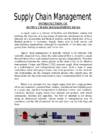
as all costs ultimately will make way to the final market place to be reflected in the price paid by the end user. Therefore, the leading edge companies seek to make the supply chain as a hole more competitive through the value it adds and the cost it reduces overall. Thus today the real competition is not the companies against the companies but rather supply chain against supply chain. DEFINITIONS Supply Chain Management (SCM) is the process of planning, implementing, and controlling the operations of the supply chain with the purpose to satisfy customer requirements as efficiently as possible. Supply chain management spans all movement and storage of raw materials, work-in-process inventory, and finished goods from point-of-origin to point-of-consumption. According to the Council of Supply Chain Management Professionals (CSCMP),
− Cares for shareholders’ interests. − Assures that the corporation is managed in accordance with state laws, security regulations and conflict of interest situations. Role of the Board in Strategic Management • Monitor developments inside and outside the corporation. • Evaluate and influence management proposals, decisions and actions. • Set corporate strategy, the corporation’s overall direction, mission, and vision. Carroll’s (1979) four responsibilities of business in order of priority … • Economic (must do) • Legal (have do) • Ethical (should do) • Discretionary (might do) *agenditeooria suures ettevõttes, * mis on mission, EKSISTENTS – KES ME OLEMA JA MIDA VÄÄRTUSTAME *suure ettevõtte hierarhia *Mintzberg The 5 Ps of Strategy were created by Henry Mintzberg in 1987. Each of the 5 Ps stands for a different approach to strategy: 1. Plan. 2. Ploy. 3. Pattern. 4. Position. 5. Perspective.
and methods and events of the base class, and can be customized with additional properties and methods. •Polymorphism is the ability of different classes to define properties or methods with the same name. Polymorphism is essential to object-oriented programming because it allows you to call methods with the same names, no matter what type of object is in use at the moment. 2. COMPONENT TECHNOLOGY – THE PROBLEM The Problem •Today, anything and anyone must be net-enabled. •Automated business processes, products, and software systems need to evolve in „e-Time“. •Everything must be changeable, extensible, adaptable. •Quality is an important issue. Architectural consequences of these requirements: •Software should not be designed as monolithic unit but partitioned into composableservices that can be spontaneously connected and orchestrated by business/technical processes (component-based software).
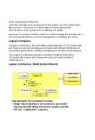
are made precise and unambiguous through well-defined interfaces and component specifications, and key architectural mechanisms are detailed. The Logical Architecture provides a detailed "blueprint" from which component developers and component users can work in relative independence. Logical Architecture. Model System Behavior Execution Architecture An Execution Architecture is created for distributed or concurrent systems. The process view shows the mapping of components onto the processes of the physical system, with attention being focused on such concerns as throughput and scalability. The deployment view shows the mapping of (physical) components in the executing system onto the nodes of the physical system. Architecture views 2. Business Architecture A formalized model of what the business looks like, in terms of IT. Information Architecture Logical description of the translated Business Architecture in IT terms.
Consultant: Roode Liias- Professor and Dean, Faculty of Civil Engineering, Tallinn University of Technology Title: Integration of Lean Construction and Building Information Modelling Archived: University of Applied Sciences, Faculty of Construction ABSTRACT This research can be divided into two. The first part investigates the current state of the construction industry, while the second part looks at new emerging business models in particular, Lean Construction (LC) and Building Information Modelling (BIM), as well as an integration of these two. Given that the construction industry does not have a particularly good reputation among the public, the first part of this thesis focuses mainly on this problem and its sources. It is the reason why we need new and better business models, like LC and BIM, or even an integration of the two models.
individual or other unit of adoption.” (Rogers 1952) ● CIS survey: “Product innovations must be new to your enterprise, but they do not need to be new to your market”. ● “Companies achieve competitive advantage through acts of innovation. They approach innovation in its broadest sense, including both new technologies and new ways of doing things” – (Porter 1990) ● “An innovative business is one which lives and breathes “outside the box”. It is not just good ideas, it is a combination of good ideas, motivated staff and an instinctive understanding of what your customer wants” – (Branson 1998) ● “...novel implementation of an invention, discovery, new or existing knowledge in economic process” (Joseph A. Schumpeter) ● An innovation is the implementation of a new or significantly improved product
Table of Contents 1. Background ..............................................................................................................................2 2. Business Plan............................................................................................................................2 2.1. Mission..............................................................................................................................2 2.2. Values ...............................................................................................................................2 2.3. SWOT Analysis of the Organization ..........................
much to educators. Since I don't have an educational theory neatly worked-out, nor an outline of my perceptions, my intent is to address each educational ingredient that comes to my mind. After I've said what I think about each topic, readers may have a fair comprehension of my philosophy. First comes sensitivity. If a person be insensitive, be it from numbing cold, exhaustion, drugs, genetic makeup, or upbringing, then the process of education is bogged down, and results come only after great efforts. Sensitivity in my integrated meaning is broad, covering literally the senses, so that deaf and blind people are less sensitive, as well as people whose senses work perfectly, but whose receptivity or thought processes are blunted for whatever reason. A person can be insensitive in one way, such as blind, and extraordinarily sensitive in another way, such as in hearing
 annaabi.ee






Kõik kommentaarid