British Parliament Structure and Functioning of the British Parliament today Britain is a parliamentary monarchy . The British Parliament is a bicameral parliament , that is to say that it is made up of two chambers, or two "Houses"; above the two Houses, but in an essentially formal role , there is the Sovereign - king or queen - also known as "the crown." Role of the Sovereign The British monarch has all authority, but no power. The Sovereign appoints the Prime Minister, and every year opens the sessions of parliament, in a historical and ritual ceremony called the State Opening of Parliament . Historically, this ceremony used to take place in the Autumn; but since 2012, it has been brought forward to May. This is the only regular time when the members of both Houses come together. During the ceremony, the Sovereign reads out the government's intended programme. The "Queen 's Speech" is a summary of the programme "his" or "her" ...
UK Parliament Parliament of the United Kingdom The Parliament of the United Kingdom is the highest legislative body in the United Kingdom and British overseas territories. It alone has parliamentary sovereignty over all other political bodies. At its head is the Queen Elizabeth II. The parliament has an upper house, the House of Lords, and a lower house, the House of Commons. The House of Lords plays an important role in checking and challenging the decisions and actions of the government through questions and debates. A House of Commons evolved at some point in England during the 14th century, becoming the House of Commons of Great Britain after the political union with Scotland in 1707. How laws are made Most new laws passed by Parliament result from proposals made by the government. Proposals aim to shape society or address particular problems. Normally, they are created over a period of time. ...
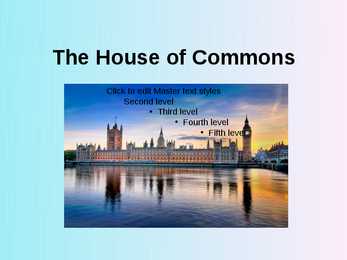
The House of Commons Click to edit Master text styles Second level Third level Fourth level Fifth level The House of Commons is the lower house of the Parliament of the United Kingdom, which also comprises the Sovereign and the House of Lords. It consists of 650 elected members called Members of Parliament. The House of Commons was originally far less powerful than the House of Lords, but today its legislative powers greatly exceed those of the Lords. The full, formal style and title of the House of Commons is The Honourable the Commons of the United Kingdom of Great Britain and Northern Ireland in Parliament assembled. Role The House of Commons main purpose is to make laws by passing Acts of Parliament, as well as to discuss current polit...
The British Parliament The Parliament of the United Kingdom of Great Britain and Northern Ireland, commonly known as the British Parliament,Westminster Parliament or simply "Westminster". The British constitution has envolved over many centuries and unlike many other nations, the UK has no single constitutional documents. But Britain does, however, have certain important constitutional documents, including Magna Carta, Bill of Rights and Reform Act. It is formed partly by statue law, partly by common law and partly by conventions. Fundamental law doesn´t exist in the United Kingdom. There can be distinguish three separate organs: the legislature, the executive and the judiciary. Parliament, the law-making body, consists of three elements: the Monarchy, the House of Commons and the House of Lords. They meet together only on occasions of ceremonial significance, such as the state opening of Parli...
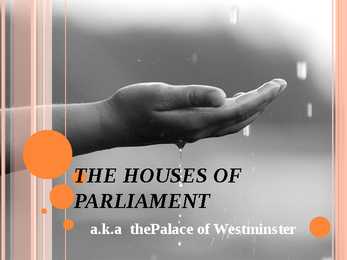
THE HOUSES OF PARLIAMENT a.k.a thePalace of Westminster IN GENERAL... The last monarch to live there, Henry VIII, moved out in 1512 Parliament has met in the Palace of Westminster since around 1550 there has been a royal palace on this site for nearly 1,000 years in the 19th Century a fire destroyed most of the earlier medieval buildings HISTORY Was originally laid out for Edward the Confessor more than 1,000 years ago in 1066, became the home of William the Conqueror in 1834, everything except Westminster Hall was burnt in the great fire the present building was designed specifically to house parliament and was laid out in Gothic style by Sir Charles Barry, completed in the 1840's THE BUILDING Nearly 1,200 rooms 100 staircases over 3 kilometres (two miles) ofcorridors located next to the River Thames in London TOWERS Includes several towers: Victoria Tow...
Established church The Church of England is the established church, which means that: 1.)the Monarch is the Supreme Governor of the church, 2.)the Church performs a number of official functions, 3.)Church and State are linked. To disestablish Disestablishmentarianism refers to campaigns to sever links between church and state, particularly in relation to the Church of England as an established church. It was initially a movement in the United Kingdom in the 18th century. The established churches in Wales and Ireland could not count on even nominal adherence by a majority of the population of those countries. In Ireland, the predominantly Roman Catholic population campaigned against the position of the established Anglican Church of Ireland - eventually disestablished in Ireland from 1 January 1871. A broad church The Church of England is a broad church, representing a wide spectrum of theological thought and practice ...
The UK & London The United Kingdom (or the UK) is a short way of saying the United Kingdom of Great Britain and Norther Ireland. The UK is situated north-west of the European continent between the Atlantic Ocean and the North Sea. The UK consists of England, Wales, Scotland and Northern Ireland. Its highest point is Ben Nevis in Scotland followed by Snowdon in Wales. The Severn is the longest river in the United Kingdom. Other important rivers are the Trent, the Mersey, the Tyne, etc. Lough Neagh which lies in the centre of Northern Ireland is thr UK's largest freshwater lake. The climate in the UK is variable. The weather changes so frequently that it is difficult to forecast. It is not unusual for people to complain that the weathermen were wrong. Fortunately there is no extreme weather conditions, it is never very cold or very hot. The first inhabitants were Iberians and Celts who sett...
1. Ancient Britain: the Celtic tribes. 2000 years ago there was an Iron Age Celtic culture throughout the Br Isles. It seems that the Celts, who had been arriving from Europe from the 8th cent BC onward, intermingled with the peoples who were already there. The Celts were extremely talented people, creative and artistic. More than 1 Celtic tribe invaded Br. The descendants of ancient Celts live in Wales, Scotland, Cornwall and Ireland. They lived in primitive society. Druids priests, more powerful than chiefs. Acted like prophets. 2. Stonehenge From prehistoric period. Was built on Salisbury plain between 2500 and 1500 bc. One of the most famous and mysterious archaeological sites in the world. One of the mysteries is how it was built at all with the technology of the time. Another is its purpose. It appears to function as a kind on astronomical clock and we know it was used by the Druids for ceremonies marking the passing ...
HOUSES OF PARLIAMENT Houses of Parliament also known as the Palace of Westminster is one of the most attractive buildings in London. It stands on the site where Edward the Confessor had the original palace built in the first half of the eleventh century . In 1547 the royal residence was moved to Whitehall Palace, but the Lords continued to meet at Westminster, while the commons met in St. Stephen's Chapel. Ever since these early times, the Palace of Westminster has been home to the English Parliament. In 1834 there was a huge fire that destroyed much of the old palace. All that remained was the chapel crypt, The Jewel Tower and Westminster Hall. It was Lord Melbourne, the Prime Minister, who saved the great hall by arranging for the fire engines to be brought right into the hall and personally supervising the fire fighting operation. The magnificent Gothic Revival masterpiece you see ...
Describe the British Parliament Works in a large building called the Palace of Westminster aka The Houses of Parliament. There are offices, committee rooms, restaurants, bars, libraries and even some places of residence. Two large rooms: The House of Lords meet in one and the House of Commons in the other. The British Parliament is divided into two houses, but the House of Commons is obviously more important and only they are considered to be the MPs. In the House of Commons there are just two rows of benches facing each other. On the left sit the members of the governing party and on the right sit the opposition. The Speaker sits between them and controls the action. The arrangement of the benches encourages confrontation between the government and the opposition. There is no place for somebody who isn't neither in the opposition nor in the government side. Usually peeps like this sit in the opposition furthest from the Speaker. || The...
The Houses of Parliament The Houses of Parliament also known as The Palace of Westminister or Westminister Palace was built in 11th century by man called Charles Barry .It is located on the north back of the River Thames. In 1834 most of it burned, so in 1840 The Palace of Westminister was rebuilt. It is the meeting place of the two houses of the Parliament of the United Kingdom - the House of Lords and the House of Commons. The Houses of Parliament is composed of 1100 rooms, 100 staircases and three miles of corridors. Parliament takes breaks during Christmas, Easter and over the summer. The Palace of Westminster features three main towers The Central Tower, The Victoria Tower and The Clock Tower, also known as Big Ben. The Central Tower stands over the middle of the building, immediately above the Central Lobby. This tower is proof that after the fire in 1834, the palace can still look good. The...
THE U.K Different Parts The United Kingdom is a short way of saying the United Kingdom of Great Britain and Northern Ireland. The UK is the political name for those countries which share a parliament in London. All of them were at one time independent kingdoms with their own monarch. Now they are all part of the same kingdom and share the same monarch. The UK consists of Northern Ireland, Scotland, England and Wales. The peoples of these countries are British subjects; they hold British passports and therefore their nationality is British. The british Isles is the geographical name for all the islands off the west coast of Europe. These islands also include The Republic of Ireland, which is politically independent of the Britsh government. Many people refer to the inhabitants of the British isles as 'the English', but England is only one of the countries. The other countries are Scotla...
The United Kingdom The United Kingdom consists of England, Scotland, Wales and North Ireland and it is situated in the Atlantic Ocean near the mainland of Europe. The population of the UK is 58.6 million and area is 244,110 sq km. Britain has a temperate humid climate. Its characteristic features are mild winters, warm summer, no temperature extremes, abundant rain all year round and frequent changes of weather. The mild climate is partly due to the warm Gulf Stream and partly to the south westerly winds. Occasional winds from the east in winter may bring cold and dry weather. The distribution of rainfall is influenced by the Atlantic Stream. The mountainous areas of the north and west have more rain than the lowlands of the south and east. Wales is located on a peninsula in central-west Britain. The entire area of Wales is about 20,779 km². Wales borders by England to the e...
HISTORY TEST 5 invasions to Britain until 1066 1) The Celts o Gaels in 600BC; Cymry(Britons) in 300BC o From present-day Austria, Switzerland o The Celtic language survives in the names of many places in England- Dover, Kent, Thames o The Celts are best known for their art- many bronze objects with elaborate designs; brooches; pins; mirrors; Celtic stone crosses o The Celts had 3 social orders: warriors, druids(priests) ordinary people 2) The Romans o (55 BC-Caesar) 43 AD- 410 AD- Claudius o From present-day Italy o Southern Britain became Britannia and was ruled by a roman governor o The Romans built over 20 towns: Colchester, Londinium, Winchester etc. They were good engineers and built roads and villas that had central heating, glass windows and mosaic floors ...
BRITISH POLITICS Helen Laine 12 A POLITICAL SYSTEM Democracy Constitutional monarchy Head of the state – Elizabeth II Actual power – Prime Minister Executive power - Her Majesty’s Government Legislative power – Parliament House of Commons and House of Lords Multi-party system MAIN PARTIES Two largest - the Conservative Party and the Labour Party Before labourers - The Liberal party Third largest – the Liberal Democrats Current: Conservative, Liberal Democrats ... Some other parties in UK: Democratic Unionist Party Scottish National Party Palace of Westminster UK Independence Party Green Party of England and Wales Scottish Green Party Social Democratic and Labour Party Alliance Party of Northern Ireland MAIN POLITICIANS Prime Minister: David Cameron (Conservative) Nick Clegg (head of L...
Changing the Guard · Perhaps the epitome of London's surviving pageantry can be found in the ceremonial Changing of the Guard. · A hugely popular spectacle, the Changing of the Guard takes place at a range of royal locations in and around · London daily during the summer and on alternate days for the rest of the year. · There is no ticketing, so make sure you get there early. · Ever since 1660 Household Troops have guarded the Sovereign Palaces. · The Palace of Whitehall was the main residence until 1689 and was guarded by the Household Cavalry. · The court moved to St James's Palace in 1689 and when Queen Victoria moved into Buckingham Palace the Queen's Guard remained at St James's Palace and a detachment guarded Buckingham Place, as it does today. Trooping the Colour · Often cited as the ceremonial event of the year, the Troopi...
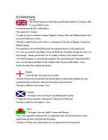
1) General facts The UK: * the United Kingdom of Great Britain and Northern Ireland was formed in 1801 * it covers 243,610 sq km * everybody from the UK is called British * the capital city is London * is made up of four constituent countries: England, Scotland, Wales and Northern Ireland which in turn are divided into counties * the flag is called the Union Jack which is a combination of the flags of England, Scotland and Northern Ireland * the population is about 60,000,000 people, the population density is 242 people/sq km * its coasts are washed by the Atlantic Ocean, the North Sea, the English Channel, the Celtic Sea, Saint George's Channel, and the Irish Sea. It is linked to France by the Channel Tunnel * the United Kingdom is a constitutional monarchy. The current monarch is Queen Elizabeth II, who is also the Queen and Head of State of fifteen other Commonwealth Realms, such as Can...
1. What are the capitals of the 4 constituent countries? England- London; Northen Ireland- Belfast; Scotland- Edinburgh; Wales- Cardiff 2. Order the invaders in correct chronological order: Anglo-Saxons, Normans, Romans, Celts. Romans Anglusaxons , Norman 3. How did the Celts influence Britain? Language. Wars. Engand and Scotland eventually became 1 contry 4. How many people approximately speak English? Approximately 600 million 5. Who (which tribes) gave the base of the English language?Germanic tribes- Anglo-Saxons. 6. Describe Wales.- Wales is a mountainous country on the western side of Great Britain. The national game of Wales is Rugby. Flag- Red dragon on a green and white field. They have their own language Cymraeg ( Welsh) . Anthem- Land Of My Fathers. Official animal- Dragon. There used to be a lot of coalmines. 7. What are the symbols of the 4 constit...
REVISION QUESTIONS 1. What do you know about Margaret Thatcher? Winston Churchill? Margaret Thatcher was the first female Prime Minister in Europe. She was a member of the conservative party. She died recently. Winston Churchill was the Prime Minister during WW II. He was excellent in making speeches, but he was a heavy drinker and also smoker. 2. What are the main countries of the UK and their capitals? There are 4: England with London as the capital; Wales with Cardiff as the capital; Scotland with Edinburgh as the capital; and Northern Ireland with Belfast as the capital. 3. What is Remembrance Day all about and why is it celebrated at that time? It is about the men (and women) who lost their lives fighting in the World Wars. It's celebrated then, because that's the day WWI was ended with a treaty. 4. Which powers does the Queen of the UK have? The Queen has to sign all the bills for them to pass. She is the o...
The Church of England Carry Kangur Sotsiaal- ja Haridusteaduskond Religion in the UK 2001: 72% Christians (41 million people) 3% Muslims 1% Hindus 15% No Religion around ~19 550 churches in Britain Major Christian denominations in the Catholics UK Anglicans Baptists Lutherans Methodists Quakerism Shakers Presbyterianism The Salvation Army Congregationalism Scientologists Church of England How it began 1509 Henry VIII became king He was a devout catholic Wanted a divorce from Catherine Fell in love with Anne Boleyn Took the position of Supreme Head of the Church of England Anglicanism in the UK State religion of the UK is Christianity The monarch is the head of Church of England Church of England today Structure Starts off with the local parish ...
Suurbritannia Suurbritannia on kaasaegses põlvkondade vaheldumise etapis. See tähendab, et nii suremus kui sündimus on väiksed. Sündimus on 649 % , suremus 612 % , loomulik iive 1.7 % . Vanemaealised on ülekaalus, kõige rohkem on 40- 44 aastaseid. Eluiga on suhteliselt pikk 79 aastat. Rahvastiku tihedus on umbes 250 inimest/ km². Suuremad keskused on: London - 7,8 miljonit elanikku; Kesk-Inglismaa (Leeds, Sheffield, Manchester, Liverpool) - 7,5 miljonit elanikku; Birmingham 2,6 miljonit elanikku; Lõuna-Sotimaa (Glasgow, Edinburgh) - 1 miljon elanikku; Cardiff - 0,3 miljonit elanikku. Rahvaarv on hetkel 60'944'000. Rahvaarvu kasv on 0.3 %. Aastal 2015 on rahvaarv 62'175'000, aastal 2025 63'819'000. Meeste keskmine eluiga on 76 aastat ning naistel 81 aastat. 0- 4 aastaseid on 3'825'527, 5- 9 aastaseid 3'858'032, 10-14 aastaseid 3'642'710, 60- 64 aastaseid 3'099'913, 65-69 aastaseid 2'675'249....
Years 1154-1485 Henry I was the first unquestioned ruler. One of the most important kings in the Middle Ages. He had lands in Britain & France. Then the government was the monarch, a person, not a place. He had more land than any pervious king. After his marriage to Eleanor of Aquitaine, he also ruled the lands south of Anjou. His empire stretched from the Scottish border to the Pyrenees. England provided most of its wealth, but the heart was Anjou. Henry II began to regain royal control. During the war some barons had become very powerful. He pulled down some of their castles. He tried to restore law & order. He wanted the same kind of justice to be used everywhere. He appointed his own judges to travel around the country. They dealt with crimes & disagreements over poverty. Serious offences were tried in the king's court. At first they had no special knowledge or training. They were trusted to use common se...
The Irish Problem ~the Irish can not be trusted~ In 1641, just prior to the Civil War, the Irish of Ulster had begun an uprising and attacked the planters who had been settled 30 years before. Between 10,000 and 15,000 Protestant planters were murdered by the Irish at places such as Portadown. Due to the war, the English did nothing about this and the death-toll became heavily exaggerated over time. In 1649, after the Civil War had ended, Cromwell landed at ...
British history Roman Britain Roman Britain was those parts of the island of Great Britain controlled by the Roman Empire between 43 and about 410. The Romans referred to their province as Britannia. Prior to the Roman invasion, Iron Age Britain already had cultural and economic links with Continental Europe, but the invaders introduced new developments in agriculture, urbanization, industry and architecture, leaving a legacy that is still apparent today. Historical records beyond the initial invasion are sparse, although many Roman historians mention the province in passing. Most of the knowledge of the period stems from archaeological investigations and especially epigraphic evidence. The invasion force in AD 43 was led by Aulus Plautius.It is not known how many Roman legions were sent; only one legion, the II Augusta, commanded by the future emperor Vespasian, ...
How has Margaret Thatcher affected Britain Margaret Thatcher is former British politician who served as Prime Minister of the United Kingdom from 1979 to 1990 and leader of the conservative party from 1975 to 1990. She is the first and only woman to hold either post. Since her resignation, Thatcher has remained active in the politics of the United Kingdom, as well as the world. She was raised to the House of Lords by the conferment of a life peerage as Baroness Thatcher. Margaret Thatcher has affected Britain in many ways. Thatcher was committed to reducing the power of the trades unions. Several unions launched strikes in response to legislation introduced to curb their power, but these actions eventually collapsed, and gradually Thatcher's reforms reduced the power and influence of the unions. Also, though an early backer of decriminalization of male homosexuality, Thatcher, at the 1987 Conservative party confere...
1 Basic law, constitutional engineering · The Basic Law (= constitution) drawn up by West German politicians under Allied supervision 48-9 · Key Themes of Constitutional Engineering: Protecting the constitution Preventing abuse of human rights Ensuring stable government Effective leadership but no over-concentration of power · Compare turbulence of German politics 1918-45, and stability since In part about design of constitution, in part about Germans becoming democrats Solutions Concept of the Rechtstaat, a state based on the rule of law ...
The Middle Ages The Middle Ages are one of the most turbulent periods in English history. The Middle Ages are so called as the middle period between the decline of the Roman Empire and the Renaissance. The Middle Ages started in 1066. with the Battle of Hastings and the Norman Conquest. William the Conqueror took all the lands from the Saxon English and gave these to French nobles. Normans were known as great builders. This is assured by the fact that many great castles and other buildings, including the Tower of London, were built during the Norman Conquest. In 1086. Domesday Book was compiled. It is a detailed survey of England ordered by William the Conqueror. The reign of King William Rufus who was the son of William started in 1087 and lasted until 1100. Next king was Henry I who was the brother of William Rufus. His reign was from 1100-1135. In 1135 Henry I nephew Stephen got to the throne of Engla...
Kadri Laur PRG 11B. 26.05.07 Queen Victoria and Victorian England (Queen Victoria is supposed to have said this as a 10-year-old girl on learning that she was likely to become queen in the future: I will be good.) VICTORIA (r. 1837-1901) Victoria was born at Kensington Palace, London, on 24 May 1819. She was the only daughter of Edward, Duke of Kent. The Duke and Duchess of Kent selected the name Victoria but her uncle, George IV, insisted that she be named Alexandrina after her godfather, Tsar Alexander II of Russia. Edward died when Victoria was eight months old, upon which her mother enacted a strict regimen that shunned the courts of Victoria's uncles, George IV and William IV. Father ...
LANDMARCS HYDE PARK: Hyde Park is one of the largest parks in central London, England and one of the Royal Parks of London, famous for its Speakers' Corner. The park is divided in two by the Serpentine. The park is contiguous with Kensington Gardens; although often still assumed to be part of Hyde Park, Kensington Gardens has been technically separate since 1728, when Queen Caroline made a division between the two. THE TOWER OF LONDON: Her Majesty's Royal Palace and Fortress, more commonly known as the Tower of London (and historically as The Tower), is a historic fortress and scheduled monument in central London, England, on the north bank of the River Thames. It is located within the London Borough of Tower Hamlets and is separated from the eastern edge of the City of London by the open space known as Tower Hill. It is the oldest building used by the British government. [1] TOWER BRIDGE: Tower Br...
Tallinn English College Topic Great Britain 2007 1. Introduction The official name of Great Britain is `the United Kingdom of Great Britain and Northern Ireland (or short United Kingdom)' The population is about 60.4 million. The capital is London. Other biggest cities include Birmingham, Bristol, Portsmouth, Glasgow and Swansea. English is the main language of Great Britain, but Welsh is officially recognized in Wales and Gaelic in Scotland. 2. Geographical position The British Isles is the geographical term for a group of about 5000 islands off the coast of mainland Europe. The largest island is Great Britain, which is also the largest island in Europe. It consists of England, Wales and Scotland. The next largest island is Ireland, which is made up of Northern Ireland and the Irish Republic. Britain and Northern Island together form the United Kingdom. When referring to Britain ...
N. A. Vavilov ASPECTS OF BRITISH HISTORY Н. А. Вавилов КРАТКАЯ ИСТОРИЯ ВЕЛИКОБРИТАНИИ Учебное пособие на английском языке Москва Институт международного права и экономики имени А. С. Грибоедова 2008 2 УТВЕРЖДЕНО кафедрой лингвистики и переводоведения Вавилов Н.А. Краткая история Великобритании: Учебное пособие на английском языке. – 2-е изд., пересмотр. и испр. – М.: ИМПЭ им. А.С. Грибоедова, 2008. – 88 с. Пособие содержит краткий очерк важнейших событий в истории Великобритании – от первых документально засвидетельствованных вторжений на остров (кельтов, римлян и англосаксов) до создания и распада Британск...
The early middle ages The Norman Conquest Since William was crowned king, there were many rebellions against the Normans. A small Norman army marched from village to village and destroyed the ones it couldn't control. The Normans took away the Saxon lords' land. Only a few Saxons who supported William could keep their land. Feudalism William gave parts of his conquered land to his captains around the country to avoid rebellions and uprisings. He also kept some land to himself to make sure his was much stronger than his nobles. Of all the farmland half went to his nobles, quarter to church and fifth he kept to himself. William organised the English kingdom according to feudal system. The main purpose of using that system was economic. King gave the land to "vassals" in return of army services and goods. When a noble dies, his son took over the estate. When there was no family, the land went back to king who could give it to another n...
MÕISTED Absolutism- valitsemisvorm, mille korral riigijuhile kuulub piiramatu võim. Valgustatud absolutism- valitsemisvorm, kus valitseja surub peale, ta ei huvitu rahva arvamusest (louis) Parlamentaarne monarhia- on parlamentarismi vorm, kus riigipeaks on monarh, kellele kuulub vaid esindusfunktsioon ja ta ei oma poliitilist võimu. Merkatilism- õpetus, mille kohaselt riigi heaolu sõltus suurest kulla ja hõbedavarudest ja import peab olema väiksem kui eksport Hugenot- protestant Prantsusmaalt, usuvabaduse säilitaja Püssirohuvandenõu- Guy Fawkes paigutas parlamendihoone keldrisse püssirohutünnid, et parlament koos kuningaga õhku lasta House of Lords- ülemkoda, istusid osalt pöritavatel, osalt ametiseisundiga kaasnevatel kohtadel kõrgaadlikud ja valimulikud House of Commons- alamkoda, liikmed valiti House of Parliament- on Westminster'i paleee, kus parlament koos käib Long Parliament- Charles I 1640 aastal kutsus kokku parlamendi, parlame...
London London is the capital of Great Britain. It is situated on the river Thames. The Thames is a river flowing through southern England and connecting London with the sea. The Thames has a length of 346 kilometres (215 miles). The first bridge was the tower bridge, built in the 12th century. The second bridge was built in the year 1750. .The river Thames divides London into the northern and the southern part. The port of London is one of the greatest trade centres in the world. The river Thames is certainly the most famous water body in London. London is also the seat of the government of Great Britain. It is one of the largest cities in the world with its population of about seven million. Before the great fire in 1666 there were many wooden houses and narrow crooked streets in the town but after the fire it became a well-planned city with wide streets, beautiful squares and parks. It star...
Anglo-norman period (1066-1300) The normans · The name derives from "the Northmen" · Descendants of the Vikings · Seized the north-western part of France · The area known as Normandy · Adopted French customs and Christianity · Norman-French (their version of French). 1066 · Edward the Confessor dies in January · Harold Godwinson crowned as king in Westminster Abbey on the same day · Another candidate for the throne William, Duke of Normandy · Gathered an army · Invasion delayed (bad weather) · Harald, king of Norway, invades England from the North · A battle at Stamford Bridge · Harald's army defeated, leaders killed · The end of the Viking Age · The Normans land in Britain (a few days after Stamford Bridge) · The Battle of Hastings · Harold defeated ...
How well do you know London? Form 10, February 2012 Welcome back to the tour of London! This is your second day (lesson) that you spend exploring the famous landmarks of the city. Again - follow the map so that you would not get lost and try to get streetwise in London. It is also wise to use Google Maps Street View simultaneously it gives you the wonderful feeling of strolling the streets and landmarks. Take the following questions with you, find answers to them and put them down for yourself in this MSWord document. Don't forget to "take" photos - you are supposed to recognise the landmarks later on! At the end of the tour send the worksheet to yourself so that you could use it again. Good luck with exploring the city! DAY 2. The route: Westminster Abbey The Houses of Parliament London Eye 10 Downing Street St Paul's Cathedral The Tower of London Tower Bridge Globe Theatre Greenwich Ob...
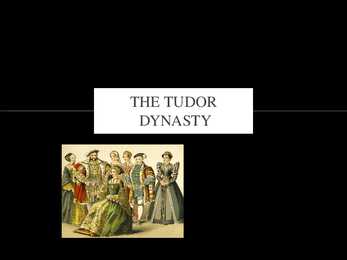
THE TUDOR DYNASTY THE TUDOR DYNASTY The Tudor dynasty or House of Tudor was a European royal house of Welsh origin that ruled the Kingdom of England and its realms, including the Lordship of Ireland, later the Kingdom of Ireland. Its first monarch was Henry VII. Henry VII THE TUDOR DYNASTY The Tudors extended their power beyond modern England, achieving the full union of England and the Principality of Wales in 1542 and successfully asserting English authority over the Kingdom of Ireland. They also maintained the traditional claims to the Kingdom of France, but none of them tried to make substance of it, though Henry VIII fought wars with France to try to reclaim that title. After him, his daughter Mary I lost the claim on France forever with the Fall of Calais. ...
Stonehenge One of the best known ancient wonders of the world, 5000 years old Megalith monument, built by western mediterraneans during 3000-1600 BC Circular structure, large standing stones, aligned with rising sun at teh solstice Attlers and bones were sued to dig pits that hold the stones The Celts in Britain and their legacy 700-200 BC celts invade Britain Gaels or Goehls(Ireland and Scotland),Cymri(Wales) and Brythons(gave name to Brittany) Fierce fighters,superb horsemen.Most of them farmers, lived in thatched houses Good at art, craftmanship, used iron Divided into tribes, ruled by kings, only in face of danger would they choose a single leader Legacy- hill-forts, farms, churches, field system, woodland, pasture, weapons, iron objects, langugae, culture Caesar in Britain The great Roman Emperor Firts came 55 BC to gather information, celts ...
United Kingdom AT115 Martin Pillai Early history • In 1066, the Normans invaded England from France • In 1603, the kingdoms of England, Scotland and Ireland were united in a personal union when James VI, King of Scots, inherited the crowns of England and Ireland and moved his court from Edinburgh to London • In the mid-17th century, all three kingdoms were involved in a series of connected wars, which led to the temporary overthrow of the monarchy and the establishment of the short-lived unitary republic of the Commonwealth of England, Scotland and Ireland. Acts of Union • On 1 May 1707, the united Kingdom of Great Britain came into being, the result of Acts of Union being passed by the parliaments of England and Scotland to ratify the 1706 Treaty of Union and so unite the two kingdoms • The term "United Kingdom" became officia...
16th century (Tudors) 1. Henry VII - avoided wars, careful with money, didnt have expensive parties, was a rather shadowy figure 2. Henry VIII- brilliant scholar, excellent knight, good-looking, ambitious, self- centered, loved expensive clothes and parties. Wasted his fathers money very quickly and had 6 wives. His first wife couldnt give birth to a baby boy and they only had a daughter. His next wife only gave birth to a girl too. His next wife gave birth to a boy but died after the labor. He didnt like his 4th wife so he sent her back. His fifth wife was young and beautiful but had many lovers and Henry didnt like it so she was sent to the Tower and was beheaded. HIs 6th wife survived. 3. Edward- was sickly and ruled only for a few years and then he died 4. Mary Tudor/Bloody Mary- was catholic and killed many protesntants. Ruled only f...
BRITISH HISTORY 17TH-19TH CENTURY SEVENTEENTH-CENTURY ☄ When James I became the first English king of the Stuart dynasty, he was already king of Scotland, so the crowns of these two countries were united. ☄ The kind of Middle English spoken in lowland Scotland had developed into a written language known as Scots ☄ The Scottish Protestant church adopted English rather than Scots bibles ☄ Religion and politics are inextricably linked ☄ Some people tried to kill the king because he wasn't Catholic enough and another king had been killed, partly because he seemed too Catholic ☄ Anger grew in the country at the way that the Stuart monarchs raised money ☄ Puritanism- ideological Protestantism ☄ Some of them thought the luxurious lifestyle of the king and his followers was immoral. They were also fiercely anti-Catholic and suspicious of the apparent sympathy t...
ENGLISH LITERATURE Ancient Britain Lived on the British Isles in the 1st millenium. They most probably came from Eastern Europe and belonged to the Celtic race and also spoke Celtic. They were primitive hunters- gatherers, farmers. Some Celtic words are still used in modern English, however they are used mostly in place names. For example: · avon river · cumb valley · ford shallow place in the river Ancient Britons had their own religion and priests or druids and temples. In the year 55 BC Britain became a Roman province. Romans were highly developed and had their own language latin, which has also greatly influenced English. The military occupation of the Isles ended in 410 AD. The Romans eventually brought Christianity to Britain. Hadrian's wall on the border of Scotland and England. It began constru...
khTallinn English College The United Kingdom Topic Mari-Liis Pakats Tallinn 2008 2 Table of Contents Introduction..................................................................................................................4 Geographical Position .................................................................................................4 History .........................................................................................................................4 Government..................................................................................................................5 Queen Victoria.............................................................................................................5 Relief...............................................................................................................................
London History The Romans AD 43- AD 410 The Romans finally invaded Britain in AD 43 from Kent. The Romans lead by Julius Caesar attempted to invade Britain twice before that in 55 and 54 BC but the invasions were unsuccessful. They made their way to the river Thames and sailed up it. The Romans knew it was important to control a crossing point at the river Thames, so they decided to build a settlement on the north bank. Although small settlements had been built on the banks of the Thames, the Romans were the ones who built the first city. They called their city Londinium. The Roman engineers noticed that the point where the swampy river narrowed would make an ideal crossing point, they built London Bridge. Less than 20 years later the native Iceni tribe, led by Queen Boudicca, rose up against the Romans in revenge for mistreatment and burnt Londinium to the ground. The well disciplined Roman army defeated her forces and Londinium was r...
1. What is the object of philosophical study? The object of philosophical study is being itself on an abstract level. Everything and nothing can be or exist. Things like colour, nature, material things like a table just are, but the meaning of being in be-ing in itself is unclear. Non Material things can also be or exist. If something is, then it is a being. But what exactly is this IS that we can see or on the opposite can not see? Therefore this is one of the fundamental questions of philosophy. 2. Can you reject solipsism? Solipsism (solus ipse) means nothing exists, therefore everything is an illusion outside of our own minds. I think that it is true that we know WE as in myself exists. But i can not for certain say that the person reading this exists although it might seems like it to me. I think that you really can’t reject solipsism on the whole because you do know that you exists, but can you for certain say t...
The Saxons & Vikings Fragmentary knowledge of England in the 5th & 6th centuries comes from the British writer Gildas, the Anglo-Saxon Chronicle, saints' lives, poetry, archaelogical findings and place- name studies. British landlords ruled small, unstable kingdoms and continued some Roman traditions of governance. In the mid-5th cent, Vertigern, a British leader, hired Germanic mercenaries to help defend against peoples of the north (Picts & Scots). In the end they revolted & the process of invasion and settlement began. The first Saxon ,,kings" were Hengist & Horsa in Kent, Aelle in Sussex, Cerdic / Cynric in Wessex. So the first ,,English" became mainly from Northern Germany & Denmark. The resistance of the Celts was long. They were free at the time, not like other Roman provinces on the Continent. Around 500, the Britons seem to have won several victories. One of their leaders was Ambrosius Aurelianus and one of...
Tallinn Järveotsa Gymnasium MARGARET THATCHER Maria Ignatenko Form 11.B Tallinn 2008 Margaret Thatcher (1925-...) General Data Margaret Hilda Thatcher was born on the 13th of October, 1925 in London. She is a British politician who served as Prime Minister of the United Kingdom and Leader of the Conservative Party. Margaret is the first woman who has ever held these posts. Childhood and Education Margaret Hilda Roberts was born on the 13th of October, 1925 in Grantham in Lincolnshire, England. Her parents were Alfred Roberts and Beatrice Stephenson Roberts. Thatcher spent her childhood in the town of Grantham in Lincolnshire. The Roberts family ran a grocery business, bringing up their two daughters in a flat over the shop. Her father was active in local politics a...
1. The Queen’s official title. Elizabeth the Second, by the Grace of God, of the United Kingdom of Great Britain and Northern Ireland and of Her other Realms and Territories Queen, Head of the Commonwealth, Defender of the Faith. 2. The Queen’s working day. Starts after breakfast. Reads the newspapers which are prepared by the Press Secretary, and a report on the previous day’s proceedings in the Parliament and the letters she receives. Also phone calls. Once a month she attends the Privy Council in order to give Royal Assent to various items of government legislation. Discusses domestic matters with the Master of the Household. Towards the end of the day, there is always another pile of official papers and reports waiting to be read or acted upon. The business on constitutional monarchy never ends. 3. Who is the present heir to the throne? Speak about his education. Wh...
History exam *Stonehenge - is a monument located in England. It is one of the most famous prehistoric sites in the world and is composed of earthworks surrounding a circular setting of large standing stones. The surrounding circular, earth bank and ditch, have been dated to about 3100 BC. Stonehenge was produced by a culture with no written language. Many aspects of Stonehenge remain subject to debate. There is little or no direct evidence for the construction techniques used by the Stonehenge builders. *The Celts in Britain and their legacy The Cets lived in Britain in The Iron Age. They were warring tribes who were battleful amongst themselves as well as inter-tribal war. They were not centrally governed. The Celts brought iron working, iron ploughs and metal swords, horses, wheels and chariots - all these things gave them an instant superiority over the native tribes. The Celts built a number ...
Introduction Tallinn, the capital city of the Republic of Estonia and of the Harju county, is a town in North Estonia on the coast of the Gulf of Finland. It has nearly half a million inhabitants and covers an area of almost 160 sqkm. It is also an important economic and cultural centre and one of the main ports in the Baltic States. Tallinn is one of the oldest cities on the Baltic Sea. It is unique for its well-preserved architecture from the 13-15 centuries. In contrast to the ancient town-walls and towers, Tallinn of today offers modern hotels, restaurants, sport and cultural centres. Every five years national song and folk dance festivals take place in Tallinn. The yachting regatta of the 1980 Moscow Olympic Games was held at Pirita. History Tallinn means in English "Danish town". The place is believed to have been settled by Finno-Ugric people about 2500 BC. It was first marked on a map of the world by the Arab geographer al-I...
 annaabi.ee