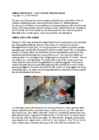
Estonians and their habits There are hundreds of different countries and nationalities in the world and each one is peculiar in its own way. For example, Italians are very impulsive. French people don't like the British. Germans are pedantic. Russians are generous, but lazy. What about Estonians? In Estonia when a stranger on a street smiles at you, you can assume that: he is either drunk, insane, from another country or all of the above. Estonians don't smile too often. Estonians are not very talkative either. In Estonian schools teachers have stopped asking their students "Are there any questions
Setomaa The extreme south-eastern corner of Estonia - this is the location of SETOMAA, a peculiar historical and ethnical province in Estonia. Setomaa is bounded in the north-east by Lake Pihkva, in the east and south-east by Russia, in the south by Latvia and in the west by Võru County. The greatest extent from north to south is 65 km and from east to west 40 km. Today Setomaa is divided between three administrative units: Võru and Põlva counties of Estonia and Pechorsky district of Russia. On the territory of Estonia, Setomaa comprises four municipalities: Misso, Meremäe,
Karl Johannes Malm, the Captain (of Swedish origin) of his ship "Brig Morian", in this Castle. For this the baron was deported to Siberia. There are currently two schools in the Castle: Suuremõisa Gymnasium and Suuremõisa Technical School. In the latter one can also study how to become a ship's captain. · The Estonian Railway Museum is located in the socalled Emperor's Pavilion. Haapsalu Railway Station (built in 19051907) is one of the most peculiar buildings of the town; its wooden lace historical building style has become an example for many other representative houses of the town. The Railway Station project was compiled in St Petersburg and its grandeur stressed the importance of Haapsalu as a summer town hosting the crowned heads of Russia. · The Ridala Church, erected in the 13th century, is one of the bestpreserved Middle Ages churches, built in the characteristic Western Estonian onenave
Compulsory-kohustuslik Private nursery-eraalgkool Comprehensive school- tava-, üldkool Pre-school playgroups-algkooli lasteaed College-kolledz Preparatory schools- ülikool Co-educational-segakool Preps-eraalgkool, ettevalmistus kool Complete a degree course at a university- Peculiar-iseäralik Chivarly-rüütellik Recive a certificate- saama tunnistust Charge fees-maksma makse Required subjects-kohustuslikud ained Contibution to educational methods- Segmented-lõik Examinations-eksamid School grounds-kooli territoorium
Estonians... Estonia is quite a northern country and therefore Estonians may seem a bit peculiar to ones from south, but don't be scared, they will not eat you (alive). Estonians are quite tranquilly and bottled up people - they might love or hate you and if you're not an expert will not make a difference as they didn't care at all. Rarely tend they to kiss or hug each other unless their beloved ones. So if they nevertheless do it then there's a great chance you're dealing with some non- Estonians. But there's no reason for worrying- if
The Price of Everlasting Youth Everlasting youth is something that people value most when they are already older. But Dorian captured the ideal moment which he wanted to be eternal. His decision was influenced by Harry's ideas and the portrait of him where he saw how beautiful he was. Dorian wished that he could remain young forever and his portrait would get older. Harry was a friend of Basil's, the artist who painted Dorian's picture, and he had quite peculiar ideas of life. He told Dorian that youth is the most relevant in life and that everyone should enjoy it. Basil knew that Harry wouldn't be good influence for young boy, but he wasn't able to prevent their encounter. Over time Harry's ideas fix in Dorian's mind and he changes into someone that he was not like before. When his first love, Sibyl Vane, who was an actress in a cheap theatre, disappoints him, he is very callous towards her which breaks the girl's heart and she commits suicide
but Tesla was penniless and rejected as he failed to protect his commercial interests. He invested all his money into inventions to make men’s life a little easier. Tesla was born at the stroke of midnight between July 9th and 10th 1856. A fierce electrical storm raged that night. His father was an Orthodox priest. His mother accompanied by .one of the oldest Serbian families. In his boyhood he suffered from a peculiar reflection due to the appearance of images often descended from strong flashes of light. He was unable to distinguish whether what he saw was tangible or not. He pictured the Niagara in his imagination as a big wheel run by the Nature. In his room he could hear the ticking of a watch with 3 rooms between him and the timepiece. A carriage passed in a distance of a few miles fairly shacked his whole body
4. Cynical. Meaning in Estonian: küüniline. Example from book: They are...cynical where we are thrustful. 5. Refuges. Meaning in Estonian: varjupaigad. Example from book: ...We had to discover the compensations and refuges of life for ourselves. 6. Preposterous. Meaning in Estonian: pöörane, ekstravagantne. Example from book: ...I have nothing to show but a preposterous movie. 7. Peculiar. Meaning in Estonian: omane. Example from book: They didn’t talk exactly like English children but acquired an accent that is peculiar to fashionable people in the city of New York. 8. Grudging. Meaning in Estonian: vastumeelne. Example from book: ...he realised the half-grudging American deference that was paid to him in the Connecticut village. 9. Vague(-ly). Meaning in Estonian: ebamäärane, ähmane. Example from
In a sense, Turkey says ,,if you want an easier shift, we have to stick together". (Laciner, S., Özcan, M. & Ihsan, B., 2005) This statement might sound too naive and idealistic. But when looking at Turkish history, at their weakest and strongest times, Turkeys have turned towards Europe, wanting to be a part of it. Even after the Crusades, Turks' motion towards Europe was not bent on destruction, but aimed at unification and contribution. In a process that lasted for centuries, Turkey has a peculiar experience between East and West. In a sense, it can be said that Turkey is a laboratory. This peculiar experience, combining the peoples of the East and West, their religions and civilizations on the lands of Anatolia harbor a very special secret, a very special prescription. (Laciner, S., et al., 2005) TURKEY, ISLAM AND MUSLIMS The poor integration of some groups of Muslims in the EU member states, the growing assertiveness of second-generation Muslims, and the worldwide rise of
Anglo-Saxon lifestyle A great impact on the countryside Introduced new farming methods Established numerous villages (formed the basis of English society for centuries) First they were pagan Christianity spread during the 6th and 7th c. The south of England: straight from Rome (St Augustine settled in Canterbury in 597) Scotland and northern England: from Ireland Roman Christianity soon prevailed Anglo-Saxon poetry: a peculiar combination of pagan traditions and the Christian belief No written literature at first Stories and poems were to be memorised Letters called "runes" carved in wood and stone Fighting everyone in sight A king's power was not hereditary, depended on the ability to win battles The power of the kingdom depended on the strength of its king in battle Danish raids In the 8th c Vikings, Norsemen or Danes invaded
115. Kokkuhoidlik thrifty 116. Säästlik economical 117. Kitsi mean 118. Ihne, küüned enda poole tight-fisted 119. Ihne, kitsi miserly 120. Enesekindel self-assured 121. Ennast täis full of oneself 122. Tavaline, omapärane unconventional 123. Omapärane, originaalne original 124. Tavatu, veider, veidrik eccentric 125. Imelik, isevärki odd 126. Iseäralik, omapärane _- peculiar 127. Imelik, kummaline, veider weird 128. Avameelne, siiras frank 129. Otsekohene direct 130. Avameelne open 131. Otsekohene blunt 132. Äkiline abrupt 133. Järsk, hoolimatu brusque 134. Järsk, tõre curt 135. Salliv, tolerantne broad-minded 136. Kõlbusetu, põhimõttelage unprincipled 137. Liialt salliv, ülileplik permissive 138. Teadmishimuline inquiring 139
Southern United States to become more sustainable at a critical point in its development. Ultimately, patent infringement lawsuits consumed the profits and their cotton gin company went out of business in 1797. The cotton gin transformed Southern agriculture and the national economy. Southern cotton found ready markets in Europe and in the burgeoning textile mills of New England. Cotton agriculture revived the profitability of slavery and the political power of supporters of the South's "peculiar institution." American politics were driven by "King Cotton": maintaining the political balance between slave and free states and tariff protection for American industry. Cotton exports from the South boomed after the cotton gin's appearance (going from 180,000 pounds of total cotton production in 1793 to 93 million tons by 1810) while New England manufacturing companies struggled to compete against imported goods and clamored for tariff protection. The
Westminster, London, just to the west of the Palace of Westminster. It is one of the United Kingdom's most notable religious buildings and the traditional place of coronation and burial site for English and, later, British monarchs. Between 1540 and 1556, the abbey had the status of a cathedral. Since 1560, however, the building is no longer an abbey nor a cathedral, having instead the status of a Church of England "Royal Peculiar"--a church responsible directly to the sovereign. Sightseeing in London You can go sightseeing by bike There are bus tours to see London You can see sights from the The London Eye Sea life aquarium Let us take you on a fascinating journey from the coastline to the depths of the ocean. Discover a magical underwater world filled with a dazzling array of amazing creatures. With thousands of sea creatures, from
the differences of clothing and accent by which members of the ,,classes" can instantly recognise one another. We should respect our fellow creatures because they are good or clever, gifted or wise not because they happen to possess advantages of wealth or power. In so far as we accept these false standards (of wealth and class) we make ourselves less than free men. We deny the eqality of our common humanity. Vandalism. The worsest vice, because the most senseless, peculiar to our own time has been the destructive vandalism with which we have treated our physical heritage in our town and country. The period between the two European wars will stand out as one of the most destructive epochs in our history. The land is strewn with the wreckage of what was once beautiful. In point of fact the crime has been made possibly more by stupidity than by wickedness. Three-quarters of the damage could have been avoided without diminishing the
Computer-assisted stylistic analysis appears to be quite promising, e.g the study of cases of disputed authorship (I may claim I have written Othello) which may study the influence of one author to another. Although still somewhat chaotic stylistic is a vigorous, young science with vast prospects. Stylistician- a scholar who studies style. Stylist- a writer or speaker skilled in a literary style. Linguistic style Linguistic style is a variety of language with its peculiar vocabulary, phraseology, grammatical, phonetic features that are used selectively and purposefully to express ideas in a given situation. Linguostylistics or linguistic stylistics Studies linguistic facts from the point of view of the ability to convey additional shades of meaning. Any act of speech that is both oral and written is meant to pass on information. There are 2 types: 1. the content as such 2. additional information
Did they kill then both - mother and child? Or did they wait until the tenth month? What did they do? Mary Maloney didn't know. And she certainly wasn't prepared to take a chance. She carried the meat into the kitchen, placed it in a pan, turned the oven on high, and shoved t inside. Then she washed her hands and ran upstairs to the bedroom. She sat down before the mirror, tidied her hair, touched up her lops and face. She tried a smile. It came out rather peculiar. She tried again. "Hullo Sam," she said brightly, aloud. The voice sounded peculiar too. "I want some potatoes please, Sam. Yes, and I think a can of peas." That was better. Both the smile and the voice were coming out better now. She rehearsed it several times more. Then she ran downstairs, took her coat, went out the back door, down the garden, into the street. It wasn't six o'clock yet and the lights were still on in the grocery shop.
winters but slightly cooler summers than Majorca. The winters are generally mild with temperatures around 15°C (60°F) during the day and 8°C (46°F) at night. The hottest time of the year is July and August with temperatures reaching 30°C (90 °F) most afternoons. The lowest recorded temperature in Ibiza is -5°C (20°F), the highest is 37 °C (100 °F). People Demographically, Ibiza display a very peculiar configuration, as census agencies diverge on exact figures. According to the 2001 national census, Ibiza had 93,000 inhabitants (against 76,000 in 1991, 64,000 in 1981, 45,000 in 1971, and 38,000 in 1961). However, two years later, this figure jumped to 108,000 (Govern de les Illes Balears - IBAE 2004). This discrepancy stems from the amnesty which incorporated a number of unregistered foreign migrants. In terms of origin, about
This extraordinary diversity has been brought about by the favourable soil types, the climate and species migration from other areas. /2/ Of New Guinea's plants, there are more than 2,000 species of orchids and 2,000 species of ferns. Although almost 8 out of 10 of these plants are found nowhere else in the world, New Guinea's plant numbers are low compared to other tropical areas. / 1/ 7 Animals of the lowlands Some of the world's most peculiar evolutionary adaptations can be found in the southern New Guinea lowland forests: the lesser tube-nosed bat (a small bat with tubular nostrils that whistle when it flies), the spangled kookaburra (a bird with a brown head and brilliant blue feathers on its back and tail), and the greater bird of paradise (sports a stunning array of green, yellow, and maroon feathers, and a dashing white-and-yellow plume). Reptiles
I first met her on the eve of my university life as she arrived in my dormitory room quite late at night. I wasn't very fond of her at that moment. She has an oval face that is covered with freckles. Her complexion is very fair, she doesn't tan at all. She has blue eyes that match her blonde hair and complexion. She has a narrow nose, everything about her is slim. She is very thin and looks sometimes younger than she is, she's in her mid twenties. She has one of the most peculiar personalities I know. She is sometimes very quiet and completely shuts me out and then she can be very chatty. Her views of the world could be categorized as pessimistic, but I know she secretly harbours a lot of positivity. She often second guesses herself and that makes her kind of a perfectionist. I sometimes feel as if she is slow on purpose, but I know it's just the way she's made. She is an avid reader, you have to literally tear books away from her. She likes fantasy novels best,
Majorca . The winters are gen er ally mild with temp er atur e s around 15 °C (60 °F) during the day and 8 °C (46 °F) at night. The hottest time of the year is July and August with temp er ature s reac hing 30 °C (90 °F) mo st afterno on s. The lowest rec ord e d temp er ature in Ibiza is -5 °C (20 °F), the high e st is 37 °C (100 °F). People Dem o gr a p hic ally, Ibiza display a very peculiar configuration, as cen s u s age n ci e s diverg e on exa ct figure s. According to the 2001 national cen s u s , Ibiza had 93,000 inhabitants (against 76,000 in 1991, 64,000 in 1981, 45,000 in 1971, and 38,000 in 1961). Howev er, two year s later, this figure jump e d to 108,000 (Gov ern de les Illes Balears IBAE 2004). This discr e p a n c y ste m s from the amn e sty which incorporate d a numb e r of unregister e d foreign migrants
1 SYNTACTIC STYLISTIC DEVICES SYNTACTIC STYLISTIC DEVICES are based on a peculiar place of the word or phrase in the utterance (text, sentence, etc).This special place creates emphasis irrespective of the lexical meaning of the words used. Categories: syntactic stylistic devises based on: SDD: based on ABSENCE OF LOGICALLY REQUIRED ELEMENTS OF SPEECH ELLIPSIS ELLIPSIS or ELLIPTICAL SENTENCES means leaving out one or both principle members of the sentence that is the subject or predicate. NT: Where is the man I'm going to marry? - Out in the garden. (no subject)
linguistics that studies principles of selecting different linguistic means for passing on thoughts and emotions. It studies: · Different functional styles, styles of genres, individual styles · Expressive, emotional features of different language units Stylist--a writer or a speaker skilled in a literary style Stylistition--a scholar who studies stylistics The word "style" is applied to many things. A linguistic style is a variety of subsystem of lg with its peculiar vocabulary, phraseology, grammatical and phonetic features that are used selectively and purposefully to express ideas in a given situation. The stylistics of language studies different styles, including registers, stylistic devices and shades of meaning. The stylistics of speech studies individual text, viewing the way the author's message is expressed. Literary stylistics--analyzes means of artistic expressiveness, characteristics of a literary
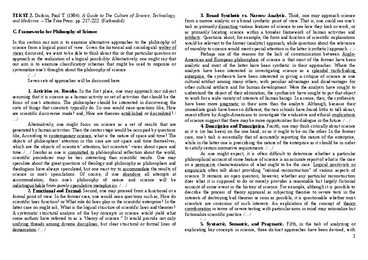
Where the systematize one's thoughts about the philosophy of science. analysts have been interested in investigating science as a splendid truth-finding /.../ enterprise, the synthesists have been interested in giving a critique of science as one Seven sets of approaches will be discussed here. cultural artifact among many others, with peculiar advantages and disadvantages for other cultural artifacts and for human development. Were the analysts have sought to 1. Activities vs. Results. In the first place, one may approach our subject understand the object of their admiration, the synthesists have sought to put that object
novels and short stories, Wodehouse was also a talented playwright and lyricist who was part author and writer of fifteen plays and of 250 lyrics for some thirty musical comedies. Wodehouse took a modest attitude to his own works. In Over Seventy (1957) he wrote: "I go in for what is known in the trade as 'light writing' and those who do that humorists they are sometimes called are looked down upon by the intelligentsia and sneered at." Wodehouse's characters are often eccentric, with peculiar attachments, such as to newts (Gussie Fink-Nottle) or socks (Archibald Mulliner). His "mentally negligible" good-natured characters invariably make their lot worse by their half-witted (if that) schemes to improve a bad situation. Wodehouse's aristocrats, however, embody many of the comic attributes that characterize buffoons created by a genius. In many cases the classic eccentricities of Wodehouse's upperclass give rise to plot complications.
A month later, Elizabeth wins the bonus and pays for the appointment to get her breasts enlarged. When Elizabeth learns that Amy and Scott are chaperoning an upcoming field trip, she taints an apple with poison ivy and leaves it for Amy. Amy ends up with blisters covering her face and backs out of the trip. On the trip, Elizabeth seduces Scott. They engage in non-penetrative sex, and Elizabeth secretly calls Amy to ensure she knows. However, Scott's peculiar behavior starts annoying Elizabeth. Elizabeth later gives advice to one of her students (Matthew J. Evans) who has an unrequited crush on a superficial girl in class, which causes her to reflect on how she has been superficial as well. After hearing Elizabeth and Scott having sex, Amy switches Elizabeth's desk with her own to trick the janitor into unlocking Elizabeth's sealed drawer. The evidence Amy finds leads her to suspect Elizabeth cheated on the state exam
määratlustest Encyclopaedia Britannica (2003): "Inimesele e. Homo sapiens'ile eriomane käitumine, mille moodustavad ühtlasi materiaalsed objektid kui lahutamatu osa sellest käitumisest. Kultuur koosneb keelest, ideedest, uskumustest, kommetest, koodidest, institutsioonidest, tööriistadest, tehnikatest, kunstiteostest, rituaalidest, tseremooniatest ja teistest elementidest." ,,behaviour peculiar to Homo sapiens, together with material objects used as an integral part of this behaviour. Thus, culture includes languages, ideas, beliefs, customs, codes, institutions, tools, techniques, works of art, rituals, and ceremonies, among other elements." Kust tuleb sõna "kultuur"? lad.k cultura < colere maad harima, taimi v loomi kasvatama, viljelema, hooldama, korras hoidma (vrdl e.k põllukultuurid; ingl.k agriculture) kultus religioosne talitus, jumalate austamine
Foreshore / 'f:: / tõusu ja mõõna vaheline rand Recreational / rekr'enl / lõõgastumis-, vabaaja- Scenery / 'si:nr / maastik Juxtaposition / dkstpz'in / kõrvuti asetsev GB consists of England, Scotland and Wales. GB is only a dot on the world map. It offers a great variety and scenic contrasts are often within easy reach. The coastline is washed by the tidal system twice a day. Britain´s speciality is the man-made scenery. Each part of the country has its peculiar geographical features. England Indented / n'dentd / sakiline Estuary / 'estjr / suudmelaht Watershed / 'w:td /veelahe Pike / pak / haug Rugged / 'rgd / konarlik, karm Meadow / 'med / aas, heinamaa
French or German stylistics; it has not been discussed thoroughly. The very term "stylistics" came in more common use in English only some 45 years ago. However, it was recorded for the first time much earlier in 1882, meaning "the study of literary style, the study of stylistic features" (Oxford Dictionary). Stylist is a writer / speaker skilled in a literary style (e.g. Hemingway is considered a peculiar stylist used a lot of repetitions). Stylistician is a scholar (a student). Style is applied to many things: clothing, architecture, hairstyles, etc. A linguistic style (style in language) is a variety of subsystems of language with its peculiar vocabulary, phraseology, grammatical and phonetic features that are used selectively to express ideas in a given situation.
always did. They both are doomed to death. `Fate goes ever as it must' says the poet. The course of life cannot be predicted with any certainty. One can hope only to foresee what is able and meet the unforeseen with dignity and resolution. That's the poem's deepest wisdom. A similar view of life is to be found in many other OE poems. 2. Chrst. Elem. In OE lit. The dream of the road. This poem stands supreme with its peculiar boldness and brilliancy. It describes not the biblical event itself but a vision or dream in which that event, the Crucifixion, is both symbolically represented and narrated by a participant. The functions of both symbol and narrator are performed by the rood, Christ's Cross. It first appears as a visionary symbol of overpowering mystery. It is a towering tree, at one moment covered in gold and jewels, at the next soaked in blood
dissimilar vowels: blood - blade, love - live, crisp grasp. These rhymes are sometimes referred to as partial rhymes or pararhymes. Compound rhymes are made up of two or more words, united by a single stress, that reproduce the sound form of a correlated word: women - two men, adorer - before her. Compound rhymes are mainly employed to evoke a humourous response. They also add a colloquial touch to the text. A peculiar property of English rhymes is eye-rhyme. It contains identical letters while vowel sounds are pronounced differently: love - grove, farm - warm, flames - Thames. Eye-rhyme is appreciated by the eye rather than by the ear. Thus, it is a property of the written poem. Internal rhymes occur within a poetic line. Head rhyme is rather uncommon. It connects the end of a line with the beginning of the next one by similar sound combinations
The universe has a complexity beyond comprehension. conventional adj. following accepted rules or standards adv. conventionally Syn. traditional n. convention Professor Canfield agreed with the conventional theory about the origin of the Basque language. To become integrated into a society, you must learn the conventions of that society. curious adj. odd or strange; eager to learn adv. curiously Syn. peculiar n. curiosity A curious object was discovered in the remains. Sally was curiously interested in the history of Alaska. exceedingly adv. very; to an unusual degree v. exceed Syn. extremely n. excess adj. excessive adv. excessively In tropical zones, it is exceedingly hot and humid. It is not safe to exceed the speed limit. exclusively adv. no one else; nothing else; not shared adj
Palestine issue is on the way to being resolved through the Oslo Accords. This means that many potential supporters might lose interest and move their focus to other areas of the world. The result of this situation is that Palestinian organizations have to work harder to use mass-comm and other channels to maintain worldwide interest in our issue, and to stress that there is greater than ever need for international support for Palestinian NGOs because of the peculiar situation created by the peace-making process. Using the mass media and communication channels in the four contexts mentioned above requires a clear understanding of each one, and how it works within its own political culture and national values. The Palestinian mass-comm sector is fragmented, very local in its orientation, highly personalized, and also both traditional and very new. The Israeli sector is highly political and commercial, with few personal dimensions
this, the effort on man's part to provide a store of things that minister to his comforts and wants -- and not for himself alone, but for his wife and children and the others whom he holds dear and for whom he ought to provide; and this responsibility also stimulates his courage and makes it stronger for the active duties of life. Above all, the search after truth and its eager pursuit are peculiar to man. And so, when we have leisure from the demands of business cares, we are eager to see, to hear, to learn something new, and we esteem a desire to know the secrets or wonders of creation as indispensable to a happy life. Thus we come to understand that what is true, simple, and genuine appeals most strongly to a man's nature. To this passion for discovering truth there is added a hungering, as it were, for independence, so that a mind well-moulded
needling the aesthetic to the reader” (1989, 129). In the case of Larkin, the translator will avoid that tendency so in rows inclined to “poetize” the poetry translations, regarding who their author could be, and will consider the eagerness of Larkin about, in words of Everett, creating “an unobtrusive art”, that never has to be confused with “artlessness” (1989, 132). We found in Larkin a peculiar mixture of fluid orality and very noticeable structure, whose maximum examples would be “Here” and “High Windows”, Brownjohn says that: Larkin has never written easily (...) But any sense of effort or contrivance is utterly absent: the diction of the poems, the beautifully judged selection of imagery, fit into frameworks which support and enhance them with immense metrical skill
importance of copying texts. St. Benedict of Nursia, in his Regula Monachorum (completed around the middle of the 6th century) later also promoted reading. The Rule of St. Benedict (Ch. XLVIII), which set aside certain times for reading, greatly influenced the monastic culture of the Middle Ages and is one of the reasons why the clergy were the predominant readers of books. The tradition and style of the Roman Empire still dominated, but slowly the peculiar medieval book culture emerged. Before the invention and adoption of the printing press, almost all books were copied by hand, which made books expensive and comparatively rare. Smaller monasteries usually had only a few dozen books, medium-sized perhaps a few hundred. By the 9th century, larger collections held around 500 volumes and even at the end of the Middle Ages, the papal library in Avignon and Paris library of Sorbonne held only around 2,000 volumes.
from the bias and pressure exerted by any technical form of human expression, we have only to visit a society where that particular form has not been felt, or a historical period in which it was unknown. Professor Wilbur Schramm made such a tactical move in stydying Television in the Lives o f Our Children. He found areas where TV had not penetrated at all and ran some tests. Since he had made no study of the peculiar nature of the TV image, his tests were of "content" preferences, viewing time, and vocabulary counts. In a word, his approach to the problem was a literary one, albeit unconsciously so. Consequently, he had nothing to report. Had his methods been employed in 1500 A.D. to discover the effects of the printed book in the lives of children or adults, he could have found out nothing of the changes in human and social, psychology resulting from typography
1. Loopealsed 2. Nõmmemetsad 3. Palumetsad 4. Laanemetsad 5. Salumetsad 6. Soovikumetsad 7. Rabastuvad metsad 8. Rohusoometsad 9. Samblasoometsad 10. Kõdusoometsad ALVAR FORESTS LOOPEALSED METSAD This groupof types includes forests of low productivity and with a peculiar xeromesophilous ground vegetation, which grow on a layer of limestone, gravel, grit or shingle. See metsa kasvukohatüüp sisaldab madala tootlikkuse ja iseloomulikult suure või keskmise kuivusnõudlikkusega alustaimestikku, mis kasvab pae-, kruusa- , peenkruusa või klibukihil. This layer is close to surface, with thickness of soil up to 30 centimetres. See rinne on maapinnale lähemal, mullatüsedus on kuni 30 sentimeetrit.
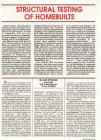
Similar behavior can be of his aircraft. It will also contribue straight lines). Twice the stress, twice observed on a tensile specimen of a to his peace of mind. the strain. The behavior of the certified spruce (yield point around Let us start by pausing briefly to stretched aluminum alloy (20 24 -T3), 5.3 ksi, ultimate strength about 9.4 consider a peculiar mechanical prop- spruce, or 4130 steel (not shown) is, ksi), or a low carbon steel, or CrMo erty of composite materials. Figure 1 however, quite different. Take, for steel, among others. shows the relationship between the example, aluminum. As the tensile Experiments in the testing device, tensile stress the material is subjected force is applied, the specimen (for as well as our own daily experience,
Noah Claypole, renamed by Fagin as Morris Bolter, was sent on his first assignment to find out what was going on with the boy there. The evidence was strong against him, and though he tried to fight it, the Dodger would be locked up for life for his crimes. Chapter 44: Fagin was visiting Sikes when the clock struck eleven on Sunday evening. Nancy put on her bonnet and prepared to go out, but Sikes stopped her. They began fighting, and finally Sikes won and she did not go out. Fagin thought it peculiar that she would throw such a fit about taking a walk so he assumed that she had another lover, or was sick of Sikes brutality. Fagin decides that he needs Nancy to become more closely allied with himself, and wants to ask her to poison Sikes. Chapter 45: Fagin informs Noah that he wants him to spy on Nancy for him. He wants to know everywhere she goes, and whom she is with. Noah agrees and waits for the time when Fagin wants him to go
as `us': And yet, I'm also pretty sure that [. . .] despite the obstacles, the corruptions, the strangeness of professional relations Á the desire to help and do some good exists here as well, in its peculiar and, to us, alien forms. (Hoffman, 1999, pp. 299Á300; italics mine) The intertextual informative support for successful intercultural communication with home readers comprises, in Murphy's case, the Rough Guide to Eastern Europe.
1 First performed by ERSO, 30 Sept. 1948, under Sergey Prokhorov. much attention to refined details. His ideological aim was to advance the struggle and development of despair and hardship towards the light. The building materials for him were rocks. He did not like the finishing touches… A great philosophic seriousness, honesty in work, evocativeness, profound love of classical music, escape from the ravishing Bohemian spirit, cordiality, a peculiar humour, which could occur as satire, the grotesque or sarcasm; all this was combined in him. 1 Heino Eller’s music was mostly inspired by nature; turning to nature’s infinite resources he evoked the sense of spaciousness and largess in several of his works. This feature is inherent in Eller’s earlier tone poems like Dawn and Calls of the Night. One of the best works of Eller in his last creative period is undoubtedly the tone poem Laulvad põllud (Singing Fields, 1951)2
and cinnamon/fawn offspring. However, those colours are not found in the purebred Norwegian Forest Cat gene pool. Had the gene pool become polluted by someone, perhaps generations ago, breeding their Norwegian Forest Cat to another breed? Was it a spontaneous mutation? Crossing of those cats with known chocolate and cinnamon colour cats of other breeds ruled out chocolate/lilac and cinnamon/fawn genes. These cats were a totally new colour, peculiar to the Norwegian Forest Cat gene pool and dubbed the "X Colours". They are now called Amber and Light Amber. The Amber effect is due to the extension gene (also called red factor) which controls the production of red and black pigment. The dominant version of the gene produces normal black pigment in the coat while the recessive version produces red pigment. The name comes from the effect of black or brown pigment not being
In 1955, when Prof. A. V. Isacenko left Bratislava for Olomouc, the department already had ten full-time teachers. Russian studies continued developing in the second half of the 1950s and in the 1960s when Prof. A. V. Isacenko was replaced first by Assoc. Prof. . urovic (1955-1959) and then by Assoc. Prof. J. Kopanicák (1959-1970). The political turnaround in 1989, of course, also had impact on the evolution of Russian studies as an academic discipline. The department found itself in a peculiar situation. On the one hand, it represented one of the most developed philological disciplines with a large personnel and material base; on the other hand, the factors that had made Russian studies one of the favoured philological disciplines in the past ceased to be significant. What followed was a perceptible drop in the number of applicants for the Russian teaching programme as Russian gradually lost its dominant position at primary and secondary schools. In terms of
76. Kirjeldage lehe kranz (pärg) tüüpi anatoomia The C4 plants often possess a characteristic leaf anatomy. Their vascular bundles are surrounded by two rings of cells, the inner ring, called bundle sheath cells, contain starch-rich chloroplasts lacking grana, which differ from those in mesophyll cells present as the outer ring. Hence, the chloroplasts are called dimorphic. This peculiar anatomy is called kranz anatomy, from the German word for wreath. The primary function of kranz anatomy is to provide a site in which CO2 can be concentrated around RuBisCO, thereby avoiding photorespiration. In order to maintain a significantly higher CO2 concentration in the bundle sheath compared to the mesophyll, the boundary layer of the kranz has a low conductance to CO2, a property that may be enhanced by the presence of suberin. Kranz-anatoomia
indicate artifacts in music, literature, painting and sculpture, theater and film. Encyclopaedia Britannica (2003): "Inimesele e. Homo sapiens'ile eriomane käitumine, mille moodustavad ühtlasi materiaalsed objektid kui lahutamatu osa sellest käitumisest. Kultuur koosneb keelest, ideedest, uskumustest, kommetest, koodidest, institutsioonidest, tööriistadest, tehnikatest, kunstiteostest, rituaalidest, tseremooniatest ja teistest elementidest." ,,behaviour peculiar to Homo sapiens, together with material objects used as an integral part of this behaviour. Thus, culture includes language, ideas, beliefs, customs, codes, institutions, tools, techniques, works of art, rituals, and ceremonies, among other elements." Kust tuleb sõna "kultuur"? lad.k cultura < colere maad harima, taimi v loomi kasvatama, viljelema, hooldama, korras hoidma (vrdl e.k põllukultuurid; ingl.k agriculture) kultus religioosne talitus, jumalate austamine
designing bridges and roads (Ponts et Chaussées). This corps of specialists gave the Neo-Classical period a range of monumental and elegant bridges on rivers as the Loire (Blois, Orléans, Saumur) and the Seine in Paris. This model spread all over Europe, producing large monumental urban bridges in capitals such as London, Saint Petersburg, and Prague. In Italy, Bartolomeo Ammannati evolved a new form for the Santa Trinità Bridge - a peculiar double-curved arch whose departure from an ellipse was deliberately concealed by a decorative escutcheon at the crown. Its 1:7 rise-to-span ratio resulted in an elegantly shallow, long-arch span widely adapted in other bridges of the Renaissance. The bridge was reconstructed using original stones recovered from the river following demolition during World War II. By the mid-18th century, masonry bridge building had reached its apogee. French engineer Jean-
Dimmesdale only loves his community enough to preach in it, but he is preacher harboring a great sin, and so he cannot truly guide his community spiritually. Dimmesdale's and Hester's love are alike in their limitations. While Dimmesdale does speak up for Hester keeping her Pearl "Truth in what Hester says, and in the feeling which inspires her! God gave her the child, and gave her, too, an instinctive knowledge of its nature and requirements,both seemingly so peculiar,which no other moral being can posses. And, moreover, is there not a quality of awful sacredness in the relation between this mother and this child."(Dimmesdale 78) but he cannot love her enough to be her husband. The scene at the scaffolding at night is a truly disgusting scene of hypocrisy. Arthur seizes the opportunity to go up on the scaffolding and feel better about his sin, but when he sees a fellow man of the cloth walking by, he cowers
be an ordinary predicate like "was Scotch" or "is bald," and takes "not" to modify or apply to that predicate: At least one person is presently King of France, and 16 Reference and referring at most one person is presently King of France, and whoever is presently King of France does not exist. The anomaly is that the first conjunct asserts the existence of a present King, while the third conjunct denies it. No wonder (7) sounds peculiar to us. To make sense of (7), we must understand "not", not as modifying the verb "exist", but as applying to the rest of (7) as a whole, thus: Not: (The present King of France exists). [That is, it is false that: the present King of France exists], which is obviously what would be meant by someone who uttered (7) seriously. Then we apply Russell's pattern of analysis inside the "not," as follows. Not: (At least one person is presently King of France, and at most one
" His lips twitched as he stared at the road. "A while," he admitted at last. "Okay." I smiled, pleased that he was still being honest with me. He stared down at me with watchful eyes, much as he had before, when he was worried I would go into shock. I smiled wider in encouragement, and he frowned. "Don't laugh -- but how can you come out during the daytime?" He laughed anyway. "Myth." "Burned by the sun?" "Myth." "Sleeping in coffins?" "Myth." He hesitated for a moment, and a peculiar tone entered his voice. "I can't sleep." It took me a minute to absorb that. "At all?" "Never," he said, his voice nearly inaudible. He turned to look at me with a wistful expression. The golden eyes held mine, and I lost my train of thought. I stared at him until he looked away. "You haven't asked me the most important question yet." His voice was hard now, and when he looked at me again his eyes were cold. I blinked, still dazed. "Which one is that?" "You aren't concerned about my diet
little curiosity, satisfied herself with walking to the window and pretending not to hear. In a doleful voice Mrs. Bennet began the projected conversation: "Oh! Mr. Collins!" "My dear madam," replied he, "let us be for ever silent on this point. Far be it from me," he presently continued, in a voice that marked his displeasure, "to resent the behaviour of your daughter. Resignation to inevitable evils is the duty of us all; the peculiar duty of a young man who has been so fortunate as I have been in early preferment; and I trust I am resigned. Perhaps not the less so from feeling a doubt of my positive happiness had my fair cousin honoured me with her hand; for I have often observed that resignation is never so perfect as when the blessing denied begins to lose somewhat of its value in our estimation. You will not, I hope, consider me as showing any disrespect to your family, my dear
 annaabi.ee