Book 1 BASIC ENGLISH BASIC ENGLISH GRAMMAR GRAMMAR BASIC ENGLISH GRAMMAR Book 1 Book 1 Younger students at beginning to intermediate levels will greatly benefit from this step-by-step approach to English grammar basics. This is the ideal supplement to your language arts program whether your students are native English speakers or beginning English language learners. Skill-specific lessons make it easy to locate and prescribe instant reinforc...
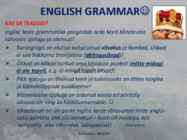
ENGLISH GRAMMAR KAS SA TEADSID? Inglise keele grammatika peegeldab seda keelt kõnelevate rahvaste ajalugu ja olemust! Kuningriigis on olulisel kohal olnud viisakus ja kombed. Ülikud ei saa hakkama teenijateta (abitegusõnad)! Ülikud on kõikjal tuntud oma kitsiduse poolest (mitte midagi ei ole topelt, e.g. ei mingit topelt eitust)! Pikk ajalugu on lihvinud keelt ja tulemuseks on lihtne loogika ja käändelõppude puudumine! Mitmekesine ajalugu on aidanud kaasa eri päritolu sõnavarale ning ka hääldusmuredele. Väidetavalt on üle poole inglise keele sõnavarast mitte anglo- saksi päritolu, ehk siis laenatud – kontrolli hoolega, kas ‘sympathy’ ikka tähendab ‘sümpaatiat! kaastunne Aari Juhanson, MA 2009 Tenses – Tegusõna ajad • Olevik (Present) • Minevik (Past) • Tulevik (Future) • Kaudne tulevik (Future-in-the-Past) ...
English download B2 workbook lk 8 harjutus 1 vastused (Grammar 2) 1. Have you been hiding 2. Has just finished 3. Have you ever smiled 4. Has been biting 5. Have been waiting 6. Has expressed
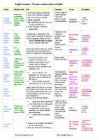
English Grammar - The most common tenses in English Signal Example Tense Use Form words s something happens repeatedly how often something happens every one action day follows sometim another es I work always infinitive Present things in he/she/it he works often Simple general + s I go usually he goes seldom ...
1) Standard and non-standard varieties of English Standard varieties of English are the varieties of the English language that are considered to be a norm and are spoken and written by the minority (educated people). This is the optimum for educational purposes. The standard varieties of English are: BrEng (British), EngEng (English), NAmEng (North-America), USEng (United States), CanEng (Canada), AusEng (Australia), NZEng (New Zealand). Standard English (British English) is the most widely accepted and understood among native speakers, learned by foreigners. It is used in broadcasting, TV, news etc. It doesn't concern pronounciation (accent), but grammar and vocabulary. It includes formal and informal styles. British Standard English grammar and vocabulary, together with the RP accent should be called English English. RP (Received Pronounciation) is an accent that originates from South-East of England. A social accent, associated o...
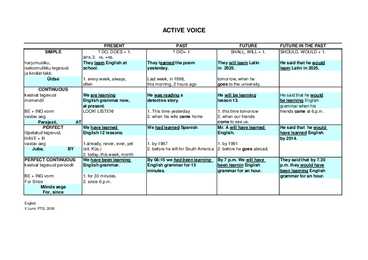
ACTIVE VOICE PRESENT PAST FUTURE FUTURE IN THE PAST SIMPLE ? DO, DOES + 1. ? DID+ 1. SHALL, WILL + 1. SHOULD, WOULD + 1. ains.3. +s, +es. harjumusliku, They learn English at They learned the poem They will learn Latin He said that he would iseloomulikku tegevust school. yesterday. in 2025. learn Latin in 2025. ja kindlat fakti. Üldse 1. every week, always, Last week, in 1998, tomorrow, when he often this morning, 2 hours ago goe...
INGLISE KEELE TÖÖPLAAN 6. KLASSILE Aeg: I, II veerand 2003/2004 õ.-a Õpetaja: Age Tamm Õppe- Teemad. Alateemad. Mõisted, faktid nädal 1. nädal Unit 1. What did you do last summer? Past Simple questions, statements 2. nädal Summer activities Did you...? Yes, I did / No, I didn't Alan's summer play ball / the violin My summer go swimming / ...ing Polite English. Saying hello and introducing 3. nädal Unit 2. A trip to England Past Simple 4. nädal Outdoor activities by bus / car / train / plane, on foot English Country School Ordinals (the first, the second, ...) The Tower of London Posessive pronouns ...
Pidgins, creoles and standard language Pidgin language A simplified language Mainly employed in trade NOT the native language of any community may be built from words, sounds, or body language from multiple other languages and cultures No particular rules Chinese Pidgin English a pidgin lexically based on English and influenced by Chinese developed in 17th century in China Began to decline during the 19th century, when standard English began to be taught in schools Chinese Pidgin English Some characteristics: Based on a vocabulary of 700 English words Grammar and syntax are simple and positional (grammatical categories are indicated by the position of words in a sentence) Lack of plural personal pronouns Chinese Pidgin English Example sentences: Hab gat rening kum daun (Have got raining come down) “There is rain coming down” Tumoro mai no kan kum (Tomorrow my ...
Fill the gaps with the correct tenses. 1. I (learn)................................ English for seven years now. 2. But last year I (not / work) ........................................ hard enough for English, that's why my marks (not / be) ............................. really that good then. 3. As I (pass / want) ............................... my English exam successfully next year, I (study) ............................... harder this term. 4. During my last summer holidays, my parents (send) ..................................... me on a language course to London. 5. It (be) ............................ great and I (think) .................................. I (learn) ................................... a lot. 6. Before I (go) .................................. to London, I (not / enjoy) .................................. learning English. 7. But while I (do) .......
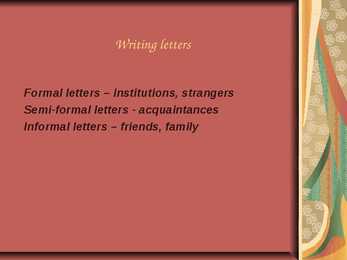
Writing letters Formal letters institutions, strangers Semi-formal letters - acquaintances Informal letters friends, family Layout Always in paragraphs A paragraph starts with a space, which is as wide as your finger No empty rows Block style in the content of the letter Greeting and farewell on the left side The greeting and farewell have the same style Dear..................... ........................................................................ ............................................................................. ......................................................... ........................................................................ ............................................................................. ............................................................................. .........................................................................
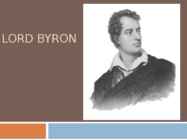
LORD BYRON Sissejuhatus George Gordon Noel Byron, kuues parun Baryn Tuntud ka kui Lord Byron 22. jaanuar 1788 London – 19. aprill 1824 Mesolóngi, Kreeka Romantiline luuletaja Elukäik George Byron kasvas üles Aberdeenis. Tema isa John Byron oli surnud juba 1791. aastal Kümnenda eluaastani elas Byron koos emaga Šotimaal. 1801–1805 õppis Byron Harrow‘ koolis, seejärel Cambridge'I ülikoolis Läbi Lissaboni sõitis ta Hispaaniasse, külastas seejärel Maltat, Albaaniat, Kreekat ja Väike-Aasia rannikut. 2. jaanuaril 1815 abiellus ta Anne Isabella Milbanke'iga, kuid abielu. oli täis pingeid. 10. detsembril 1815 sündis neil tütar Lady Augusta Ada. 1816. aastal läks Byron Šveitsi. Seejärel läks ta Veneetsiasse. Ta kirjutas raamatud "English grammar and the Armenian" (1817) ja "Armenian grammar and the English" (1819), ...
The history of the English Language Kristin Klaus, 10a Short history · Started with the arrival of three Germanic tribes who invaded Britain during the 5th century AD · The tribes: the Angles, the Saxons, the Jutes · At that time the inhabitants spoke a Celtic language · The invadors pushed them west and north Germanic invaders entered Britain on the east and south coasts in the 5th century. Old English · 450-1100 AD · The Germanic tribes spoke similar languages which developed into Old English · Did not sound or look like English today · About half of the most commonly used English words have Old English roots · Be, strong, water Part of Beowulf, a poem written in Old English. Middle English · 1100-1500 · In 1066 William the Conqueror, the Duke of Normandy (part of modern France), invaded and conquered England · The new conquerors (called the Normans) brought with them a kind of French, which became the la...
English structure revision for the exam 1. Terms Language → A systematic, conventional (tavakohane) use of sounds, signs or written symbols in a human society for communication and self-expression. Human language at all levels is rule- or principle- governed (valitsema) meaning that language corresponds to the grammar. Natural language is usually spoken, while language can also be encoded into symbols (such as letters, morse etc) For example: Estonian, English. Linguistics → The scientific study of human natural language. Broadly, there are three aspects to the study which are Pragmatics (studies the use of language → interested in the gap between the sentence’s meaning and the speaker’s meaning). Semantics (concerned with the meaning of the language aspects and the way they change, also how objects and language and thinking and language are related). ...
Introduction English is spoken on all five continents. With regard to the numbers of speakers it is only exceeded by Chinese and Spanish. But in terms of geographical spread it stands at the top of the league. The varieties of English in the modern world are divided into four geographical groups as follows. British Isles America United States (with African American England English) Wales Canada Ireland The Caribbean Africa Asia, Pacific West Africa South- and South-East Asia East Africa Australia and New Zealand South Africa ...
Jamaica Lehasalu Andres AT112 Jamaica Jamaica is an island country situated in the Caribbean Sea, comprising the third- largest island of the Greater Antilles. The island, 10,990 square kilometres in area, lies about 145 kilometres south of Cuba, and 191 kilometres west of Hispaniola, the island containing the nation-states of Haiti and the Dominican Republic. Jamaica is the fifth- largest island country in the Caribbean. The indigenous people, the Taíno, called it Xaymacain Arawakan. meaning the "Land of Wood and Water" or the "Land of Springs". Jamaica Marcus Garvey, Father of the Back to Africa Movement and Jamaica's first National Hero. Language The official language of Jamaica is English. Jamaicans primarily speak an English- African Creole language known as Jamaican Patois, which has become known widely through the spread of Reggae music. Jamaican Patois was formed from a bas...
1 Grammatical Terminology PRACTICAL ENGLISH GRAMMAR FLGR.01.042 Grammatical Terminology analytic analüütiline (= uninflected - grammar is focused in the sentence , e.g. English) synthetic sünteetiline (= inflected - grammar is focused in the word, e.g. Estonian, Latin, Russian, Old English) ending lõpp (käände- ja pöördelõpud) marker tunnus (mitmuse, oleviku, lihtmineviku, tingiva kõneviisi, käskiva kõneviisi, kaudse kõneviisi, umbisikulise tegumoe, ma- tegevusnime, oleviku kesksõna, mineviku kesksõna) derivational affix liide, tuletusliide, tuletusafiks (e.g. postwar, anti-American, wiser, greenish) parts of speech sõnaliigid English Estonian ...
English began as a west Germanic language which was brought to England bt the Saxons around 400 AD. The spoken and written laguage berween 400 and 1100 AD is referred to as Old English. Many words used today come from Old English. In the 9th and 10th centuries, when Vikings invaded England, Old Norse words entered the language English from about 1300 to 1500 is known as Middle English. It was influenced by French and Latin. French brouht many words connected with goverment. Modern English eas greatly influenced by the English used in London and changed a great deal until the end of the 18th century. Many words were introduced from Greek and Latin to express new ideas, especially in science, medicine and philosophy. Nowadays 80 percent of the word-stock is foreign-born. So we can say that most world languages have contributed some words to English at some time, and the process is now being reversed. Purists of the languages are res...
The School I come from The school I come from, is named Anna Haava nimeline Pala school and there learns a little bit less than 100 students, I learned there from 7-9 grade. I started learning English in third grade and if I remember correctly then our teachers name was Reet Ernits but she is not the only who has taught me English So far I have had five teachers (not including my current teacher), who all have been very different but they had one thing in common, they all used I love English books. With my first teacher we wrote down lots of rules about grammar and other stuff like that but I did not understand them so for me it was more like a waste of time. With my second, third and fourth teacher I met in Jõhvi High school and they all were not good teachers because they did not want to teach us, during their lessons half of the class just played with their phones and other half of the class tried t...
Modals Sandra Haar Form 11 I am going to talk about... Can Could May Might Must Should Would Ought to Excercises References How do we use modal verbs? Affirmative: Subject + modal + infinitive, Example: She should stay Negative: Subject + modal(n`t) + infinitive, Example: She shouln`t stay Interrogative: (Wh) Modal + Subject + Infinitive, Example: Why should she stay? Can Ability to do something in the present-I can speak English. Permission to do something in the present-Can I go to the cinema? Request - Can you wait a moment, please? Offer- I can lend you my car till tomorrow. Suggestion- Can we visit Grandma at the weekend? Possibility- It can get very hot in Arizona. Could Ability to do something in the past- I could speak English. Permission to do something in the past- I could go to the cinema. Polite question- Could I go to the cinema, please? Polit...
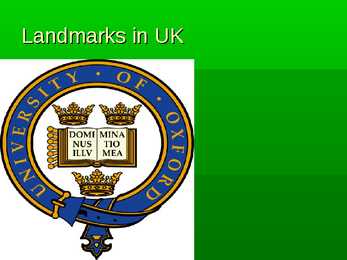
Landmarks in UK Annette Kirotar 8.c Gustav Adolf Grammar School 2008/2009 University of Oxford University of Oxford is located in the city of Oxford, Oxfordshire, England. Oxford is the oldest university in the English-speaking world. It is also one of the world's leading academic institutions. Oxford has 38 independent colleges. History The university was built in the end of 12th century, although the exact date remains unclear. After a dispute between students and townsfolk broke out in 1209, some of the academics at Oxford fled north-east to the town of Cambridge, where the University of Cambridge was founded. The two universities have since had a long history of competition with each other. Interesting to know Oxford is consistently ranked in the world's top 10 universities. Oxford's motto is Dominus Illuminatio Mea (Latin). Motto in English: "The L...
If I were an English teacher Being a teacher is not an easy task. Teachers have many problems with students who does not know how to behave. Some of them even make fun of teachers and I find this kind of behaviour disturbing, because it is not fair that urchins have more fun in school than decent students have. Yes, teachers can throw the rebels out or punish them in other ways, but that usually agitates the students against the teacher. Firstly, I would like to say that if I were an English teacher I would variegate the classes with subjects, which students would actually find interesting. I would find it exciting to let them think and explore more about politics, social issues, world news and of course other subjects that they really find interesting to speak about. I believe these subjects need also considering because the majority of youth actually has no idea or interest who represents...
All the world's a puzzle All the world's a stage, And all the men and women merely players; They have their exits and their entrances, And one man in his time plays many parts, His acts being seven ages. At first, the infant, Mewling and puking in the nurse's arms. Then the whining schoolboy, with his satchel And shining morning face, creeping like snail Unwillingly to school. And then the lover, Sighing like furnace, with a woeful ballad Made to his mistress' eyebrow. Then a soldier, Full of strange oaths and bearded like the pard, Jealous in honor, sudden and quick in quarrel, Seeking the bubble reputation Even in the cannon's mouth. And then the justice, In fair round belly with good capon lined, With eyes severe and beard of formal cut, Full of wise saws and modern instances; And so he plays his part. The sixth age shifts Into the lean and slippered pantaloon, With spectacles on nose and pouch on...
1. ASKING SOMEONE FOR THEIR OPINION ABOUT A TOPIC 1.1 Yes/No Questions Do you believe in horoscopes? Do you believe in a God who rewards good and punishes wrong-doing? Do you think we should be tougher on crime? Do you think we should maintain our traditions or make way for change? Do you think the Government should act to curb the power of media barons....? Do you think everybody should be trained to use computers? Do you think that public sector workers such as teachers, doctors, nurses and fire fighters should be allowed to strike? Do you think that the young have anything to learn from the elderly and vice versa? Would you consider sending your child to a grammar school? Would you ever consider taking out private health insurance? 1.2 OR Questions Are you for or against self-sufficiency? Would you prefer your child to be edu...
My languages I love different languages. I mean, I really, really love different languages. I also believe and have been told that I pick them up rather easily. That might be true, although I did not pick any Greek up in Greece but that might have been because they spoke so damn fast that I could not tell if it was a word or an entire sentence. The first foreign language I learned was Russian. Considering I was ten when Estonia became a Republic, it makes sense. We began studying Russian in first grade, though it was simplified – "koška" instead of "kot", "medvešonok" instead of "medved", "saichik" etc. Did not make much sense and we mostly played some games in Russian (Tare-tareke etc). Learned as much playing outside, since we had Estonian-Russian kids around as well. Not that we played with them. It's sad to say but it was not a nice time to be a Russian kid. We were mean to them, and we...
Tallinna Polütehnikum Automation Author: TomTom2 Group :AA-09 Instructor: Marina Zotikova Tallinn 2010 Contents Introduction......................................................................................................................3-4 Person Knowledge Technologies supports......................................................................4-6 Online Essay Evaluation Service.....................................................................................6-7 WordNet lexical database................................................................................................7-8 Practice Online (TPO)................................................................................................
British Literature Ilya Zaitsev 10 class John Tolkien Was born in 3 January 1892 Bloemfontein. English writer, philologist, and Oxford university professor, best known as the author of the classic high- fantasy works The Hobbit, The Lord of the Rings. Tolkien was appointed a Commander of the Order of the British Empire by Queen Elizabeth II on 28 March 1972. His works The Hobbit and The Lord of the Rings form a connected body of tales, fictional histories, invented languages about a fantasy world called Arda, and Middle-earth. While many other authors had published works of fantasy before Tolkien,[ the great success of The Hobbit and The Lord of the Rings led directly to a popular resurgence of the genre. This has caused Tolkien to be popularly identified as the "father" of modern high fantasy literature. Biography. Childhood John Ronald Reuel Tolkien was born in Bloemfontein in South ...
Robert Burn's Robert Burns, Scotland's national poet, was born on 25 th January in 1759 in Scotland. There were seven children in the family, and Robert was the eldest. His father knew the value of a good education, and he tried to give his children the best education he could. Robert was sent to school at the age of six. Reading and writing, arithmetic, English grammar, history, literature and Latin - that was Robert Burn's education. Robert Burns began to write poems when he was fifteen. Burns published some of his poems in 1786. Their success was complete. And Robert Burns became well known and popular. When Burns came to Edinburgh, the capital of Scotland, a new and enlarged edition of his poems was published. He died in poverty at the age of thirty -- seven in 1796. On 25th January people all over the world celebrate Robert Burn's birthday by having Burn's Night Dinners. Robert Burns was Scotland's...
1. Be ready to explain the terms (lecture 1): language, linguistics, synchronic approach to language, diachronic approach to language, linguistic competence, linguistic performance, what is grammar?, prescriptive grammar vs. descriptive grammar; phonology, phonetics, phone, allophone, phoneme; morphology, morphemes (types of morphemes), morphs, allomorphs, types of affixes, derivational affixes, inflectional affixes; open vs closed class words; syntax. Language: a systematic, conventional use of sounds, signs or written symbols in a human society for communication and self-expression. - human language at all levels is rule- or principle-governed. Linguistics: the scientific study of human natural language Synchronic approach to language: Diachronic approach to language: Linguistic competence: Linguistic performance: What is grammar?: "The sounds and sound patterns, the basic units of meaning, such as words, and the rules to combine them...
INGLISE KEELE RIIGIEKSAM I VIHIK 11.mai 2002 Letter of application Dear Ms Parker, I would like to apply for the position of office manager advertised in ´´The BalticTimes´´. I am 22 years old and i am graduated from the university. I hope i can get this job because i would love to be the office manager. I like to communicate with people, help them and give advice and also i am very open-minded too. In the college i studied secretary work and i find it really interesting. My mom works as a secretarian so i have learned many things from her. I have good computer skills, i know how to use Powerpoint and Libre office programs and it is veri necessary for office jobs. My advantage is that i am Estonian and i am good at grammar and speaking in Estonian, and also i have knowledge of English, Russia and Germany so i can communicate with people from different countries. I think that i am the right person for this job because i enjoy talkin...
Wa l t e r Scott Walter Scott Scottish novelist and poet One of the greatest historical 1771-1832 novelists. Scott wrote twenty-seven historical novels. Early Life o Was born August 15 1771 o Caught polio and survived. o Sent to Sandyknowe , his grandparents farm. o Taught to read and influenced by his aunt Jenny. o Given private tutoring by James Mitchell. o attended grammar school and met James Ballantyne. o At age 12, started studying at the University of Edinburgh. o Began an apprenticeship with his fathers office. o Later became a lawyer in Edinburgh. Literary Career launched Began to write at 25 by translating works from German. Became an ardent volunteer in yeomanry where he met Margaret Charlotte Charpentier in 1791 Had five children together Invested in money over time through various jobs and events. Fo...
Grammar English Future simpleWe use future simple: a) in predictions about the future usually with the verbs think, believe, expect, etc.., the expressions be sure, be afraid, etc.., and the adverbs probably, perhaps, certainly.., b) for on-the-spot decisions c) for promisses, threats, warnings, requests, hopes and offers. d) for actions/ events/ situations which will definitely happen on the future and which we cannot control.Be going to We use be going to: a) for plans, intentions or ambitions we have for the future. b) for actions we have already decided to do in the near future . C) in predictions when there is evidence that something will happen in the near future.Future continious. A) for an action ehich will be in progress at a started future time. B) for an actions ehich will definitely happen in the future as the result of a routine or arrangement. C) when we ask politely about someone's plans for the near future. Future p...
Level of education The aim of the report is to analyze the level of education of men and women in Estonia at the turn of the century. A secondary education is by far the most popular level of education. This shows that it is a centric way to cover ground in life. A significant number of men have basic education. This implies that most men prefer not to pursue education. In case of women, they want to get a better education. This is demonstrated by the fact that only 18 % of women have basic education. A large proportion of women have chosen secondary vocational. This indicates that is chosen an occupation, which suggest a fixed income. A higher level of education is not certainly necessary. This is illustrated by the fact that about 6 % of people have elementary education. A small number of men and women have no schooling. This suggests that some people do not have opportunity to get an education. A substantial number of people have a ...
English writers Maria maasing Edwin Abbott Abbott · Edwin Abbott Abbott(1838-1926)was an English clergyman and writer.He was born in London. He wrote several theological works and a biography (1885) of Francis Bacon, but he is best known for his Shakespearian Grammar (1870) and religious allegory the Flatland. William Blake · William Blake (17571827) was an English poet, philosopher and artist.He was one of the most extraordinary personalities to emerge during the period of Romanticism. He believed that spiritual reality lies hidden behind the visible world of the senses and he attempted to create a symbolic language to represent his spiritual visions. He began printing his own illustrated poems in colour in 1787. The first example was Songs of innocence(1789). Towards the end of his life, he joined a circle of younger artists who appreciated his remarkable pow...
ELT Methodology (FLGR.01.041) 27.12.2012 Home Assignments. I Youtube clips: · A vision of K-12 students I personally think that Estonian learners are also digital learners. They spend more time at the computers or laptops or iPads etc. than read books or move outside. And another thing is that teachers are less capable in using technological appliances. But the latter mentioned fact is an advantage for us teachers as well. It gives us an opportunity to provide our students to experience success. They can help and assist us if we need some technological help. Another thing is that in schools, in classes generally students are not allowed to use their appliances, so it means they have to communicate verbally as well. I think that teachers ...
NAVAJO LANGUAGE Merilin Reisenbuk What is Navajo Language? Navajo is an Athabaskan (is a large group of indigenous peoples of North America) language spoken in the southwest United States by the Navajo people. It is geographically and linguistically one of the Southern Athabaskan languages. Orthography and pronunciation Consonants Vowels. Navajo has four basic vowel qualities: a, e, i and o. Each of these may occur either short or long. Tones. Navajo has two tones, low and high. - high, as in áá and éé - low, as in aa and ee Grammar The key element in Navajo is the verb. Every verb must have at least one prefix. Many concepts expressed using nouns in other languages appear as verbs in Navajo. There are two main types of nouns in Navajo: -Simple nouns (béésh - "knife") -Nouns derived from verbs (called deverbal nouns) ...
Grammar Present Simple (Lihtolevik) and Present Continuous (Kestev olevik) PRESENT SIMPLE - LIHTOLEVIK Lihtolevik väljendab: 1) Harjumuspärast tegevust või seisundit olevikus. What time do you usually get up? 2) Üldtuntud tõdesid ja fakte. It always rains in October. 3) Oskusi ja võimeid. She speaks English well. Juhul kui tegusõna lõpeb häälikuga `s` või ühenditega sh`, `ch`, lisatakse ainsuse kolmandas pöördes tegusõna lõppu ` ES` (switch switches). Täpselt sama reegel kehtib tegusõnade kohta, mis lõpevad häälikuga `o` (go goes). Erandina tuleks välja tuua tegusõna `have`, mille ainsuse kolmas pööre on has. He/She has a nice car. Does he/she have a nice car? He/She does not have a nice car. Juhul kui küsimus algab küsisõnaga (when, where, how, why, what), järgneb küsisõnale alati abitegusõna DO või DOES. Jaatav lause Küsiv lause Eitav lause I live in Tallinn. Do ...
English Grammar - The most common tenses in English Tense Signal words Use Estonian Form Examples · something happens repeatedly *korduv tegevus every day · how often something happens *püsiv olukord sometimes, *tulevikus · one action follows another I work Present twice a week toimuv, seotud · things in general infinitive he works Simple always, often sõiduplaanidega · after the following verbs (to love, ...
Estuary English 1. The geographical dimension: Is `Estuary' English estuary? Estuary English is a dialect of English widely spoken in South East England, especially along the River Thames and its estuary. Phonetician John C. Wells defines Estuary English as "Standard English spoken with the accent of the southeast of England".[1] The name comes from the area around the Thames, particularly London, Kent, north Surrey and south Essex. The variety first came to public prominence in an article by DavidRosewarne in the Times Educational Supplement in October 1984. [2] Rosewarne argued that it may eventually replace RP (Received Pronunciation) in the south-east. Studies have indicated that Estuary English is not a single coherent form of English; rather, the reality behind the construct consists of some (but not a...
UNIT 1 Writing in the Business World Writing gives structure and form to our ideas. In the business world this is done for a purpose: to persuade, recommend, offer advice, give an order, etc. The business text must therefore be easily and quickly read and its message must be understood exactly as intended. If you learn to recognize and avoid the more common errors of information control, grammar and style, you will achieve this aim. You will write more confidently and more correctly if you check everything you write. Pay particular attention to the following: · Appropriate Subject Heading Take care to prepare your reader by introducing the subject appropriately in your subject heading. · Carefully Organized Information If a reader needs to be persuaded or convinced, your information will need careful planning and organizing. · Correct Grammar and Sp...
Grammar point Made by Nikolai Hodosevich Conditional mood The conditional mood is the form of the verb used in conditional sentences to refer to a hypothetical state of affairs. Conditional verb forms can also have temporal uses, often for expressing "future in the past" tense. Condition sentences are often entered with conjunction IF Real events Structure: Additional clause Present Indefinite Main clause Future Indefinite If I have a lot of money, I will buy a car , Almost unreal events *In additional and main clauses usually use Subjunctive I and II *When you translate into Russian these sentences, you should use conjunction * This type of unreal conditional sentence use, when speaker wants to underline small probability of condition realization Almost unreal events Structure: Additional claus...
Shakespeare Elulugu · Was born in 1564, probably on April 23, in the small country town of Stratford-on- Avon · Father was a prosperous glove maker and held several important positions in the town government · Mother, Mary Arden, was the daughter of a wealthy landowner · By the age of 7, Shakespeare was probably attending the local grammar school · In 1582, at the age of 18, he married Anne Hathaway (26), the daughter of a farmer who lived about a mile from Stratford · Daughter Susanna (born in 1583) and twins, Hamnet and Judith (born in 1585; Hamnet died in 1596) · From 1585 to 1592, a period some scholars call ,,the lost years" · From 1592 the recors about Shakespeare are much fuller. · Sometime during the lost years Shakespeare moved to London and became part of the city's busy theatrical life · By 1594 he was a shareholder, or part owner, in one London's most popu...
J.F.Cooper(1789-1851): he was born in Burlington, New Jersey in 1789. When he expelled from Yale bacause of prank, he joined the navy as a midshipman. In 1810 he took a furlough and never returned to active duty. He married with Susan De Lancy and got 5 children. They lived Europe, but returned to America because he was unpopular in Europe. In 1920 je published his first fiction "Precaution", in 1821 the second one "The Spy". His third book "The Pioneers" was the first of five novels. He died at Cooperstown in 1851. He was immensely popular writer and he considered to be the first major American novelist. R.L.Stevenson(1850-1894): he was born in Edinburgh, Scotland in 1850. He was a sick little boy who spent much of his time in bed. He was very lonely only child. When he grew older and seemed stronger, his father took him on trips to he wildest coasts of Sotland. Stevenson was no student. He roamed about Edinburgh, learning to know peop...
Estonian language Seliin-Doris Tsinjakov 11. Klass Kehra Gümnaasium · Estonian is the official language of Estonia. · Spoken natively by about 1.1 million people. · It belongs to the Finnic branch of the Uralic language family. Classification · Belongs to the Finnic branch of the Uralic languages, along with Finnish, Karelian, and other nearby languages. · Estonian has been influenced by Swedish, German and Russian, though it is not related to them genetically. History · The two different historical Estonian languages, the North and South Estonian languages, are based on the ancestors of modern Estonians migration into the territory of Estonia in at least two different waves, both groups speaking considerably different Finnic vernaculars. · Modern standard Estonian has evolved on the basis of the dialects of Northern Estonia. · The domination of Estonia a...
Read the following description I am from Seattle, Washington. Seattle is a city in the United States. It is near the border of Canada in the northwest corner of the USA. I live in a town called Olympia which is on the Puget Sound. I live in a house in a street in the countryside. The street is called "Bear Street" and the house is old - more than 100 years old! I am an English teacher at a school in the center of the town. I like books and taking photographs. I usually have lunch at school. I usually go home by car. We have all kinds of food in Olympia. I like Italian food very much. Sometimes, I go to an Italian restaurant in Seattle. The restaurant is called "Luigi's". Italian food is great! Here are the rules for when to use "A, An or The": · a = indefinite article (not a specific object, one of a number of the same objects) with consonants She has a dog. I work in a factory. · an = indefinite arti...
FORM 8 REVISION UNITS 1-5 GRAMMAR 1) ´S- lõpuline omastav reeglid on TV lk 30 Exercise 1. 1) George has a new car. It is ........................ 2) Ken and Chris have a friend. This boy is...................... 3) Her children have a dog. It´s.......................... 4) These newspapers were published yesterday. This is .................. 5) His parents own this house. This is...................... 6) Ted and Nancy have a son whose name is Fred. Fred is ............... 7) The key belongs to my sister. It´s....................... 8) These skis belong to Uncle Thomas. They are....................... 9) This camera belongs to her parents. It´s.................. Answers: 1) George´s car 2) Ken and Chris`s friend 3) her children´s dog 4) yesterday´s newspaper 5) his parents´ house 6) Ted and Nancy´s son 7) my sister´s key 8) Uncle Thomas´s skis 9) her parents´ camera 2) NUMBER + NOUN ADJECTIVES Numbr...
LEL 2E Notes on Vocabulary One of the key facts about the lexicon of any language is that it reflects in various ways the physical and cultural environment in which the language is spoken. A people unfamiliar with, say, horses is unlikely to have a word for `horse'; similarly with ploughs, printing presses, and internet porn sites. For the most part this is trivial it's hard to imagine how it could be otherwise, given the general nature of human language. People tend to make a great deal of the alleged fact (see Pullum 1989) that "the Eskimos have lots of words for snow", but it doesn't take much thought to realise that any language spoken in a given physical and cultural environment is likely to have efficient ways of referring to distinctions that are important in that environment. That doesn't mean that you can read very much into individual words and individual facts about the lexicon of a given language (this topic has already c...
Technical translation Technical translation Forms a part of specialised translation The other part is comprised by institutional translation (politics, commerce, finance, government, etc.) Can be considered somewhat culture-free (not really true?) Universal: not confines to one speech community Characteristic features: Terminology (5-10%), only that much, but it makes the text hard to translate Format: technical report, but also instructions, manuals, notices, publicity Grammatical features in English: passives, third persons, empty verbs, present tenses. Technical Style Free from emotive language, connotations, sound-effects, original metaphor Part of technical translator’s job often is to rephrase poorly written language and convert metaphor to sense. Varieties of Technical Style Academic or scientific styl...
adjective + preposition omadussõna + eessõna proud of, good at, married to adverb particle Some verbs are followed by adverb particles. Examples are: put on, take off, give away, bring up, call in. Sometimes the particle is detached from the verb and put after the object. •He took his boots off. •They called the doctor in. apposition a grammatical construction in which two usually adjacent nouns having the same referent stand in the same syntactical relation to the rest of a sentence (as the poet and Burns in “a biography of the poet Burns”) back-reference In grammatical analysis, the term reference is often used to state a relationship of identity which exists between grammatical units, e.g. a pronoun 'refers' to a noun or noun phrase. When the reference is to an earlier part of the discourse, it may be called a 'back-reference' (or anaphora); collective noun Collective noun is the name we give to a group of nouns...
PRESENT CONTINUOUS Klaarika Kaljula 9a Use 1.Present actions 2.Temporary actions 3.Longer actions in progress 4.Future (personal) arrangements and plans 5.Trends 6.Irritation 1.Present Actions Happening at the moment of speaking Most often, we use the Present Continuous tense to talk about actions happening at the moment of speaking. Ex. He is eating a dinner. Mary is talking with her friends. They are swimming in the pool. Stative Verbs There is a certain group of verbs that usually does not appear in the Continuous form. They are called Stative Verbs, and if used in the Continuous form, they have a different meaning. Ex. I think you look pretty today. Meaning: Opinion I'm thinking of moving to San Francisco. Meaning: Act of thinking 2.Temporary Actions Activities continuing only for a limited period of time This tense is also used fo...
ENGLISH LITERATURE Ancient Britain Lived on the British Isles in the 1st millenium. They most probably came from Eastern Europe and belonged to the Celtic race and also spoke Celtic. They were primitive hunters- gatherers, farmers. Some Celtic words are still used in modern English, however they are used mostly in place names. For example: · avon river · cumb valley · ford shallow place in the river Ancient Britons had their own religion and priests or druids and temples. In the year 55 BC Britain became a Roman province. Romans were highly developed and had their own language latin, which has also greatly influenced English. The military occupation of the Isles ended in 410 AD. The Romans eventually brought Christianity to Britain. Hadrian's wall on the border of Scotland and England. It began constru...
 annaabi.ee