 50 punkti
Autor soovib selle materjali allalaadimise eest saada 50 punkti.
50 punkti
Autor soovib selle materjali allalaadimise eest saada 50 punkti.
 ~ 10 lehte
Lehekülgede arv dokumendis
~ 10 lehte
Lehekülgede arv dokumendis
 2011-01-17
Kuupäev, millal dokument üles laeti
2011-01-17
Kuupäev, millal dokument üles laeti
 7 laadimist
Kokku alla laetud
7 laadimist
Kokku alla laetud
 0 arvamust
Teiste kasutajate poolt lisatud kommentaarid
0 arvamust
Teiste kasutajate poolt lisatud kommentaarid
 NoNStoP
Õppematerjali autor
NoNStoP
Õppematerjali autor
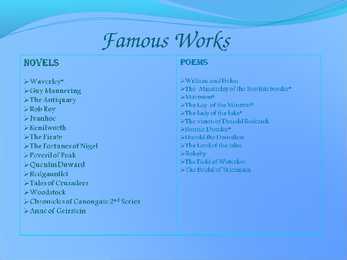
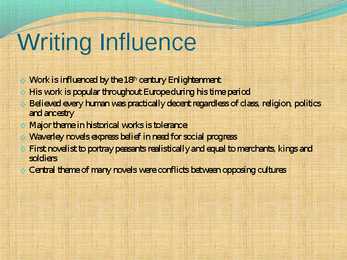
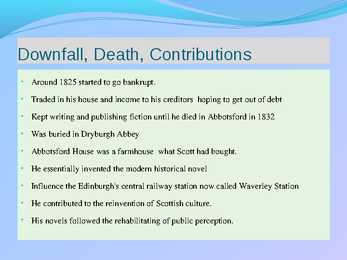
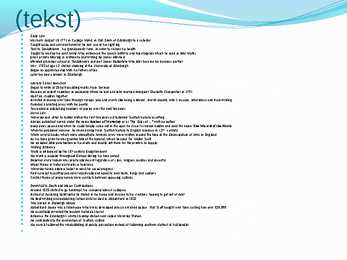
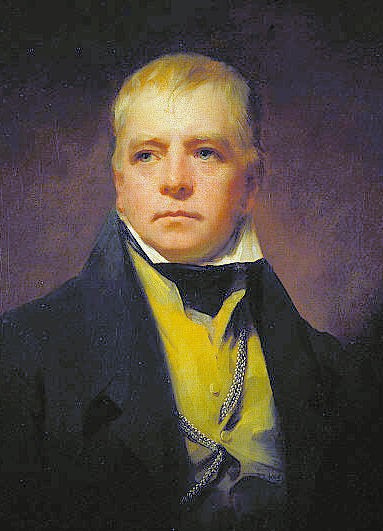
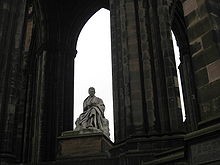
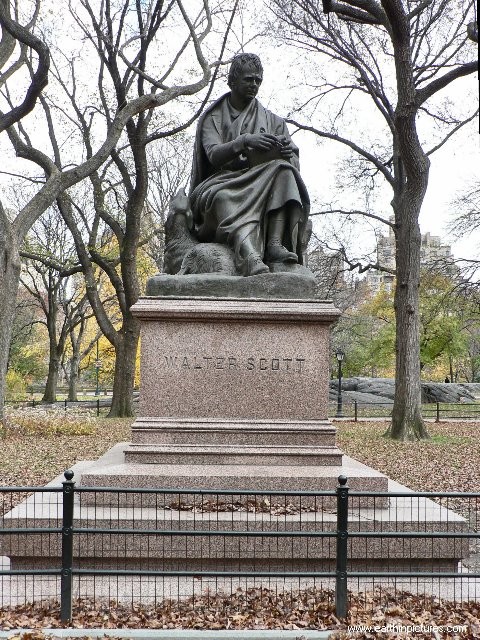
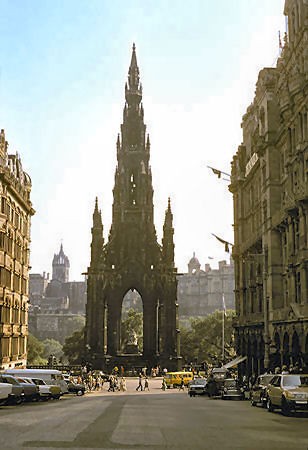
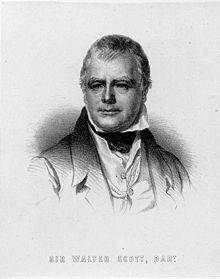
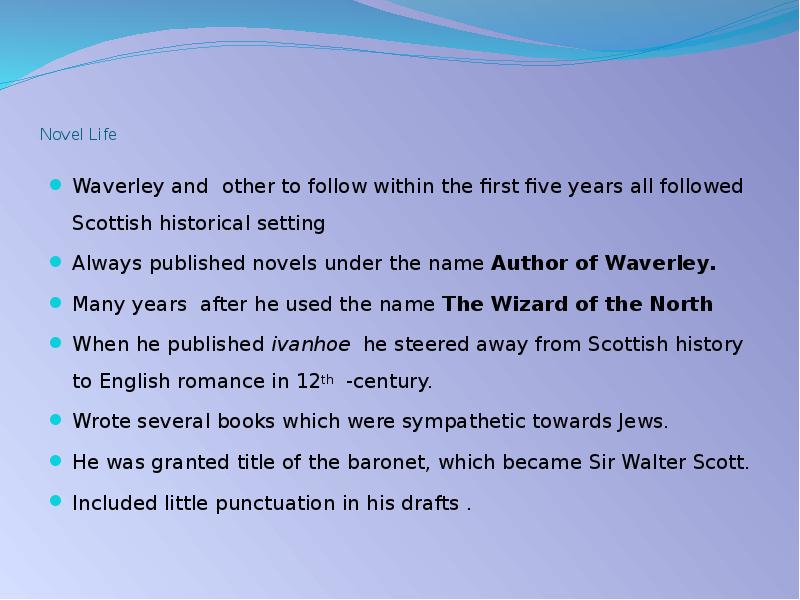
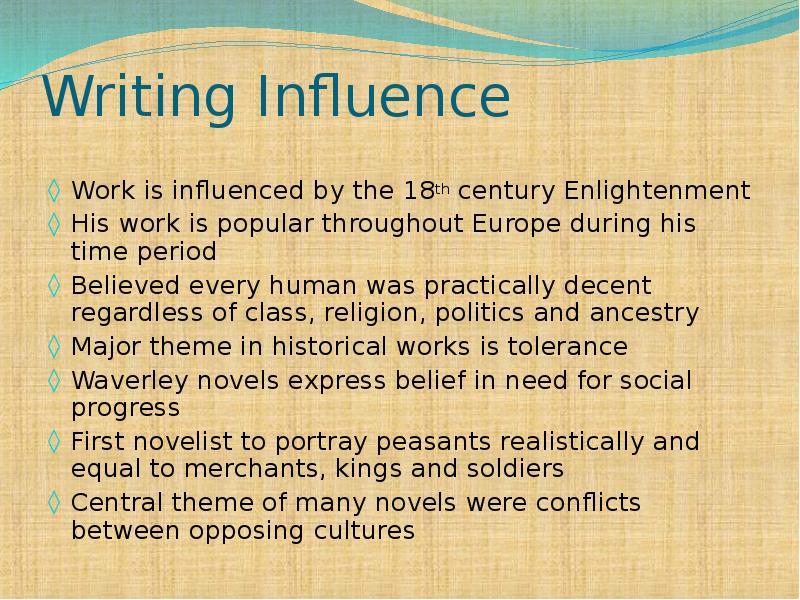
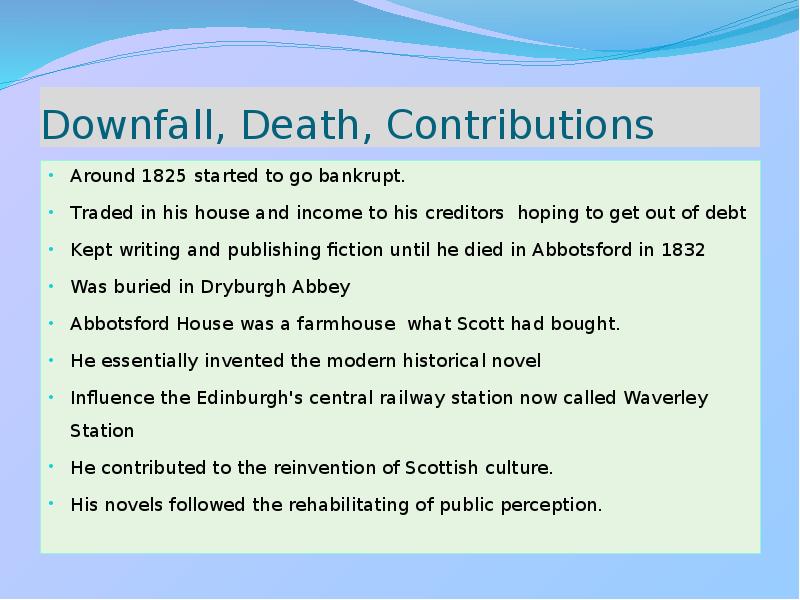
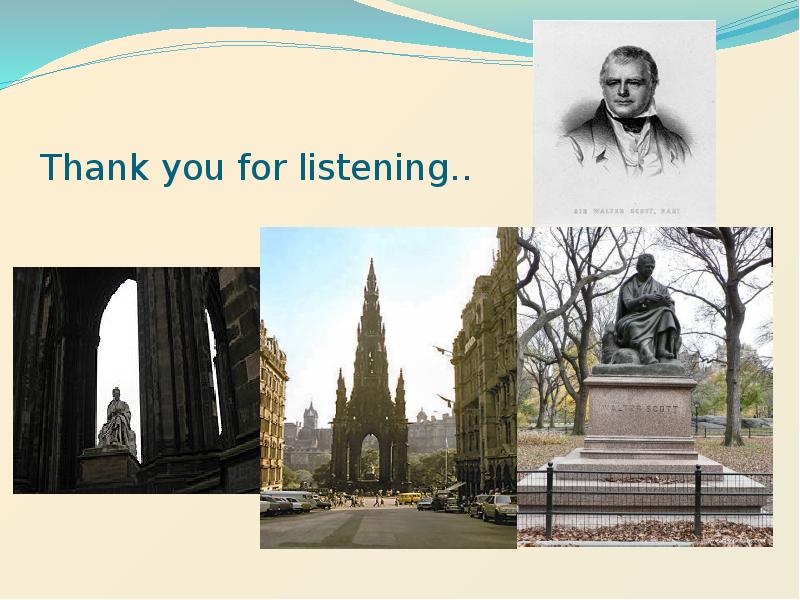
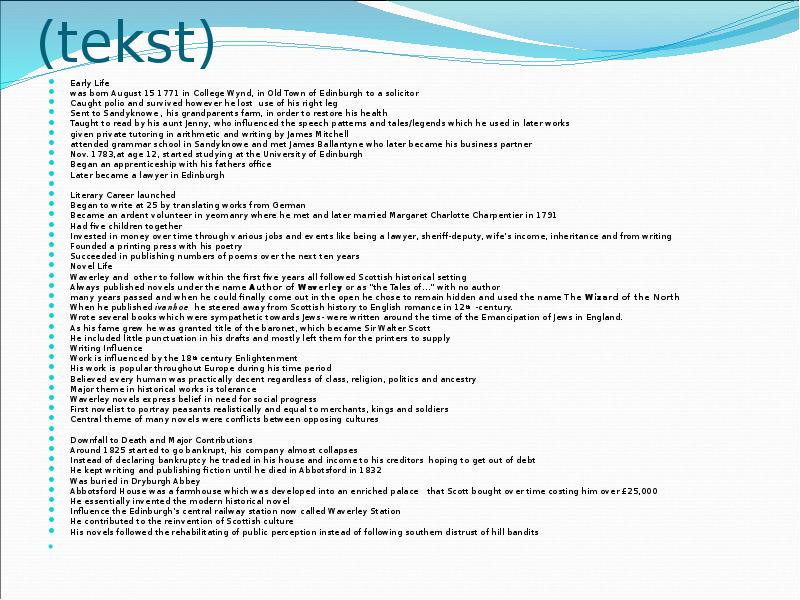
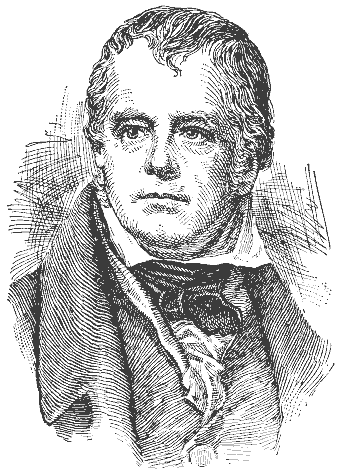
Macbeth, Othello..) In 1608 tragedy is replaced with romance Wrote historical plays too (Richard III, Julius Caesar..) Used allegory and methaphores Brought over 1700 words into the English language ,,A fool thinks himself to be wise, but a wise man knows himself to be a fool. " ,,Hell is empty and all the devils are here. " ,,Expectation is the root of all heartache." ,,It is not in the stars to hold our destiny but in ourselves." ,,Words without thoughts never to heaven go." Sir Walter Scott 1771 1832 Suffered polio, which left him with a permanent limp Studied law and history Became interested in Scotland's rural habitants, collected folklore A writer and a poet, a born storyteller and master of dialogue, one of the greatest historical novelists, who especially loved to write about Scotland The creator of the modern historical novel A prominent figure in Edinburgh society, entertained famous people like Washington Irving and William Wordsworth
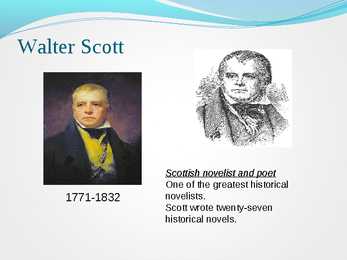
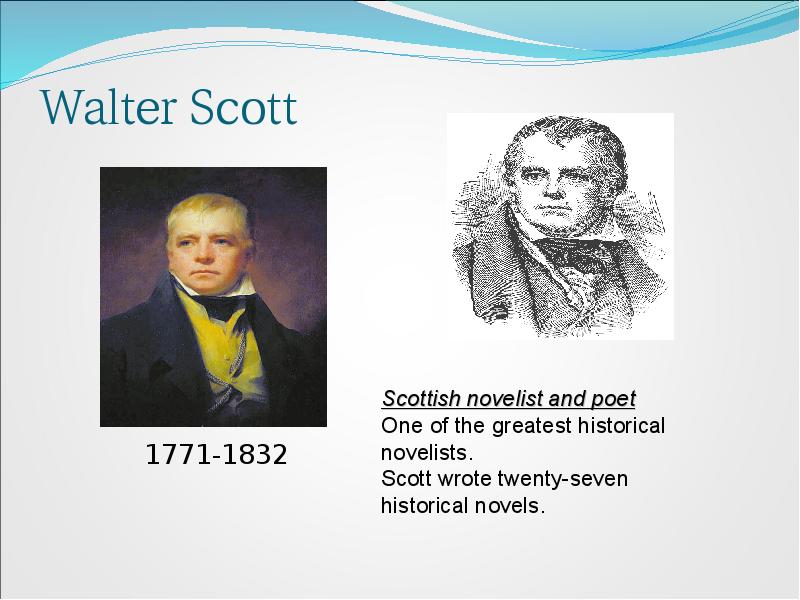
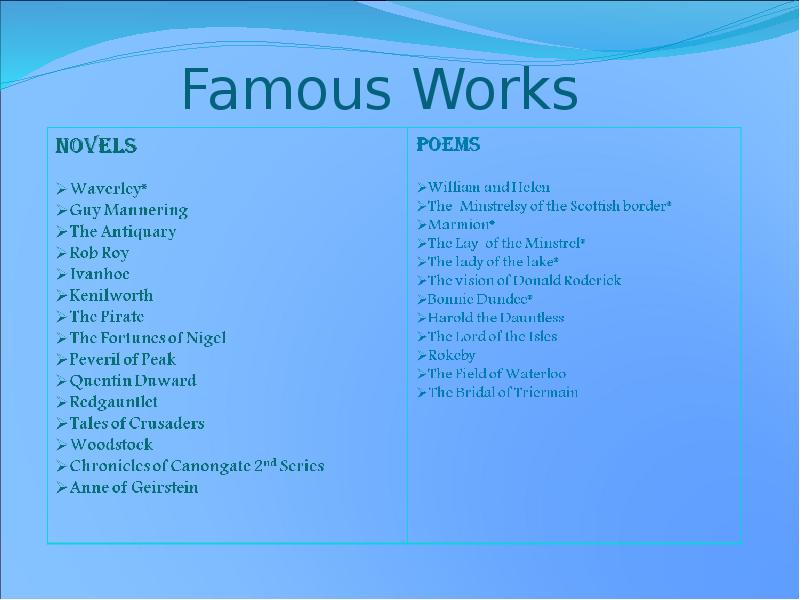
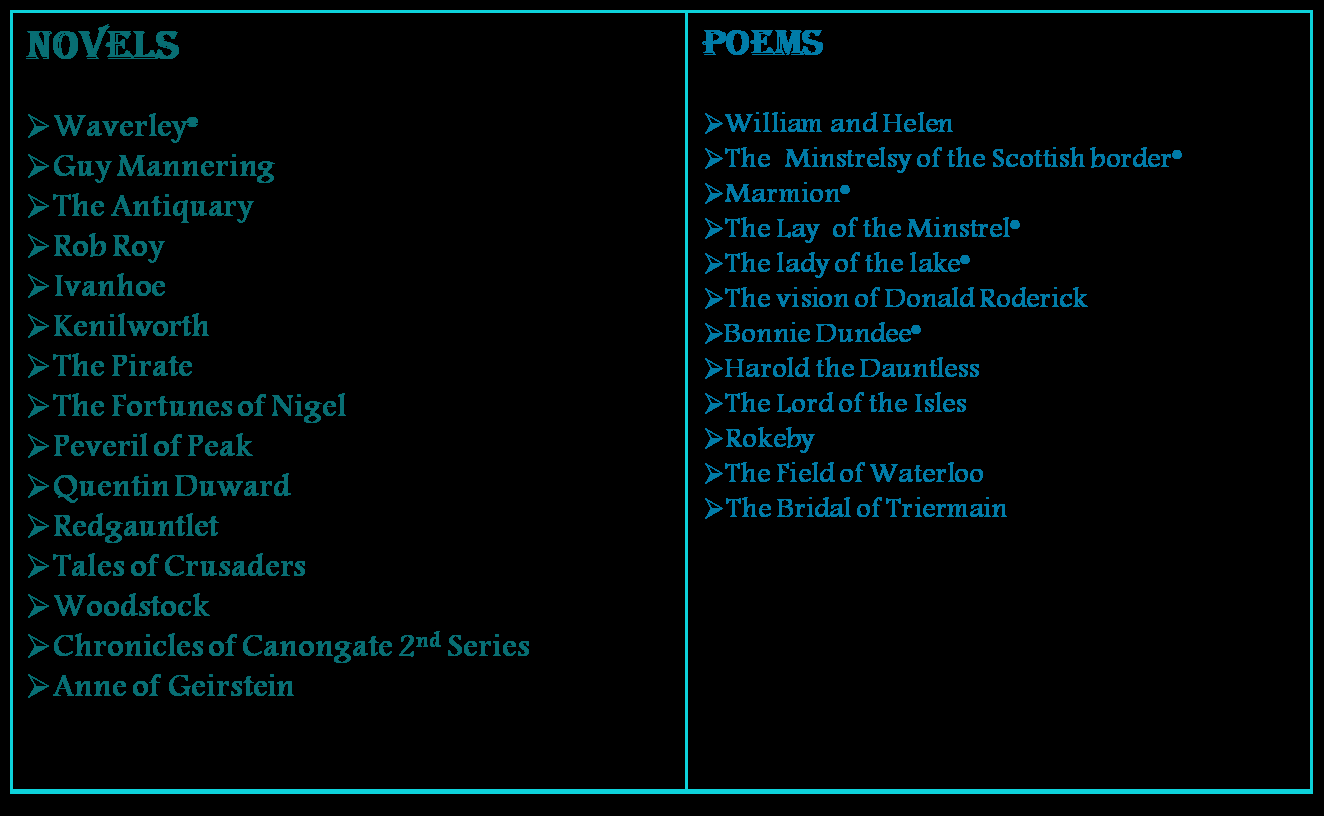
oneself into the position of another person. 9. Novel in the Romantic era: main genres: essays, pamphlets, novels. Main ideas and writers: 1) Attack and defence of poetry (Love Peacock vs. Shelley) William Hazlit. 2) Politics: utilitarianism, urbanism, socialism, and anarchy Edward Gibbon, Thomas Paine, Edmund Burke, and William Godwin. 3) Quest for national style: the rise of the historical and gothic novels Sir Walter Scott, Horace Walpole. 4) Women writers and feminist ides: the rise of literacy amongst women, equality ideas Jane Austen, Mary Hays. Sir Walter Scott (1771-1832) Scottish historical novelist and poet; wrote: ballads, narrative poetry, and verse tales, novels. He wrote Waverley, a novel, which did not name its author (got success). Over the next years, he wrote a number of novels, each with a historical setting. He maintained the anonymous habit he had begun with Waverley. He
· The Kempton-Wace Letters (1903) · The Sea-Wolf (1904) · The Game (1905) · White Fang (1906) Short story collections · Son of the Wolf (1900) · Children of the Frost (1902) · Tales of the Fish Patrol (1906) · South Sea Tales (1911) Autobiographical memoirs · The Road at Project Gutenberg (1907) · John Barleycorn (etext) at Project Gutenberg (1913) Francis Scott Key Fitzgerald Francis Scott Key Fitzgerald (September 24, 1896 December 21, 1940) was an American writer of novels and short stories, whose works are evocative of the Jazz Age, a term he coined himself. He is widely regarded as one of the twentieth century's greatest writers. Fitzgerald is considered a member of the "Lost Generation" of the twenties. He finished four novels, including The Great Gatsby, with another published posthumously, and wrote dozens
Irving's first venture into lit was a collaboration with his brother and a friend on the Salmagundi Papers (1807-1808), a serial publication, later reissued as a book, which depicted life in New York in the first decade of the cent. This was followed by A History of New York (1809), a satirical attack on the upper class old Dutch families of New York. Irving's early works were very heavily influenced by neo-classical satirists such as Alexander Pope and Jonathan Swift. After he met Sir Walter Scott and became familiar with imaginative German lit, a new romantic note became evident in works such as The Sketch Book (1819-1820), which includes Rip Van Winkle, The Legend of Sleepy Hollow and Bracebridge Hall (1822). Irving was the first Am writer to win the respect of British lit critics. (also the first internationally famous author from the USA) James Fenimore Cooper was perhaps the most popular writer of the period.
Russian philology The meaning of the word "philology" is "love for word". This is love that unites teachers and researchers of modern and Classical languages and literature, interpreters and diplomats, journalists and publishers, writers and poets. Russian philologis are highly demanded in various spheres of scholarly research and education, in the mass media, in civil service at the Ministry of Foreign Affairs, in archives, libraries, museums, in travel agencies, as well as Russian and international companies. Curriculum within in philological faculty includes courses of Russian and European languages and literature, courses of Linguistics and Theory of Literature for students to familiarize themselves with various schools and trends of Russian and foreign philology. The core curriculum also includes a number of Liberal Arts courses (Philosophy, History, Psychology, Pedagogy), as well as courses of basic mathematics and computer studies, and optional courses of science and the
Charles Dickens Charles John Huffam Dickens was the foremost English novelist of the Victorian era, as well as a vigorous social campaigner. Considered one of the English language's greatest writers, he was acclaimed for his rich storytelling and memorable characters, and achieved massive worldwide popularity in his lifetime. Charles Dickens was born in Landport, Portsmouth in Hampshire, the second of eight children to John Dickens n 7 February 1812. The 12-year-old Dickens began working ten hour days in a Warren's boot-blacking factory. In May 1827, Dickens began work in the office of Ellis and Blackmore as a law clerk. At the age of seventeen, he became a court stenographer and, in 1830, met his first love, Maria Beadnell. Maria's parents disapproved of the courtship and effectively ended the relationship when they sent her to school in Paris. In 1834, Dickens became a political journalist, reporting on parliamentary debate and traveling across Britain by
Arthur Conan Doyle Life Arthur Conan Doyle was born on 22 May 1859, in Edinburgh, Scotland, to an English father, Charles Altamont Doyle, and an Irish mother, Mary Foley, who had married in 1855.] Although he is now referred to as "Conan Doyle", the origin of this compound surname is uncertain. Conan Doyle's father was an artist, as were his paternal uncles (one of whom was Richard Doyle), and his paternal grandfather John Doyle. Conan Doyle was sent to the Roman Catholic Jesuit preparatory school St. Mary's Hall, Stonyhurst, at the age of eight. He then went on to Stonyhurst College, but by the time he left the school in 1875, he had rejected Christianity to become an agnostic. From 1876 to 1881 he studied medicine at the University of Edinburgh, including a period working in the town of Aston (now a district of Birmingham). While studying, he also began writing short stories; his first published story appeared in Chambers's Edinburgh Journal bef
The making of a new nation. The Enlightenment in America. The emergence of the notion of the American Dream. The great Enlighteners: Crèvecoeur, Jefferson, Paine, Franklin. The American Enlightenment is the intellectual thriving period in the United States in the midtolate 18th century (17151789), especially as it relates to American Revolution on the one hand and the European Enlightenment on the other. Influenced by the scientific revolution of the 17th century and the humanist period during the Renaissance, the Enlightenment took scientific reasoning and applied it to human nature, society, and religion. American Enlightenment a gradual but powerful awakening that established the ideals of democracy, liberty, and religious tolerance in the people of America. If there were just one development that directly caused the American Revolution and uplifted the intellectual culture of the continent while it was only a British colony, it would be the American Enlightenment. Broadly
 annaabi.ee














Kõik kommentaarid