· Guernsey English · Jersey English Malta · Maltenglish North America · American English (AmE, AmEng, USEng) o Cultural African-American Vernacular English (AAVE) Chicano English General American New York Latino English Pennsylvania Dutchified English Yeshivish Yinglish o Regional Northeastern dialects Boston English Hudson Valley English (Albany) Maine-New Hampshire English New York City Dialect, Northern New Jersey Dialect (New York metropolitan area) Providence-area English Vermont English Philadelphia-area English Buffalo English
· Estonian has been influenced by Swedish, German and Russian, though it is not related to them genetically. History · The two different historical Estonian languages, the North and South Estonian languages, are based on the ancestors of modern Estonians migration into the territory of Estonia in at least two different waves, both groups speaking considerably different Finnic vernaculars. · Modern standard Estonian has evolved on the basis of the dialects of Northern Estonia. · The domination of Estonia after the Northern Crusades, from the 13th century to 1918 by Denmark, Germany, Sweden, and Russia delayed indigenous literacy in Estonia. · The oldest written records of the Finnic languages of Estonia date from the 13th century. Grammar · Typologically, Estonian represents a transitional form from an agglutinating language to a fusional language, the canonical word order is SVO. (subject-verb-object)
single language but they parted about 5000 years ago. Most of Estonian vocabulary is borrowed from other languages like German ang English. Very few of Estonian words are originally Estonian. For example, suu (mouth), vesi (water) and ema (mother). One thing that features Estonian is that unlike any other language, Estonian has three degrees of phoneme lenght: short, long and overlong. Pronouncing the phoneme differently can change the meaning of the word. There are many different dialects in Estonian language. The dialects are divided into two groups: southern and northern dialects. They differ from each other so much that it is very difficult for a northern dialect speaker to fully understand southern dialect speaker. Estonian is a very complicated language and there is (I think) no reason for a foreigner to learn it. When somebody moves to Estonia, it is easier to communicate in Engilsh. As result, Estonian could die out.
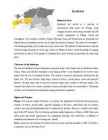
The territory of Estonia covers 45,227 km2. The capital, Tallinn, has around 400000 inhabitants.Tallinn's ability to blend medieval architecture with Scandinavian modernity with all the comforts you'd expect from a modern, competitive and innovative capital. Estonian language, does not belong to the Indo-European group. It belongs to the Finno-Ugric language family, which also includes Finnish and Hungarian. Estonian dialects are divided into two groups, Northern and Southern, usually associated with biggest cities of those regions Tallinn, the capital, in the north and Tartu, second largest city, in the south. In some of the southern regions, people speak Seto and Võro dialects, which are sometimes considered to be separate languages altogether. Dialects spoken in northern Estonia are more influenced by Swedish and Finnish, especially along the coast and on the islands.
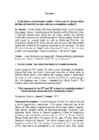
Estonian dialects Kui k'äzi k'äüles? Kuiss käbäre käivä? Kuidas käsi käib? Traditionally, the Estonian dialects are categorized to three as follows: 1) Northestonian dialects : Insular, Western, Central and Eastern dialect 2) Southern Estonian dialect Group : Mulgi, Tartu and Võru dialect 3) Northeastern coastal dialect S-Saartemurre/insular dialect L-Läänemurre/western dialect K-Keskmurre/central dialect M-Mulgimurre/Mulgi dialect T-Tartumurre/Tartu dialect V-Võrumurre/Võru dialect I-Idamurre/eastern dialect R-(Kirde)rannikumurre/ northeastern coastal dialect Dialect Speakers % 1
Esitage kirje. Kuidas otsingu läbi viite? Trükkisin google'i täpsemasse otsingusse ,,kultuuridevaheline kommunikatsioon" ja ilma sõnadeta otsingusse ,,teadusartikkel." Leidsin artikli ,,kultuuridevaheline kommunikatsioon ja... suhted" http://www.advent.ee/artikkel/16156/ 12. Leidke digiteeritud raamatuid dialektide kohta. Esitage ühe kirje. Kuidas otsingu läbi viite? Trükkisin otsingusse ,,Google Books" ja avanenud lehel trükkisin otsingusse ,,Dialects." Trudgill, P. (2004) Edition two. Dialects. Routledge. http://books.google.com/books? id=QLsvsCrmTj8C&printsec=frontcover&dq=dialects&ei=72O9SYmuIZ_EzATRtumnCw #PPP1,M1 Maarja Kikkas WI1 (081944)
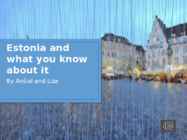
you get to know them they’re very open. • Estonians are patriotic due to the hardships during it’s history and their own shared love of their home country. • Historically Estonia is one of the "least religious" countries in the world in terms attitudes, though many Estonians do look for alternative beliefs. Language • The Estonian language is finno ugric, it’s closest relatives are the Finno-Ugrian languages of the Vedic and Livonian languages. • There are many dialects, the main groups can be separated into North and South Estonian dialects. • Besides the typical spoken Estonian language the second most notewordy dialect is the Võru dialect. • Estonian is one of the languages with a larger number of noun cases than typical. • According to comparative grammar studies, Estonian is one of the most sophisticated languages among the world languages. Holidays and Celebrations • Jaanipäev(Jaans day)
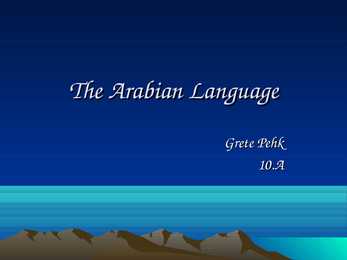
The Arabian Language Grete Pehk 10.A General · One of the most widely spoken language in the world. · One of the oldest existing language in the world. · The national language in most of the North African countries. About Arabic · There are about fourteen different dialects and language derivatives (tuletised). · It came in use in 7th century. · Arabic is written from right to left. · There aren't any capital letters. · There are 28 letters in the alphabet. Basics · I: ana · You (sl): inta/inti (m/f) · He: huwa · She: hiya · We: nahnu · You (pl): untum/inti (m/f) · They: uhum The Holy Quran Used literature · http://www.kwintessential.co.uk/resources/lang · http://www.al-bab
kilometres · Capital St. John's http://en.wikipedia.org/wiki/Newfoundland_and_Labrador#/me dia/File:Newfoundland_and_Labrador_in_Canada.svg FLAG http://en.wikipedia.org/wiki/List_of_premiers_of_Newfoundland_and_Labrador POPULATION · In 2013 526 702 people · 92 % of population on the Newfoundland · 40% on population in St. John's city · 97.6% of residents reporting English as their mother tongue · In Labrador local dialects of Innu-aimun and Inuktitut are also spoken. CULTURE · Folk musical heritage based on the Irish, English and Scottish traditions · Much of the region's music focuses on the strong seafaring tradition · Ice Hockey · Soccer, rugby http://www.stjohnsicecaps.com/team/ LANDSCAPE / http://www.nlreda.ca SOURCES · http:// en.wikipedia.org/wiki/Newfoundland_and_ Labrador · http://www.newfoundlandlabrador.com/ · http://www.nlreda
Declaration of Arbroath, the textile pattern tartan that often signifies a particular Scottish clan, and the Lion Rampant flag.Flower of Scotland is popularly held to be the National Anthem of Scotland, and is played at events such as football or rugby matches involving the Scotland national team. However, since devolution, more serious discussion of the issue has led to this being disputed. Language Historically, Scottish people have spoken many different languages and dialects. The Pictish language, Norse, Norman-French and Brythonic languages have been spoken by descendants of Scottish people. However, none of these are in use today. The remaining three major languages of the Scottish people are English, Lowland Scots (various dialects) and Gaelic. Of these three, English is the most common form as a first language. People The Scottish people (Scottish Gaelic: Albannaich (plural)) are a nation l "_note-3"[6] and an ethnic group indigenous to Scotland
During the end of the 18th and 19th centuries, a period known as the "Golden Age", the grammar, vocabulary and pronunciation of the Russian language was stabilized and standardized, and it became the nationwide literary language; meanwhile, Russia's world-famous literature flourished. Until the 20th century, the language's spoken form was the language of only the upper noble classes and urban population, as Russian peasants from the countryside continued to speak in their own dialects. By the mid-20th century, such dialects were forced out with the introduction of the compulsory education system that was established by the Soviet government. Despite the formalization of Standard Russian, some nonstandard dialectal features (such as fricative [] in Southern Russian dialects) are still observed in colloquial speech. History The history of Russian language may be divided into the following periods. Kievan period and feudal breakup The Moscow period (15th17th centuries)
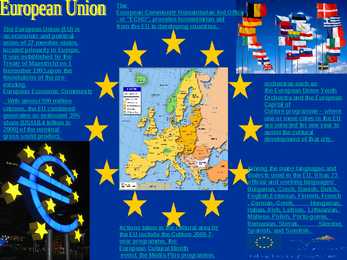
2008) of the nominal assist the cultural gross world product. development of that city. Among the many languages and dialects used in the EU, it has 23 official and working languages: Bulgarian, Czech, Danish, Dutch, English,Estonian, Finnish, French , German, Greek, Hungarian,
France General As of January 1, 2008, 64,473,140 people live in the French Republic. 61,875,822 of these live in metropolitan France, whereas 2,597,318 live in the French overseas departments and territories. Since the 1980s, France has ceased being a country of mass immigration. At the beginning of the twentieth century, France's population growth was low compared to its neighbours, and to its past history. However, the country's population sharply increased with the baby boom following World War II. Age 15 and over can read and write. Religions Rates and groups The birth rate is 12.91 births/1,000 population (2007 est.).The death rate is 8.55 deaths/1,000 population (2007 est.).Total median age is 39 years. Ethnic groups: Celtic and Latin with Germanic, Slavic, North African (Ara...
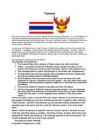
· Thailand Flag · Sawadi (Sawadi, meaning hello or goodbye, is likely to be the first Thai word you pick up during your travels to Thailand.) · Stupa · Muay Thai Boxing · Tuk Tuks · Asian Elephants · The national symbol of Thailand is Garuda, a half bird, half human figure · The Thai language is Thailand's national language, written in its own alphabet but many areas have their own local dialects. Facts · It is the year 2551 there.The date in Thailand is based on Buddha's death. Although Thai New Year is in April. · It snowed in Thailand in 1955. · The actual name of what Westerns refer to as Bangkok is: KrungThepMahaNakhonAmonRatta nakosinMahintharaAyutthayaMahadi lokPhopNoppharatRatchathaniBurir omUdomRatchaniwetMahasathanA monPhimanAwatanSathitSakkathatt iyaWitsanuKamprasit.
2nd person (plural) (You) YOUR YOURS 3rd person (plural) (They) THEIR THEIRS Reflexive pronouns: A reflexive pronoun is a pronoun that is preceded by the noun or pronoun to which it refers (its antecedent) within the same clause. In English, the reflexive pronouns are myself, yourself, thyself, himself (in some dialects, "his self"), herself, itself, oneself, ourselves, yourselves, and themselves (in some dialects, "their selves"). "I see myself" or "She sees herself" Relative pronouns: A relative pronoun "relates" a subordinate clause to the rest of the sentence. It may be found in adjective and noun clauses. A relative pronoun is found only in sentences with more than one clause. In modern English there are five relative pronouns: that, which, who, whom, and whose. He who laughs last laughs best
The object of the game was to strike the disk or prevent Other games included corn, your opponents from cane, and moccasin games. hitting it. Chunkey player Language English, Choctaw The Choctaw language belongs to the Muskogean linguistic group. Closely related to Chickasaw, some linguists consider the two dialects a single language The Choctaw language is the essence of tribal culture, tradition, and identity. Religion Protestant, Roman Catholic, traditional beliefs Good spirit and an evil spirit. Sun, or Hushtahli, worshippers. Prayers may have been introduced by missionaries. Choctaw prophets were known to have addressed the sun. Traditional clothing Dresses are made by hand Choctaw elders, dress in their traditional garb every day
concern pronounciation (accent), but grammar and vocabulary. It includes formal and informal styles. British Standard English grammar and vocabulary, together with the RP accent should be called English English. RP (Received Pronounciation) is an accent that originates from South-East of England. A social accent, associated only with England. 12-15% of native speakers in England use Standard English (BrEng). 3-5% of them use RP (EngEng). Non-standard varieties of English are often called dialects. They are any other dialect of English other than Standard English. They are stigmatized as shameful and inferior, socially lower. Judging people by their accent might, however, be offensive. These varieties are connected to race in US and class in UK. Grammatical and lexical differences throughout the world in the English language are rather insignificant . Most oftenly pronounciation is the most significant/different. Deviations from the standards: 1
(majoritairement au Québec, Nouveau-Brunswick et en Ontario), en Suisse (en Romandie), au Luxembourg et aussi en quelques pays d'Afrique comme au Sénégal, en Côte d'Ivoire et en République Démocratique du Congo. Le français est aussi utilisé dans beaucoup d'organisations, par exemple dans l'Union Européenne, NU, WTO, FIFA, d'organisations de la poste, Français est aussi le langue de la diplomatie. En France il y a 28 dialects: Par example Nord de la France il y a normand,wallon, picard Sud de la France il y a occitan, gascon, provencal Centre de la France il y a limousin, orleanais, berrichon Les examples: L'accent Normand Picard Occitan Gascon Provencal parisien soir sei tout rate asser ser souar trouver trouaer dégoter trobar trobar se capito
years of hard labour and 20,000 workers. It was finally finished in 1653. The Taj Mahal Click to edit Master text styles Second level Third level Fourth level Fifth level The many faces of India A country so beautiful, India represents diversity in all its forms: people, religions, customs and traditions, clothes and dialects. India is a 34,000 year old country with rich legends and history. It is also a land of fascinating festivals and mesmerizing ceremonies. But its growing population and poverty often overshadow its rich legacy. Thank you for listening!
because they really hate us. What are the biggest pressures for teens in your city? Võru doesn’t have many pressures but maybe the biggest problem is that in Võru there is no place to be with your friends. In our city luckily is no problem with criminality. Is there a difference in Estonia between the north and the south? No, our country is small and there aren’t big differences. Maybe the biggest difference is that south has many dialects and the north doesn’t understand our language. Also north has bigger salary and for that lives better. Have you visited any other countries? Yes, I have visited many countries. Finland, Latvia and Lithuania for many times, that’s more than three times. Also Poland for once. What is your ambition for the future? I really haven’t thinking about it because there is a much time to think about it more and more.
had become more important. Nevertheless, that programme was never completed, because no one thought it was interesting enough. Then Graddol writes about importance of language and how it should be assessed. He discusses whether it should be the number of speakers, their social status or even wealth and whether the number of speakers of Putonghua should include only native speakers, which is 1.3 billion people, or should they take other dialects into consideration too. Furthermore, Graddol brings an example from Guangzhou and their local language Cantonese which is endangered by Putonghua. Many people protest about using too much Putonghua, but the students believe that in Hong Kong, the problem is mostly in official signs wrote in Putonghua. He also points out that one of his students said that Putonghua is gaining power instead of English. The writer then highlights the fact that English is envied by many other language speakers in
· Asian Elephants (Thailand people make money by selling riding tours with elephants for tourists). Elephants have their guides men who spend their whole life together with the particular elephant. Elephants in Thailand are as important as humans; · The national symbol of Thailand is Garuda(a half bird, half figure) · The Thai language is Thailand's national language (written in its own alphabets but many areas have their own local dialects). I learnt also one main statement "thank you very much" in Thai language which sounds as "kop-khun-mama- mama" ; I think one aspect worth to mention which also makes Thailand of my favourite place is that people in Thailand are very kind, friendly and tolerant. Thailand is often called the ''land of smiles'', and that's true because you can see more smiling people there than anywhere else in the world. And this is not the "American smile", if you know what I mean.
The World Factbook - https://www.cia.gov/library/publications/the-world- factbook/geos/en.html GEOGRAPHY: 1) Area: total 551,500 km² )Coastline: 3,427 km PEOPLE and SOCIETY: 3) Ethnic groups: rahvastiku etniline kuuluvus Celtic and Latin with Teutonic, Slavic, North African, Indochinese, Basque minorities overseas departments: black, white, mulatto, East Indian, Chinese, Amerindian 4) Languages: keeled (nimetage suuremad) French (official) 100%, rapidly declining regional dialects and languages (Provencal, Breton, Alsatian, Corsican, Catalan, Basque, Flemish) overseas departments: French, Creole patois, Mahorian (a Swahili dialect) 5) Religions: usundid (nimetage suuremad) Roman Catholic 83%-88%, Protestant 2%, Jewish 1%, Muslim 5%-10%, unaffiliated 4% overseas departments: Roman Catholic, Protestant, Hindu, Muslim, Buddhist, pagan 6) Population: 65,630,692 (July 2012 est.) country comparison to the world: 21
Secular writing Troubadour writing:"courtly love", romance Epic poem(song of roland) Travel writing History writing-chronicles Allegory The use of symbols and analogy to convey a certain meaning /message Literary output of medieval English Anglo-saxon or Old English literature(7th century-1066) Middle english literature(12th century-15th century) End of the period:1470s chancery standard(regulating english) and onset of renaissance Middle English literature Written in many dialects in early period 14th century Middle english was used for majority literary works-known poets Chaucer, Langland Standardization-printing from 1470 Geoffrey Chaucer 13401400 London 1357 public servant 1359 fought in the war 1360 diplomatic career 1366 married Philippa Roet 1368 King Edward ssquire 1370-87 diplomatic missions 1391%Gardenerof King´s park Rests in Poets Corner Westminster Abbey Chaucer works Parlement of Foules Troilus and Criseyde The Legend of Good Women
The British Isles, because of their good geographical position have been conqured only twice. And both occasions had a great influence on the language. First came Latin with the conquest of Roman Empire. Latin gave some terms to English and now it is a scientific language. Romans stayed for half a century, when they left, different Germanic tribes came and estabilished new kingdoms. They brought a new language with them. The Old English is developed from their Germanic dialects. After that, came Christians and brought new words like martyr, bishop etc. The second and last conquest was in 1066, when the Duke of Normandie, also known as William the Conqurer, invaded England to claim his right to the throne. He was the one who estabilished the House of Normandy. He brought Old French to England making it the official language. It gave many new terms to English, like pig and pork etc. After the hundred years' war, English took over as the official language.
Tallinn : Tallinna Pedagoogikaülikool. 4) Mitu murreteteemalist perioodikaväljaannet on Tallinna, mitu Tartu kataloogis? Esitage ühe perioodikaväljaande, mis leidub nii Tallinna kui Tartu kataloogis, pealkiri. Kuidas otsingu läbi viite? Valin märksõnaks murded, kataloogi osaks valin perioodika. Leidsin 16 väljaannet. Kõrvale võtan Tartu kataloogi. Kontrollin, et oleks märksõna ning perioodikaväljaanne. Sain 7 tulemust. Ühine tulemus: Swedish dialects and folk traditions... 5) Milline eestikeelne väljaanne leidub TLÜ Akadeemilise Raamatukogu teadusraamatukogus, mille pealkirjas on sõna arheoloogia ja mis on ilmunud aastal 2001? Esitage kirje. Kuidas otsingu läbi viite? Kasutan liitotsingut. Otsin pealkirja kaudu ''arheoloogia''. Aastaarvu kaudu 2001. Keeleks määran eesti keele ning kataloogi osaks TLÜAR teadusraamatukogu. Praktiline töö nr 1
Kihnu, Ruhnu and Abruka. Straitland is low-lying and flat. It was flooded by the sea for much longer than the rest of mainland Estonia. The climate is maritime and greatly influenced by the Baltic Sea. The area features large bogs, extensive forests, coastal plains, warm and peaceful beaches, the lake Kaali with its mystical meteorite flight and a number of offshore islands. The islanders have their own customs, national costumes and speak their own local dialects. Thousands of birds visit Straitland areas during their spring and autumn migrations. Sights and Tourism Pärnu is the summer capital of Estonia. In summer, the population of forty-four thousand grows tenfold. Its beach, seaside parks, squirrels hopping in the trees, sanatoriums and rest homes, curative sea-mud and holidaymakers are its characteristic features. Pärnu as a summer resort dates back to the 19th century. The first bathing institution started operations in Pärnu in 1838
[15] Lycos võimaldab otsingus kasutada ka erinevaid piirangudi. Neid on küll vähe võrreldes näiteks Google-ga. Lycos-es on võimalik piirata domeeniga, näiteks tripod.com või .gov. Seal saab valida maa või piirkonna ning saab ka valida kas otsingutulemustes on ainult täiskasvanutele mõeldud materjalid. Näiteks Otsing ,,received pronunciation"; domeeniks on seatud .gov.[14] Stopsõnadena kasutatakse: A, An, In, On, Are, Is, They. Tulemuste saamiseks panna jutumärkidesse nt. Dialects ,,in" Britain. Kui on teada täpne fraas, siis saab kasutada fraasiotsingut jutumärkidega. Lycos-el tõstutundlikkus puudub. Pole vahet, kas otsitav on kirjutatud suure või väikse algustähega. Lisateenussena saab kasutada Lycos top 50, Lycos weather ja Channel Lycos. Lycos top 50 lisateenusena võimaldab näha www.lycos.com leheküljel külastajate ja kasutajate lemmikuid ja enim kasutatavaid lehekülgi. Samas on see ka abiks leidmaks kiiremini populaarseimaid
English life, although the nobility and the poor are missing as they would not have taken part in this type of group pilgrimage. Why masterpiece: It is written in English in a period when it was forgone conclusion that all serious writing had to done in Latin or French. It is a valuable social document as it gives us an insight into a cross-section of 14th-cent. LITERATURE IN THE MIDDLE AGES. Languages spoken : English, French, Latin. There was four major dialects, east became the basic dialect because it was spoken in London. By 1476, when William Caxton introduced printing, Old English into New English. Latin was generally considered to be the language of serious writing. Religious lyrics also made an appearance at this time. Throughout the Middle Ages ballads, short folk tales that tell stories, were very popular. THE RENAISSANCE: The Literary Background 16th century, - humanism
In the text: goon to go wenden - to turn Gan was suppletive in Old English, past form: eode.Eode was supplanted by went (past form of wenden) at the end of the Middle English period.To wend has survived in Modern English in phrases such as to wend one's way, we wended homewards (ironic usage). Thus: suppletivity- suppletion different parts of one and the same paradigm come from what were originally different paradigms (different words with close meanings or words in different but close dialects).Suppletion embraces verbs, adjectives, nouns. Be was/were been (Old English beon/wesan) (am, art, is, are); in Old English some suppletive forms were used parallel to one another) Good better best Bad worse worst Much more most Little less least Estonian: hea parem (cf "paras" fitting, in Finnish "the best" - metonymical link), palju - rohkem Finnish: mennä (to go), lähteä (to leave) Estonian: minema, mine, lähen, läksin
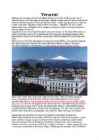
There are minor areas of Italian speakers near Huatusco and Tuxtlas, where Venetto is common use and there are a very few Greek speakers in towns near Rinconada, the "gitanos" (Gypsy). As well on the region of the low San Rafael, the French is predominant, due to the settle of the remaining Maximilian of Hapsburg troops that were allowed to stay, after they were defeated, on the fall of the second empire in the XIX century. Also needs to be mentioned: Catalan, Basque, Gaelic, and more Spaniard dialects that were brought and kept by their descendants. Although some people know essentials of English, mainly in commerces or touristic zones of big cities, locals never use it to communicate. Summary(Õpi pähe) This article is about Veracruz.Text by Michael Parfit and photogtaphs by Stuart Franklin.The Municipal Palace in Veracruz, heart of the state of the same name and one of the busiest ports in Mexico
pass through. As knowledgeable guides of the desert they controlled the desert trade routes, and escorted caravans. Table 1. Bedouin Total population Regions Languages Religion Related ethnic groups Sunni Islam, extremely few Arabic dialects, Arab World, Bedouins who practice Shia ? Bedawi, Najdi, Arabs Africa, Israel Islam and other religions Hassani exist
Finally, six speakers' data were analysed auditorily in two phases. The outcomes suggest that the variety used in Basildon displays the characteristics of Cockney, rather than Estuary English: "there appears to be a case for claiming that the vernacular is simply 'Cockney moved East'" (Fox 2000). Therefore, it is tempting to disagree that ex-Londoners accommodated in terms of language to speakers of traditional dialects by adopting what some people now call `Estuary English', but this situation may have been one of the many contributory factors in the gradual process of the establishment of Estuary English. Altendorf 1997: London Project (1) Altendorf's study was conducted in London. The adolescent informants, born and brought up in Greater London, were aged 9 and 14, and at the time of the study were attending a moderately expensive, private day school located in a middle-class area,
Gaelic. Less than a quarter of all Welsh people speak Welsh. Scottish Gaelic and Irish Gaelic are still spoken, although they have suffered more than Welsh from the spread of English. However, all three languages are now officially encouraged and taught in schools. Nowadays all Welsh, Scottish and Irish people speak English (even if they speak their own language as well), but all the countries have their own special accents and dialects, and their people are easily recognizable as soon as they speak. A southern English accent is usually taught to foreigners as it is the most easily understood. Regional movements of people For over a century there has been a drift of people from the north and west to the south-east of England. Some of the major reasons for this movement are listed here. 48. A decline in the farming workforce and rural population (rural depopulation). 49
possessions and sentenced him to be permanently banished from Florence, threatening the death penalty upon him if he returned. Dante spent most of his time in exile writing new pieces of literature. It is believed that around 1307 he interrupts his unfinished work, Convivio, a reflection of his love poetry philosophy of the Roman tradition, to begin The Comedy (later known as The Divine Comedy). He writes a book called De Vulgari Eloquentia explaining his idea to combine a number of Italian dialects to create a new national language. In 1310 he writes De Monarchia presenting Dante's case for a one-ruler world order. Among his works, his reputation rests on his last work, The Divine Comedy. He began writing it somewhere between 1307-1314 and finished it only a short while before his death in 1321, while in exile. In this work, Dante introduces his invention of the terza rima, or three-line stanza as well as himself as a character.
Territories, and 4% in Labrador. Statistics Canada reported that between 1996 and 2006, the First Nations population increased 29% which is 3.5 times the growth rate of 8% for the non- Aboriginal population of Canada. Tribal Groups There are 8 main tribal groups: the LABRADOR, UNGAVA, BAFFIN ISLAND, IGLULIK, CARIBOU, NETSILIK, COPPER and Western Arctic Inuit (who replaced the MACKENZIE INUIT). There are five main Inuit language dialects in Canada, Inuvialuktun, Inuinnaqtun, Inuttitut, Inuttitut, and Inuttut that are collectively known as Inuktitut or Inuttituut. (see NATIVE PEOPLE, LANGUAGES) In the last census 32 580 people or reported Inuktitut as their mother tongue (first language learned). Traditionally, the Inuit were hunters and gatherers who moved seasonally from one camp to another. Large regional groupings were loosely separated into
• Roman Jakobson – intralingual, interlingual and intersemiotic translation. Problems in telling the difference between intra and interlingual translation (social and regional language varieties). Interpretation of a verbal sign according to Roman Jakobson can happen in three ways: Intralingual-(within)- Eng-Eng/Fin-Fin/Est-Est Interlingual-(between)- Est-Eng/Rus-Ger Intersemiotic-(between)- Sound-Words/Words-Sound. F.e.-in movies *phone ringing* Problems: Dialects/Regional varieties- When translating: Mainstream Eng. vs Jamaican Eng., then you could translate MS Eng to MS Est, and Jamaican Eng into a language variety with a similar (social) role. Social class- RP-received pronunciation-(aka posh lang.) When translating: RP vs lower class Eng, then you could translate RP using complicated words, and lower class Eng, using limited vocabulary. • Hatim and Munday – what is translation according to these two men? Why is this not quite enough nowadays?
The military occupation of the Isles ended in 410 AD. The Romans eventually brought Christianity to Britain. Hadrian's wall on the border of Scotland and England. It began construction in 122 AD. An Anglo-Saxon attack on Rome forced the Romans to leave The British Isles. They were replaced by Germanic tribes Angles, Jutes and Saxons, who drove the Celts to the north (Scotland) and west (Wales). They came from the North and Baltic Seas. Along with them came their dialects, which constitute the basis for Old English. Around 4500 words are still used today. They also had their own religion and Germanic gods. Their names are still used today: Freya Friday, Thor Thursday, Angle-land England. The Anglo-Saxons divided the cuntry into small warring kingdoms Northumbria, Mercia, Wessex, Sussex, Essex, Kent, East Anglia. Due to constant conflict weakened the kingdoms. The political power was in Wessex, which was the most powerful of the kingdoms
Scotia, with the monarch represented in Canada by governor-general. HOW CANADA GOT THE NAME CANADA There have been many theories about the origin of the name Canada but there can be a little doubt that the word is Indian in origin. When Jacques Cartier sailed up the St. Lawrence River in 1534 to the Indian village of Stadacona, now Quebec, he heard the village called ,,kanata" and took that to be the name of the country. However, in some Huron dialects, ,,Kanata" means settlement or a village. In the Mohawk language, a similar word means simply a place. In Cartier's map of St. Lawrence, he put tha name Canada on the area between the Saguenay River and what is now Quebec City. In the 16th century mapmaker, Mercator, used the name New France for the French colony along the St. Lawrence, but Dutch and English mapmakers gave that name a much broader meaning, extending it to all French colonies in the New World
The invaders came from 3 powerful tribes: · The Saxons settled from the Thames Estuary westwards, in the south of England; they formed the kingdoms of Sussex, Wessex, Essex & Middlesex · The Angles settled in East Anglia, the Midlands & Northumbria · The Jutes settled mainly in Kent, Hampshire & the Isle of Wight The name Jutes died out & the conquerors are generally referred to as the Anglo-Saxons. At first they spoke various dialects, but gradually the dialect of the Angles of Mercia became predominant. The Anglo-Saxon migration gave the larger part of Britain its new name, England, ,,The land of the Angles". The British Celts were slowly pushed westwards. Finally most were driven into the mountains in the far west, which the Saxons called ,,Wales". Some were driven into Cornwall, where they later accepted the rule of Saxon lords and northward to Strathclyde. Further north lived the Picts and Scots
pl they them their theirs th em sel ve s At least in certain dialects, the morphs I and me (and similarly we and us, he and him, etc.) are in non-contrastive distribution; in some dialects, indeed, the complementation is probably complete. We may suspect that if it were not for the Latinizing school tradition, the complementation would be complete for most speakers: I initially, except in isolation, me directly after a verb or a preposition and in isolation. Actual exceptions to this are either on the Latin pattern (It's I, or Who's there
repect tribal boundaries. Tribes returned to particular places to bury their dead. Some places, like Uluru, were sacred because they were associated with the "Dreamtime", the time when the earth was formed and cycles of life and nature were begun. Aboriginal legends, songs and dances tell of powerful spirits who created the land and peaople durin the Dreamtime. There was no written Aboriginal language. Most of the 600 tribes spoke different dialects and rarely met except on ceremonial occasions. The tradition of Dreamtime united the people. Rock paintings showing this creation period can be found all over the country. Some of the most spetacular and best preserved can be seen at rock galleries in Kakadu National Park and other parts of nortehrn Australia. The arrival of white people gradually brought an end to the traditional Aboriginal way of life. People began to build and settle on Aborigine tribal lands. Today, most Aborigines live
Creoles (African & European Decent) in Belize. It also refers to the syncretism of the various cultures which influenced the area. This is also referred to as the creolization of society "due to its ability to suggest some of the complex sociocultural issues also involved in the process". Creole, 'Kreyol' or 'Kweyol' also refers to languages in the Caribbean that are derived from a mixture of African and European languages, dialects and grammar. In parts of the Southern Caribbean the term "Creolean" is used to refer to a French-speaking person of Caucasian ethnicity. Especially if they are from the smaller islands belonging to Saint Vincent. Indian Ocean In Mauritius, in the Indian ocean, the term denotes anyone with African/Malagasy and French origin, but is also a language derived from French. In the Seychelles, the term includes all ethnic groups, regardless of background
(nt, snob-Thackery). Etymology has 2 meanings: the origin of words and it's a branch of lexicology that studies the origin of words. Voc is divided into 2 cathegories:native and borrowings. A native w belongs to the original english stock. A borrowing is a word taken from another language. Modern Engl is the result of development of Germanic trikes(inimhulk) that settled on Br isles on 5-6 century, they wre Angles, Saxons, Jutes. In Middle Engl periods (11-15 cent)there were 5 mail dialects: Northen, East-central, west-central, south-western, kentish. The basis of E became the London dialect. Due to the importance of London as the capital, the London dialect spread over the country. 15. Sources of borrowing: Latin, Old Scandinavian, French. Latin: there are 3 layers of Lain borrowings:1)these words stand for objects in everyday life (, nt pepper, plum, butter, wine, cup, dish, chalk, kitchen, street, mile, inch). 2)At the end of 6th cent christianity was introduced
Stress: Just as in English, Spanish stresses a certain syllable in a word. If a word ends in a consonant, except s or n, the stress is on the last syllable. If a word ends in a vowel, or s or n, the stress is on the second-to-last syllable. For words that do no follow these rules, an accent is written over the vowel so that you will know to stress that syllable, as in el pájaro (bird). Please keep in mind that because Spanish is spoken in many countries, there are several regional dialects and accents so pronunciation rules may not apply to all countries. This tutorial is mostly concerned with the language that is spoken in Mexico and Spain. 3. Alphabet a ah j hoh-tah r air-ay b bay k kah rr airr-ay c say l ay-lay s ay-say ch chay ll ay-yay t tay
for some time to come. But generally speaking, anybody who learnsto speak and write the standard English of his own country, and to regard that of the other country as a legitimate variety with certain interesting differences, will have little trouble wherever he goes". This section will be very useful if built upon listening comprehension and discussion exercises mainly. Thus students will be given both listening and oral experience of distinguishing between dialects and using their knowledge in practice. The approximate volume of information for the first (but not the only one!) lesson on this topic is given below, for both lexical and grammatical differences. 16 Used http://www.google.ee/imgres http://en.wikipedia.org/wiki/Great_Britain http://www.historyworld.net/wrldhis/PlainTextHistories.asp?historyid=ab07 http://www.study-abroad-uk.com/study-in-great-britain.html http://www.english-theatre
Such words are easily understood, not secret and used to make communication easier less official. Very often long words are shortened in hunting- buff (buffalo); lab (laboratory); fresher first year student, lit-literature. Dialectic words words used locally so they characterize a person as belonging to a certain geographical area, also education and breeding may be suggested. Some dialectal words have become common colloquial e.g. lad- man, lassy-lady. In some dialects thou (sina), tell (gossip), strike a daisy (exclamation meaning), addle (to earn). 8
argisuhtluse keel ehk argikeel, asjaajamiskeel jms. 2 Kolmas on eristus, milles keeleliste valikute mõjuriks või aluseks on keele kasutajate omadused (elukoht, sotsiaalne kiht, haridus, sugu jne; vt nt Chambers, Trudgill 1998). Siin vastandatakse kõigepealt kaks allkeelerühma. Osa allkeeli on kasutusel üle vastava keeleala ja kõigis inimrühmades, osa aga ainult teatud territooriumil või inimrühmades. Esimest rühma nimetame ühis(all)keelteks ja teist murreteks ehk dialektideks (dialects). Ühiskeele mõiste on oluline eeskätt vastanduses murretega. Murded jagatakse kohamurreteks (dialekt kitsamas mõttes) ning sotsiaalmurreteks (sotsiolektideks).3 Me tegeleme selles kursuses eesti suulise ühiskeelega ning murdeid puudutame vaid möödaminnes. Keskne liigendus, millest me lähtume, on seega register. Suuline ja kirjalik pearegister Keelt analüüsides tulevad välja need situatsioonijooned, mis mõjutavad keelelisi valikuid paljudes erinevates olukordades
Continuous tenses may express surprise, disbelief, indignation. Sometimes continuous tenses are more polite and mild. In the dialogue we may come across ungrammatical instances: I says; we says; times has changed. These cases reflect ungrammatical, uneducated, original, or excited state of mind. Archaic verbal forms may be used to create the historical background or make the narrative more elevated. On the other hand they may suggest the colloquial speech, because these forms are preserved in dialects (e.g. ending st (you live you livest (second person Singular). ADVERBS: are expressive when used as intensifiers (e.g. terribly smart, horribly polite, awfully pleased, etc.). Such adverbs give a colloquial touch and their expressiveness depends on 2 incompatible clashing notions put together (oxymoron case). Also degrees of comparison may be involved (e.g. better weller).
Such as: Greeks, Turks, French, Italians, Russians, Chinese, Dutch, Poles etc. 8. The Native Australians Aboriginies probably came to Australia from Indonesia 50,000 years ago. Aboriginies were nomads. They respected their ancestors, traditions and sacred places. Some places like Uluru, were sacred because they were associate with the ,,dreamtime", the time when the Earth was formed and cycles of life and nature were begun. There were more than 600 tribes who spoke different dialects. The arrival of white people gradually brought an end to the traditional Aboriginal way of life. Nowadays there are about half a million aborigines living in Australia. 9 . Plants The west of the continent give place to savannahs and further west the trees disappear and give place to bushlands. The real desert occupies the center of the Western Plateau. In the very southwest there are thin forests of evergreen trees
 annaabi.ee