 5 punkti
Autor soovib selle materjali allalaadimise eest saada 5 punkti.
5 punkti
Autor soovib selle materjali allalaadimise eest saada 5 punkti.
 ~ 1 leht
Lehekülgede arv dokumendis
~ 1 leht
Lehekülgede arv dokumendis
 2009-04-01
Kuupäev, millal dokument üles laeti
2009-04-01
Kuupäev, millal dokument üles laeti
 18 laadimist
Kokku alla laetud
18 laadimist
Kokku alla laetud
 2 arvamust
Teiste kasutajate poolt lisatud kommentaarid
2 arvamust
Teiste kasutajate poolt lisatud kommentaarid
 mew
Õppematerjali autor
mew
Õppematerjali autor
Rahvastiku andmed analüüsiks: Näidiseks Eesti andmed 2012 The World Factbook - https://www.cia.gov/library/publications/the-world- factbook/geos/en.html GEOGRAPHY: 1) Area: total 551,500 km² )Coastline: 3,427 km PEOPLE and SOCIETY: 3) Ethnic groups: rahvastiku etniline kuuluvus Celtic and Latin with Teutonic, Slavic, North African, Indochinese, Basque minorities overseas departments: black, white, mulatto, East Indian, Chinese, Amerindian 4) Languages: keeled (nimetage suuremad) French (official) 100%, rapidly declining regional dialects and languages (Provencal, Breton, Alsatian, Corsican, Catalan, Basque, Flemish) overseas departments: French, Creole patois, Mahorian (a Swahili dialect) 5) Religions: usundid (nimetage suuremad) Roman Catholic 83%-88%, Protestant 2%, Jewish 1%, Muslim 5%-10%, unaffiliated 4% overseas departments: Roman Catholic, Protestant, Hindu, Muslim, Buddhist, pagan 6) Population: 65,630,692 (July 2012 est.) country compar
The West Indies are situated in the Caribbean Sea, between Caribbean and North Atlantic Ocean, north of South-America. They are known by that name because Columbus thought he had reached India when in fact he had reached the islands. 2. Original inhabitants of the area: Arawak Indians (200 BC) and Carib Indians (AD 1300). 3. For the Europeans, most of these islands were discovered by Columbus during the 15 th century. 4. The area was colonized by England, Spain, France, Portugal and the Netherlands. 5. Languages spoken in The West Indies: English, French, Spanish, also Creole and Pidgin (by black slaves). The origin of the people is mostly African, who were brought there for slavery. 6. Most West Indian countries gained independence during the 1960s-1980s. 7. The main branches of economy are tourism and companies kept offshore (tax haven). 8. Reggae, limbo dancing and salsa have originated from the West Indies. 9
2. Who were the original inhabitants of the area? After 500 BC, the Saladoid people migrated from present-day Venzuela to the Lesser Antilles. Around 650 AD, the Saladoid people were replaced by the Arawak Indians Around 1200 AD, the Arawaks were in turn succeeded by the Caribs. 3. When and by whom were most of these islands discovered for the Europeans? 1490s Christopher Columbus 4. Which countries colonised this area? The Spanish and Portuguese arrived in C16. England, France, and the Netherlands began their conquests in C17. Denmark only acquired a few islands. 5. Which languages are spoken in the West Indies? What is the origin of the people who live there? Pidgin is a simplified language that is born out of contact (e.g. trade) between speakers who do not speak the same language. The elements of two or more languages coalesce. Creole is a pidgin language that has become the native language of a community. Usually it was a mix of a European and another language
However, the people from Scotland, Wales, Northern Ireland and England are all British. What makes the Scottish, Welsh, English and Northern Irish different from each other? About 2,000 years ago the British Isles were inhabited by the Celts who originally came from continental Europe. During the next 1,000 years there were many invasions: the Romans from Italy, the Angles and Saxons from Germany, Denmark and the Netherlands, the Vikings from Denmark and Norway, and the Normans from France. These invasions drove the Celts into what is now Wales and Scotland, and they remained, of course, in Ireland. The English, on the other hand, are the descendants of all the invaders, but are more Anglo-Saxon than anything else. These various origins explain many of the differences to be found between England, Wales, Scotland and Ireland differences in education, religion and the legal systems, but most obviously, in language. Language
mixed racial ancestry). 6 Current usage has broadened the meaning of Louisiana Creoles to describe a broad cultural group of people of all races who share a French or Spanish background. Louisianans who identify themselves as "Creole" are most commonly from historically Francophone communities, with some ancestors who came to Louisiana either directly from France or via the French colonies in the Caribbean. They generally are Roman Catholic and influenced by the traditional French culture of the early part of the state. The term is also often used to mean simply "pertaining to New Orleans". Louisiana's Creole People (Creoles of Color) are of mixed (mainly) French, Spanish, African American, and Native American heritage.(Those Louisianans descended from the Acadians Chesapeake Colonies
On 20 May in 1497 an Italian named John Cabot sailed west from Bristol in England, hoping to reach Kathay. He sighted land on 24 June rediscovered of Canada's eastern shores and landed somewhere near Newfoundland, Maine or Cape Breton Island. King Henry VII gave him 10 pounds for "finding a new isle" and sponsored a new yoyage. Jaques Cartier did three expeditions to Canada. He sailed from Northern France in 1534, 1535-1536 and 1541-1542 and sailed up the St Lawerence River. He visited the sites of the present Quebec City and Montreal then Indian villages. Samuel de Champlain founded New France and Quebec City on July 3, 1608. He is important to Canadian history because he made the first accurate map of the coast and he helped establish the settlements. 9. Who founded the first permanent French settlement in Canada? Where?
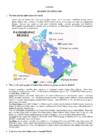
Canada Canada is a country occupying most of northern North America, extending from the Atlantic Ocean in the east to the Pacific Ocean in the west and northward into the Arctic Ocean. It is the world's second largest country by total area, and shares land borders with the United States to the south and northwest. Canada is a federation composed of ten provinces and three territories; in turn, these may be grouped into regions. Western Canada consists of British Columbia and the three Prairie provinces (Alberta, Saskatchewan, and Manitoba). Central Canada consists of Quebec and Ontario. Atlantic Canada consists of the three Maritime provinces (New Brunswick, Prince Edward Island, and Nova Scotia), along with Newfoundland and Labrador. Eastern Canada refers to Central Canada and Atlantic Canada together. Three territories (Yukon, Northwest Territories, and Nunavut) make up Northern Canada. Provinces have a large degree of autonomy from the
1. What is known about the earliest settlers from Estonia to the territory of the present-day US? *The first immigrants from Estonia in the US = 1627 no trace of the "Estonians and Livonians" who left their homeland to settle at the mouth of the Delaware River (a Swedish colony) · 1654 at least one Estonian in the settlement of New Sweden on the Delaware River Johan Schalbrick, a drummer from Tallinn (Reval) · New Sweden Swedish colony on the Delaware River from 16381655 · 1657 Martinus Hoffman, born in Tallinn (Reval), came to New York (New Amsterdam), started to work as a saddlemaker. · His great-granddaughter Cornelia Hoffmann (b. 1734) married Isaac Roosevelt, which makes her the great-great-grandmother of Franklin Delano Roosevelt, president of the US from 193345. · Hans Rebane = 1897 founded the first Estonian-language newspaper in the US Eesti Ameerika Postimees (published in NY until 1911)
 annaabi.ee





Kõik kommentaarid