A Class Divided Ants Verliin 02.02.2016 Selles ekperimendis õpetaja seletas kolmanda klassi lastele rassismist, aga ta tegi seda läbi katse, et lapsed saaksid paremnini aru. Katse algul olid lapsed kõik selle poolt, et vihkame ja mõnitame inimesi kes pole meiega sama naha värvi. Õpetaja nei ltegi aga nii, et ühel päeval olid sinisilmsed õpilased „paremad“ kui pruunisilmsed õpilased. Sinisilmsetel olid eelised ja nad tundsid end kui jumalad. Pruunisilmsetel oli väga palju keelatud ja nad tundsid end alandatud ja nad ei saanud sinna isegi midagi teha, kui sinisilmsed mõnitasid neid. Järgmine päev oli aga teistmoodi. Nüüd olid pruunisilmsed need, kes olid „paremad“ ja sinisilmsed olid need, keda alandati ja kiusati kogaueg. Sinisilmsetel läks kõik halvemini too päec, kuna nad mõtlesid juba, et nad on halvemad ja nad ei näinud vaev...
Estonian and British Education System Estonian and British education system is not quite different. In Estonia, the education system is based on six levels which include the: kindergarten, primary school, basic school, secondary school and university or vocational school. In Britain, the education system is also based on six levels which include the: nursery school, infant school, junior school, secondary school, 6th form and university or college. What is similar for both systems is that the first level of education starts at age of three. While in Estonia this level is called Kindergarten, then in Britain it is called Nursery school. Kindergarten is for children´s from age three to six, but Nursery school is for children´s three to four. Differently from Estonian system, at age of five to seven, British children ´s go to Infant school. This is called year one, year two and year three and all these three...
Why does Marx elevate proletariat? Do you see Wright doing the same? What do you think why? In Karl Marx’s eyes, the society was divided into two classes – the bourgeoisie and the proletariat. He considered bourgeoisie to be the upper class and proletariat the lower class, also known as the working class, which he elevated and believed more in. On the other hand, a man named Erik Olin Wright had a different set of mind. Firstly, Karl Marx thought that proletariat was more powerful than bourgeoisie, because he believed, that if there would be a revolution one day, then it would be carried out by the proletariat. In work, Marx saw a form of human self-expression, which the capitalist mode of production did not allow to develop. He claimed, that the pressure would arise interest in economics and politcs among the proletariats so they could take over power, fight against the injustices the bour...
Should class attendance be mandatory for university students? It has been heavily debated, whether class attendance in general should be compulsory or optional. While most people can agree on the necessity of class attendance in elementary, as well as secondary school being obligatory, then opinions on required class attendance at university are quite divided. Both two alternatives have their respective up- and downsides but all aspects considered, which is more beneficial? To start off, the students’ chosen specialty usually reflects their interests which means that said students, in fact, want to attend classes. In this case, it seems unnecessary to make classes mandatory as it will be more time consuming and virtually even pointless for them to explain their reason for absence. After all, it is relatively common that when students take interest in a subject, it is highly unlikely they will deliberately miss a class. Regardless of c...
Good evening! My name is ... Today I am going to share information about Bodybalance workout. I`ve divided my presentation into 3 parts. I`ll start of by introduction. Then I`ll speak about details and bring you some recommendations for these people who would like to try Bodybalance. I will end with benefits of this workout. My talk should take about 4-6 minutes. Please feel free to ask your questions in the end of presentation. At first I would like you to ask have you tried Bodybalance? Do you know WHAT Bodybalance workout? Bodybalance is the yoga-based class that will improve your mind, your body and your life. Some people call it new yoga. Frankly speaking it is not yoga. Bodybalance is a motivating BLEND OF YOGA WITH TAI CHI AND PILATES provided with music for a thoroughly refreshing, holistic workout. Breathing control is a part of all the exercises, and instructors will always provide options for those just getting started. You'l...
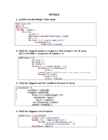
Arrays 1. Delete certain integer from array int[] massiv={}; int b = 5; int count = 0; for (int i : massiv) { if (i == b) count++; } int[] temp = new int[massiv.length - count]; int x = 0; for (int j = 0; j < massiv.length; j++) { if (massiv[j] != 5) temp[x++] = massiv[j]; 2. Find the longest numbers sequence (for example out of array [1111223344] -> sequence of number 1) int[] massiv = {}; int count = 1; int result = 0; int number = -1; for (int i = 1; i < massiv.length; i++) { if (massiv[i] == (massiv[i-1])) { count++; } else { count = 1;}обновляем, если цифра поменялась if (result <= count) { ...
2 Educational system in Croatia divided into: 1. Early childhood education 2. Primary education 3. Secondary education 4. Higher education 3 Early childhood education There are three stages of early childhood education: • from when the child is 6 months old to when they're one • from the ages of one to three • from the age of three until the child stars attending primary school Even though these three stages are not compulsory, every child must attend kindergarten for a year prior to primary school. 4 Primary education (Children begin school at the age of 6 or 7.) There are two stages: • 1st through 4th grade, being taught by one teacher per class t...
Class 10 2008 Few facts about cities Muckanaghederdauhaulia Inch village Inch village The Vikings founded sign Dublin in 841 Worth to mention The Titanic Guiness beer Traditional field sports Gaelic football- The game Hurling Similiar to hockey is like a mix of a soccer and but played on a field. rugby. Flag and religion o Irish flag is a vertical tricolour of green, white, and orange. o About 90 % of the people are Roman Catholics St. Patrick's Cathedral The Irish flag Natural resources The primary natural resources of Ireland, include natural gas, petroleum, peat, copper, lead, dolomite, barite, limestone, gypsum, silver and some zinc Ireland has no coal. Gypsum mine Limestone pavem...
Education The education system is a little bit different in the UK than ours. For example they have go to school 2 years earlier than us. Primary school is for pupils aged 5-11. Though schooling is only compulsory from age 5 in the UK, children most commonly enter Reception Class aged 4 in the academic year in which they will reach their 5th birthday. When pupils are aged 7 they sit Key Stage 1 [SATs]. Key Stage 2 SATs are taken when pupils are aged 11. Secondary school is for pupils aged 11-16. 11-13 years old pupils study a broad range of 10–15 subjects. No public examinations are taken during this time. Traditionally, at the age of 14 students start a programme that lasts for 2 years and during which time they study up to 11 subjects of their choice. After this students take GCSE state examinations After 16 attending at school isn't compulsory but pupils can stay at school, go to coll...
Education in Croatia Educational system in Croatia divided into: 1.Early childhood education 2.Primary education 3.Secondary education 4.Higher education Early childhood education There are three stages of early childhood education: · from when the child is 6 months old to when they're one · from the ages of one to three · from the age of three until the child stars attending primary school Even though these three stages are not compulsory, every child must attend kindergarten for a year prior to primary school. Primary education (Children begin school at the age of 6 or 7.) There are two stages: · 1st through 4th grade, being taught by one teacher per class that teaches every subject with the exception of foreign languages and Religion. The students stay in one classroom for the 4 years. · 5th through 8th grades, where different teachers teach different subj...
,,The Road to Wigan Pier" George Orwell AUTHOR George Orwell was the pen name of the English author, Eric Arthur Blair. He was born on June 25 in 1903 in Motihari, Bengal, in the then British colony of India, where his father, Richard, worked for the Opium Department of the Civil Service. His mother, Ida, brought him to England at the age of one. Orwell was educated in England at Eton College. After service with the Indian Imperial Police in Burma from 1922 to 1928, he returned to Europe to become a writer. He lived in Paris for the next two years, and then came to England as a school-teacher. He lived for several years in poverty. By 1936, Orwell had joined the Republican forces in the Spanish Civil War. He was wounded in the fighting. Late in the war, Orwell fought the Communists and eventually had to flee Spain for his life. During the Second World War, Orwell wrote a weekl...
Essay based on ,,The General Prologue" by G. Chaucer Geoffrey Chaucer wrote The Canterbury tales at the end of the 14th century. It is a collection of stories where a group of pilgrims have a storytelling contest. All of them are on their way from Southwark to visit the shrine of a holy martyr who had brought health to them when they were ill. Chaucer joined the twenty nine of them in a tavern and started to talk to them. They quickly became friends and then there were thirty. All of the stories and very different characters create a body to the story, which depicts the picture of the English society at that time. Chaucer depicts the knight as a typical hero. In my opinion he is making fun of him because he exaggerates describing his very polite manners and love for chivalry. He says that the knight had fought bravely for their country, was honest, polite and wise and had never in his life lost a battle....
Anglo-Saxon period Celts-came from Germany,2000-1200BC began to migrate to Britain,spoke Celtic language,were known as Britons,lived in small villages,round wooden huts-mainly farmers-no towns,organised in tribes with a king/queen as a leader,intertribal wars were very common,the Ancient Britons:one of the Celtic tribes living in Britain 4thBC,believed in different gods,governed by a class of priests-druids who had great power. Romans in Britain:55BC came to conquer Britain(Julius Caesar),brought their own civilization,taught Britons to build roads,bridges,houses,baths,temples,protected Britain for several hundred years,4thBC Romans left Britain,43AD Queen Boadicea of Iceni tribe lost their battle with Romans. Who were the next invaders and where did they come from? Anglo-Saxons came from northern Germany,Denmark and northern Holland. What was their lifestyle like?Anglo-Saxons liked fighting,drinking,gambling,life expectancy not very lo...
The Most Influential Figures in British History There are many important historical figures, who have helped shape Britain into what it is today. In my opinion Elizabeth I, Queen Victoria and Winston Churchill are the ones who stand out and have had the biggest impact on British history. Firstly, Elizabeth I made a great impression on British history as she kept England from major wars during her reign, the kingdom expanded and she supported culture. The rule of Elizabeth I can be called a peaceful time as England did not enter any huge conflicts. She managed to keep good relations with other great countries. However, the defeat of the Spanish Armada left no one questioning the superiority of the British navy. In addition, the kingdom’s territories grew during her reign, Virginia in America being named after „The Virgin Queen“. Queen Elizabeth I also valued culture. Arts flourished while Elizabeth was i...
The foundation stones The Island Britain has a mild climate due to the Gulf Stream which brings warm waters from the Gulf of Mexico. The northern part of the island in average 5'C cooler and it's mountainous or hilly and that's why the south has been more populated.. Britain became an island only 5000 years BC after the Ice Age ended. Britain's prehistory The first evidence of human life on the island are dated back to 250 000 BC. 50 000 BC in a milder Ice Age period Britain became habitable again. People from that time were the ancestors of the modern British. 10 000 BC ige age ended and Britain became inhabited by small groups of hunters who probably followed herds of deer. 5000BC Britain became an island and deer died out. 3000BC the Neolithic people came (probably from Spanish peninsula or even North African ...
HISTORY TEST 5 invasions to Britain until 1066 1) The Celts o Gaels in 600BC; Cymry(Britons) in 300BC o From present-day Austria, Switzerland o The Celtic language survives in the names of many places in England- Dover, Kent, Thames o The Celts are best known for their art- many bronze objects with elaborate designs; brooches; pins; mirrors; Celtic stone crosses o The Celts had 3 social orders: warriors, druids(priests) ordinary people 2) The Romans o (55 BC-Caesar) 43 AD- 410 AD- Claudius o From present-day Italy o Southern Britain became Britannia and was ruled by a roman governor o The Romans built over 20 towns: Colchester, Londinium, Winchester etc. They were good engineers and built roads and villas that had central heating, glass windows and mosaic floors ...
The Saxons & Vikings Fragmentary knowledge of England in the 5th & 6th centuries comes from the British writer Gildas, the Anglo-Saxon Chronicle, saints' lives, poetry, archaelogical findings and place- name studies. British landlords ruled small, unstable kingdoms and continued some Roman traditions of governance. In the mid-5th cent, Vertigern, a British leader, hired Germanic mercenaries to help defend against peoples of the north (Picts & Scots). In the end they revolted & the process of invasion and settlement began. The first Saxon ,,kings" were Hengist & Horsa in Kent, Aelle in Sussex, Cerdic / Cynric in Wessex. So the first ,,English" became mainly from Northern Germany & Denmark. The resistance of the Celts was long. They were free at the time, not like other Roman provinces on the Continent. Around 500, the Britons seem to have won several victories. One of their leaders was Ambrosius Aurelianus and one of...
Years 1154-1485 Henry I was the first unquestioned ruler. One of the most important kings in the Middle Ages. He had lands in Britain & France. Then the government was the monarch, a person, not a place. He had more land than any pervious king. After his marriage to Eleanor of Aquitaine, he also ruled the lands south of Anjou. His empire stretched from the Scottish border to the Pyrenees. England provided most of its wealth, but the heart was Anjou. Henry II began to regain royal control. During the war some barons had become very powerful. He pulled down some of their castles. He tried to restore law & order. He wanted the same kind of justice to be used everywhere. He appointed his own judges to travel around the country. They dealt with crimes & disagreements over poverty. Serious offences were tried in the king's court. At first they had no special knowledge or training. They were trusted to use common se...
The United Kingdom The United Kingdom consists of England, Scotland, Wales and North Ireland and it is situated in the Atlantic Ocean near the mainland of Europe. The population of the UK is 58.6 million and area is 244,110 sq km. Britain has a temperate humid climate. Its characteristic features are mild winters, warm summer, no temperature extremes, abundant rain all year round and frequent changes of weather. The mild climate is partly due to the warm Gulf Stream and partly to the south westerly winds. Occasional winds from the east in winter may bring cold and dry weather. The distribution of rainfall is influenced by the Atlantic Stream. The mountainous areas of the north and west have more rain than the lowlands of the south and east. Wales is located on a peninsula in central-west Britain. The entire area of Wales is about 20,779 km². Wales borders by England to the e...
1. Society- people who interact in such a way as to share a common culture. The cultural bond may be ethnic or racial or geographical, based on gender, or due to shared beliefs, values, and activities. 2. Culture- beliefs, behaviors, objects, and other characteristics common to the members of a particular group or society. 3. A unitary state- a state governed as one single power in which the central government is ultimately supreme and any administrative divisions (subnational units) exercise only powers that their central government chooses to delegate. The majority of states in the world have a unitary system of government. 4. A federal state-- a political entity characterized by a union of partially self- governing states or regions under a central (federal) government. 5. A multinational state- A multinational state is a sovereign state which is viewed as comprising two or more nations. Such a state contrasts with a nation-state...
1.Who were the Normans and what did they bring with them? The normans were the people who in the 10th and 11th centuries gave their name to Normandy, a region in France. 2.How long did the Norman period last in the British Isles? 1066-1154 3.How did the Norman Conquest take place and what were the events leading to this? Edward the Confessor died and the throne was seized by his leading aristocrat, Harold Godwinson, who was crowned. Almost immediately, Harold faced two invasions - one from the king of Norway, Harald Hardrada, who was supported by Harold Godwinson's brother Tostig, and the other from William, Duke of Normandy. Harold defeated the Norwegian invasion at the Battle of Stamford Bridge in September 1066, but he was defeated and killed shortly afterwards at the Battle of Hastings. The victorious William claimed the throne. 4.What is Domesday book all about ? William the Conqueror started recording England, because he wanted...
Indigenous People in Australia Class 12a Contests: 1. Indigenous peoples: an overview.................................................................. 3 2. Language......................................................................................................... 3 3. Spirituality...................................................................................................... 3 4. Art and culture.............................................................................................. 4 5. Traditional recreation.................................................................................... 4 6. Aboriginal food............................................................................................ 4-5 7. Famous indigenous Australians.................................................................... 5 8. Int...
Eli Whitney Whitney was born in Westborough, Massachusetts, on December 8, 1765, the eldest child of Eli Whitney Sr., a prosperous farmer. At age fourteen he operated a profitable nail manufacturing operation in his father's workshop during the Revolutionary War.[2] Because his stepmother opposed his wish to attend college, Whitney worked as a farm laborer and schoolteacher to save money. He prepared for Yale at Leicester Academy (now Becker College) and under the tutelage of Rev.Elizur Goodrich of Durham, Connecticut he entered the Class of 1789. Whitney expected to study law but, finding himself short of funds, accepted an offer to go to South Carolina as a private tutor. Instead of reaching his destination, he was convinced to visit Georgia. Georgia was a magnet for New Englanders seeking their fortunes. He invented the cotton gin, which was the beginning of his success. After he f...
CHARACTERISTIC FEATURES OF OLD ENGLISH - 15 monophtongs, (7 long, 7 short, 1 central), 4 diphtongs, 17 consonants. Free variaton of R, and it was pronounced everywhere. Very much Germanic in character. Quite some special consonants that no longer exist. About morphology: synthetic with numerous aglutinating tendencies. System of tenses Germanic, but with a reduction of tenses. Paradigmatic leveling; Stress shift; Word order; Loan words (Old Norse, Old French). Dual pronouns. Determiners - no separate definite article. Strong and weak verbs. Word order relatively free with tendencies towards SVO. SVO, SOV, VSO most common. Adposition and podposition were both possible (eesliide ja tagaliide). About syntax: clauses were joined much simpler than nowadays, using and, then etc. Because of case syncretion the word order in a sentence became much more important to be able to tell the difference between words. FIRST CONSONANT SHIFT (GRIMM'S L...
When and where was he born? He was born somewhere around 1343 in London. What occupations did he have during his life? He was trained for knighthood, he also worked as a courtier, a diplomat, and a civil servant, as well as working for the king, collecting and inventorying scrap metal How many periods are his works divided into? What are they called? What are the main works of each period? What/who are they inspired by? His poetry is generally divided into three periods the French period ("The romance of the rose"), the Italian period ("Troilus and Criseyde", inspired by his own trip to Italy) and the English period ("The Canterbury Tales") What type of a work is The Canterbury Tales ? Poetry (two tales are in prose: the Tale of Melibee and the Parson's Tale) When did Chaucer die? Where is he buried? He is believe...
Estonian history between 1710-1850 and 1850-1918 Contents Contents.................................................................................................................................. 2 17101850.............................................................................................................................. 3 Population and social structure........................................................................................ 4 Serfdom and the intensifying manorial economy ............................................................. 4 Influences of Pietism and the Moravian Brethren............................................................. 5 Enlightenment and enlightened absolutism...................................................................... 6 18501918.......................................................................................................................
1. Be ready to explain the terms (lecture 1): language, linguistics, synchronic approach to language, diachronic approach to language, linguistic competence, linguistic performance, what is grammar?, prescriptive grammar vs. descriptive grammar; phonology, phonetics, phone, allophone, phoneme; morphology, morphemes (types of morphemes), morphs, allomorphs, types of affixes, derivational affixes, inflectional affixes; open vs closed class words; syntax. Language: a systematic, conventional use of sounds, signs or written symbols in a human society for communication and self-expression. - human language at all levels is rule- or principle-governed. Linguistics: the scientific study of human natural language Synchronic approach to language: Diachronic approach to language: Linguistic competence: Linguistic performance: What is grammar?: "The sounds and sound patterns, the basic units of meaning, such as words, and the rules to combine them...
Creole Culture Report Table of contents INTRODUCTION.........................................................................................................................................................2 FAMILY LIFE..............................................................................................................................................................3 HISTORICAL CREOLE GENDER ROLE...............................................................................................................4 CREOLE CUSTOMS.......................................................................................................................................................5 CREOLE CULTURE...................................................................................................................................................5 PEOPLE.......................
English structure revision for the exam 1. Terms Language → A systematic, conventional (tavakohane) use of sounds, signs or written symbols in a human society for communication and self-expression. Human language at all levels is rule- or principle- governed (valitsema) meaning that language corresponds to the grammar. Natural language is usually spoken, while language can also be encoded into symbols (such as letters, morse etc) For example: Estonian, English. Linguistics → The scientific study of human natural language. Broadly, there are three aspects to the study which are Pragmatics (studies the use of language → interested in the gap between the sentence’s meaning and the speaker’s meaning). Semantics (concerned with the meaning of the language aspects and the way they change, also how objects and language and thinking and language are related). ...
The Renaissance 1500 1650: background 1. What does the word ,,renaissance mean? Characterize briefly the period called the Renaissance. "The rebirth" from French Renaissance, meaning "rebirth"; Italian: Rinascimento, from re- "again" and nascere "be born") Rebirth of scholarship based on classical learning and philosophy. The Renaissance was a cultural movement that spanned roughly the 14th to the 17th century, beginning in Italy in the late Middle Ages and later spreading to the rest of Europe. It encompassed a revival of learning based on classical sources, the development of linear perspective in painting, and gradual but widespread educational reform. (wikipedia)Bridge between Medieval Ages and Modern Era. 2. Where did the Renaissance start and why? In the opening years of the 14th century, there began to develop in Italy and increasing interest in the manuscripts that had surviv...
1. OBJECT-ORIENTED PARADIGM The Model •The model defines an abstract view to the problem. This implies that the model focuses only on problem related stuff and that you try to define properties of the problem. These properties include: 1 •the data which are affected and 2 •the operations which are identified by the problem. Object-oriented Paradigm •Everything is an object •A program is a bunch of objects telling each other what to do by sending messages •Each object has its own memory made up of other objects •Every object has a type •All objects of a particular type can receive the same messages Domain Model •A domain model does not represent the entire domain as it is in the real world. It includes only the concepts that are needed to support the application. Object •Is a partitioned area of memory where object code is stored •The area of memory is protected •This code can function relatively independently of othe...
ENGLISH LITERATURE Ancient Britain Lived on the British Isles in the 1st millenium. They most probably came from Eastern Europe and belonged to the Celtic race and also spoke Celtic. They were primitive hunters- gatherers, farmers. Some Celtic words are still used in modern English, however they are used mostly in place names. For example: · avon river · cumb valley · ford shallow place in the river Ancient Britons had their own religion and priests or druids and temples. In the year 55 BC Britain became a Roman province. Romans were highly developed and had their own language latin, which has also greatly influenced English. The military occupation of the Isles ended in 410 AD. The Romans eventually brought Christianity to Britain. Hadrian's wall on the border of Scotland and England. It began constru...
Introduction Estonia, officially the Republic of Estonia (Estonian: Eesti or Eesti Vabariik) is a country in the Baltic region of Northern Europe. It is bordered to the north by Finland across the Gulf of Finland, to the west by Sweden across the Baltic Sea, to the south by Latvia (343 km), and to the east by the Russian Federation (338,6 km). The territory of Estonia covers 45,227 km² and is influenced by a temperate seasonal climate. The Estonians are a Finnic people closely related to the Finns, with the Estonian language sharing many similarities to Finnish. The modern name of Estonia is thought to originate from the Roman historian Tacitus, who in his book Germania (ca. AD 98) described a people called the Aestii. Similarly, ancient Scandinavian sagas refer to a land called Eistland, close to the German term Estland for the country. Early Latin and other ancient versions of the name are Estia and Hestia. Until the late 1930s, the ...
N. A. Vavilov ASPECTS OF BRITISH HISTORY Н. А. Вавилов КРАТКАЯ ИСТОРИЯ ВЕЛИКОБРИТАНИИ Учебное пособие на английском языке Москва Институт международного права и экономики имени А. С. Грибоедова 2008 2 УТВЕРЖДЕНО кафедрой лингвистики и переводоведения Вавилов Н.А. Краткая история Великобритании: Учебное пособие на английском языке. – 2-е изд., пересмотр. и испр. – М.: ИМПЭ им. А.С. Грибоедова, 2008. – 88 с. Пособие содержит краткий очерк важнейших событий в истории Великобритании – от первых документально засвидетельствованных вторжений на остров (кельтов, римлян и англосаксов) до создания и распада Британск...
English literature is one of the oldest literatures in Europe; dates back to the 6th century AD. Oral literature, i.e. not written down, spread from person to person. In 449 AD Anglo-‐Saxon tribes invaded England – beginning of the Anglo-‐Saxon period in English literature. The first form of literature was folklore, carried by scops and gleemen, who sang in alliterative verse (a kind of simple poetry). Prose developed much later. The first form of recorded English literature was the epic Beowulf, which was produced sometime near the end of the 7th and beginning of the 8th century. It has no ...
The Life of Dante, the Inferno of Dante Dante Alighieri, one of the greatest poets of the Middle Ages, was born in Florence, Italy on June 5, 1265. He was born to a middle-class Florentine family. At an early age he began to write poetry and became fascinated with lyrics. During his adolescence, Dante fell in love with a beautiful girl named Beatrice Portinari. He saw her only twice but she provided much inspiration for his literary masterpieces. Her death at a young age left him grief-stricken. His first book, La Vita Nuova, was written about her. Sometime before 1294, Dante married Gemma Donati. They had four children. Dante was active in the political and military life of Florence. He entered the army as a youth and held several important positions in the Florence government during the 1290's. During his life, Florence was divided politically between Guelphs and Ghibellines. The Guelphs supported the church and liked to keep thi...
LEXICOLOGY 1. Size of English vocabulary 1) Old English – 50,000 to 60,000 words Vocabulary of Shakespeare OE – homogeneous; 1/3 of the vocabulary has survived • 884,647 words of running text About 450 Latin loans (Amosova) • 29,000 different words (incl. work, working, Viking invasions added 2,000 worked, which are counted here as separate 2) Middle English – 100,000 – 125,000 words) English becomes heterogeneous (Norman French, • 21,000 words English, Latin), hybrid of Germanic and Romance languages Norman French influence – about 10,000 words, 75 % are still in use (Baugh) Latin influence continues 3) Early Modern English – 200,000 – 250,000 English becomes a polycentric language; polyglot, cosmopolitan lang...
1 Grammatical Terminology PRACTICAL ENGLISH GRAMMAR FLGR.01.042 Grammatical Terminology analytic analüütiline (= uninflected - grammar is focused in the sentence , e.g. English) synthetic sünteetiline (= inflected - grammar is focused in the word, e.g. Estonian, Latin, Russian, Old English) ending lõpp (käände- ja pöördelõpud) marker tunnus (mitmuse, oleviku, lihtmineviku, tingiva kõneviisi, käskiva kõneviisi, kaudse kõneviisi, umbisikulise tegumoe, ma- tegevusnime, oleviku kesksõna, mineviku kesksõna) derivational affix liide, tuletusliide, tuletusafiks (e.g. postwar, anti-American, wiser, greenish) parts of speech sõnaliigid English Estonian ...
Stonehenge One of the best known ancient wonders of the world, 5000 years old Megalith monument, built by western mediterraneans during 3000-1600 BC Circular structure, large standing stones, aligned with rising sun at teh solstice Attlers and bones were sued to dig pits that hold the stones The Celts in Britain and their legacy 700-200 BC celts invade Britain Gaels or Goehls(Ireland and Scotland),Cymri(Wales) and Brythons(gave name to Brittany) Fierce fighters,superb horsemen.Most of them farmers, lived in thatched houses Good at art, craftmanship, used iron Divided into tribes, ruled by kings, only in face of danger would they choose a single leader Legacy- hill-forts, farms, churches, field system, woodland, pasture, weapons, iron objects, langugae, culture Caesar in Britain The great Roman Emperor Firts came 55 BC to gather information, celts ...
Indroduction This assignment will examine Britain's car market and shows how the external and internal environment factors influences it, mostly on Mini Ltd. External marketing environment is divided into 4 different groups; socio-cultural, economic, technological and political factors. Internal marketing evironment is divided into 6 different groups; which are customers, competitors, suppliers, distributors, employees and stakeholders. Also this assignment is provided with the SWOT analysis, where strengths, weaknesses, opportunities and threats are examined. Mini Mini was at first manufactured by the Austin Motor Company Ltd. In 1957 Alec Issigonis was commissioned to develop a new type of small car. At the same year were the first sketches of Mini made and after that the Mini model is been created from wood and also the most important mechanical parts for Mini has been developed. Four years later the Mini hits the streets. In 1965...
1.Lexicology as a science L. studies the voc of lg as a system. Word-learning, lexis-logos. The task of L is to establish the general features of modern Engl voc. Theoretical L. gives a complete picture of voc. Practical value lies in using and appretiating the lg more conciously. There is diachronic (historical) L that studies origin and development; syncronic studies voc at a given historical period. There are general L (studies words disregarding particular features of any particular lg); special L (studies specific features of a separate lg, there is Engl that bases on general L); contrastive (compares vocabularys in different languages). 2. Connection of L with other linguistic disciplines a) the word performes a certain grammatical function (nt, he always misses the class, how many misses are there; the girl powders her nose, soliders face powder)In speech words are combined according to grammatical rules. The plural of nouns m...
1. Loopealsed 2. Nõmmemetsad 3. Palumetsad 4. Laanemetsad 5. Salumetsad 6. Soovikumetsad 7. Rabastuvad metsad 8. Rohusoometsad 9. Samblasoometsad 10. Kõdusoometsad ALVAR FORESTS LOOPEALSED METSAD This groupof types includes forests of low productivity and with a peculiar xeromesophilous ground vegetation, which grow on a layer of limestone, gravel, grit or shingle. See metsa kasvukohatüüp sisaldab madala tootlikkuse ja iseloomulikult suure või keskmise kuivusnõudlikkusega alustaimestikku, mis kasvab pae-, kruusa- , peenkruusa või klibukihil. This layer is close to surface, with thickness of soil up to 30 centimetres. See rinne on maapinnale lähemal, mullatüsedus on kuni 30 sentimeetrit. Alvar forests grow mainly in western Estonia (also on the islands) and to a lesser extent in Northern Estonia. Loopealsed metsad kasvavad peamiselt Lääne-Eestis (samuti saartel) ning vähemal määral P...
Ameerika Kirjandus 30.01.13 Naturalism · France, Emile Zola · Put down his theory in 1879: Le Roman Experimental, attempt to explain the development of human society throuch biological laws · Outlook is deterministic, pessimistic, fatalistic (fate or biology) · Man as an animal-clever than other beasts, still explainable within the framework · Man is not a free agent, is govern by something · Unable to determine his own faith · Hereditary · Naturalists tried to apply in fiction the processes of natural sciences · Writers task is to record facts, systems of behaviour, living conditions, never revealing any natural unbiased (completely natural) · Point of view: amoral-outside the category of morality, neither good or bad · Naturalist find it absurd to blame the wicked. These criminals are doing what nature, environment, their unconscious tells them to do. Naturalists do not ...
khTallinn English College The United Kingdom Topic Mari-Liis Pakats Tallinn 2008 2 Table of Contents Introduction..................................................................................................................4 Geographical Position .................................................................................................4 History .........................................................................................................................4 Government..................................................................................................................5 Queen Victoria.............................................................................................................5 Relief...............................................................................................................................
Filmikunsti ajalugu 31.01.12 The age of pioneers: the early history of film How the horses helped to ivent the cinema. Cinema was invented by accident. 1872, west coast: leland standford, party, rich people, end of the 19 century, bored. Stanfrod talks friends about horses: problem: question is, what happens with the hooves while its moving, running. Bet, with eyes, can't settle this. Cannot ever see if the hooves touch the ground. Stanford has enough money, hires most famous photographer. Eadwerd muybridge, comes to usa. Tells him to settle this with photography. That time with photography you cannot get any informatio either. Started to install boxes, in each box, there was a camera. Does the hooves touch the ground or not? Fast shutter, can freeze the moment. Makes fast shutters, to record this. Finds solution, hooves are touching. The prerequisites for cinema: camera(edison and dickson), film stock that is flexible and stable to ru...
Tartu Kivilinna Grammar School Netherlands Report Composer: Reino Urbanovits Supervisors: Tiia Krass Erika Hunt Tartu, 2003 Table of contents Table of contents............................................................................................................................2 Introduction....................................................................................................................................3 Chapter 1........................................................................................................................................4 The Netherlands.............................................................................................................................4 Chapter 2.......
SOCIETY AND CULTURE OF ENGLISH-SPEAKING COUNTRIES Introduction 1. Nowadays, English is so widely spoken that it can hardly be considered "a one nation's" language. The main countries where English is spoken are: the U.K, the U.S, Canada, Australia, the Republic of Ireland, New Zealand, West Indies 2. There are approx. 300-400 million speakers of English in the world. English occupies the 3rd place by its number of speakers; it is right behind Mandarin and Spanish. 3. ESL (English as a Second Language) used in your own country (e.g. India) EFL (English as a Foreign Language) used in a foreign country ESP (English for Specific Purposes) used in business, airlines, hotels etc. 4. Settlement colonies people migrated into them from Britain and started their own communities, they are the present English-speaking countries (USA, Australia, Canada, New...
Maturita Solutions Advanced Workbook Key stand bananas and coffee! It's a bit 3 1 to 8 of Unit 1 uncanny really. Is it something she's 2 about 9 century passed on to me genetically, or is it 3 like 10 assumed / 1A Memories page 3 learned behaviour? Who knows? 4 of thought / 1 See exercise 2 2 5 6 any ...
BOOKS (From Wikipedia, the free encyclopedia) A book is a set or collection of written, printed, illustrated, or blank sheets, made of paper, parchment, or other various material, usually fastened together to hinge at one side. A single sheet within a book is called a leaf, and each side of a leaf is called a page. A book produced in electronic format is known as an electronic book (e-book). Books may also refer to works of literature, or a main division of such a work. In library and information science, a book is called a monograph, to distinguish it from serial periodicals such as magazines, journals or newspaper. The body of all written works including books is literature. In novels and sometimes other types of books (e.g. biographies), a book may be divided into several large sections, also called books (Book 1, Book 2, Book 3, etc.). A lover of books is usually referred to as a bibliophile, or, more informally, a bookworm. A st...
BRITISH NATIONAL SYMBOLS Research work CONTENTS CONTENTS.....................................................................................................................................2 INTRODUCTION............................................................................................................................3 1. BRITISH NATIONAL SYMBOLS..............................................................................................5 1.1 Great Britain and British story................................................................................................5 1.2 National Symbols and Nation Building..................................................................................5 1.3 The Use of Flags throughout History.....................................................................................6 1.4 The Early Modern Flags. United Kindom: Union Jack.........................................
 annaabi.ee