 50 punkti
Autor soovib selle materjali allalaadimise eest saada 50 punkti.
50 punkti
Autor soovib selle materjali allalaadimise eest saada 50 punkti.
 ~ 2 lehte
Lehekülgede arv dokumendis
~ 2 lehte
Lehekülgede arv dokumendis
 2010-02-18
Kuupäev, millal dokument üles laeti
2010-02-18
Kuupäev, millal dokument üles laeti
 5 laadimist
Kokku alla laetud
5 laadimist
Kokku alla laetud
 0 arvamust
Teiste kasutajate poolt lisatud kommentaarid
0 arvamust
Teiste kasutajate poolt lisatud kommentaarid
 Marie-Helene Sarapuu
Õppematerjali autor
Marie-Helene Sarapuu
Õppematerjali autor
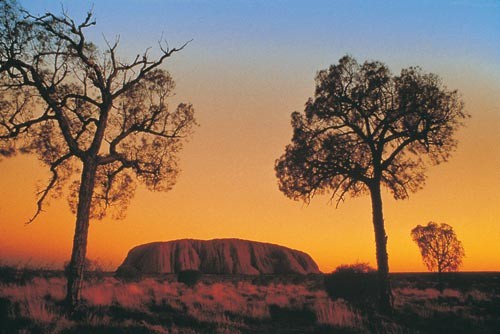
There is a road to Charlotte Pass, from which it is a seven kilometre walk up a path to the summit. Anybody with a modest level of fitness should be able to climb it. Until the 1960s the road was open to motor vehicles and it was possible to drive close to the summit. Uluru, also known as Ayers Rock, is a large sandstone rock formation in central Australia, in the Northern Territory. It is located in UluruKata Tjuta National Park. Uluru is 346 metres high, more than 8 km (5 miles) around with a hard exterior compared to most other large rock formations which has prevented formation of scree slopes, resulting in the unusual steep faces down to ground level. It is the greatest tourist attraction in the Northen Territory but it also is and awe inspiring, huge monolith, 862,5 metres above sea level, rising out of the desert in the centre of Australia. The local
New South Wales, then into Victoria and turning west, before finally fading into the central plain at the Grampians in western Victoria. It consists of a complex of mountain ranges, plateaus, upland areas and escarpments. One part of the Great Dividing Range is the Australian Alps. It's highest point is Mount Kosciuszko, which is 2,228 metres high. The Snowy Mountains in New South Wales are also part of the Alps. The most famous land mark of Australia is the Uluru. It's a large sandstone rock formation in the southern part of the Northern Territory. It lies 335 km south west of the nearest large town, Alice Springs; 450 km by road. Kata Tjuta (The Olgas) and Uluru are the two major features of the Uluru - Kata Tjuta National Park. Uluru is sacred to the Aboriginal people of the area. It has many rock caves and ancient paintings. Water bodies: Australia is a very dry continent. There are very few rivers and no big lakes in Australia
In central Australia there are lowlands, covered with sedimentary rocks (settekivimid). The Great Dividing Range runs along the Pacific coast. The mountains are old and worn down. The Australian Alps are the highest of them. The highest top of Australia is Mount Kosciusko (2,2 km above sea level). Australian rocks are rich in gold, polymetallic ores, iron ore, copper, uranium. Much coal is mined in the sedimentary rocks of south-east. The greatest attraction in the Northern Territory is Uluru. It is a huge monolith rock, 862 metres above the sea level, rising out of the desert. The local Aborigines regarded it as a sacred site. No one is sure when the first Aborigines moved into the area but the best evidence suggests that it was at least 10000 years ago. The first graded road was built in 1948 on mount Uluru. Ayers Rock was created as a national park in 1950. Artistically Kata Tjuta is noted for its engravings and its rock piles whereas
Victoria Desert. The biggest mountain ranges are the Great Divining Range, the Australian Alps, the Blue Mountains and the New England Range. The outback is flat and hot centre of Australia. The nearest neighbor may be a hundred kilometers away. The nearest city may be more than one thousand kilometers away. Many people in this area live on sheep stations which are enormous farms. Uluru One of the most beautiful things in Australia is Uluru (Ayers Rock) in the outback. It is an enormous rock alone in the middle of the desert. It is three kilometers long and 348 metres high. There is another 2000 meters under the ground. Uluru is 600 000 000 years old and it is the largest rock in the world. The Great Barrier Reef. One of the natural wonders of the modern world is the Great Barrier Reef. It is located off the northeast coast of Australia. It is the biggest coral reef in the world extending 2000 kilometers
of the country, where the summers are warm and the winters not too cold. The highest mountain in Australia is Mount Kosciuszko, at 2,228 metres. Australia's longest river, the Murray-Darling, is 2,700 kilometres long. The only large permanent lakes in Australia have been artificially created, as most of the natural lakes there are dry for months or years at a time. Lake Eyre is the largest lake in Australia and also the lowest point. One of the most beautiful things you can see in Australia is Uluru, also called Ayers Rock. It is an enormous rock in the middle of the desert in the Northern Territory. It is three kilometres long and nearly 2.5 kilometres high in total. It is 600 million years old, and it is the largest rock of its kind in the world. Uluru is a sacred place for the Aborigines. Thanks to Australia's isolation, it has plants and animals unlike anywhere else in the world. The kangaroo is the most well-known of them. They have strong back legs and tails, allowing
years by Aborigines. It was settled by the British just over 200 years ago, in 1788, and since then has transformed from a colonial outpost into a nation with a population of more than 20 million. For visitors, its ancient, worn landscape contrasts with the vitality and youthful energy of its inhabitants. It is an ancient culture that is deeply connected to the land. At the heart of the continent is Uluru (named Ayers Rock by the colonial settlers), a monolith of great spiritual significance. This great rock reaches 348 metres tall and measures nine kilometres at its base. Take a guided walk around Uluru or visit the Aboriginal Cultural Centre to find out more about the history of the area. Sydney Sydney is well known for its seafood including Balmain Bugs (a small local freshwater lobster creature), Crayfish from Tasmania, Barramundi
depression. About a third of Australia's work force was unemployed. During the WWII Australia was an important war ground for the USA and Japan. Landforms Australia is the lowest continent in the world with an average elevation of 330 m. The land is quite low, but far from featureless. The mountains are represented by the Australian Alps, which run along the southeast coast. The highest mountain is Mt Kosciusko (2228m), but the most attracting are the world's biggest monolith Uluru and the beehive mountains of the "Bungle Bungles". Of course, the Great Dividing Range that runs along the Pacific Coast is a tourist must. In addition, the largest outback town Alice Springs is a sure must also. Ayers Rock-Uluru The Australian Outback is one of a kind in the world. It is actually a vast arid plateau stretching across most of the continent. There are the Gibson, the Great Victoria, the Great Sandy Deserts and many smaller deserts
about ancient Australia. The east is the mountainous part of the country. There is The Great Dividing Range. It runs along the Pacific coast and finds it end in Tasmania. The mountains are old and worn down. The highest mountains on the Australian mainland are in an area known as the Australian Alps. They are a small part of the Great Dividing Range. The Highest Peak on the mainland is 2228m high – Mt Kosciusko. One of the largest monoliths – Ayers Rock, also known as Uluru, can also be found in Australia. It’s located in the middle of the country. The monolith is 348 m high. The flat hot centre of Australia is called the outback. The Outback is more then two thirds of Australia, but less than 100 000 people live there. Between the Western Australian Shield and the Great Dividing Range is the Great Artesian Basin region. It is an area of vast plains. It includes three major basins: The Carpentaria, the Eyre and the Murray basins
 annaabi.ee







Kõik kommentaarid