 10 punkti
Autor soovib selle materjali allalaadimise eest saada 10 punkti.
10 punkti
Autor soovib selle materjali allalaadimise eest saada 10 punkti.
 ~ 10 lehte
Lehekülgede arv dokumendis
~ 10 lehte
Lehekülgede arv dokumendis
 2016-01-25
Kuupäev, millal dokument üles laeti
2016-01-25
Kuupäev, millal dokument üles laeti
 3 laadimist
Kokku alla laetud
3 laadimist
Kokku alla laetud
 0 arvamust
Teiste kasutajate poolt lisatud kommentaarid
0 arvamust
Teiste kasutajate poolt lisatud kommentaarid
 mjarvekulg
Õppematerjali autor
mjarvekulg
Õppematerjali autor
West. Alfred's men took London in 886 and repaired the walls of the old Roman city. In 1016 the Vikings attacked London again but the Saxons fought them off. The attacks ceased when the Danish king Cnut came to power in 1017. Cnut managed to unite the Danes with the Anglo-Saxons, and invited Danish merchants to settle in the city. London prospered under Cnut, but on his death the city reverted to Anglo-Saxon control under Edward the Confessor. He built a wooden palace at Westminster, were the parliament met later. This is why Westminster became the seat of government not the city of London itself. Edward the Confessor also built Westminster Abbey. He ruled until his death in 1065, after which King Harold was crowned. Norman period( Medieval London) 1066 In 1066 in the Battle of Hastings the Normans were victorious and William was crowned King. William granted the citizens of London special privileges, but he also built a castle in the
the most significant form of broadcasting in Britain. When commercial television began, it was feared that advertisers would have too much control over programming an that the new channel would exhibit all the worst features of tabloid journalism. Over the years, however, these fears proved to be unfounded. 33. The places of interest in London: 9 The Houses of Parliament - The Palace of Westminster, also known as the Houses of Parliament or Westminster Palace, is the meeting place of the two houses of the Parliament of the United Kingdom--the House of Lords and the House of Commons. It lies on the north bank of the River Thames[note 1] in the heart of the London borough of the City of Westminster, close to the historic Westminster Abbey and the government buildings of Whitehall and Downing Street. The name may refer to either of two structures: the Old Palace, a medieval
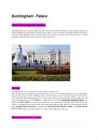
Buckingham Palace About Buckingham Palace Buckingham Palace serves as both the office and London residence of Her Majesty The Queen. It is one of the few working royal palaces remaining in the world today. During the summer, visitors can tour the nineteen State Rooms, which form the heart of the Palace. These magnificent rooms are decorated with some of the greatest treasures from the Royal Collection, including paintings by Rembrandt, Rubens and Canaletto and sculpture by Canova. History Buckingham Palace history is going back to the time of Queen Victoria in 1837 . Then, the Palace has been serving as the London Royal residence. In 1703, the Duke of Buckingham had created the Buckingham House. In 1761, George III (1738 1820) buy it
Art Museum of Estonia Art Museum of Estonia was founded on November 17th, 1919, but it was not until 1921 that it got its first permanent building the Kadriorg Palace, built in the 18th century. In 1929 the palace was expropriated from the Art Museum in order to rebuild it as the residence of the President of Estonia. The Art Museum of Estonia was housed in several different temporary spaces, until it moved back to the palace in 1946. In September, 1991 the Kadriorg Palace was closed, because it had totally deteriorated by then. At the end of the year the Supreme Council of the Republic of Estonia decided to guarantee the construction of a new building for the Art Museum of Estonia in Kadriorg. Untill then the Knighthood House at Toompea Hill served as the temporary main building of the Art Museum of Estonia. The exhibition there was opened on April 1, 1993. Art Museum of Estonia premanently closed down the exhibitions in that building in October 2005.
· Perhaps the epitome of London's surviving pageantry can be found in the ceremonial Changing of the Guard. · A hugely popular spectacle, the Changing of the Guard takes place at a range of royal locations in and around · London daily during the summer and on alternate days for the rest of the year. · There is no ticketing, so make sure you get there early. · Ever since 1660 Household Troops have guarded the Sovereign Palaces. · The Palace of Whitehall was the main residence until 1689 and was guarded by the Household Cavalry. · The court moved to St James's Palace in 1689 and when Queen Victoria moved into Buckingham Palace the Queen's Guard remained at St James's Palace and a detachment guarded Buckingham Place, as it does today. Trooping the Colour · Often cited as the ceremonial event of the year, the Trooping the Colour marks the 'official' birthday of the Queen.
HOUSES OF PARLIAMENT Houses of Parliament also known as the Palace of Westminster is one of the most attractive buildings in London. It stands on the site where Edward the Confessor had the original palace built in the first half of the eleventh century . In 1547 the royal residence was moved to Whitehall Palace, but the Lords continued to meet at Westminster, while the commons met in St. Stephen's Chapel. Ever since these early times, the Palace of Westminster has been home to the English Parliament. In 1834 there was a huge fire that destroyed much of the old palace. All that remained was the chapel crypt, The Jewel Tower and Westminster Hall. It was Lord Melbourne, the Prime Minister, who saved the great hall by arranging for the fire engines to be brought right into the hall and personally supervising the fire fighting operation. The magnificent Gothic Revival masterpiece you see today was built between
Kadriorg and Pirita Kadriorg (Catherine's Valley), one of the oldest and largest parks in Estonia, covers about 70 hectares. Originally it was an are on the seashore featuring low meadows, shrub land and a few manor houses. In the 17th century most of the land was in the possession of Fonne, the Town Council's secretary. At the time the park was called Fonnenthal. A century later the name was changed to Yekaterinenthal after Yekaterina, wife of Peter I. Kadriorg Palace was designed in Baroque style by the Italian Niccoló Michetti and built in the 1720s on the order of Peter the Great in honour of his wife. The tsar himself is known to have laid three bricks in the foundation of the building. The palace was also planned to serve as a summer house for the tsar's family. For a long period, Kadriorg Palace housed the Art Museum of Estonia, but after thorough repairs over quite a few years it was finally opened as the Museum of Foreign Art in the summer of 2000
The City of London borders the City of Westminster to the west. The City of London is England's smallest ceremonial county by both population and area covered and is the second smallest British city in both population and size, after St. David's in Wales. 5. The City of Westminster The City of Westminster is a borough of London with city status. The city contains most of London's West End and is the seat of the United Kingdom's government, with the Palace of Westminster, Buckingham Palace, Whitehall and the Royal Courts of Justice. The City of Wesminster covers all or part of the following areas of London: Covent Garden, Hyde Park, Mayfair, Paddington, Queen's Park, St. James's, Soho (including Chinatown), West End and ofcourse Westminster. 6. Sights Hyde Park this park is one of the largest parks in central London and one of the Royal Parks of London, famous for its Speakers' Corner. The park is divided in two by the Serpentine Lake
 annaabi.ee













Kõik kommentaarid