 50 punkti
Autor soovib selle materjali allalaadimise eest saada 50 punkti.
50 punkti
Autor soovib selle materjali allalaadimise eest saada 50 punkti.
 ~ 4 lehte
Lehekülgede arv dokumendis
~ 4 lehte
Lehekülgede arv dokumendis
 2010-02-28
Kuupäev, millal dokument üles laeti
2010-02-28
Kuupäev, millal dokument üles laeti
 13 laadimist
Kokku alla laetud
13 laadimist
Kokku alla laetud
 0 arvamust
Teiste kasutajate poolt lisatud kommentaarid
0 arvamust
Teiste kasutajate poolt lisatud kommentaarid
 Mirjam Nugis
Õppematerjali autor
Mirjam Nugis
Õppematerjali autor
-different diseases, bad healthcare -unhealthy ways/habits of living (drinking, smoking etc) Well developed countries: -diseases of heart and blood vessels -cancer -accidents and suicides -HIV/AIDS -natural disasters Less dev. countries: -famine -AIDS/HIV -different diseases, epidemics -wars, conflicts -natural disasters THE COURSE OF DEMOGRAPHIC TRANSITION Highest peak of dem. explosion in the 18th c. Demographic transition slow proccess Importance of children 40% of population Vacant places in the world where to send people -> founding colonies to solve the problems 1950s developing world's demographic explosion Quick process 60% of population are children No vacant places for ppl or colonies Education and Employment North every ppl can get general education, basic education South: the Mediterrarean, the Carribean, Latin-America quite good South-East Asia, Africa the worst It isn't possible to satisfy all the needs. They dont have equipment
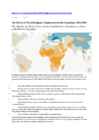
http://www.pewforum.org/2015/04/02/religious-projections-2010-2050/ APRIL 2, 2015 The Future of World Religions: Population Growth Projections, 2010-2050 Why Muslims Are Rising Fastest and the Unaffiliated Are Shrinking as a Share of the World’s Population The religious profile of the world is rapidly changing, driven primarily by differences in fertility rates and the size of youth populations among the world’s major religions, as well as by people switching faiths. Over the next four decades, Christians will remain the largest religious group, but Islam will grow faster than any other major religion. If current trends continue, by 2050 …
Population 1. Size, its changes 2. Distribution 3. Towns 4. Ethnic makeup 5. Age breakdown 6. Religion(s) 1. Size. 1 July 2006 population estimates by UK National Statistics: % (mid- Part Population (mid-2006) 2006) England 50,762,900 83.8 Scotland 5,116,900 8.4 Wales 2,965,900 4.9 Northern Ireland 1,741,600 2.9 United Kingdom 60,587,300 100 Although Britain is quite small in terms of land area (245,000 sq km), it has a large
Iron and other metals brought to Alaska were prized for trading and making tools. Russia left a footprint in Alaska by establishing its first library and museums, as well as introducing Russian Orthodoxy to the locals(Alaska natives) (Russian Orthodox Church in Ninilchik, Alaska and also Chapel in Fort Ross, California). Some of the religious books were further translated into native languages. However, the Russians did great damage to the local environment by depleting the sea otter population. 4. Significance of the Jewish element in Russian immigration to the US. Immigration from Russia to the US in 18811914: Nearly 3.2 million immigrants from the Russian Empire. The most prominent Russian groups that immigrated in this period were the groups seeking freedom from religious prosecution. Nearly half of the immigrants were Jews. Religion of the Russian immigrants: Russian Orthodox, Jews, Nominal Jews (non-religious people of Jewish descent). Eastern European Jews
Large numbers of Irish came following the potato famine in Ireland in the 1840s. Germans and Italians came, escaping the consequences of the failed 1848 revolutions. And, as the century wore on, there were increasing numbers of Central European Jews, especially fleeing from the pogroms of the 1880s. In the first two decades of the twentieth century, immigrants were entering the USA at an average of three-quarters of a million a year. In 1900, the population was just over 75 million. This total had doubled by 1950. [3, p.35] Within one or two generations of arrival, most of these immigrant families had come to speak English, through a natural process of assimilation. Grandparents and grandchildren found themselves living in very different linguistic worlds. The result was a massive growth in mother-tongue use of English. [3, p.35] According to the 1990 census, the number of people (over five years of age) who
English Literature ,Victoria Age 1) Overview of the Victorian age · Periodization During the reign of Queen Victoria (1837-1901) · Why is the Victorian Age compared to the Elizabethan Age? Both are associated with the reign of a very popular queen; Victorian age idealised the Elizabethan Age; many changes in different fields- economy, religion etc.; focusing more on people's attitudes, political developments etc; Victorian age was inspired by Elizabethan era; Britain became an empire · What were the most important changes in politics, religion and social life that occurred during the Victorian age? Politics: 1848 Chartist movement (voting right for the working class); women's suffrage movements; feminist outburst (wanted to have business openly; own property, voting etc.); world dominion (British empire); Economy: Industrialization; urbanization (people moved to towns no agriculture & food); laissez- faire economy new type, where government has no con
Syntactically and semantically determined case alternation (Baltic, Finnic, Russian) Evidentiality (Lithuanian, Latvian, Estonian, Livonian) 4. Ethnic and cultural formation of the Estonian area from the perspective of prehistory. Conclusions for the second millennium BC: Cultural and economic setback together with depopulation followed the Neolithic in the northernmost eastern Baltic region and Finland. Land did not become empty of people; yet the population became rather sparse and socially, culturally, and economically ‘passive’. There is no aDNA information of post-Neolithic people in the study region yet. Spoken language most likely varied over the region. Substrate(s) in Finnic languages refer to none of IE or FU languages. Due to depopulation, the eastern Baltic region and Finland became open and tempting for new population. Conclusions based on cemeteries and human aDNA:
excellent quarterly tabloid Annals of Earth, Vol. VIII, No. 2, 1990. Subscriptions $10/year from 10 Shanks Pond Road, Falmouth, MA 02540. If today is a typical day on planet Earth, we will lose 116 square miles of rainforest, or about an acre a second. We will lose another 72 square miles to encroaching deserts, as a result of human mismanagement and overpopulation. We will lose 40 to 100 species, and no one knows whether the number is 40 or 100. Today the human population will increase by 250,000. And today we will add 2,700 tons of chlorofluorocarbons to the atmosphere and 15 million tons of carbon. Tonight the Earth will be a little hotter, its waters more acidic, and the fabric of life more threadbare. The truth is that many things on which your future health and prosperity depend are in dire jeopardy: climate stability, the resilience and productivity of natural systems, the beauty of the natural world, and biological diversity.
 annaabi.ee







Kõik kommentaarid