Estonian in multilingual Baltic-Sea Europe: language contacts and linguistic
landscapes.
Kordamisküsimused
Questions for the exam
1. What is meant by SAE? Give a few examples of possible SAE features.
SAE – Standard Average European. Martin Haspelmath: 12 typical structural
features (concentrated in Europe, rare outside of Europe) and some other possible common
features.
Examples:
Definite and indefinite articles, e.g., a book vs. the book
Relative clauses with relative pronouns, e.g., I woke up a student who had nodded off
‘have’-perfect, e.g., has done
Nominative experiencers, e.g., I like, I need
Participial passive, e.g., you are invited
Particles in comparative constructions, e.g. She is older than me
2. Is Estonian a typical SAE language? Why do you think so?
SAE in Estonian:
Relative clauses with relative pronouns, e.g., raamat, mida ma lugesin ‘the book that I read’
Comparative construction with the particle kui ‘than’, e.g., suurem kui hiir ‘bigger than a
mouse’.
But cf. also
Estonian hiirest (ELA) suurem ‘bigger than a mouse’, where the standard is marked with the
elative case!
Finnish isompi kuin hiiri ~ hiirtä (PRT) isompi ‘bigger than a mouse’
SAE features developing or expanding their usage in Estonian:
Article-like usages of üks (‘one’ > ‘a’), see (‘this’ > ‘the’)
Nominative experiencer, e.g.,
Mul (ADE) on vaja puhkust > Ma (NOM) vajan puhkust ‘I need some rest’
Peetril (ADE) õnnestus kaugushüpe > Peeter (NOM) õnnestus kaugushüppes ‘Peeter
succeeded in long jump’
No ‘have’ -perfect but the so called possessive perfect is spreading, e.g., mul on töö tehtud ‘I
have the work done’
Passive, e.g., sa oled ülikooli vastu võetud ‘you are accepted into the university’
Estonian has 2 SAE features.
3. What characterises the Circum Baltic Area? (Language-wise, history-wise)
The Circum-Baltic area is a meeting point for the languages of two language families –
Uralic and Indo-European. Contacts between Finnic and Baltic languages have lasted for
more than two thousand years. The formation of the Southern Finnic area and contacts
between the languages in this region have gained attention in various studies. Examples of
features that are characteristic to at least some languages of the CircumBaltic area:
Sentence-initial particle (Baltic, Belarusian, Ukrainian, Polish, Estonian, Livonian, and South
Saami) as opposed to verb-fronting.
Syntactically and semantically determined case alternation (Baltic, Finnic, Russian)
Evidentiality (Lithuanian, Latvian, Estonian, Livonian)
4. Ethnic and cultural formation of the Estonian area from the perspective of
prehistory.
Conclusions for the second millennium BC:
Cultural and economic setback together with depopulation followed the Neolithic in the
northernmost eastern Baltic region and Finland.
Land did not become empty of people; yet the population became rather sparse and socially,
culturally, and economically ‘passive’.
There is no aDNA information of post-Neolithic people in the study region yet.
Spoken language most likely varied over the region. Substrate(s) in Finnic languages refer to
none of IE or FU languages.
Due to depopulation, the eastern Baltic region and Finland became open and tempting for
new population.
Conclusions based on cemeteries and human aDNA:
After remarkable depopulation during the early second millennium BCE, coastal regions of
Finland and Estonia were settled by newcomers from the west and south-west. Their
language was probably IE (Pre/Proto Germanic). Earlier indigenous population was sparse,
not IE or FU.
In Estonian stone-cist graves, the ‘Siberian component’ is missing until 500 BC but the first
evidence (Loona) is dated to the 5th-4th centuries BC.
The ‘Siberian component’ became stronger in the early tarand graves, starting from between
800-500 BCE. Culturally seen, the tarand graves were like a symbiosis between stone-cist
graves and houses of the dead known by FU tribes in the east.
From genetic point of view, no new noteworthy immigrations after the early tarand graves’
period are needed to explain the genetic composition of modern Estonians.
5. Factors influencing language contact: intralinguistic and social factors (describe
and give some examples).
Intralinguistic factors: typological distance, markedness, relationships between elements.
Transmission of linguistic elements from one language to another as a result of typological
factors or supporting intralinguistic development??? – Perspectives from the 1st half of 20th
century
BUT apocope
+ in Estonian/ Latvian: kael/kakls (neck)
- in Finnish/Lithuanian: kaula/kaklas
Structural borrowing demands knowledge of the language.
Social factors: intensity of contact, incomplete mastering +/-, attitudes of speakers
Eg. Estonian language texts in 17-18th century written by Germans, based on German
language
Borrowing somatic and family vocabulary shows prevailing bilingualism
Eg. Lt: kaklas > Est: kael (neck), Lt: marti > Est: mõrsja, Finn: morsian (bride)
Transmission of grammatical structure:
Eg word stress on first syllable in Latvian
Attitudes of speakers:
Eg lots of loans from Finnish slang in Estonian slang (In a forum: nukkuma, loma, vero, lista,
kännis, bailatama etc.)
6. What do we mean by substrate, superstrate and adstrate? Give some examples
(at least five examples in total).
Substrate (so-called sub-layer): linguistic elements from faded, ie assimilated language in the
“winning” linguistic form or in a language with higher social status
Eg place names (Kolka , cf Est: kolgas (a remote place), In Latvia, Kura peninsula)
Estonian substrate in the Baltic German language, Baltic hydronyms in Russia etc.
Superstrate (so-called top layer): linguistic elements that have moved from a language with
higher social status to a language with lower social status
Eg Low German loans in Estonian, English words and phrases in Estonian
Adstrate (so-called neighbouring layer): mutual influence of languages of equal status (eg
Estonian-Latvian in the border area)
7. What is language ecology and what are its central concepts?
The concept of ecology:
the interaction of species/organisms with its environment/habitat; resilience.
sociolinguistic ecology: the language policy of any community is revealed by its language
practices – in other words, its sociolinguistic ecology or ethnography of speaking – who uses
what language in what domain for what function
8. What is essentialist and what is constructivist in collective identity?
Essentialist:
ethnic groups have a certain inherited essence, or nature
It has biological roots
It is anchored in objective empirical reality
It is primordial
Constructivist:
Ethnic categories are social constructions rather than natural entities
ethnic group only exists through its social representation
Identity is malleable
9. What factors cause language shift?
Language shift is very often a symptom of a more profound change - ethnic identity shift.
The Swiss German case. If identity is maintained, language is maintained
The Irish case. Identity is maintained, language is lost.
A systemic approach to ethnic identity shift is needed: a theory of ethnolinguistic
sustainability
Groups evolve and develop their culture through the history in th interaction of their
environment.
This has produced the world of ethnic cultures.
Ethnic cultures self-perpetuating:
Genetically
Linguistically
Culturally
Doing these ethnic cultures adapt to their environment:
Historically
Functionally
10. How is language used in identity maintenance?
As long as the boundary is maintained the group and its identity is maintained. Strong tie
networks are supporting language and culture maintenance. Weak ties facilitate language and
identity shift. Network structure is highly dependent on economy. Agricultural communities
have strong tie network Industrialisation and urbanisation reduce the number of strong ties in
the network. Network structure also depends on the type of culture. Collectivistic cultures
have stronger networks than individualist cultures. Identity is constructed, maintained and
changed in linguistic communication. This communication requires a shared language. This
shared language has a privilege to become an identity marker. Language is active in
constructing other than ethnic identities. What is said gets associated to how it is said
11. Describe the ethnolinguistic composition of Estonian population between the
wars and after WWII? Which settings (geographical areas and sectors)
underwent the biggest change?
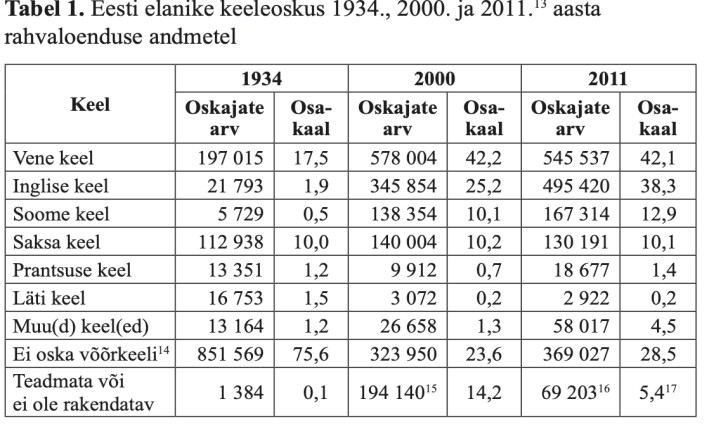
In 1922, Estonians 969,976 (87,7%), incl. 8,595 (0,8%) whom Estonian was not a common
language (est harilik keel; Mis keelt harilikult eraelus kõneleb?); Russians 91,109 (8.2%);
Germans 18,319 (1.7%); Jews 4,566 (0.4%); Swedes 7,850 (0.7%); other ethnises 14,508
(1.3%); unknown 731 (0,1%); Did not include questions about foreign language. (Koreinik,
Tender 2013). In 1934, the 1922 questionnaire + foreign language (What languages do you
speak except your common language (fr exceptée la langue habituelle); Residents’
trilingualism in Est+Ger+Rus? not necessarily (see Ariste 1969); In 1941, in administered
another census was administered by German occupational authorities: 90% Estonians; in
1939-1940 the resettlement/repatriation of Baltic Germans (ger Umsiedlung).
In 1918-1940, Estonian got its official status, Russian and German lost their dominant
position and became equal in status to other minority languages. The Manifesto to the
Peoples of Estonia of 24 February 1918 proclaimed the right to cultural autonomy for
Germans, Russians, Swedes and Jews (Müüripeal & Neljas 1999); native-language education
for both Estonians and non-Estonians was implemented in 1918, and the right to education in
one's mother tongue was later protected in the 1920 Constitution. This was followed in 1925
by the Act on Cultural Self-Government Bodies for Ethnic Minorities (aka the Law on
Cultural Autonomy), which was implemented by the German (1925) and Jewish minorities
(1926). Russians, Swedes, Latvians lived more compactly, and were able to realise minority
rights through local self-government (ibid.). See also Smith (2010).
The large-scale population losses sustained as a result of the Nazi and Soviet occupations,
coupled with mass settlement by Russian-speakers, brought a dramatic change in ethnic
composition (Verschik 2005). By 1989, the share of Estonians had dropped to 61.5%, in the
north-east, Estonians had become, and still are a minority (ibid.). the Soviet annexation and
the influx of labour from the other Soviet republics to Estonia in post-WWII decades
increased the share of foreign-born population to one of the highest in Europe (Puur et al.
2013). All-Soviet Union censuses were conducted in 1959, 1970, 1979 and 1989. During the
latter three, the census asked respondents to note their language skills beyond the mother
tongue, though limited response options to only the native languages of the peoples of the
Soviet Union.
Estonian sociolinguistic ecology in 1941-1991:
Domain loss to Russian in public administration, banking, militia, railway, navy and aviation
(Verschik 2005). A network of Russian-medium schools was created after the war, in which
little or no Estonian was taught after the 1950s. This “dual school system” extends beyond
the Soviet era (ibid.; Koreinik, Klaas-Lang 2021). Large-scale Russian monolingualism,
asymmetrical bilingualism, but cf. Old Believers’ extensive Russian-Estonian bilingualism
(Verschik 2005). South Estonian varieties (aka dialects): The process of language shift to
Standard Estonian throughout the XX c but intensified in the 1960s-1980s (Brown &
Koreinik, 2019).
12. What are those four (or five) types of linguistic/language environments speakers
of Estonian and speakers in Estonia interact in? Describe each in a couple of
sentences.
Four language environments in Estonia, plus one abroad:
• the capital Tallinn, characterized by equal shares of Estonians and Russian-speakers; north-
eastern Estonian towns, with a large majority of Russian-speakers; towns with a small (15–
30%) share of Russophones; Estonian-dominant towns and rural areas (Rannut 2005; Ehala et
al. 2014).
• Tallinn the most heterogeneous; “sleeping Population “vs. commuters, visitors, tourists
included the share of residents without knowledge of Estonian in metropolitan
neighbourhoods varies from 6.7% (in Nõmme) to 39.5% (in Lasnamäe)
• Estonian, English and Russian in its linguistic landscape (LL).
•Within the predominantly Estonian-speaking towns, Tartu is a special case, with its small
but diverse expat community, mainly consisting of international students and staff at HE
institutions. The share (18.7%) of those who have a command of three foreign languages is
higher than elsewhere.
• In the north-eastern towns, the share of residents with Estonian as their home language is
less than 10%. The linguistic environment is predominantly Russian. Fewer people have
acquired three or more foreign languages (2.5% in Narva compared to 21.3% in Tallinn).
• In most small towns and rural areas, Russian-speakers make up 1–5% of the population.
Due to the small number of Russians, in most places there have never been Russian-medium
schools.
Võru - the most distant variety of Standard Estonian; its collateral language.
• one of South Estonian (SE) dialects.
• the second most spoken and cultivated Estonian variety.
• In 2011 70,000+ reported some use of Võro; 60% of them reside outside the traditional
language area = not exposed to it daily and lack support of language environment
13. Describe sociolinguistic changes (language demography, domains, etc.,) in
Estonia after the WWII.
•The large-scale population losses sustained as a result of the Nazi and Soviet occupations,
coupled with mass settlement by Russian-speakers, brought a dramatic change in ethnic
composition (Verschik 2005).
• By 1989, the share of Estonians had dropped to 61.5%, in the north-east, Estonians had
become, and still are a minority (ibid.).
• the Soviet annexation and the influx of labour from the other Soviet republics to Estonia in
post-WWII decades increased the share of foreign-born population to one of the highest in
Europe (Puur et al. 2013).
• All-Soviet Union censuses were conducted in 1959, 1970, 1979 and 1989. During the latter
three, the census asked respondents to note their language skills beyond the mother tongue,
though limited response options to only the native languages of the peoples of the Soviet
Union.
After the war:
•Domain loss to Russian in public administration, banking, militia, railway, navy and aviation
(Verschik 2005).
• A network of Russian-medium schools was created after the war, in which little or no
Estonian was taught after the 1950s. This “dual school system” extends beyond the Soviet era
(ibid.; Koreinik, Klaas-Lang 2021)
• Large-scale Russian monolingualism, asymmetrical bilingualism, but cf. Old Believers’
extensive Russian-Estonian bilingualism (Verschik 2005)
• South Estonian varieties (aka dialects):
• The process of language shift to Standard Estonian throughout the XX c but intensified in
the 1960s-1980s (Brown & Koreinik, 2019).
14. Provide your definition of language policy and explain why this is a better
definition than others.
Language policy (LP) is about choice, choice of practice, beliefs and management: “it may be
the choice of a specific sound, or expression, or of a specific variety of language. It may be
the choice regularly made by an individual, or a socially defined group of individuals, or a
body with authority over a defined group of individuals” (Spolsky 2004: 217; 2009; 2012).
LP not as disembodied text but a situated sociocultural process, “a kind of social practice,
specifically a practice of power” (Levinson et al. 2009: 767).
15. What is the main language political challenge in Estonia today? Why?
1. Lack of a unified Estonian school system: Estonian schools and Russian schools.
2. Sustainability of Estonian in higher education.
3. Corpus planning: Regulation of official language as such.
16. Please consult Language Act (§ 23) and its Estonian-language Regulation of the
Government of the Republic on language requirements in public and other jobs
in our Moodle page. Use any application of MT for translation if needed.
§ 23. Requirements for proficiency in and use of Estonian language
(1) Officials and employees of state agencies and of local government authorities, as well as
employees of legal persons in public law and agencies thereof, members of legal persons in
public law, notaries, enforcement agents, sworn translators and the employees of their
bureaus shall be able to understand and use Estonian at the level which is necessary to
perform their service or employment duties.
(2) The requirement for employees of companies, non-profit associations and foundations
and for sole proprietors, as well as the members of the board of the non-profit associations
with the compulsory membership to be proficient in Estonian to the level that is necessary to
perform their employment duties shall be applied if it is justified in the public interest.
(3) The mandatory levels of language proficiency shall be established based on the language
proficiency levels defined by the Common European Framework of Reference for Languages
compiled by the Council of Europe, the description of which shall be presented in Appendix
1 to this Act.
(4) The requirements for proficiency in and use of the Estonian language for officials,
employees and sole proprietors shall be established by a Regulation of the Government of the
Republic. The regulation governs the requirements for proficiency in and use of Estonian of
persons specified in subsections (1) and (2) of this section, in accordance with the character
of work and the situation of the use of language at work or in the position.
(5) The requirements for proficiency in the Estonian language do not apply to persons who
work in Estonia temporarily as foreign experts or foreign specialists. Foreign lecturers and
researchers shall not be applied the requirements for proficiency in Estonian if they have
worked in Estonia for less than five years.
Ametniku, töötaja ning füüsilisest isikust ettevõtja eesti keele oskuse ja kasutamise nõuded
§ 2. Keeleoskuse nõue
(1) Keeleoskuse nõude määramisel lähtutakse töö iseloomust ja töö- või ametikoha
keelekasutusolukordadest, sh kutsestandardites esitatud keeleoskusnõuetest.
(2) Keeleoskuse nõude määramisel võetakse aluseks Euroopa keeleõppe raamdokumendis
määratletud keeleoskustasemed, mille kirjeldus on esitatud „Keeleseaduse” lisas 1.
Keeleoskustasemete kirjeldustes loetletud oskustele ja pädevustele lisandub töö- ja ametialase
sõnavara valdamise nõue.
(3) Tööandja tagab, et töötajad või ametnikud, kellelt ametialaste kohustuste ja
tööülesannete täitmiseks vastavalt käesolevale määrusele nõutakse eesti keele oskust,
valdavad eesti keelt nõutaval tasemel.
(4) Käesolevas määruses kehtestatakse keeleoskuse nõue miinimumtasemel. Tööandjal on
õigus kehtestada töö- või ametikohale käesolevas määruses kehtestatust kõrgem eesti keele
oskuse nõue, kuid mitte kõrgem kui C1-tase.
Keelekasutusolukordade iseloomustus
§ 3. A-tasemel keelekasutaja keelekasutusolukordade iseloomustus
Vähemalt A-tasemel keeleoskust nõutakse isikutelt, kelle teenistuskohustused või
tööülesanded on konkreetset laadi ning täpselt piiritletud, keelekasutusolukorrad on rutiinsed
ja kirjalik töö piirdub tüüpdokumentide koostamise või plankide täitmisega.
§ 4. B-tasemel keelekasutaja keelekasutusolukordade iseloomustus
Vähemalt B-tasemel keeleoskust nõutakse isikutelt, kelle teenistuskohustused või
tööülesanded on mitmekesised ning võivad olla seotud asjaajamise, allüksuse juhtimise või
koostööga, samuti tööks vajalike (etteantud sisuga) dokumentide koostamisega.
§ 5. C-tasemel keelekasutaja keelekasutusolukordade iseloomustus
C-tasemel keeleoskust nõutakse isikutelt, kelle teenistuskohustused või tööülesanded on
seotud üksuse juhtimise, tegevuse kavandamise ja koordineerimisega, samuti nõustamise,
avalike ettekannete, sõnavõttude ja ametlike kirjalike tekstide koostamisega.
Keeleoskusnõuded
§ 6. A2-tasemel keeleoskuse nõue
Vähemalt A2-tasemel eesti keele oskust nõutakse järgmistelt isikutelt:
1) ametiasutuse tehnilist või abistavat laadi tööülesandeid täitvad töötajad, nagu autojuhid,
kütjad, paljundajad ja teised sarnased töötajad;
2) veduri- ja rongijuhid;
3) valvetöötajad, piletikontrolörid, riidehoidjad, uksehoidjad, käskjalad.
§ 7. B1-tasemel keeleoskuse nõue
Vähemalt B1-tasemel eesti keele oskust nõutakse järgmistelt isikutelt:
2) tegevteenistuses olevad sõdurid ja nooremallohvitserid;
3) ametiasutuse töötajad, kelle tööülesanded on seotud ametiasutuse asjaajamise
korraldamise toetamisega, nagu andmesisestajad, postisekretärid ja teised sarnased töötajad;
4) päästetöötajad;
5) õppejõud (v.a eesti keele ja eesti keeles õpetatavate ainete õppejõud);
6) teenindus- ja müügitöötajad, kelle tööülesannete hulka kuulub tarbijate vahetu ja
regulaarne teenindamine, tööalase teabe edastamine või tööohutuse eest vastutamine;
7) seadusest tuleneva kohustusliku liikmesusega mittetulundusühingute juhatuse liikmed ja
töötajad, kelle tööülesannete hulka kuulub mittetulundusühingu liikmetega suhtlemine või
teabe edastamine;
8) toitlustus-, müügi- või majutusteenust osutavate väikeettevõtete juhid, kelle tööülesannete
hulka kuulub tarbijate teenindamine;
9) isikuhooldustöötajad ja sotsiaalhoolekandeasutuse abipersonal;
10) ühissõidukite juhid (v.a laevade ja õhusõidukite ning veduri- ja rongijuhid);
11) oskus- ja käsitöölised, kelle tööülesannete hulka kuulub tarbijate teenindamine;
12) seadmete operaatorid ja mehhanismide juhid, kelle tööülesannete hulka kuulub tarbijate
teenindamine.
§ 8. B2-tasemel keeleoskuse nõue
Vähemalt B2-tasemel eesti keele oskust nõutakse järgmistelt isikutelt:
1) kinnistusameti tehnilised sekretärid, kohtukordnikud, äriregistri tehnilised sekretärid ning
ametiasutuse raamatupidajad ja referendid;
2) laevaliikluse juhtimise keskuse operaatorid (VTS operaatorid);
3) politseiametnikud, kes on vanemspetsialisti või nooremspetsialisti ametikohal
piiripunktis, kordonis, piirivalvelaeval, valmidusüksuses või Lennusalgas;
4) päästeametnikud, kes on rühmapealiku või meeskonnavanema ametikohal;
5) valitsusasutuste hallatavate riigiasutuste, kohaliku omavalitsuse ametiasutuste hallatavate
asutuste ning avalik-õiguslike juriidiliste isikute ja nende asutuste osakondade või muude
struktuuriüksuste juhid ning nende asetäitjad;
6) pedagoogid (v.a eesti keele ja eesti keeles õpetatavate ainete õpetajad);
7) eripedagoogid, kelle teenust tarbivad mitte-eesti emakeelega isikud;
8) hoolekandetöötajad (nt rehabilitatsiooniteenuse, erihoolekandeteenuse, lapsehoiuteenuse
osutajad, asenduskodu kasvatajad jne), välja arvatud § 7 punktis 9 nimetatud abipersonal;
9) velskrid, ämmaemandad ja meditsiiniõed;
10) tervishoiu abispetsialistid, kelle tööülesannete hulka kuulub patsientidega suhtlemine ja
teabe edastamine;
11) teenindus- ja müügitöötajad, kes tegelevad seadusega sätestatud kindlustustegevuse või
-vahendusega;
12) teenindus- ja müügitöötajad, kes tegelevad isiku elu ja tervist, ühiskonna turvalisust või
keskkonda ohustada võivate kaupade müügi või käitlemisega ja selles valdkonnas tarbijate
nõustamisega;
13) turvatöötajad, kelle tööülesanded on seotud avaliku korra tagamisega või kes seoses
tööülesannete täitmisega kannavad relva või kasutavad erivahendeid;
14) lootsid;
15) tegevteenistuses olevad vanemallohvitserid;
151) ametiasutuse töötajad;
16) muud töötajad, kes töötavad keskeri- või kõrgharidust nõudvatel töökohtadel ja kelle
tööülesannete hulka kuulub tarbijate teenindamine, tööalase teabe edastamine või tööohutuse
eest vastutamine;
17) muud eespool nimetamata valitsusasutuste hallatavate riigiasutuste, kohaliku
omavalitsuse ametiasutuste hallatavate asutuste ning avalik-õiguslike juriidiliste isikute ja
nende asutuste keskeri- või kõrgharidust nõudvatel töökohtadel töötavad spetsialistid.
§ 9. C1-tasemel keeleoskuse nõue
C1-tasemel eesti keele oskust nõutakse järgmistelt isikutelt:
1) ametnikud;
21) ametiasutuse struktuuriüksuse juhid, nende asetäitjad ja tippspetsialistid;
3) tegevteenistuses olevad ohvitserid;
4) juristid-asjaajajad, sekretärid-asjaajajad ja kohtuistungi sekretärid;
5) valitsusasutuste hallatavate riigiasutuste, kohaliku omavalitsuse ametiasutuste hallatavate
asutuste ning avalik-õiguslike juriidiliste isikute asutuste juhid ja nende asetäitjad;
6) õppeasutuste juhid, nende asetäitjad ja õppejuhid;
7) eesti keele ja eesti keeles õpetatavate ainete õpetajad või õppejõud;
8) arstid (sh veterinaararstid), psühholoogid, farmatseudid ja proviisorid;
9) eripedagoogid (v.a need, kelle teenust tarbivad mitte-eesti emakeelega isikud);
10) kohtutäiturid;
11) advokatuuri liikmed (vandeadvokaadid, vandeadvokaadi vanemabid ja vandeadvokaadi
abid);
12) notarid;
13) pankrotihaldurid;
14) kohtunikud ja kohtunikuabid;
15) prokurörid;
16) politseiametnikud, v.a § 8 punktis 3 nimetatud politseiametnikud;
17) päästeametnikud, v.a § 8 punktis 4 nimetatud päästeametnikud;
18) vanglaametnikud;
19) laevade ja õhusõidukite juhid (v.a rahvusvahelises õhuveos osalevate õhusõidukite
juhid);
20) õhu-, mere- või raudteeliiklust korraldavad ja sellekohast teavet edastavad töötajad,
välja arvatud lennujuhid, kes osutavad lennuliiklusteenust piirkondlikus
lennujuhtimissektoris, mille alumine piir on 9500 jalga, kus lendude juhtimine toimub ainult
inglise keeles.
§ 10. Üleminekusätted
(1) Paragrahvi 7 punktis 6 ja § 8 punktis 16 nimetatud isikud, kelle tööülesannete hulka
kuulub tööalase teabe edastamine või tööohutuse eest vastutamine, ja § 7 punktis 7 nimetatud
isikud, kelle keeleoskus vastab käesoleva määruse jõustumise ajal oma töö- või ametikohal
töötamiseks kehtestatud keeleoskustasemele, viivad oma keeleoskuse käesoleva määrusega
vastavusse 1. juuliks 2012. a. Kuni selle tähtpäevani ei ole käesoleva määrusega nõutaval
tasemel keeleoskuse puudumine „Töölepingu seaduse” § 88 lõikes 1 nimetatud põhjusel
töölepingu ülesütlemise aluseks.
(2) Vanglaametnikud, kes töötavad käesoleva määruse jõustumise ajal valvuri,
vanemvalvuri, saatja või vanemsaatja ametikohtadel ja kelle keeleoskus vastas enne 1.
veebruari 2011. a B2-tasemele, viivad oma keeleoskuse käesoleva määrusega vastavusse 1.
veebruariks 2013. a. Kuni selle tähtpäevani ei ole käesoleva määrusega nõutaval tasemel
keeleoskuse puudumine „Avaliku teenistuse seaduse” § 117 lõike 1 punktis 3 nimetatud
põhjusel teenistusest vabastamise aluseks.
(4) Isikud, kelle keeleoskus vastas enne 1. aprilli 2013. a oma töö- või ametikohal
töötamiseks kehtestatud keeleoskustasemele, viivad oma keeleoskuse vastavusse pärast 1.
aprilli 2013. a töötamiseks kehtestatud keeleoskustasemega 1. aprilliks 2016. a.
17. Describe at least two sociolinguistic/language policy aspects in which the Baltic
states are like each other? Please elaborate on your answer in a couple of
sentences.
The smallness and socio-economic weakness of the titular collectives.
Estonian L1 users – 1m
Latvian L1 users – 1,5m
Lithuanian L1 users – 3m
The centrality of the state in language policy.
„Although the Soviet successor states share a common past with common linguistic concerns,
each of the Baltic States represents a unique sociolinguistic experiment owing to its unique
demographic and economic predicament. This has led to three different patterns of
development. “
• Language issues are salient in policies and public debates in all the Baltic countries.
• Maintaining the national language is important collective goal for Estonian, Latvian, and
Lithuanian L1 speakers.
• Language maintenance efforts run in parallel with the discourse of being threatened by
dominant languages (Russian, English, (Polish)).
• The state policy discourse often portrays Estonian, Latvian, and Lithuanian as weak and
vulnerable, and thus in the need for state action (Rozenvalde, Klaas-Lang, Mačiankiene, in
press; Rozenvalde 2022; Brubaker 2011)
We explore state and university language policy agents in Estonia, Latvia & Lithuania to
illuminate their relationship and standpoints in higher education language management.
→ Humboldt (1810): the interests of the state are best served when it ensures the material
existence of universities but does not prescribe how to put the financing in use.
→ Autonomy should not be boundless; the state should formulate “organizational laws that
are few and simple” to pre-empt the universities from threatening the freedom themselves as
universities also “take on a certain spirit and like to stifle a different one from arising.”
→ Universities in Europe are often free to decide upon their language policies.
18. How can the concept of ‘minoritized majority languages’ help us clarify the
particularities of the language policy regimes in Estonia, Latvia, and Lithuania?
19. Are top-down language policies important for sustaining languages such as
Estonian, Latvian, and Lithuanian? Why?
Power is not simply a top-down exercise of control and domination, but it is also dispersed
and horizontal:” Power is everywhere … because it comes from everywhere” (Foucault 1998,
p. 63). It is not an agency or a structure. Instead it is a kind of” metapower” or “regime of
truth” that pervades society, and which is in constant flux and negotiation.
POWER FROM TOP-DOWN ⇩
* Nation- and state-building: linguistic unification, monolingualism, homogenization,
simplification; social cohesion
* importance of institutions (education, labour market, ..)
* overt and covert policies
Overt institutional policies have a very limited impact on the language choice of speakers.
→ Philippe van Parijs (2011): default language choice, for language learning/teaching, for
symbolic emphasis, due to language policy
Policies ”can at best impose the acquisition, but not the generalized use and therefore the
autonomous reproduction, of the legitimate language.”
20. Describe the challenges that the current linguistic diversity on the ground creates
for state policymakers in the Baltic countries?
“Linguistic diversity has advantages as well as disadvantages, in clearly distinguishing friend,
acquaintance, trading partner and foe.”
“Linguistic diversity complicates attempts to build stable and cohesive forms of political
community.” (p. 3)
“Why isn’t the appropriate solution simply a hands-off approach, leaving the choice of
language use to individuals? /…/ Although the state can avoid interfering with the language
choices people make away from public institutions, there is no way to avoid taking a stand on
a series of other language policy issues” (p. 9) – public services, public education
21. Differences (at least five) and similarities (at least five) in the linguistic
environment and in state language management in Estonia and your home
country (or between Estonia and the country analysed in your presentation/or in
the country introduced in the seminars)?
The dialectic of instrumental and integrative functions of language and culture gives rise to
linguistic environment. Language environment is the totality of communicative conditions
surrounding an individual or a linguistic community. In semiotic terms: linguistic
environment is bordering and overlapping of different semiospheres in a given territory, be it
a village, city, state, continent or the world. The evolutions of the language environment is
the consequence of interethnic processes where each group tries to find balance between its
instrumental and integrative needs.
Status – association with power and influence in the social group (H and L).
H language is used by government, schools, powerful individuals, urban people.
L language is not used in some of these situations or by these people.
Intimacy – association with friendship, solidarity, ingroup contacts.
Some language varieties are used for intimate communications, some other are not or less.
These factors affect language choice: there is reverse correlation of status and intimacy.
Linguistic union: languages of one geographical area, which are not genetically related, but
due to long term contacts have developed many similar traits.
The Baltic sea linguistic union
Convergence: the change of languages in contact to becom more similar, eg in the case of a
linguistic union
Eg intonation in Swedish, Latvian and Estonian islands.
Structural and lexical similarities between related and non-related languages
The core (EST; LAT) and periphery of a linguistic unioon (FIN; LIT): (silta:sild:tilts:tiltas
´bridge´) - apocope
Baltic (Baltic Sea) linguistic union:
Finnic (Estonian, Livonian, Finnish)
Baltic (Lithuanian, Latvian;Old Prussian???)
Slavic (North-Western Russian dialects)
Germanic (Baltic German dialects, Swedish, Estonian Swedish)
22. How would you assess the vitality of Estonian now? Justify your assessment.
Estonian
has a critical mass of speakers.
enjoys the status of a state language and an official language of EU.
used in all spheres of life including everyday communication and high culture,
business and science.
used as a medium of instruction on all educational levels from compulsory school to
doctoral studies.
used at home, and they have offspring.
IT-support is available
One of the smallest languages in the world that functions as official language in all spheres of
use: administration, media, literature, theatre, business, school, universities, research, etc.
23. What measures can be taken to ensure the vitality of a less widely spoken
language?
To ensure the vitality and functioning of the Estonian language in the Republic of Estonia as
the primary language in all areas of life, to ensure the right and opportunity for everyone to
use Estonian in Estonia, to preserve and strengthen the status and prestige of Estonian and the
Estonian cultural and information space, and to value proficiency in other languages.
In order to achieve the overall objective, strategy sets out goals in three sub-areas:
1. Status and prestige of Estonian.
2. Language research and infrastructure.
3. Teaching and learning.
24. Describe some language PR actions in Estonia (at least five) and give some
examples in your home country or in the country introduced in the seminars.
Emakeelepäev – The Mother Tongue-day 14th March; 1996;
https://et.wikipedia.org/wiki/Emakeelep%C3%A4ev
The national F. J. Wiedemann Language Award has been bestowed since 2004
the language deed of the year has been nominated since 2007;
https://et.wikipedia.org/wiki/Aasta_keeletegu
KEELETALGUD – 2008 - The contest to find the most beautiful Estonian sentence
https://et.wikipedia.org/wiki/Keeletalgud
Sõnaus – the President´s Estonian-word competition – Toomas Hendrik Ilves
https://et.wikipedia.org/wiki/Presidendi_s%C3%B5nav%C3%B5istlus
from 2011 onwards an award will be given for the best university textbook;
EHE EESTI – EESTI ETTEVÕTTELE EESTI NIMI (Name competition – Genuine Estonia
– Estonian names for Estonian companies);
https://www.internet.ee/eif/news-archive/genuine-estonia-estonian-names-for-estonian-
companies-is-now-also-looking-for-the-most-beautiful
 10 punkti
Autor soovib selle materjali allalaadimise eest saada 10 punkti.
10 punkti
Autor soovib selle materjali allalaadimise eest saada 10 punkti.
 ~ 21 lehte
Lehekülgede arv dokumendis
~ 21 lehte
Lehekülgede arv dokumendis
 2023-01-24
Kuupäev, millal dokument üles laeti
2023-01-24
Kuupäev, millal dokument üles laeti
 0 laadimist
Kokku alla laetud
0 laadimist
Kokku alla laetud
 0 arvamust
Teiste kasutajate poolt lisatud kommentaarid
0 arvamust
Teiste kasutajate poolt lisatud kommentaarid
 Liilia Soo
Õppematerjali autor
Liilia Soo
Õppematerjali autor
 annaabi.ee









Kõik kommentaarid