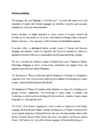
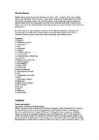
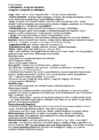
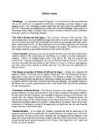
CONTENT · Australia · Symbols · Location · States · Language · Religion · Education · Health · Culture · Humour · Video AUSTRALIA · Is a country, and a continent · Is the sixth largest country in the world · The world's smallest continent SYMBOLS · Green and gold were confirmed as Australia's national colours in 1984 · The Golden Wattle was officially proclaimed as the national floral emblem in 1988 · National anthem is Advance Australia Fair · National Gemstone is Opal Coat of arms of Australia LOCATION · Located in oceania, continent between the Indian Ocean and the South Pacific Ocean STATES · Western Australia · Northern Territory · South Australia · Queensland · New South Wales
Australian symbols National symbols of Australia are the symbols that are used to represent what is unique about the nation, reflecting different aspects of its cultural life and history. FLAG- It was first flown in Melbourne on 3 September 1901. This date has been proclaimed as Australian National Flag Day. COAT OF ARMS- The Coat of Arms is the formal symbol of Australia and its ownership and authority. ANTHEM- Created by the Scottish-born composer Peter Dodds McCormick, the song was first performed in 1878, and was sung in Australia as a patriotic song. It did not gain its status as the official anthem until 1984, following a plebiscite to choose the national anthem in 1977.
appointed as a Provincial Commissioner of Estonia. A six-member Provisional National Council, the Maapäev, was formed. The Maapäev appointed a national executive that began to organise and modernise local government and educational institutions. Prior to its forceful dissolution by Bolshevik authorities, and the foreseeable invasion by German forces, the Maapäev took a decisive step toward sovereignty by declaring itself the supreme authority in Estonia on November 15, 1917. Independence Proclaimed The elections to the Estonian Constituent Assembly were held on February 3-4, 1918. Parties which supported the idea of national independence, gained two-thirds of the popular vote. With Soviet forces hastily retreating and German forces advancing, the Maapäev elected a three-member Salvation Committee, Päästekomitee, and granted it full decision-making powers to ensure the continued activity of the Maapäev. The Päästekomitee drafted a declaration of independence.
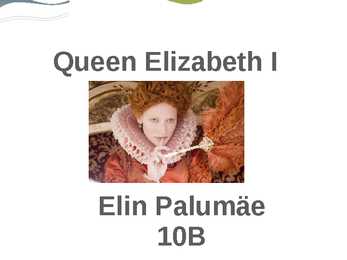
In eight short years she had lost her mother and had had three stepmothers, two of whom were now dead. Janeli Õim 11A The line of succession (Edward Mary Elizabeth) Henry died on 28 January 1547. Edward become King of England at the age of only nine. Edward Seymour became Protector of England Elizabeth went to live with the Queen Dowager Katherine, but left her household after an incident. When Edward VI died in 1553 Lady Jane Grey was proclaimed Queen Janeli Õim 11A Nine days after Jane was proclaimed Queen, Mary rode into London with her sister Elizabeth Mary becomes Queen She sensed the danger from her younger sister, and imprisoned her in the Tower. Later Elizabeth was moved from the Tower to Woodstock, where she was to spend almost a year under house arrest. Elizabeth had survived finally as a Queen of England after news of Mary's death on November 17, 1558.
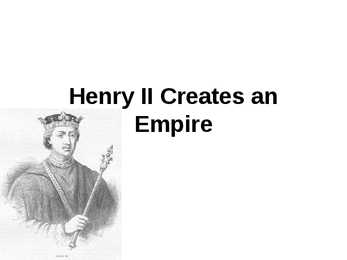
· It was 1147 when Henry had accompanied his mother on an invasion of England. · On 22 May 1149 he was knighted by King David I of Scotland. · Within the year he secured his right to the throne. · On 19 December 1154 he was crowned in Westminster Abbey. Lordship over Ireland · Shortly after his coronation, Henry sent a group of clerics to invade Ireland. · In 1171, Henry arrived from France, declaring himself Lord of Ireland. · In 1172, Roman Catholicism was proclaimed as the only permitted religious practice in Ireland. Consolidation in Scotland · An invasion force from Scotland led by their King was advancing from the North. · Flemish armada was sailing for England, just days from landing. · The hostile armada dispersed in the English Channel. · By the end of this crisis the King was "left stronger than ever before".
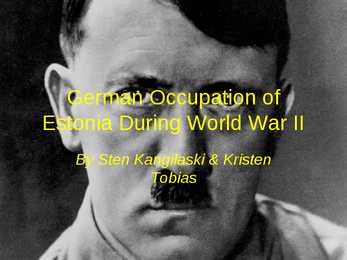
German Occupation of Estonia During World War II By Sten Kangilaski & Kristen Tobias The Beginning · WWII began with the invasion of Poland · Poland was an important regional ally to Estonia · On september 24th, 1939, the Moscow press and radio started attacking Estonia as "hostile" to the Soviet Union. Summer War · After Germany invaded the Soviet Union on June 22, 1941, Finland sided with Germany in the Continuation War. · Thousands of people including a large portion of women and children were killed. · Dozens of villages, schools and public buildings were burned to the ground. German Occupation · Most Estonians greeted the Germans with relatively open arms. · In April 1941, Alfred Rosenberg laid out his plans for the East. · Rosenberg felt that Estonians were the most Germanic out of the people living by the Baltic Sea. The Holocaust · The first...
and the Indians thought the Pilgrims how to hunt, fish, and grow food. Because of this help they had a good harvest every year. Governor William Bradford invited the Pilgrims and the Indians to share a Thanksgiving feast to strengthen the bond between them. They accepted. The celebration lasted 3 days. The holiday was a great success. Later, Thanksgiving was celebrated in all the colonies of New England. In 1863 President Abraham Lincoln proclaimed it a national thanksgiving. The modern Thanksgiving turkey is much like the ones hunted in Plymouth. Squash, corn, pumpkin pie and Indian pudding appear on the Thanksgiving table. Today Thanksgiving lasts for 4 days. It's a family day and also a day of hospitality and giving.
Tallinn The first traces of human settlement found in Tallinn's city center by archeologists are about 5000 years old. In 1050 the first fortress was built on Tallinn Toompea.[3] In 1285 the city became the northernmost member of the Hanseatic League. Medieval Tallinn enjoyed a strategic position at the crossroads of trade between Western and Northern Europe and Russia. On 24 February 1918, the Independence Manifesto was proclaimed in Tallinn, followed by Imperial German occupation and a war of independence with Russia. On 2 February 1920, the Tartu Peace Treaty was signed with Soviet Russia, wherein Russia acknowledged the independence of the Estonian Republic. Tallinn became the capital of an independent Estonia. After World War II started, Estonia was occupied by the Soviet Union (USSR) in 1940, and later occupied by Nazi Germany from 1941–44. After Nazi retreat in 1944, it was occupied by the USSR again
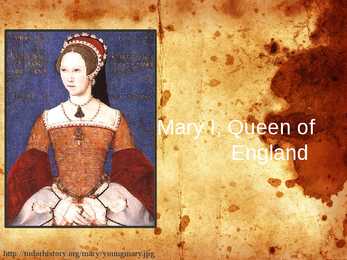
Mary I, Queen of England http://tudorhistory.org/mary/youngmary.jpg Queen Mary I of England Born: 18 February 1516 Proclaimed Queen: 19 July 1553 at St. Paul's Cathedral Coronation: 1 October 1553 Died: 17 November 1558 Buried: 14 Decenber 1558 http://tudorhistory.org/mary/marywhitehall.jpg Mary Tudor The Tudor Britain (1485-1603) Daughter of Henry VIII and Catherine of Aragon Henry divorced Catherine and married Anne Boleyn From "princess" to "The Lady Mary" http://tudorhistory.org/mary/marytudorsig.gif http://tudorhistory
I love my brother/and I'm going to bury him, now." Antigone, non-heroically, accuses Ismene of not loving her brother, but of course Ismene loved her brother, Ismene was just afraid of the king. Antigone, in the heat of the moment, took Ismene's frightened state as a sign of the lack of love on Ismene's part. On page 39, lines 550-558, Antigone accuses King Kreon that his decisions were contrary to what the Gods laid out. Antigone says in lines 551, and 554: "that Zeus was the one who had proclaimed;/. . . The laws they have made for men are well marked out." Antigone should have realized, as she stated, the laws they, the gods, have made for men are well marked out, and if she had allowed the gods to correct matters she would not have needed to confront the king. Her unfaithfulness toward the gods was very non-heroic. In modern society, we today act in the same manner as Antigone did toward her family. Our loyalties
autonomy within Imperial Russia as the Duchy of Estonia. The Magistracy of Reval was abolished in 1889. The 19th century brought industrialization of the city and the port kept its importance. During the last decades of the century Russification measures became stronger. February 1918, the Independence Manifesto was proclaimed in Tallinn, followed by Imperial German occupation and a war of independence with Russia. On 2 February 1920, the Tartu Peace Treaty was signed with Soviet Russia, wherein Russia acknowledged the independence of the Estonian Republic. Tallinn became the capital of an independent Estonia
Throughout this period the Baltic German nobility enjoyed autonomy, where the language of administration and education was German. • The Estophile Enlightenment Period 1750–1840 led to the Estonian national awakening in the middle of the 19th century. In the aftermath of World War I and the Russian revolutions, the Estonian Declaration of Independence was issued in February 1918. The Estonian War of Independence ensued on two fronts between the newly proclaimed state and Bolshevist Russia to the east and the Baltic German forces (the Baltische Landeswehr) to the south, resulting in the Tartu Peace Treaty recognising Estonian independence in perpetuity. • In 1939-1940, Estonia was occupied and (according to e.g. the USA, the EU, and the European Court of Human Rights) illegally annexed by the Soviet Union as a result of the Molotov–Ribbentrop Pact.
Estonian Declaration of Independence · Estonian Declaration of Independence, also known as the Manifesto to the Peoples of Estonia is the founding act of the Republic of Estonia from 1918. It is celebrated on 24 February, the National Day or Independence Day of Estonia. · The declaration was drafted by the Salvation Committee of the Estonian National Council, Maapäev, and approved by the elders of the Maapäev. Originally intended to be proclaimed on 21 February 1918, the proclamation was delayed until the evening of 23 February, when the manifesto was printed and read out aloud publicly in Pärnu. On the next day, 24 February, the manifesto was printed and distributed in the capital, Tallinn. MORE · 1991 Collapse of the Soviet Union: Estonia declares its independence from the Soviet Union. · 1991 The United States recognizes the independence of Estonia, Latvia and Lithuania.
In Kopli was established ship factories( ,,Vene-Balti's", ,,Noblenesser's" and ,,Bekker's factory"). Tramway was opened in Kopli in 1915 by factories ( ,,Vene-Balti's", ,,Noblenesser's" and ,,Bekker's factory") to they'r workers transport. 4 Independent Estonia (1918-1940) On February 24, 1918 Estonia took advantage of the weakening Bolsheviks and proclaimed independence; already the next day German troops occupied Estonia. Local town government was restored after Germany capitulated in the WW I. The first city council elected during the Republic of Estonia assembled on June 16, 1919. On 2 February 1920, the Tartu Peace Treaty was signed with Soviet Russia, wherein Russia acknowledged the independence of the Estonian Republic. Tallinn became the capital of an independent Estonia. Esonian first constitutional law was accepted in 15.06.1920
and a part of China each for a certain amount of time. Tibet was first unified under King Songtsän Gampo in the seventh century. A government nominally headed by the Dalai Lamas, a line of spiritual leaders, ruled a large portion of the Tibetan region at various times from the 1640s until 1950s. During most of this period, the Tibetan administration was subordinate to the Chinese empire of the Qing Dynasty. The 13th Dalai Lama proclaimed Tibet independent in 1913, but this declaration was not accepted by China. Furthermore, Tibet was not recognized by any country as a de jure independent nation. As a measure of the power that regents must have wielded, it is important to note that only three of the fourteen Dalai Lamas have actually ruled Tibet; regents ruled during 77 percent of the period from 1751 until 1960.The Communist Party of China gained control of central and western Tibet
university in Estonia was founded at Tartu in 1632. Tartu University is still widely considered the most important university in Estonia. The period is still often remembered by Estonians as "the Good old Swedish time". In the early 18th century, the Great Northern War left Estonia under Russian rule. A high point of the Estonian national movement was the first nation-wide Song Festival in Tartu in June 1869. In 1918 on the 24th of February, the Estonian Republic was proclaimed. It is a highly important holiday in Estonia. At first it was merely a decision on paper. True independence was fought for in the following years, in the War of Liberation. Independence lasted until 1939 when a pact between Nazi Germany and the Soviet Union was signed. Following the Soviet occupation in 1940, Estonia was occupied by Nazi Germany from 1942 to 1944. The Soviet Union incorporated Estonia in the autumn of 1944. A large proportion of the population fled abroad
In 1840 the Treaty of Waitangi was signed between the Maori and the British, with what the Maori accepted the British colonization in exchange for the protection of their lands. But still, 20 years later a war between the Maori and white people or pekaha broke out and finally the native people of New Zealand were defeated. New Zealand was given dominion status in the British Empire in 1907 and granted autonomy by Britain in 1931, independence was formally proclaimed 1947. Today the Maori population is increasing faster than the pekaha, and Maori culture has had a major impact on New Zealand's society. The word "aboriginal" means "the first" or "the earliest known". The Aborigines reached Australia more than 40 000 years ago. They are dark-skinned people who probably came from Asia. They were hunter-gatherers, using spears and boomerangs for hunting. Before the first white settlers came, there were around 300 000 aborigines in about 250 tribal groups
Because Henry divorced Catherine, Mary was declared illegitimate. Nonetheless, Henry included her in his will, and on the death of her half-brother, Edward VI, on July 6, 1553, she became the legal heir to the throne. Although Lord High Chamberlain John Dudley, Duke of Northumberland, favoured the succession of his daughter-in-law, Lady Jane Grey, and proclaimed her queen on July 10, the country supported Mary. As a Roman Catholic, Mary began her reign by sweeping away the religious innovations of her father and her brother. Henry VIII had separated England from the Church in Rome; Edward VI had replaced Roman Catholicism with a Protestant settlement. Mary restored the Mass and re-established the authority of the papacy, but, although she handed back Crown property to the Church, Parliament refused to restore Church lands seized by Henry VIII.
June 1940.Thousands of Estonians were killed or deported to Siberia. In 1944, Estonia became part of the Soviet Union. Proindependence guerrilla forces continued to fight against the Soviets into the 1950s. In the "Singing Revolution" of the 1980s, Estonians showed their desire for independence in peaceful mass meetings. In 1989, 2 million people from the three Baltic countries linked hands in a human chain stretching from Tallinn to Vilnius in Lithuania. Independence was proclaimed(declared) on Aug. 20, 1991.Within weeks Estonia was recognized as a free and independent country On June 20, 1992, the kroon replaced the rouble. In September 1992 Estonians elected their first president and parliament in more than 50 years. On 14 September 200 In May 1993, the Council of Europe voted Estonia a full member. On May, 1, 2004 Estonia joined the European Union. Wordlist 1. vallutama Eestit 2. pärinema 12 sajandist 3. ühinema millegagi 4. nõudma iseseisvust 5
Australia's national anthem is `Advance Australia Fair', which replaced `God Save the Queen' in 1984. It was written by a Scottish-born composer, Peter Dodds McCormick. The unofficial anthem of Australia is `Waltzing Matilda'. It tells a story about a swagman, who has named his sleeping blanket Matilda. He is chased by police for stealing a sheep which he wanted to eat. The swagman doesn't want to be punished, so he jumps into a billabong and drowns. The golden wattle was proclaimed the official national floral emblem in 1988. It is a spreading shrub or a small tree, which grows in the under storey of open forest, woodland and open scrub in South Australia, Victoria, New South Wales and the Australian Capital Territory. Green and gold were proclaimed Australia's national colour by the Governor-General in 1984. Before the proclamation, Australia had no official colour, although three colour
, the barons were restored their former privileges. Life changed for the better thanks to the opening of a railway line from St. Petersburg to Tallinn in 1870. Tallinn grew into a major port and an industrial centre, with huge shipyards employing a large workforce. Interest in culture grew and Estonians became conscious of their national identity; dreams of independence gained ground. Tartu was the centre of the movement of national awakening. On 24 February 1918, Estonia was proclaimed an independent democratic republic. Tallinn developed into a modern European capital. A period of prosperity followed, but independence only lasted for 20 years. 1 During World War II Estonia was occupied by both German and Russian invaders, and Tallinn suffered heavily. The bombing of the city by the Soviet air force on 9 March 1944 left over 20,000 people homeless. During the Russian occupation
of Blanche Herbert, Lady Troy who remained her Lady Mistress until her retirement in late 1545 or early 1546. Catherine Champernowne, better known by her later, married name of Catherine Ashley, was appointed as Elizabeth's governess in 1537, and she remained Elizabeth's friend until her death in 1565. She clearly made a good job of Elizabeth's early education. Mary I's Regin Edward VI died on 6 July 1553, aged 15. His will swept aside the Succession to the Crown Act Lady Jane was proclaimed 1543, excluded both Mary and queen by the Privy Council, Elizabeth from the succession. but her support quickly Instead declared as his heir crumbled, and she was Lady Jane Grey, deposed after reigning nine granddaughter of Henry VIII's days. sister Mary, Duchess of Mary rode triumphantly into Suffolk. London, with Elizabeth at her side.
Britain, France, Sweden and Portugal started establishing their colonies in America. Pilgrim Fathers (the British) established a colony called Jamestown in Virginia. They had to fight for their lives over there because America was still unknown for them, but they survived and started establishing even more colonies. The Thirteen British colonies started a rebellion against their motherland in 1775 and proclaimed their independence in 1776 and formed a nation in 1781 called United States of America. The United States defeated British army with help of Spain and France in The American Revolutionary War (17751783). Thirteen colonies formally declared their independence from Great Britain on July 4, 1776 when they declared it in the Declaration of Independence. In 1789 George Washington became the first president of the United States.
the church. Henry VIII delegated more state business to him, he was asked to use his influence in Rome to get a papal annulment for the divorce. Wolsey was anable to do this, his downfall began. He was accused of treason, he died on a journey to trial Catherine of Aragon A spanish princess, Henry´s wife. She had borne him 5 children, but only Mary survived. King demanded a male heir to protect Tudor dynasty. After Henry proclaimed hismelf the Head of the English church, he secretly married Anne Boleyn . Catherine was forced to live much reduced conditions and denied access to her daughter. Anne Boleyn Second wife. She was already pregnant when getting married. They had a daughter Elizabeth, alter Elizabeth I. Anne miscarried a deformed male fetus, henry was convinced, God had damned this marriage. Anne was publicly executed Jane Seymour 3rd wife
overwhelmingly large, with citizens holding fast to the city's Hong Kong and Shanghai -- as mantra, "Keep Austin Weird." a tourist destination. The city Although home to vast green boasts world-class attractions, spaces, funky boutiques and cozy like the Forbidden City and coffee shops, Austin really comes Tiananmen Square, that to life at night; the self-proclaimed showcase country's past and "Live Music Capital of the present. Plus, the jaw-dropping World" boasts numerous live Great Wall of China stands just music venues and one of the north of the city, making largest music festivals in the U.S. Beijing a world-traveler must. Sydney and Rio de Janeiro Why Go: Sydney has more than just Why Go: With its sun- an opera house
vast Umayyad Caliphate's empire of Damascus that stretched from the Indus river in India up to the South of France until its collapse in 750, a year in which the west of the empire gained its independence under Abd-ar-Rahman I with the creation of the Emirate of Córdoba. After almost two centuries, the Emirate turned into the Caliphate of Córdoba in 929 until its dissolution a century later in 1031 to no less than 23 small kingdoms, called Taifa kingdoms. The governors of the taifas proclaimed themselves each Emir of his province and established diplomatic relations with the Christian Kingdoms of the north. Most of Portugal fell into the hands of the Taifa of Badajoz of the Aftasid Dynasty, and after a short spell of an ephemera taifa of Lisbon in 1022, fell within the dominion of the Taifa of Seville of the Abbadids poets. The Taifa period ended with the conquest of the Almoravids that came from Morocco in 1086
The rebuilding of Westminster Abbey was started by him. King Edward III Reigned as King of England from January 25, 1327 to 1377. During his reign in 1340 the Hundred Years War was started between England and France. King Edward III main ambition was military glory. King Henry VI Reigned as King of England from Aug 31,1422 to March 4, 1461 and also from October 31,1470 to April 14, 1471. Henry VI., was only nine months old when he was proclaimed King of France and England. He was the king who ended the Hundred Years War and also started the Wars of Roses. In 1471. he was imprisoned in the Tower of London where it is believed that he was murdered. Sources: http://www.eyewitnesstohistory.com http://en.wikipedia.org http://www.historylearningsite.co.uk http://ehistory.osu.edu http://www.new2-geaneology.com http://www.tiscali.co.uk http://www.historycentral.com
owner from Virginia James Madison, who is known to be a father of the constitution. The constitution consists of Preamble and seven articles. 27 amendments have so far been added to its original text. The first 10 amendments, known as "the Bill of Rights', were added in a group in 1791. These amendments establish the individual rights and freedoms to all people of the states, including freedom of speech, freedom of the press, freedom of worship etc. Americans fill that of all freedoms, proclaimed in the constitution, there is only one freedom - the freedom of enterprise. But it means freedom of the wealthy people only. The 21st amendment limited the President's ruling by maximum two terms. The legislative branch. Supreme legislative power in the American government lies with Congress: the Senate, the upper house; and the House of the Representatives - the Lower House. Each state has its own government - State Assemblies or, Legislatures with two houses
started to implement the utopian ideals of their egalitarian communism. The Soviet power nationalised the banks and large enterprises and prepared to assume possession of the mainly Baltic German manor houses. As it neglected to give land to the peasants and ignored the pursuits of national self-determination, it failed to find support among most of the Estonian population. On 28 November 1917, the Land council proclaimed itself the highest power in Estonia until the convening of the Constituent Assembly. This act declared, for the first time, the Estonians' right to determine their own fate. The first step towards real statehood was thus taken. The Bolsheviks then forcefully dissolved the Land Council and the leading Estonian politicians were compelled to go underground. At the early-1918 Constituent Assembly election, organised by the Bolsheviks, two-thirds of
and was ratified. Sophia Alekseyevna, one of Alexis' daughters from his first marriage, led a rebellion of the Streltsy (Russia's elite military corps) in AprilMay 1682. In the subsequent conflict some of Peter's relatives and friends were murdered, including Matveev, and Peter witnessed some of these acts of political violence. The Streltsy made it possible for Sophia, the Miloslavskys (the clan of Ivan) and their allies to insist that Peter and Ivan be proclaimed joint Tsars, with Ivan being acclaimed as the senior. Sophia acted as regent during the minority of the sovereigns and exercised all power. For seven years, she ruled as an autocrat. A large hole was cut in the back of the dual-seated throne used by Ivan and Peter. Sophia would sit behind the throne and listen as Peter conversed with nobles, while feeding him information and giving him responses to questions and problems. This throne can be seen in the Kremlin Armoury in Moscow.
1700. Estonia remained under Russian rule and the Baltic-German nobility vowed allegiance to the Tsar; the barons were restored their former privileges. In 1870 a railway line was opened from St. Petersburg to Tallinn. Tallinn grew into a major port and an industrial centre. Estonians became conscious of their national identity. Tartu was the centre of the movement of national awakening. On 24 February 1918, Estonia was proclaimed an independent democratic republic. Tallinn developed into a modern European capital. A period of prosperity followed, but independence only lasted for 20 years. During World War II Estonia was occupied by both German and Russian invaders, and Tallinn suffered heavily. The bombing of the city by the Soviet air forces on 9 March 1944 left over 20,000 people homeless. During the Russian occupation which followed (and which lasted for five decades) attempts were made to Russify the local people
He would always be on the move, looking for somewhere to settle down. But he never quite succeeded in finding a country that lived up to his expectations. After The U.S , South Africa became the next land he felt able to transfer his affections to. The Boer war had just begun, and Kipling, never a man to shirk his imperial responsibilities, threw himself whole heartedly into the fray. He enthusiastically supported the British claim to the territory, and proclaimed that the Dutch settlers must be subdued. At this point in Kipling's career, the political enthusiasms/ obsessions that would contribute greatly to his falling out of favour with the British Public began to become prominent themes in his work. Kipling lived outside Capetown from 1900-08, and during that period again produced a great deal of work, much of it far more `Imperialist ` than anything he had written before. During this
wilderness. One spring morning in 1621, an Indian came into the little village of Plymouth and introduced himself in friendly way. The Indians taught the pilgrims how to hunt, fish, and grow food. Because of this help from Indians, the pilgrims had a good harvest that year. Governor William Bradford invited the Indians to a feast. It lasted three days. They ate, danced, sang, ran races, whistled. This was called thanksgiving day. On October 3, 1863 Abraham Lincoln proclaimed a national thanksgiving. Many of the traditions of the modern American thanksgiving come from that first thanksgiving celebration more than 300 years ago. People eat squash, corn, turkey, Indian pudding and pumpkin pie. Thanksgiving is a four-day holiday. Schools are closed on thanksgiving, and grownups don't work. People spend the holiday among family. 5) MICHAEL FARADAY Michael Faraday was a physics and chemist. he was born in 1791. He was a son of blacksmith
led by a new Spanish commander, Alessandro Farnese. (3) In 1579 the Union of Utrecht, an anti-Spanish alliance of all northern and some southern territories, was formed. The union signified the final divergence of the northern part of the Low Countries, which later became the Netherlands, from the southern part, which later became Belgium. The Union of Utrecht became the nucleus of the present Dutch nation. In 1581 the Dutch provinces within the Union of Utrecht proclaimed their independence from Spain. Subsequently, the new nation suffered a series of reverses in the war with Spain, sustaining a major loss when William the Silent was assassinated in 1584. By 1585 the Spanish had reconquered practically all the south, including the important port of Antwerp. Eventually, however, the tide of war turned in favor of the Dutch. From 1585 to 1587 English troops were sent overseas to aid the insurgent cause, and in 1588 the English destroyed the great Spanish
started growing rich and many of them lived in the new West End, while other people suffered terrible poverty and lived in the East End slums. For some six hundred years the only bridge across the Thames in London was London Bridge. In 1750 an other stone bridge, Westminster Bridge, was added to ease the movement. During the reign of King George III, Australia was discovered and colonized. Also, the troubles in America began with the Boston Tea Party. The American Colonies proclaimed their independence on July 4th 1776. Victorian London 1837-1901 In 1837, Victoria became Queen. She was only 18 years old. In the 1830s, the Industrial Revolution turned London into a manufacturing and trading centre. During the Victorian era the British Empire became powerful and rich. During the reign of Victoria, London expanded enormously as industry came to Britain and railways were built linking much of Britain to the capital.
New methods of farming meant that England could produce enough food to feed itself and export as well. England was rich in coal, iron ore and wool, and its aim was to supply two-thirds of the globe with cotton spun, dyed, and woven in the industrial centres of northern England. A vast network of canals was built, supplemented by railways. Telegraph lines, magazines, and newspapers provided people with steady flow of information. England proudly proclaimed itself to be the "Workshop of the World, "a position that the country held until the end of the 19th century when Germany, Japan and United States overtook it. However, working conditions were brutal and unhealthy, safety was disregarded it all left an imprint on workers' life expectancy. For the jobless there were poorhouses and debtors ' prisons the dark side of Dickens' novels. Between the 1770 and 1821, the population of Britain rose from 8.3 million to 14.2 million
Sydney is also popular for its heading the Olympic Games 2000. Brisbane is the capital and most populous city of the Australian state of Queensland, and is the third largest city in Australia, with a population of just under 2 million. It is a city set close to the Pacific Ocean, and is situated beside the Brisbane River. Named in honour of Sir Thomas Brisbane. It was chosen as the capital of Queensland when it was proclaimed a separate colony in 1859.. Brisbane staged a successful Commonwealth Games in 1982 and World's Fair in 1988. In the new millennium, it is Australia's fastest growing city and the second fastest in the developed world. From late spring through to early autumn, thunderstorms are common over the greater Brisbane area. Brisbane has a thriving live music scene, as well as museums and theatres, performing arts and creative arts. It is the birthplace of
A new contract was drawn up, giving Monroe approval of the director as well as the option to act in other studios' projects. The first film to be made under the contract and production company was Bus Stop, directed by Joshua Logan. She played Chérie,[29] a saloon bar singer who falls in love with a cowboy. Monroe deliberately appeared badly made-up and unglamorous. She was nominated for a Golden Globe for the performance and was praised by critics.[15] Bosley Crowther of The New York Times proclaimed: "Hold on to your chairs, everybody, and get set for a rattling surprise. Marilyn Monroe has finally proved herself an actress." In his autobiography, Movie Stars, Real People and Me, director Joshua Logan wrote: "I found Marilyn to be one of the great talents of all time... She struck me as being a much brighter person than I had ever imagined, and I think that was the first time I learned that intelligence and, yes brilliance have nothing to do with education."
poverty-action-plan.pdf [accessed 5 May 2014] 41 Appendix 1 Convention on the Rights of the Child Adopted and opened for signature, ratification and accession by General Assembly Resolution 44/25 of 20 November 1989 entry into force 2 September 1990, in accordance with Article 49 Preamble The States Parties to the present Convention, Considering that, in accordance with the principles proclaimed in the Charter of the United Nations, recognition of the inherent dignity and of the equal and inalienable rights of all members of the human family is the foundation of freedom, justice and peace in the world, Bearing in mind that the peoples of the United Nations have, in the Charter, reaffirmed their faith in fundamental human rights and in the dignity and worth of the human person, and have determined to promote social progress and better standards of life in larger freedom,
As the king was often very displeased with what the Commons had decided, this was not a pleasant task. For this reason, nobody wanted the job. They had to be forced to take it. Now it is a very important position but the tradition of dragging an unwilling Speaker to the chair has remained to this day. b) 6. When Elizabeth I died, she was succeeded by King James VI Stuart of Scotland, a relative of hers, who became King James I of England (1603–1625). In 1604 he was proclaimed King of Great Britain. Яков I. Charles I (1625–1649). Карл I. 7. Oliver Cromwell, Lord Protector of the Commonwealth of England, Ireland and Scotland (1653–1658). Оливер Кромвель. ‘Paint me warts and all’, Cromwell told his painter, Samuel Cooper. 8. Charles II (1660–1685). Карл II. 9. James II (1685–1688). Яков II. 10. William III (1689–1702) and Мary II (1689–1694). Вильгельм III
• Sisemine ja väline vaatepunkt – Emic-etic vaatepunkt, seesolija ja välisvaatleja pilk! IMF soovitused Ukrainale, PISA ja õnnetunne! • T.Kuhn ja relativism – Relativistlik teadus? Palju tõdesid – hinnang Eesti haridusele? – Thomas Kuhn's philosophy of science, as expressed in The Structure of Scientific Revolutions is often seen as relativistic (and enthusiastically proclaimed as such within the humanities). He claimed that as well as progressing steadily and incrementally ("normal science"), science undergoes periodic revolutions or "paradigm shifts", leaving scientists working in different paradigms with difficulty in even communicating. – Relativistlikud argumendid arenguhindamises • Kultuuriargument. Kultuur kui kollektiivne kohanemisskeem (tegevused, suhted, tähendused). Väide:
England. King Edward III founded the Order of the Garter as "a society, fellowship and college of knights." Its original statutes required that each member already be a knight. It initially included the monarch and 25 knights. Membership in the order was intended as a mark of royal favour and a reward for loyalty to the sovereign and for outstanding military service. At roughly the same time that the Order of the Garter was founded, Edward proclaimed Saint George as the patron saint of England and the Order. St. George's Chapel at was named the spiritual home of the Order. *Black Death 1348-1350 and the subsequent decline of the manor system In Medieval England, the Black Death killed 1.5 million people. The Black Death is the name given to a disease called the plague. Its impact on English society from 1348 to 1350 was terrible. It was also to have a major impact on England's social structure which lead to the Peasants Revolt.
concession near the key port of Sulaco. He is tired of the political instability in Costaguana and its concomitant corruption, and uses his wealth to support Ribiera's government, which he believes will finally bring stability to the country after years of misrule and tyranny by self-serving dictators. Instead, Gould's refurbished silver mine and the wealth it has generated inspires a new round of revolutions and self-proclaimed warlords, plunging Costaguana into chaos. Among others, the revolutionary Montero invades Sulaco; Gould, adamant that his silver should not become spoil for his enemies, orders Nostromo, the trusted "capataz de los cargadores" (head longshoreman) of Sulaco, to hide it on an offshore island. ,,Heart of darkness"-1902. Conrad's landmark. Novel is highly symbolic. The main events render by Marlow, happened in Congo, the river has the same name, is described as serpentine river
According to the declaration, the sovereignty of "the Estonian SSR" meant that the highest authority within its territory was the states own legislative, governmental and judicial institutions. On 30 March 1990, the Supreme Council of the Estonian SSR, acting at that time as the de facto representative of the people, stated its will to restore Estonian independence and declared the rule of the Soviet Union in Estonia illegal from its inception. As of the day of its implementation, and proclaimed the restitution of the Republic of Estonia (restitutio ad integrum). A decision by the Estonian Supreme Council of 16 May 1990, established that the judicial system of the Republic of Estonia was to be founded on the will of the Estonian people and universally recognised norms of international law. During the days of the August 1991 coup attempt the Estonian Supreme Council confirmed once more the national sovereignty of the Republic of Estonia and requested that diplomatic
Some scholars consider the treaty's principles as norms of customary international law. The unique feature of Antarctic is that it comprises of all territories that go under the south latitude 60 (includes all ice shelves, doesn't prohibit using rights under IL concerning high seas). So Antarctic was an international territory. So it is a common heritage of mankind. It was prohibited to make any new claims on it or enlarge existing claims on it (these were proclaimed as frozen ones). Antarctic is a peaceful zone, any military activities are prohibited, inter alia, any measures of military nature, establishment of military bases, tests of equipment and weapons, fortification. It was permitted to use military equipment for scientific research/purposes. Prohibited to do nuclear explosion and to dispose any nuclear waste. Member states can compose expeditions (under the organizing state's jurisdiction) and polar
The work of art should be evaluated from the point of view of the author's intention, what the author intended. He stood somehow aloof somehow on the side. He was ahead of his time. He mentally anguished landscapes, far from nature or society. He seemed to European his contemporaries could not understand his ideas. The first group of writers who started to appreciate his writing was the French symbolists, especially Baudelaire. They proclaimed Poe their predecessor. Major influence on later writers he can be called the first detective stories writer. Moreover Poe was interested in scientific discoveries (motifs, inventions). Existentialist life has no hope but people can make choices. Only death gives a salvation. He grew up in Virginia (southern state) the society was rather aristocratic in structure, there were planters at the top of the structure, white people without any means, and slaves. Poe
But no one save Valere shall ever have me. VALERE You thrill me through with joy! Whatever comes . . . DORINE Oho! These lovers! Never done with prattling! Now go. VALERE (starting to go, and coming back again) One last word . . . DORINE What a gabble and pother! Be off! By this door, you. And you, by t'other. (She pushes them off, by the shoulders, in opposite directions.) ACT III SCENE I DAMIS, DORINE DAMIS May lightning strike me dead this very instant, May I be everywhere proclaimed a scoundrel, If any reverence or power shall stop me, And if I don't do straightway something desperate! DORINE I beg you, moderate this towering passion; Your father did but merely mention it. Not all things that are talked of turn to facts; The road is long, sometimes, from plans to acts. DAMIS No, I must end this paltry fellow's plots, And he shall hear from me a truth or two. DORINE So ho! Go slow now. Just you leave the fellow-- Your father too--in your step-mother's hands.
Estonia’s key centre of artistic education, liberal in spirit, training new generations of artist until 1944. In the Russian October Revolution of 1917 the Russian Bolsheviks overthrew the Russian Provisional Government and seized power in Estonia. In spite of severe obstacles the Estonian Land Council assembled and declared itself the highest authority in the country until new legal state institutions could be elected. Estonian political leaders, working “underground”, proclaimed independence on February 24th, 1918 and formed the Estonian Provisional Government. Nevertheless, as a result of the First World War Estonia fell victim to first the Bolshevik and in the spring of 1918, German occupation. As soon as the Germans left, due to the end of the war and because of the internal crisis at home, the Russian Red Army invaded. The Estonian War of Independence had begun. Though with severely limited
"One day out: Add 75 grams of carbs to last two meals. Stop drinking water at 8:00 P.M.--only little sips after that, as few as possible. Cut Clen. No shake before bed. "There will be a few tweaks to this system during its progression, as every person will respond differently. But this should give you a good platform." Aesthetics are one thing, therapeutics are quite another. For a glimpse of the latter, we must learn from Nelson Vergel. In 2001, Lee Brown, the mayor of Houston, proclaimed September 13 "Nelson Vergel Day." Diagnosed as HIV-positive in 1987, Nelson has dedicated his life to furthering HIV research in both prevention and treatment. For two years, he was a member of the Metabolic Disorders Committee at the AIDS Clinical Trials Group (ACTG) in Washington, the largest HIV/AIDS research organization in the world. He is best known for simple interventions that have helped save many lives and improved thousands more.
 annaabi.ee