Vajad kellegagi rääkida?
Küsi julgelt abi LasteAbi
Logi sisse

Tallinn in the 20th century (2)

3 KEHV
Punktid
Tallinna Lillekyla Gymnasium
Report
Tallinn in the 20th century
Student : ------------
Supervisor: ---------------
Tallinn 2008

Table of Content


Table of Content 2
Introduction 3
Beginning of 20th century 4
Independent Estonia (1918-1940) 5
Occupation time (1940-1991) 6
Modern Tallinn (1991-2000) 7
Conclusion 8
References 9

Introduction


I did this choice, because I thought, I could find a lot of materials for this subject.
I hope , this is not hard subject for me and I can do this report finely .

Beginning of 20th century


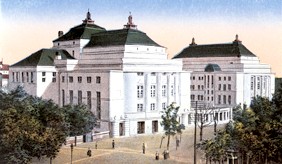
Estonian literates participated in the fight for local power mainly with the help of the newspaper “Teataja” created in 1901. The 1904 elections were won by an Estonian-Russian block of 5 Russians and 38 Estonians . The first Estonian mayor was Voldemar Lender and assistant major Konstantin Päts. In 1905 was bloody Sunday in St. Petersburg and this influenced estonian workers: mass meeting, had conflicts with police . 17.10.1905 was made first estonian party Eesti Rahvameelne Eduerankond created by newspaper „ Postimees ” supporters. In 1906 was created estonian proffesional theatre „Estonia”.
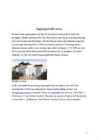
Theathre „Estonia”
In 1912 was started to constructing seastronghold and war harbour ( Peter the Great seastronghold). In 1913 was created power station , theatre building „Estonia” and townapothecary's shop was opened. In Kopli was established ship factories( „Vene-Balti’s”, „Noblenesser’s” and „ Bekker ’s factory”). Tramway was opened in Kopli in 1915 by factories
( „Vene-Balti’s”, „Noblenesser’s” and „Bekker’s factory”) to they’r workers transport.

Independent Estonia (1918-1940)


On February 24, 1918 Estonia took advantage of the weakening Bolsheviks and proclaimed independence; already the next day German troops occupied Estonia. Local town government was restored after Germany capitulated in the WW I. The first city council elected during the Republic of Estonia assembled on June 16, 1919. On 2 February 1920, the Tartu Peace Treaty was signed with Soviet Russia, wherein Russia acknowledged the independence of the Estonian Republic. Tallinn became the capital of an independent Estonia. Esonian first constitutional law was accepted in 15.06.1920. There was extensive citizenlaws: confluence -, religion-, meetings- and speechfreedom. Legislative law was accomplished by Riigikogu (100 members ). Goverment was called into job by Riigikogu. Goverment head was riigivanem , who had country representing tasks. In 01.12.1924 was rebellion in Tallinn by communists, what gaved on cotrol after few hours .
Tallinn’s Hippodrome was opened in 25.11.1923 in Tallinn north side, track lenght is 1000m.
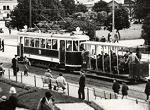
The first electrified train service in Tallinn was opened in 1924 from Tallinn to Pääsküla, a distance of 11.2 kilometres. New stopovers opened (Järve 1923, Kivimäe 1924, Hiiu ja Rahumäe 1926, Lilleküla 1929, Tondi 1933). New railway stations opened: (Järve 1925, Lilleküla ja Hiiu 1929, Rahumäe ja Nõmme 1930, Tondi 1936, Kivimäe 1937). 1936 new connection into city, Tondi-Central Tallinn tramway opened.
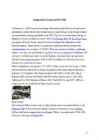
Tram in 1920s
The building of Tallinn Airport started in 1932, and the airport was opened officially on 20 September 1936. Tallinn Airport had regular connections to abroad by at least Lufthansa, LOT and the Finnish company Aero (now Finnair ). Tallinn’s zoo established in 25.08.1939 and based on the edge of Kadriorg Park.

Occupation time (1940-1991)


After World War II started, Estonia was occupied by the Soviet Union (USSR) in 1940, and later occupied by Nazi Germany from 1941-44. After Nazi retreat in 1944, it was occupied by the USSR again . After annexation into the Soviet Union, Tallinn became the capital of the Estonian SSR. The most devastating raid was the Soviet raid during the evening and night of the March 9, 1944. During the raid, 463 people were killed , 659 were wounded, 20,000 were left homeless . 10% of the buildings in Old Town and 40% living spaces were destroyed. There had heavily inyuried Estonia theatre and Harju gate. On September 25, 1944, remains of two Soviet soldiers were buried at the center of the hill . Additional remains were reburied there in April 1945.[5] After the burial of the Red Army soldiers on Tõnismägi the square was named Liberators' Square on June 12, 1945. A memorial monument was ordered from architect Arnold Alas and unveiled on September 22, 1947.
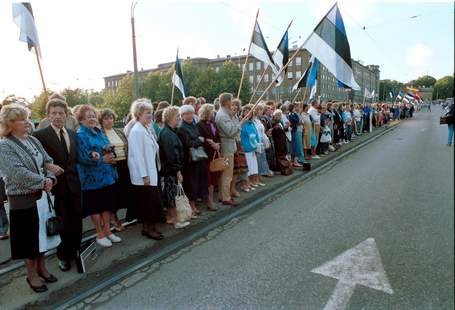
Eesti Televisioon (ETV) is the national public television station of Estonia. It made its first broadcast on 19 July 1955 and moved into color television in 1970s. Tallinn’s botanygarden created in 01.12.1961, but opened for public in 1970. In 1972 was builded Tallinn first skyscraper „Viru Hotel” what is 74m high and located in centre of Tallinn. The Tallinn TV Tower (Tallinna teletorn) is a free-standing structure with an observation deck, built to provide better telecommunication services for the 1980 Moscow Summer Olympics regatta event. It is located near Pirita , six km north- east of the Tallinn centre. The tower has a specified height of 314 m (1030.2 ft). On 26-28 August 1988, the Rock Summer Festival was held , and patriotic songs, composed by Alo Mattiisen , were played. On 11 September 1988, a massive song festival, called "Song of Estonia", was held at the Tallinn Song Festival Arena. This time nearly 300,000 people came together, more than a quarter of all Estonians. On August 23, 1989, 50 years later the three nations living by the Baltic Sea got back on their feet and, to the surprise of the entire world, took hold of each other 's hands . The 600 km human chain reached from the foot of Toompea to the foot of the Gediminas Tower, crossing River Daugava on its way.

Modern Tallinn (1991-2000)


Tallinn became the capital of a independent country once again on August 20, 1991. Thousands of esonians had protected Tallinn’s TV tower and Toompea. New contitutional law in 28.05.1992 was accepted by people. In september 1992 had lefted russian naval forces from Tallinn.
Tallinn mayors in 1990s :
Hardo Aasmäe 1990-1992 jaan-aprill
Jaak Tamm 1992-1996aprill-okt
Priit Vilba 31.okt-14.nov 1996
Robert Lepikson 1996-1997nov-mai
Ivi Eenmaa 1997-1999mai-märts
Peeter Lepp 1999 märts-nov
Jüri Mõis 1999 nov-2001 juuni
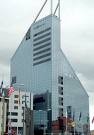
Tallinn’s town picture was changed modern in 1990s, built new modern buildings (Eesti Ühispank, Eesti hansapank and other offices)
Eesti ühispank

Conclusion


I didn’t knewed that facts and events at all , but i remind those and found new.

References


http://en.wikipedia.org/wiki/Tallinn , read on 30.03.2008
http://tallinn.mashke.org/tramm/index.php?lng=est , read on 30.03.2008
http://www.elektriraudtee.ee/?124 , read on 30.03.2008
http://en.wikipedia.org/wiki/Tallinn_Airport , read on 30.03.2008
http://rahvuslikliikumine.ee/foorum/viewtopic.php?f=42&t=1459&sk=t&sd=a , read on 06.04.2008
http://en.wikipedia.org/wiki/Baltic_way , read on 06.04.2008
http://tallinn.ee/g4200s921 , read on 06.04.2008
http://www.lifa.ee/portfolio/uhispank.jpg , read on 06.04.2008
http://tartu.postimees.ee/foto/6/8/6578645702aa7511eb_3.jpg , read on 06.04.2008
Eesti Ajalugu II. Ago Pajur,Tõnu Tannberg. Tallinn: Avita 2006
Tallinn - Eesti entüklopeedia.9.kd. Tallinn, 1996, P. 214-229
9
Vasakule Paremale
Tallinn in the 20th century #1 Tallinn in the 20th century #2 Tallinn in the 20th century #3 Tallinn in the 20th century #4 Tallinn in the 20th century #5 Tallinn in the 20th century #6 Tallinn in the 20th century #7 Tallinn in the 20th century #8 Tallinn in the 20th century #9
Punktid 50 punkti Autor soovib selle materjali allalaadimise eest saada 50 punkti.
Leheküljed ~ 9 lehte Lehekülgede arv dokumendis
Aeg2009-09-26 Kuupäev, millal dokument üles laeti
Allalaadimisi 14 laadimist Kokku alla laetud
Kommentaarid 2 arvamust Teiste kasutajate poolt lisatud kommentaarid
Autor RiM Õppematerjali autor
Referaat

Kasutatud allikad

Sarnased õppematerjalid

Tallinn
10
doc

Tallinn

Tallinn English College English Sergo Vainumäe 9A TALLINN Report Supervisor: Inge Välja Tallinn 2006 Order of contents: 1.Introduction 2.Toompea 3.Lower Town 4.Kadriorg and Pirita 5.Museums 1. Introduction Tallinn, the capital of Estonia, lies on the Baltic Sea. It is on almost the same latitude east St. Petersburg in Russia, Stockholm in Sweden and Stavanger in Norway, and covers 158 sq km. Tallinn was first marked on a map of the world by the Arab geographer al-Idrisi in 1154, its name then being Kolyvan (probably derived from the name Kalev). In the 13th-century Chronicle of Henricus de Lettis the town was called Lyndanise. Later came Reval (presumably after the old county

inglise teaduskeel
English portfolio
19
doc

English portfolio

..................................... 14 Our opinion............................................................................................................................ 18 References............................................................................................................................ 19 2|Page 1710­1850 The century and a half following the Great Northern War, which ended with the Peace of Uusikaupunki, was a relatively static period in Estonian history with few momentous events. This was the time of the crystallization and the culmination of serfdom, when various socio- political and cultural undercurrents were also active, preparing the ground for the industrial society and the national-democratic movement in the second half of the 19th century.

Inglise keel
My Town
4
doc

My Town

My Town I live in Tallinn. It's the capital and main seaport of Estonia. Tallinn is a very beautiful city that lies on the Baltic Sea. It covers 158 square kilometres. The Mayor of Tallinn is Jüri Ratas. The population of our capital is about 400000 people. About 55% of them are Estonian, 37% Russians and the other 8% are from different nations. The people here are mostly engaged in industry- mainly the food industry (23%), trade (16%) and transport and communication (14%). History. Tallinn has a great history. It was first marked on a map of the world by the Arab geographer al-Idrisi in 1154, its name then being Kolyvan. In the 13 th-

Inglise keel
Estonian holidays-festivals-cultural events
12
doc

Estonian holidays, festivals, cultural events

Musical shows, dances and contests of strength and skill will be held all over town. This festival is held in August and it is said that Haapsalu, Estonia's most famous ghost, appears during this festival Black nights film festival http://www.tourism.tallinn.ee/fpage/events/newwinprint/ Beerfestival ( Õllesummer) The beer festival "Õllesummer" is one of the largest festivals in the region--bringing together 80,000 people each year. Õllesummer is located in the Tallinn Song Festival grounds which is located 15 minutes walking time from the center of the city. The program includes Estonian bands and international acts as well featuring over a 100 concerts on more than 10 stages. Õllesummer is a friendly, safe and joyful event that attracts many tourists and visitors of Tallinn. Next Õllesummer festival will take place between 8-12 July 2009 in Tallinn Song Festival

Inglise keel
Tallinn
3
doc

Tallinn

Tallinn Tallinn is situated on the southern coast of the Gulf of Finland, in north-western Estonia. A limestone cliff runs through the city. It is exposed, for instance, at Toompea and Lasnamäe. However, Toompea is not a part of the cliff, but a separate hill. Coastline is 46 kilometres long.The highest point of Tallinn, at 64 meters above the sea level, is situated in the district of Nõmme, in the south-west of the city. The first human steps, that archeologists found, are about 5000 years old. Tallinn`s first fortress was built in Toompea, in 1050. As an important port for trade between Russia and Scandinavia, it became a target for the expansion of the Teutonic Knights and the Kingdom of Denmark during the period of Northern Crusades in the beginning of the 13th century when Christianity

Inglise keel
Tallinn
2
docx

Tallinn

Tallinn The first traces of human settlement found in Tallinn's city center by archeologists are about 5000 years old. In 1050 the first fortress was built on Tallinn Toompea.[3] In 1285 the city became the northernmost member of the Hanseatic League. Medieval Tallinn enjoyed a strategic position at the crossroads of trade between Western and Northern Europe and Russia. On 24 February 1918, the Independence Manifesto was proclaimed in Tallinn, followed by Imperial German occupation and a war of independence with Russia. On 2 February 1920, the Tartu Peace Treaty was signed with Soviet Russia, wherein Russia acknowledged the independence of the Estonian Republic. Tallinn became the capital of an independent Estonia. After World War II started, Estonia was occupied by the Soviet Union (USSR) in 1940, and later occupied by Nazi Germany from 1941–44. After Nazi retreat in 1944, it was occupied by the USSR again

Inglise keel
Tallinn-topic
7
doc

Tallinn-topic

Introduction Tallinn, the capital city of the Republic of Estonia and of the Harju county, is a town in North Estonia on the coast of the Gulf of Finland. It has nearly half a million inhabitants and covers an area of almost 160 sqkm. It is also an important economic and cultural centre and one of the main ports in the Baltic States. Tallinn is one of the oldest cities on the Baltic Sea. It is unique for its well-preserved architecture from the 13-15 centuries. In contrast to the ancient town-walls and towers, Tallinn of today offers modern hotels, restaurants, sport and cultural centres. Every five years national song and folk dance festivals take place in Tallinn. The yachting regatta of the 1980 Moscow Olympic Games was held at Pirita. History Tallinn means in English "Danish town"

Inglise keel
Topic - Estonia
8
doc

Topic - Estonia

Tallinn English College Topic Estonia Tallinn 2008 1. Introduction Estonia is a small country about the size of Switzerland, or New Hampshire and Massachussetts combined. Estonia is named after the people called "Ests" who lived in the region in the 1 st century AD. The Republic of Estonia is one of the three countries commonly known as the "Baltic States". The other Baltic States are Latvia and Lithuania. 2. Geographical position Estonia is situated in northeastern Europe. Estonia is bounded on the north by the Gulf of Finland, on the east by Russia, on the south by Latvia and on the west by the Baltic Sea. In the north it borders on Finland. The coastline of the Baltic

Inglise keel


Meedia

Kommentaarid (2)

Mihkel_Kask profiilipilt
Mihkel_Kask: Sisukas, aga kahjuks aint 49% on ise kirjutatud ülejäänu copy-paste
21:57 30-05-2011
malin profiilipilt
malin: väga hea ja mahukas materjal
20:45 28-02-2011


Sellel veebilehel kasutatakse küpsiseid. Kasutamist jätkates nõustute küpsiste ja veebilehe üldtingimustega Nõustun