University of Tartu Faculty of Social Sciences and Education Institute of Government and Politics Marie Allikmaa The strategies of creating a dominant party the case of United Russia Tartu 2011 After the collapse of USSR in 1991, many observers expected Russia to develop into a competitive party system. Yet, the reality quickly challenged this view. The developments of party politics in post-Soviet Russia have accurately been described in terms of a pendulum effect, as in the 2000s, Russia's party system did finally begin to take for, but with a remarkable twist. Following the break of one-party rule, Russia's party system became strongly fragmented - during the 1995 parliamentary elections, 43 parties competed for popular votes (McFault 1996: 90). In the 21st century, the pendulum has moved back, ...
1 Basic law, constitutional engineering · The Basic Law (= constitution) drawn up by West German politicians under Allied supervision 48-9 · Key Themes of Constitutional Engineering: Protecting the constitution Preventing abuse of human rights Ensuring stable government Effective leadership but no over-concentration of power · Compare turbulence of German politics 1918-45, and stability since In part about design of constitution, in part about Germans becoming democrats Solutions Concept of the Rechtstaat, a state based on the rule of law ...
what are `territorial politics' The multi-level politics of federal, regionalised, devolved states Distribution of power between central and regional government Party competition across levels of government `Regions' as spheres for autonomous action South Africa Mexico Germany · 9 provinces · 31 states plus federal district · Developed democracy · `Cooperative' federalism · Predominant role for federal 16 Laender German influence, ANC government · Cooperative federalism pref...
BRITISH POLITICS Helen Laine 12 A POLITICAL SYSTEM Democracy Constitutional monarchy Head of the state – Elizabeth II Actual power – Prime Minister Executive power - Her Majesty’s Government Legislative power – Parliament House of Commons and House of Lords Multi-party system MAIN PARTIES Two largest - the Conservative Party and the Labour Party Before labourers - The Liberal party Third largest – the Liberal Democrats Current: Conservative, Liberal Democrats ... Some other parties in UK: Democratic Unionist Party Scottish National Party Palace of Westminster UK Independence Party Green Party of England and Wales Scottish Green Party Social Democratic and Labour Party Alliance Party of Northern Ireland MAIN POLITICIANS Prime Minister: David Cameron (Conservative) Nick Clegg (head of L...
Men and women in politics Women have become a force to be reckoned with in the world of politics. Over the past decade, women have resolved into leadership positions, encouraging the same sex to voice their opinions in voting booths, political debates, and society. Not only in America, but nationwide. Women comprise over 35 percent of the lower house in Sweden, Norway, Finland, and Demark; 15 percent or less are seen in parliaments within ten countries . Over the years, women had to protest and fight for this right so that young women today can vote and have a say so in who represents the people of our city, state, and country. A woman's influence in politics has yet to be recognized as a true political voice of women that actually yields power. Perceptions of women and politics from the media, society, men, and even women themselves have shaped women's ability everywhere to participate politically and soc...
German federal election, 2009 On the 27th of December, germans went to the polls in parliamentary elections. It was a vote that would decide the shape of the German parliament. The opinion polls before the elections suggested that Angelina Merkel would keep the top job and she did. The Christian Democrats won with 33% of the votes. The Christian Democratic Union, the Christian Social Union of Bavaria, and the Free Democratic Party have announced their intention to form a centre-right government with Angela Merkel continuing as the Chancellor. It is said that Angelina Merkel is the biggest poker face in German politics. In her four years as chancellor she has outmanouvered her opponents and become the country's most popular politician and as the German economy is recovering from recession, the people see her as a safe pair of hands. With Angela Merkel as popular as she is, you might think that the result is a for gone conclusion,...
Politics and religion are not a safe topics to start a conversation with a stranger Every year, thousands of people want to meet someone speacial or just a new friend. Unfortunately not all of us can make it work. Some of us just can´t break the ice between himself and the stranger. Here are few examples why politics and religion are not a safe topics to start a conversation with. On the one hand, starting a conversation with this topics can be safe, If both participants are not arguing, but just unbiased and discussing it. Everything depends of place, where you have met this new person. If you had met him somewhere at conference, where is suitable to talk about politics, then it could be fine. You can start a conversation with different questions like: "Hello, which political party you belong to?" - It would not be criminal. This person will answer you, if he wants to. Then you can keep on with your ...
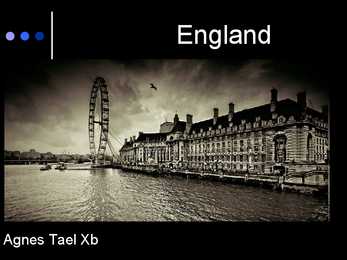
England Agnes Tael Xb Part of The UK Land borders with Scotland and Wales Includes over 100 smaller islands Total area 130395 km² Politics constitutional monarchy and parliamentary democracy leading parties Conservatives and Labour party member of the European Union Population Climate 51 000 000 people Temterate maritime 395 people per km² climate biggest influences come from the proximity to the Atlantic Oean Economy one of the largest in in the world average GDP per capita of £22,907 regarded as a mixed market economy official currency is the pound sterling Education optional nursery, primary, secondary Sixth form college Sports Thank you for your attention!!
South Africa Apartheid and before South Africa was created by peoples from Africa, Asia, and Europe. created their own states , combined (sometimes through war, sometimes through negotiation) to form the current South African state. The important thing is not what states were called or how long they lasted, but how they were organised, maintained control, gained and lost legitimacy. South African state formed out of: Conquest Colonization Slavery Indentured labour Racially discriminatory laws reserved jobs for whites; differential pay-scales etc Post 1910 state strong and centralized institutionalised racism: "power, wealth and privileges [distributed] unequally on a racial basis" (Giliomee, 1995, p190) Farming and mining (the basis of the economy) both required large work forces. Once slavery was abolished, need for to generate labour force. Taxation (poll tax) used to force blacks...
How has Margaret Thatcher affected Britain Margaret Thatcher is former British politician who served as Prime Minister of the United Kingdom from 1979 to 1990 and leader of the conservative party from 1975 to 1990. She is the first and only woman to hold either post. Since her resignation, Thatcher has remained active in the politics of the United Kingdom, as well as the world. She was raised to the House of Lords by the conferment of a life peerage as Baroness Thatcher. Margaret Thatcher has affected Britain in many ways. Thatcher was committed to reducing the power of the trades unions. Several unions launched strikes in response to legislation introduced to curb their power, but these actions eventually collapsed, and gradually Thatcher's reforms reduced the power and influence of the unions. Also, though an early backer of decriminalization of male homosexuality, Thatcher, at the 1987 Conservative party confere...
Satire in Lilliput In Jonathan Swift's Gulliver's Travels, Swift uses satire to tell a tale of Lemuel Gulliver going on voyages in strange lands and meeting a variety of different characters. Jonathan Swift's was one of the greatest satirists of his and our time. In the first book of Gulliver's Travels millions of young schoolchildren have grown to love this famous story and never recognize the satire hidden in the story. In his first Book he uses satire to demonstrate English politics by using the citizens of Lilliput. Gulliver's first adventure takes place in Lilliput. Gulliver gets shipwrecked and finds himself tied down by a considerable number of little people called Lilliputians. The Lilliputians stood only six inches high. During this time Swift recognized that England was also small in stature but was dominant force and had a great influence in Europe. England, despite its small size, had the potential to defeat any n...
Lessons for the future Education seems to be in government's, media's and people's spotlight all the time. Times change and education, as one of the most important areas of our society, needs constant reforming. Nowadays, the main focus seems to be on subjects like maths, physics, chemistry etc. because of current IT-era demands more knowledge in those regions than in humanities. I agree that Estonia's government's steps towards making maths and physics our school- system's top priority is quite right, but I think that there can be a lot more done to improve our educational structure. I find that Estonian schools should pay more attention to teaching our children current state in our political landscape. Kids, who go to school, are our future and soon-to-be full- right voters in national elections. They will become old and independent enough to be a part of deciding process over their coun...
Tallinn Järveotsa Gymnasium MARGARET THATCHER Maria Ignatenko Form 11.B Tallinn 2008 Margaret Thatcher (1925-...) General Data Margaret Hilda Thatcher was born on the 13th of October, 1925 in London. She is a British politician who served as Prime Minister of the United Kingdom and Leader of the Conservative Party. Margaret is the first woman who has ever held these posts. Childhood and Education Margaret Hilda Roberts was born on the 13th of October, 1925 in Grantham in Lincolnshire, England. Her parents were Alfred Roberts and Beatrice Stephenson Roberts. Thatcher spent her childhood in the town of Grantham in Lincolnshire. The Roberts family ran a grocery business, bringing up their two daughters in a flat over the shop. Her father was active in local politics a...
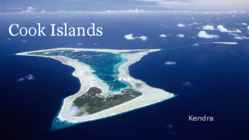
Cook Islands Kendra Location Capital: Avarua South Pacific Ocean 15 islands, 9 main islands Rarotonga Area: 240 square km Time zone: 12h behind Associated: New Zealand Geography Capital: Avarua Divided into two Coastline: 120km Natural resources: coconuts Climate: Tropical Mountainous, volcanoes, palms, soils, caves, People European, Chineese, African settlers Polynesian roots 2 polynesian languages: Pukapuka and other islands Official language Cook Islands Maori, English Population: 14,974 Villages, farms Politics Left: Henry Puna, right: John Key Self-governing state In international treaties Head of state: British monarch Parliamentary elections: 4 years Independence: 4th August 1965 Political parties: Cook islands party, the Democratic Economy Few natural resources: cobalt, phosphate Inadequate infrastructure Main industries: Tourism, fishing, banking, mining Export: citrus & tropical fruits, handicraft...
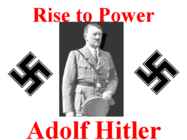
Rise to Power Adolf Hitler Objectives: • The objective of this presentation is to give students an understanding of Adolf Hitler’s early, pre-adult years. • Students will also become familiar with how this seemingly unimportant Austrian rose to power in post World War I Germany. Overall Purpose: The overall purpose of this presentation is to explain how this little boy on the left became the man on the right who was ultimately responsible for the death of about 50 million people all over the world!! Birth • Adolf Hitler was born on April 20, 1889 in Braunau, Austria. • Adolf was 1 of 6 children - 3 of who died at early ages Parents Alois Schickelgruber Hitler was a customs official who was illegitimate by birth. His father, Adolf’s grandfather, may have been Jewish. He died when Adolf was ...
Otto August Strandman Otto August Strandman was an Estonian politican, who served as State Elder of Estonia in 1929 and Prime Minister in 1919. He was one of the leaders of the centre-left of Estonian Labour Party. Strandman was born on 30 November, 1875 in the village of Vandu. Vandu is pretty close to Kadrina. Vandu is situated in Undla Parish, Viru County. His father was Hans Strandman, who was a schoolteacher in Undla Parish, Neeruti Mansion. He had also one brother Andres and one sister Anna. Otto was his third child. Hans was a very good father, because first education got Otto by father. In 1886, he went to the municipal school of Rakvere and in 1888 to Emperor Alexander State High School in Tallinn, later High School in Saint Petersburg. In 1896, he graduated as an extern in the Estonian Governorate High School of Tallinn. In 1907, Otto married to Lydia Hindrikson. Their first two ch...
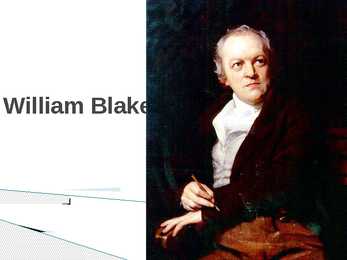
William Blake William Blake was borned in 1757 and died in 1827. He was an English poet, painter, and printmaker. He was the third of seven children. The Bible was an early and profound influence on Blake. At the age of 21, he was to become a professional engraver. After two years, Basire sent his apprentice to copy images from the Gothic churches in London His experiences in Westminster Abbey helped form his artistic style and ideas. Later life and career Blake's marriage to Catherine remained a close and devoted one until his death. Blake taught Catherine to write, and she helped him to colour his printed poems. William and Catherine's first daughter and last child might be Thel described in The Book of Thel who was conceived as dead. Politics Blake was not active in any well-established political party Blake was both concerned about senseless wars of kingdoms, and the blighting effects of the industrial revolution. Much of hi...
Adolf Hitler German politician from Austria National Socialist German Workers Party (NSDAP) leader (1921-1945). Between 1934-1945, he was the dictator of Germany the official title of the German Chancellor (1933-1945) and the title of the head of state ("Führer and Chancellor"; 1934-1945). Adolf was born on April 20, 1889 a. Braunau am Inn, Austria-Hungary, a customs official Alois h otly excitHitler (1837-1903) and his wife Klara six children fourth. Only the children reached adulthood, he and his sister Paula. 1906. Hitler visited Vienna and ended up in a hotly excited waxed city buildings, art galleries and operas.His new ambition was to take the Vienna Academy of Fine Arts. Further, he served as illustrator, often painted pictures and postcards for sale in stores.He knew how to influence people in such a way that no other head of state had failed before. Desperate was susceptible to all kind...
The role of the free press Newspapers and magazines play an imoportant role in today's society and are capable of influencing people's lives in many ways. The new electronic media have become even more influential in shaping people's opinions, attitudes and behaviour. However, does the free press offer a valuable service, or is it, as American journalist, Edward Egglestone said, "organised gossip"? On a personal level, the media can be very entertaining and informative. Reading about the lifestyles of the rich and famous is amusing and can help people forget their own problems. However, journalists frequently intrude on the privacy of celebrities, following them and photographing them in their most intimate moments. This is surely an unacceptable interpretation of the word "free". As far as politics are concerned, the free press is important as it often reveals the...
1. What are the capitals of the 4 constituent countries? England- London; Northen Ireland- Belfast; Scotland- Edinburgh; Wales- Cardiff 2. Order the invaders in correct chronological order: Anglo-Saxons, Normans, Romans, Celts. Romans Anglusaxons , Norman 3. How did the Celts influence Britain? Language. Wars. Engand and Scotland eventually became 1 contry 4. How many people approximately speak English? Approximately 600 million 5. Who (which tribes) gave the base of the English language?Germanic tribes- Anglo-Saxons. 6. Describe Wales.- Wales is a mountainous country on the western side of Great Britain. The national game of Wales is Rugby. Flag- Red dragon on a green and white field. They have their own language Cymraeg ( Welsh) . Anthem- Land Of My Fathers. Official animal- Dragon. There used to be a lot of coalmines. 7. What are the symbols of the 4 constit...
The case for socialism Four National faults Economic Inequality. The distribution of income and property is amazingly unequal. The most recent investigations suggest that 10 per cent of the population recieve over 45 per cent of the national money income, while 90 per cent recieve the remaining 55 per cent. The distribution of property is even more uniequal. 1 per cent of the population own 60 per cent of the saleable assets of the nations. Individual incomes range from £1 000 000 a year to £50 per year. This extreme degree of inequality is due to the right of inheritance at present vested in the legal institution of property. Large individual fortunes are, for the most part, made up of inherited property. The rich, as a class, are born with silver spoon in their mouths and the economic privileges that they enjoy were not acquired by the possession or exercise of great talents, but by the accident of birth. Social inequality. The appara...
These two chapters highlight the kinds of commentary Swift makes throughout the novel. By describing a society that chooses its highest officials with silly competitions like seeing who can jump the highest on a tightrope, Swift is poking fun at the way officials are chosen in England. He is also commenting on the disturbing trend of politicians who are willing to do whatever it takes to gain favour in the courtincluding humiliating themselves. The danger of ambition is also figured here; jumping badly can lead to death. Having Gulliver stand with his legs apart so that the Lilliputian armies can walk through is also a ridiculous idea. It is a comment on the pomp and circumstance of English armies. To Swift it seems that armies are often more concerned with looking impressive than with being impressive. This scene might also be an allusion to the Colossus of Rhodes, described in Julius Caesar by Shakespeare as a largerthanlife ...
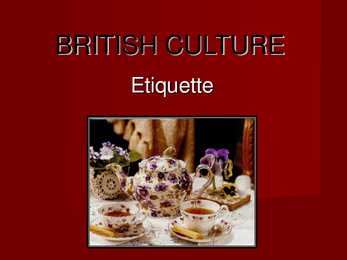
BRITISH CULTURE Etiquette Table of contents Everyday etiquette Time Eating etiquette English literature Sports Everyday Etiquette In general the British prefer to be introduced to strangers, if at all possible wait for a third party introduction when meeting someone new. Great Britain (especially England) is a non touching culture. When greeting someone a handshake accompanied by a "Pleased to meet you" is appropriate. When departing be sure to shake everyone's hand, a general group wave as is often done in the United States is not looked on favorably. Strong eye contact is not overly common among strangers and casual acquaintances, too much eye contact is considered and invasion of privacy. Eye contact is used when one really wants to make a point, when speaking with close friends, and when interest in a person or topic wants to be stressed. Bad To...
Technical translation Technical translation Forms a part of specialised translation The other part is comprised by institutional translation (politics, commerce, finance, government, etc.) Can be considered somewhat culture-free (not really true?) Universal: not confines to one speech community Characteristic features: Terminology (5-10%), only that much, but it makes the text hard to translate Format: technical report, but also instructions, manuals, notices, publicity Grammatical features in English: passives, third persons, empty verbs, present tenses. Technical Style Free from emotive language, connotations, sound-effects, original metaphor Part of technical translator’s job often is to rephrase poorly written language and convert metaphor to sense. Varieties of Technical Style Academic or scientific styl...
ENGLISH IDIOMS Nõmmik Vilian Apprentice 10 "A" class Ahtme Gymnasium Kohtla-Järve Relevance of the topic Ø The English language becomes the means of international communication, the language of trade, education, politics, and economics. People have to communicate with each other. It is very important for them to understand foreigners and be understood by them. Goal of my research work Ø Goal of my research work is to prove that idioms in the English language are integral part of it, which make our speech more colorful and authentically native. Tasks I like to achieve the following tasks: 1. To classify idioms; 2. To study the problem of the translation of idioms; 3. To understand the aim of the modern usage of idioms; 4. To distinguish different kinds of idioms; 5. To...
British Parliament Structure and Functioning of the British Parliament today Britain is a parliamentary monarchy . The British Parliament is a bicameral parliament , that is to say that it is made up of two chambers, or two "Houses"; above the two Houses, but in an essentially formal role , there is the Sovereign - king or queen - also known as "the crown." Role of the Sovereign The British monarch has all authority, but no power. The Sovereign appoints the Prime Minister, and every year opens the sessions of parliament, in a historical and ritual ceremony called the State Opening of Parliament . Historically, this ceremony used to take place in the Autumn; but since 2012, it has been brought forward to May. This is the only regular time when the members of both Houses come together. During the ceremony, the Sovereign reads out the government's intended programme. The "Queen 's Speech" is a summary of the programme "his" or "her" ...
16th century (Tudors) 1. Henry VII - avoided wars, careful with money, didnt have expensive parties, was a rather shadowy figure 2. Henry VIII- brilliant scholar, excellent knight, good-looking, ambitious, self- centered, loved expensive clothes and parties. Wasted his fathers money very quickly and had 6 wives. His first wife couldnt give birth to a baby boy and they only had a daughter. His next wife only gave birth to a girl too. His next wife gave birth to a boy but died after the labor. He didnt like his 4th wife so he sent her back. His fifth wife was young and beautiful but had many lovers and Henry didnt like it so she was sent to the Tower and was beheaded. HIs 6th wife survived. 3. Edward- was sickly and ruled only for a few years and then he died 4. Mary Tudor/Bloody Mary- was catholic and killed many protesntants. Ruled only f...
THE U.K Different Parts The United Kingdom is a short way of saying the United Kingdom of Great Britain and Northern Ireland. The UK is the political name for those countries which share a parliament in London. All of them were at one time independent kingdoms with their own monarch. Now they are all part of the same kingdom and share the same monarch. The UK consists of Northern Ireland, Scotland, England and Wales. The peoples of these countries are British subjects; they hold British passports and therefore their nationality is British. The british Isles is the geographical name for all the islands off the west coast of Europe. These islands also include The Republic of Ireland, which is politically independent of the Britsh government. Many people refer to the inhabitants of the British isles as 'the English', but England is only one of the countries. The other countries are Scotla...
1. UN as a world organization The United Nations officially came into existence on 24 October 1945, when the UN Charter had been ratified by a majority of the original 51 Member States. The day is now celebrated each year around the world as United Nations Day. The purpose of the United Nations is to bring all nations of the world together to work for peace and development, based on the principles of justice, human dignity and the well-being of all people. It affords the opportunity for countries to balance global interdependence and national interests when addressing international problems. There are currently 192 Members of the United Nations. The Aims of the United Nations: -To keep peace throughout the world. -To develop friendly relations between nations. -To work together to help people live better lives, to eliminate poverty, disease and illiteracy in the world, to stop environmental destruction and to encourage respect for ea...
The Republic of Cameroon Cameroon · A unitary republic of central and western Africa · Bordered by Nigeria to the west; Chad to the northeast; the Central African Republic to the east; and Equatorial Guinea, Gabon, and the Republic of the Congo to the south. · Cameroon's coastline lies on the Bight of Bonny, part of the Gulf of Guinea and the Atlantic Ocean. · The country is called "Africa in miniature" for its geological and cultural diversity. History · The territory of present day Cameroon was first settled during the Neolithic · Portuguese sailors reached the coast in 1472 · The German Empire claimed the territory as the colony of Kamerun in 1884 and began a steady push inland. · An economic crisis took effect in the mid-1980s to late 1990s as a result of international economic conditions, drought, falling petroleum prices, and years of corruption, mismanagement, and ...
HISTORY TEST 5 invasions to Britain until 1066 1) The Celts o Gaels in 600BC; Cymry(Britons) in 300BC o From present-day Austria, Switzerland o The Celtic language survives in the names of many places in England- Dover, Kent, Thames o The Celts are best known for their art- many bronze objects with elaborate designs; brooches; pins; mirrors; Celtic stone crosses o The Celts had 3 social orders: warriors, druids(priests) ordinary people 2) The Romans o (55 BC-Caesar) 43 AD- 410 AD- Claudius o From present-day Italy o Southern Britain became Britannia and was ruled by a roman governor o The Romans built over 20 towns: Colchester, Londinium, Winchester etc. They were good engineers and built roads and villas that had central heating, glass windows and mosaic floors ...
Country Studies The United Kingdom Test revision questions Form 11 1. What are the capitals of the 4 constituent countries? England London; Wales Cardiff; N-Ireland Belfast; Scotland - Edinburgh 2. Order the invaders in correct chronological order: Anglo-Saxons, Normans, Romans, Celts, Vikings. Celts > Romans > Anglo-Saxons > Vikings > Normans 3. How did the Celts influence Britain? The Celts were in Britain long before the English language existed. Celtic influence on English is minimal. There are more Amerindian words in English than Celtic ones. 4. How many people approximately speak English? 300million as mother tongue, 470million as 2nd language. 5. Who (which tribes) gave the base of the English language? Anglo-Saxons 6. Describe Wales. Part of the United Kingdom and the island of Great Britain, population: 3,064,000, Wales has a distinctive culture including its...
Lennart Meri Lennart Meri was a writer, a film director and a statesman who served as the second President of Estonia. Meri was a leader of the Estonian independence movement. His lifestory: Lennart Georg Meri was born in Tallinn, 29 March 1929, a son of the Estonian diplomat and later translator Georg Meri, and Estonian Swedish Alice-Brigitta Engmann. Because his father was a diplomat, Lennart left Estonia at an early age and studied abroad, in nine different schools and in four different languages. In addition to his native Estonian, Lennart Meri fluently spoke five other languages: Finnish, French, German, English and Russian. The family was in Tallinn when Estonia was occupied by the armed forces of the Soviet Union in June 1940 and in 1941, the Meri family was deported to Siberia. They came back to Estonia 1945. In 1953, Lennart Meri graduated cum laude fr...
Lennart Meri Lennart Meri was a writer, film director and statesman who served as the second President of Estonia. Meri was a leader of the Estonian independence movement. His lifestory: Lennart Georg Meri was born in Tallinn, 29 March 1929, a son of the Estonian diplomat and later translator Georg Meri, and Estonian Swedish Alice-Brigitta Engmann. Because his father was a diplomat, Lennart left Estonia at an early age and studied abroad, in nine different schools and in four different languages. In addition to his native Estonian, Lennart Meri fluently spoke five other languages: Finnish, French, German, English and Russian. The family was in Tallinn when Estonia was occupied by the armed forces of the Soviet Union in June 1940 and in 1941, the Meri family was deported to Siberia. They came back to Estonia 1945. In 1953, Lennart Meri graduated cum laude from t...
Tallinn University TURKEY AND THE EUROPEAN UNION Tallinn 2013 INTRODUCTION The accession negotiations and the forthcoming Turkish accession present challenges to both Turkey and the EU. It is widely accepted that Turkey's accession would be different from previous enlargements because of the combined impact of Turkey's population, size, geographical location, economic, security and military potential. The case of Turkey will be different and more challenging from previous accessions for a number of reasons, some of them are presented below. Turkey is a country with a large population and geographic area. With a population of 74 million today, it is projected that it could be the largest member state at the time of accession. As a Moslem secular country, Turkey will also add a new demographic and religious dimension to the EU. Also, the presence of a large number of Turkish immigrants in European count...
Sissejuhatus. Fasistlike ideoloogiate üldpõhimõtted Erinevalt paljudest teistest Euroopa riikidest jäi fasistliku ideoloogia levik Suurbritannias 1920. ja 1930. aastatel marginaalseks. Kuigi näiteks Suurbritannia fasistlike liikumiste lipulaeva British Union of Fascists ülesehitamine toimus loogilise ja ammendava programmi alusel - rahva poolehoidu taotlevad aktsioonid järgnesid alles hiljem - , ei suudetud pikaajalise demokraatiatraditsiooniga brittidelt leida piisavat toetust. Mark Hagopian nimetab pärast Esimest maailmasõda Itaalias ja mujal Euroopas tekkinud fasistliku ideoloogia olulisimateks põhimõteteks etatismi, karismaatilist juhtimist, elitarismi, hüpernatsionalismi, voluntarismi, antiparlamentarismi ning antimarksismi (Hagopian 1993, 388). Lisaks on erinevad autorid nimetanud fasistliku ideoloogia põhitunnustena veel antikonservatismi, antiliberalismi, parteilisi võitlussalku ja eesmärki totalitarismile. Kahtlemata sobinuks...
1. Feminism movement, ideology to defend women’s rights Suffrage – right to vote 2. Feminism isn’t a unitary movement because it represents different women and different experiences for them in different parts of the world. Different ideologies 3. Three waves of feminism • 1st wave – early 19th century – early 20th century (Political rights, suffrageright to vote) • 2nd wave – 1960s1980s (Social inequalities, gender norms, Women's Liberation Movement) • 3rd wave – 1990s2000s (ideas are the same, but they wanted to get rid of things the second wave had failed to do); feminisms, expansion, multiplicity, postcolonialism. 4. Anne Bradstreet the first feminist 17th century; the most prominent of early English poets of North America and first female writer in the British North American colonies to be published Mary Wollstonecraft education; an eighteenthcentury English wr...
THE REAL FABIO CAPELLO Independent, The (London), Dec 13, 2007 The Italian poised to become the new England manager is an admirer of the Pope and Silvio Berlusconi and praised the 'order' left by General Franco. The FA may be hoping he learns to keep his opinions to himself. By Cahal Milmo A touchline philosopher The blazerati of the Football Association are well known for their dislike of controversy. In the past, rampant publicity over the personal affairs of England managers has done little to endear them to the sport's mandarins. So a disciplined, conservative Italian who attempts to shun the limelight, avoids late nights and socialises outside football circles would appear to be their man. Yesterday, Fabio Capello sat down for talks with FA bosses that are expected to result in him being awarded a multi-million pound contract before Christmas. A perfect match? Well, possibly. There's just one thing. The con...
Fiji covers a total area of some 194,000 square kilometres (75,000 sq mi) of which around 10% is land. Fiji is the hub of the South West Pacific, midway between Vanuatu and the Kingdom of Tonga. The archipelago is located between 176° 53 east and 178° 12 west. The 180° meridian runs through Taveuni but the International Dateline is bent to give uniform time to all of the Fiji group. With the exception of Rotuma, the Fiji group lies between 15° 42 and 20° 02 south. Rotuma is located 400 kilometres north of the group, 670 km from Suva, 12° 30 south of the equator. Fiji consists of 322 islands (of which 106 are inhabited) and 522 smaller islets. The two most important islands are Viti Levu and Vanua Levu. The islands are mountainous, with peaks up to 1,300 metres (4,250 ft), and covered with thick tropical forests. Viti Levu hosts the capital city of Suva, and is home to nearly three quarters of the population. Other important towns incl...
Hiljuti USAs aset leidnud sündmuste ülevaade Obama kirjutas alla seaduseelnõule, mis suurendab USA võlalimiiti President Obama kirjutas alla Kongressi mõlemast kojast läbi pääsenud seaduseelnõule, mis laseb valitsusel laenata rohkem raha, et maksta sotsiaalkindlustushüvitisi ja riigitöötajate palkasid. Seega on riigi rahandusministeeriumil võimalus laenata $17.2 triljoni piirini, ilma et sellega kaasneksid eelarvekärped muude valdkondade arvelt nagu Obama juhitud tervishoiureform (BBC News, 13.02.2014). Samuti kirjutas president alla eelnõule, mille raames taastatakse nooremate veteranide hüvitised varem kehtinud tasemele. (NBC News, 16.02.2014) Samasooliste paaride õigused Kuu aja jooksul võtsid kahe USA osariigi Kansase ja Arizona kojad vastu sarnased eelnõud, mille kohaselt ei ole nimetatud osariikide ettevõtjad sunnitud pakkuma teenuseid samasoolistele paaridele, kaitstes sellega teenusepakkuja religioosseid uskumusi. Eelnõu...
1. Ancient Britain: the Celtic tribes. 2000 years ago there was an Iron Age Celtic culture throughout the Br Isles. It seems that the Celts, who had been arriving from Europe from the 8th cent BC onward, intermingled with the peoples who were already there. The Celts were extremely talented people, creative and artistic. More than 1 Celtic tribe invaded Br. The descendants of ancient Celts live in Wales, Scotland, Cornwall and Ireland. They lived in primitive society. Druids priests, more powerful than chiefs. Acted like prophets. 2. Stonehenge From prehistoric period. Was built on Salisbury plain between 2500 and 1500 bc. One of the most famous and mysterious archaeological sites in the world. One of the mysteries is how it was built at all with the technology of the time. Another is its purpose. It appears to function as a kind on astronomical clock and we know it was used by the Druids for ceremonies marking the passing ...
I Native Americans · Origin of Native Americans Origin is debatable Siberia->Alaska Crossed the land bridge around 14,000 years ago "ice-free corridor" Hunters, searching for fresh grounds · Different tribes and their way of life In tents, dark skin, hair is long, black and straight, women-agriculture, men- hunting. bands(chief. Travelled together) and tribes land was owned by the tribe that occupied it. 200 different tribes Apache- "enemy"- hunted buffalos, oil and natural gas from their land Cherokee- largest tribe Cheyenne- from Minnesota and S & N Dakota. High system of laws Northwest Ordinance of 1787 Signed in 1787 by Thomas Jefferson. The creation of the Northwest Territory as the first organized territory Ohio River was settled, 5 new states Advancement of education, maintenance of civil liberties, exclusion of slavery Promised not to invade or disturb Indians Northwest Indian War-> to stop white expropriation (sun...
Report of SCOTLAND Maiki Joakit 10. klass 2008 Etymology Scotland is from the Latin Scoti, the term applied to Gaels. The Late Latin word Scotia (land of the Gaels) was initially used to refer to Ireland. By the 11th century at the latest, Scotia was being used to refer to (Gaelic-speaking) Scotland north of the river Forth, alongside Albania or Albany, both derived from the Gaelic Alba. The use of the words Scots and Scotland to encompass all of what is now Scotland became common in the Late Middle Ages. History Repeated glaciations, which covered the entire land-mass of modern Scotland, have destroyed any traces of human habitation that may have existed before the Mesolithic period. It is believed that the first post-glacial groups of hunter-gatherers arrived in Scotland around 12,800 years ago, as the ice sheet retreated after the last glaciation. Groups of settlers began building the first known permanen...
Miina Härma Gymnasium The Relations Between the USA and Iraq Student: Hendrik Rummel 10.b Teacher: Tiia Timma Tartu 2010 The Table of Contents 1. Introduction...........................................................................................................................2 2. History 2.1. Pre-1980s.............................................................................................................3 2.2. 1980s...................................................................................................................3 2.3. 1990s...................................................................................................................4 2.4. 2000s......................................................................
Established church The Church of England is the established church, which means that: 1.)the Monarch is the Supreme Governor of the church, 2.)the Church performs a number of official functions, 3.)Church and State are linked. To disestablish Disestablishmentarianism refers to campaigns to sever links between church and state, particularly in relation to the Church of England as an established church. It was initially a movement in the United Kingdom in the 18th century. The established churches in Wales and Ireland could not count on even nominal adherence by a majority of the population of those countries. In Ireland, the predominantly Roman Catholic population campaigned against the position of the established Anglican Church of Ireland - eventually disestablished in Ireland from 1 January 1871. A broad church The Church of England is a broad church, representing a wide spectrum of theological thought and practice ...
Stonehenge One of the best known ancient wonders of the world, 5000 years old Megalith monument, built by western mediterraneans during 3000-1600 BC Circular structure, large standing stones, aligned with rising sun at teh solstice Attlers and bones were sued to dig pits that hold the stones The Celts in Britain and their legacy 700-200 BC celts invade Britain Gaels or Goehls(Ireland and Scotland),Cymri(Wales) and Brythons(gave name to Brittany) Fierce fighters,superb horsemen.Most of them farmers, lived in thatched houses Good at art, craftmanship, used iron Divided into tribes, ruled by kings, only in face of danger would they choose a single leader Legacy- hill-forts, farms, churches, field system, woodland, pasture, weapons, iron objects, langugae, culture Caesar in Britain The great Roman Emperor Firts came 55 BC to gather information, celts ...
History exam *Stonehenge - is a monument located in England. It is one of the most famous prehistoric sites in the world and is composed of earthworks surrounding a circular setting of large standing stones. The surrounding circular, earth bank and ditch, have been dated to about 3100 BC. Stonehenge was produced by a culture with no written language. Many aspects of Stonehenge remain subject to debate. There is little or no direct evidence for the construction techniques used by the Stonehenge builders. *The Celts in Britain and their legacy The Cets lived in Britain in The Iron Age. They were warring tribes who were battleful amongst themselves as well as inter-tribal war. They were not centrally governed. The Celts brought iron working, iron ploughs and metal swords, horses, wheels and chariots - all these things gave them an instant superiority over the native tribes. The Celts built a number ...
Tests Superstar 1 Luke Prodromou Test 1 Name____________________ Class_______ Use your English 1 Complete these sentences using the correct form (present simple or present continuous) of the verb in brackets. _ 1 She is in a band and she _________________________________ (record) a CD at the moment. _ 2 She is an actress and often _________________________________ (appear) on television. _ 3 At the moment she _________________________________ (have) a rest because she is tired. _ 4 Mike is a doctor and he _________________________________ (live) in Manchester. _ 5 I _________________________________ (start) work at 8.30 every morning. _ 6 He is a good cook but she _________________________________ (prefer) to eat out. _ 7 English tests _________________________________ (get) more and more interesting. _ 8 They _________________________________ (have) a party becau...
ACCESS ASSESSMENT COVER SHEET Student Name: Alex Callaghan EC1305063 Course: Access to Humanities Tutor: John Gordon Assessment Title: Critically evaluate Locke's theory of limited government Number of Words 1616 NOTE: The ESSAY should be 1500 words in length. Student signature - Alex Callaghan Date - 24/04/2014 Critically evaluate Locke's theory of limited government The end of law is not to abolish or restrain, but to preserve and enlarge freedom. For in all the states of created beings, capable of laws, where there is no law there is no freedom. John Locke Although John Locke is not the progenitor of social contract theory and is not by any means the last philosopher to wrestle with this concept, his views on fiduciary power, majority consent and limited government have been instrumental in western political thought from the time of the publication of his Two treatises of government to the present day. Locke...
Britain History Pre-Norman Britain The Iberians brought their metal-working skills and the first real civilization to Britain in the third millennium B.C and were overrun by various Celtic invasions that began in the 8th century. The Celts introduced their tribal organization and an early form of agriculture before they were forced westward by the Roman invasion. Forms of Celtic language are still spoken in Britain. Romans (with Julius Caesar in the head of them) first tried to occupy Britain in 55 B.C., but there was a rebellion in Gaul so they had to leave to fight against it. Next time they came in 43 A.D. and their leader was Emperor Claudius. Romans brought a lot with them. Their brought paved roads, the sites of important cities, the seeds of Christianity, the Roman law, Roman baths, language and advanced civilization. They also built Hadrian's Wall in 122 A.D. Romans occupied...
 annaabi.ee