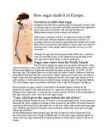
Pirita Convent Anete Samelselg 10th grade About the convent It was founded by St. Birgitta in 1412 and consercrated in 1436. The area is 1360 square meters. It was the biggest church building in the Middle aged Estonia. Name Pirita is orginated from St. Birgitta. The idea and construction The history of the the Pirita Convent dates back to the 15 century. The idea to found a convent in Tallinn, the capital of Estonia, was initiated by some Tallinn merchants already in 1400. Building plot was donated from Livonian Order. The building were built in two different parts. One for nuns and one for monks. Church in the middle and it was used by both. St. Birgitta rules In the convent have to live both - nuns and also monks. Nuns and monks were seperated and did not see each other at all. The Convent could not have more than 85 members 60 sisters and 25 brothers. The leader of the convent is a woman-abess.
The vikings Ursula 11. kl Who were the vikings? The Vikings were the Norse explorers, warriors, merchants, and pirates who raided, traded, explored and settled in wide areas of Europe, Asia and the North Atlantic islands from the late 8th to the mid11th century. The Vikings came from three countries of Scandinavia: Denmark, Norway and Sweden. The Viking age in European history was about AD 700 to 1100. During this period many Vikings left Scandinavia and travelled to other countries, such as Britain and Ireland
Tartu Hanseatic Days Tartu Hanseatic Days are celebrated every year from 17th to 19th July. For three days the Old Town of Tartu is filled with Hanseatic merchants and different workshops. People dress up in different medieval clothes and have a great time. The Hanseatic days are held so people could test their skills, learn more about their history and just have fun. Before the festival can start people set up tents and workshops in the Old Town. Some stalls are set up on the streets while others are located in the courtyards of historical buildings. People also make or buy costumes for the festival. Some dress up
Because of the names short and long Tallinn is sometimes called a limping city. Short Leg is also sometimes called street-stairs, because it is made completely out of stairs. The Upper and Lower Towns were connected by the Long Leg street (Pikk jalg) during the Middle Ages. The Short Leg street (Lühike jalg) could only be used by pedestrians, because it is and was only a stairway-street. The relations between the Upper and Lower towns were pretty tense, because both the rich merchants of the Lower Town and the noblemen and knights of the Upper Town wanted to obtain more power. Due to the conflict between the two Towns the merchants in the Lower Town were afraid of raids from the Upper town and they had the street connecting the two Towns fortified with a wall and gatehouses. The new wall has become known as "the Wall of Mistrust". During night all traffic between the Upper and Lower town was stopped and the gates were closed.
was to provide members with social interactions and ensure their rights, but also played an important political and economic role. Tallinn had three important guilds - The Great Guild, St. Canute's Guild and St. Olaf's guild. The Great Guild was the youngest among them, founded in the 14th century, but soon became the biggest and most important. It was founded as an organization of the wealthiest merchants and shipowners. The name of the Great Guild was introduced in the late 15th century. There were close ties between the guild and the town rules: only members of the Great Guild had the right to belong to the town council and could be elected for mayor. Tallinn's small coat of arms is also the Great Guild's coat of arms. Guild was led by Alderman, with the assistance of two advisers. Guild only accepted merchants, who had a house, wife and who was local.
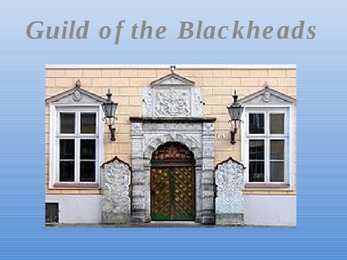
Over the centuries, it has changed slightly, but it still retains the flavour of bygone days, while it sells modern medicines. Medieval medicinal ingredients like bat powder and snakeskin are no longer available, but you can still try the fine spiced claret, renowned already in the Middle Ages. The House of the Brotherhood of Blackheads is nearly the only preserved Renaissance building in Tallinn. The Brotherhood of Blackheads emerged in 1399. The Brotherhood united the young, single merchants before they could be accepted into the Great Guild, as well as foreign merchants who were residing in Tallinn for longer periods but not permanently. The name of the Brotherhood is associated with their patron, the black St. Mauritius, an early Christian martyr who died in Switzerland around 280300 A.D. His head is the mascot on the Brotherhood's coat of arms. The Brotherhood was active only in Estonia and Latvia, unknown in the rest of Europe.
Guild o f the Blac khe ad s His to ry Mentioned in 1399 Origin of the name is not entirely clear St. Mauritius is depicted in the coat of arms of Blackheads Active only in Estonia and Latvia Left Tallinn in the 1940s They were merchants Were also in Tartu and Pärnu Main building was in Tallinn The Ho us e o f Bro the rho o d o f Blac khe ad s Located in the old town Is nearly the only preserved renaissance building in Tallinn When it's not occupied by concerts or other events it's open 10.00 19.00. Thank you for watching Kalev Gustav Lillepruun Sources : Wikipedia.org Tallinn.com Mustpeademaja.ee
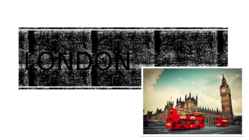
LONDON LONDON Largest city in western Europe Dominates Britain Headquarters of all goverment departments the country´s parliament major legal institutions the monarch Bussiness and banking centres, the national television networks and newspapers Seven times larger Fifth of the total population TWO AREAS Walled City (the square mile) Small Did not contain Parliament or the royal court Traders and merchants Westminster Outside London´s walls National institutions meeting place WEST END AND EAST END West End Theatres, cinemas, expensive shops East End Poorer residental area Home to successive waves of immigrant groups LONDON “Londoners“ live in its suburbs Travel to work each day Cultural and racial variety greatest 300 languages spoken Nearly third of the people were born outside
This is how the Danes obtained their national flag. In 1346 the Danish king sold his Estonian lands to the Teutonic Order, who a year later resold them to the Livonian Order. The Germans renamed Tallinn and called it Reval. Toompea became the seat of the German-born gentry. A fortified wall was built between Toompea (the Upper Town) and the Lower Town, as there were conflicts between the two. The Lower Town was the home of simple people, the artisans and the merchants. The doors and gates in the wall were locked at night. Tallinn joined the German-dominated Hanseatic League in 1285 and became a junction of trade between East and West: furs, honey, leather and seal fat moved west, while salt, cloth, herring and wine moved east. Its geographical position was very favourable, with its wide bay protected by the two outlying islands of Aegna and Naissaar for a large port. Tallinn developed along three lines: fortress, port and market town. Tallinn grew rapidly
for old Tallinn's Scandinavian community prior to the conquest of Tallinn by Denmark in 1219. A legend tells that the builder of the church, named Olaf, upon its completion, fell to his death from atop the tower. It is said that when his body hit the ground, a snake and a toad crawled out of his mouth. 5. Blackhead's house Pikk tn 26 - Reneissance, 14. cent. It is the house of the brotherhood. It used to unite single young and foreign merchants. 6. Kanuti Gild - 13.cent. It is a union of german craftsmen in Tallinn. Its was at it's best 16 cent. Above the door is the founder of the union, king Knut 7. Suurgildi hoone - gothics. Belonged to Tallinn's Suurgildile, where were the town's most powerful and richest merchants. Hoone Ehitus kestis 14071410, siseviimistlus lõpetati 1417. 8. Holy ghost church - 14. Century. One of Tallinn's oldest churches, and the only sacred building that
with many church spires forms an expressive skyline that is visible from a great distance both from land and sea. The upper town (Toompea) with the castle and the cathedral has always been the administrative centre of the country, whereas the lower town preserves to a remarkable extent the medieval urban fabric of narrow winding streets, many of which retain their medieval names, and fine public and burgher buildings, including town wall, Town Hall, pharmacy, churches, monasteries, merchants' and craftsmen' guilds, and the domestic architecture of the merchants' houses, which have survived to a remarkable degree. The distribution of building plots survives virtually intact from the 13th-14th centuries. The Outstanding Universal Value of the Historic Centre (Old Town) of Tallinn is demonstrated in its existence as an outstanding, exceptionally complete and well preserved example of a medieval northern European trading city that retains the salient features of this
Included little punctuation in his drafts . Famous Works Writing Influence Work is influenced by the 18th century Enlightenment His work is popular throughout Europe during his time period Believed every human was practically decent regardless of class, religion, politics and ancestry Major theme in historical works is tolerance Waverley novels express belief in need for social progress First novelist to portray peasants realistically and equal to merchants, kings and soldiers Central theme of many novels were conflicts between opposing cultures Downfall, Death, Contributions · Around 1825 started to go bankrupt. · Traded in his house and income to his creditors hoping to get out of debt · Kept writing and publishing fiction until he died in Abbotsford in 1832 · Was buried in Dryburgh Abbey · Abbotsford House was a farmhouse what Scott had bought. · He essentially invented the modern historical novel
It was made up of barons, bishops and abbots as usual, but also included 2 knights from every hire and 2 burgesses from every borough. Many nobles didn't support Simon de Montfort, a civil war broke out. De Montfort was defeated and killed. In 1295 Henry III's son Edward I brought together the ,,represantive institution", ,,Model Parliament", the 1st to include nobles, clergy & commoners. It was a mixture of ,,gentry" knights & wealthy freemen from the shires & merchants from the towns. He divided Parliament into 2 parts the nobles formed the House of Lords, the other part was called the House of Commons (middle class). Edward I became king at the age of 35. He was a fine warrior & won the respect of his subjects. He was very tall & strong and his nickname ,,Longshanks" referred to his long legs. He was married twice. From his 1st marriage (Eleanor of Castili) he had 15 children, his 2nd wife (Margaret of France) bore him 3 children. He had
The Man of Law's Tale Once in Syria dwelt a company, which was known by their wares, what all were so good and exellent. They went to Rome one day and found an inn what suited for them best to sell their weres and rest. They stayed there and heard one day about emperor's daugher Constance who was very beautiful and humble woman who followed the rules of Christianity and was always faithful to God. When merchants went to Syria's sultan, and told him tales of beautiful Constance, Sultan fell in love and wanted to marry with her. But then came legal difficulties in his way. He had to be christened and all his vassals too. In all this, Constance was really sad because she did not wanted to marry with Sultan. Sultan's mother also was not happy when she became aware of Sultan's intending to renounce prescriptions of Alkoran.
() - 2012 3,9% - 17,51 TEUs. , 1,5% - 13,19 TEUs, 17,4% - 4,32 TEUs 2,4% - 1,94 TEUs, 7,3% - 1,46 TEUs, 23,6% - 480 . TEUs. . 456 . . 2011 24,4 TEUs. , . , . . . 39 , 131 . 500 . (Yantian), (Shatoujiao), (Shekou), (Chiwan), (Mawan), (Dongjiaotou), (Fuyong), (Xiadong), (Shayuchong) (Neihe). 22 . ( ) -- , , . China Merchants Holdings , . 2004 135 ( -- 20,3% ), 88,5 ( -- 30,5%), 13,6 . TEU ( -- 28,2%), 3,45 ( -- 40,2%). 2009 18,25 . TEU, 2010 -- 22,51 . TEU. 40 150 . 2010 23,34%, 22,51 TEU. 2009 46, 230-. 2011 23,5 TEU, 230 . 141 : - 51 10,000 . - 90 , 43 10,000 - 18 - 9 - 18 . , . , . 330 , 50 000 , 12,5 . . , , 40% , 80% , 40% (, , ,
TEST – The history of London 1) London was definitely not an important place during the Celtic period. It was just a mosquito-infested swamp. 2) London became a trading centre during the Roman occupation. It was an important crossing point for the Romans over the river Thames. Market forces began to operate. With troops stationed and ships calling, merchants will inevitably set up shops. 3) The Celtic warrior queen Boudicca and her tribesmen fought against the Roman conquest and devastated Londinium. The city was burned down and its inhabitants massacred. 4) London was rapidly rebuilt and in AD 122 the Roman walls were built around it as a defence. 5) The Romans left Britain early in the 5th century because they had to cope with troubles elsewhere in the Empire. 6) Around AD 400 the Germanic tribes invaded Britain.
road to be taken on a carriage, as the steep rise often proved too difficult for the horses and going down usually required excellent coachman´s skills. The present day 5-storeyed gate tower dates from 1380. Lühike Jalg (Short Leg) was first mentioned in 1353. This street belonged to the lower town and was used by pedestrians only because it is and was only a stairway street. The relations between the Upper and Lower towns were tense at the best of times as both the rich merchants of the Lower Town and the noblemen and knights of the Upper Town wanted to obtain more power. Due to the conflicts between the two towns the merchants in the Lower Town were afraid of raids from the Upper Town and had the street connecting the two Towns fortified with a wall and gatehouses. The new wall has become known as the Wall of Mistrust. During night all traffic between the Upper and Lower town was stopped and the gates were shut at 9pm.
both also transmitted halfhidden social and political attitudes. In less than forty years, in 1906, the leading amateur companies, the "Vanemuine" in the university town Tartu and the "Estonia" in Tallinn, could become professional, and in 1911 the "Endla" of P ärnu joined them. Theatre became especially popular amongst Estonians in the second half of the 19th century. Before that time, theatre had mostly been staged in German for the benefit of the local nobility and merchants. Theatre in Estonian emerged in various song and drama societies, the strongholds of national thought. In the early 20th century, these societies turned into professional theatres, some of which, the national opera Estonia for example, function even today. The scheme from society to theatre is a general phenomenon, because all the present state theatres once belonged to societies.
The Holy Spirit church It was built in 1360.This church plays an important role in Estonian cultural history. The first sermons in Estonian language were held in this church in order for the local people to understand the Bible stories. The church's altar is made by the famous Lübeck master Bernt Notke. The Great Guild house The impressive building of the Great Guild is in late Gothic style During centuries the building, has been used for merchants feasts and receptions, rented out for marriages and also used for court sittings and theatre performances. It has also been rebuilt many times The Great Guild Hall is the home of the Estonian History Museum, which houses a number of treasures, including porcelain, ethnography, antiques and art objects. St.Olaf church It is believed to have been built in the 12th century Its dedication relates to King Olaf II of Norway
2 Towns (Upper & Lower Town) Tallinn used to be divided into 2 parts - Upper Town where lived the aristocracy, gentry and the clergy; and Lower Town with traders, craftsmen and merchants. Legend says the Toompea Hill is actually the tumulus mound of the great Kalev. Linda carried rocks to his grave. It is a naturally- formed limestone hill. Lower Town was a merchantile centre, Tallinn also belonged to the Hansaetic League (1285). It is often referred to as the town of citizens. Any grown-up, married and economically independent person, born in a legal marriage between two free people and having lived in the town for at least
Romans.Pope Gregory I sent Augustine to bring Christianity back to England.Augustine became 1st Archbishop of Conterbury.With Christianity came Latin learning. Venerable Bede wrote in Latin 1st history of England. Normans broke the power of the Anglo-Saxons. Medival period Social order:1)The King-the most powerful person-owned land,led the army,made laws,demanded money through taxes,had absolute power2)Aristocracy:Barons,Lords-got lands from the King3)Middle classes:Knights,Merchants,Yeomen- freefarmers-owned land,protected Lords,had to got to war4)Villeins or Serfs-didn`t own land,products went to Lord,had to do any job that the Lord asked them to do5)Slaves- had to work hard System of government:King-ruled throughly the system of patronage,he gave hands and privileges to people who were loyal to him when he needed it. The Domesday Book was the record of the great survey of England, executed for 'William the Conqueror'. The survey was
The biggest market for smuggled tea was England, but tea was also smuggled into the colonies to a lesser extent. Tea Act 1773 In response to this, the British government passed the Tea Act, which allowed the East India Company to sell tea to the colonies directly, paying the much lower American duty. This tax break allowed the East India Company to sell tea for half the old price and cheaper than the price of tea in England, enabling them to undercut the prices offered by the colonial merchants and smugglers, granting them a virtual monopoly. Many American colonists, particularly the wealthy smugglers, resented this favored treatment of a major company. Protests resulted, and it was those in Boston that made their mark in history. The Event The first of many ships which arrived at the Boston harbor carrying the East India Company tea was Dartmouth arriving in late November 1773. Thousands attended the protest meetings, every meeting larger than the one before
Built in the heart of Tallinn, next to a marketplace, the Town Hall has witnessed trade and social activities for over 700 years. It has still remained the most important representational building in town. The building history of the Town Hall goes back to the 13th century, but it acquired its medieval appearance in 140204. It was as early as 1248 when King Eric IV Ploughpenny of Denmark granted the Lübeck Charter to Tallinn. Relying on that document a town council was elected from amongst merchants of the Hanse and started convening in the Town Hall. It is possible to state on the basis of research findings that a meeting place of the magistracy and a goods depot in the form of a small, fortified town hall, constructed of local limestone, existed in its present location already in the mid-13th century. The town hall first mentioned in a real estate record in 1322 had a large meeting room (consistorium) and, considering the times, a huge warehouse (cellarium civitatis). Three walls and
town and the lake, start right from beside the Town Hall. There are five flights and 158 steps. Water Tower The old water-tower of Viljandi between the museum and Town Hall has been reconstructed now into an observation tower. Church spires and the Old Water Tower form a silhouette on the lake surface. The Water Tower offers a magnificent view of the whole town. Hanseatic merchants settled here as long ago as the 14th century. Due to its good location, varied nature and good connecting roads, Viljandi is an excellent place for trade, stopovers and living. Bridge When you walking along a footpath you will soon get to the famous suspension bridge. The first bridge in 1931 was a contribution to the town by the landlord of Tarvastu, Karl von Mensenkampff. The bridge is over 50 m long
Guitar and Mandolin Guitar (kitarr) and mandolin (mandoliin) spread among the folk in the early 20th century. They became popular first with spiritual, but also with sentimental secular music making. Their peak fell on the 1920s and 30s. Guitar continues to be popular also today. BELLOWS INSTRUMENTS Estonian bellows(Eesti lõõts) First accordions reached Estonia quickly through sailors and merchants. Soon local masters began to make these instruments, the most famous among them was August Teppo (18751959) of Võrumaa. He set a type that was copied by others. Teppo's lõõts had great volume, they lasted long and had copper ornaments. Particularly good were Teppo's strings. This lõõts has chords only in major. Teppo type instruments are called eesti lõõts or võru lõõts, or Teppo lõõts. This instrument is still very popular in Estonia, played by various age groups
" Western Mediterranean Arabs brought sugar. Having occupied the south of Spain and Sicily, there they raised sugar cane. During the Middle Ages was the major sugar importer-exporter of Venice. Raw cane sugar imported from India and refined in Venice prior to export to the rest of Europe. White gold Sugar was very expensive, and it was known as "white gold" name. The rich collections of people, even if sugar is a precious asset. It is said that one of the bishop of the Portuguese merchants bought for many years in the sugar and kept it in its chamber. When he died, his fortune was divided between the monks of the monastery. Other assets to be distributed among the sugar. Monks wanted to know how it tastes, but the faces of these people filed dragged long. Instead, they felt uncomfortable with a sweet bitter taste. They did not know that the sugar was shipped out of Egypt, camels back. During the journey itself sucked sugar camels sweat it made sugar bitter
The Short and the Long Leg ● Two streets leading up to the Toompea Hill - The Short and the Long Leg, that is why some say that the town is limping. Pikk jalg - in 14th century, connecting upper and lower town, dangerous place, not an easy road; Lühike jalg; in 14th century, belonged to the lower town and only used by pedestrians because it is and was only a stairway street. Due to the conflicts between the merchants in the towns, Wall of Mistrust; all traffic closed at 9pm. St. Nicholas’ Church ● Built in the 13th century, bombed in 1944. Restaurated ever since. Museum of religious architecture, concert hall. The duke Charles Eugene de Croy was taken prisoner by the Swedish king. He died in 1703, but since nobody was willing to pay for his funeral, he remained unbaried. The air conditions of the chapel kept him from rotting, and he became
How the Lake Ülemiste was formed It is believed that once Linda was carrying boulders to make his husband a tomb, she got tired and one of the boulders fell from her apron. She sat on it and wept, thus creating the lake. How was St. Olaf's Church built According to a legend the people of Tallinn were searching for ways to make their hometown famous. Someone got the idea of building a high church, so the merchants would see the town from far away. But soon there was a problem- they couldn't find a man to build this gargantuan house of worship. Finally a stranger offered himself to build the church for a big cost, but he said he would do it for free, if the townspeople would guess his name. Once the sanctuary was almost finished, the citizen started to worry that where would they get that much gold for the architect. So
George I from Gremany- unpopular because people didnt know or trust him Geroge II stayed in England and participated in everyday lide George III was born in England. The american colonies were lost 1789 The French Revolution. The end of monarchy in France. In endland they were very cautious and no reforms followed. New middle class appeared with banks and merchants 1775 James Watt reinvented the steam engine The 19th Century Most important american colonies were lost in war of independence In the beginning of the century at war with France By the end of the century Britain controlled the biggest empire in the world The british culture and way of life and language came to predominate in Ireland 1840 the potato crop failed and there was a huge famine in ireland
· Originally, parliament was any meeting of the king and his vassals to talk (parley), usually over taxes · Negotiating taxes with each town and shire was difficult · Called the Model Parliament in 1295 · Representatives from all three estates Parliament · Parliament became important for a couple of reasons: · England being an island enhanced its trade and the status of the middle class · The middle class merchants and lower nobility thrown together in the House of Commons · Their common interests led to a powerful combination capable of challenging royal power · England being an island faced few invasions · Little need for heavy taxes to pay for expensive armies · This left England's kings relatively weak · By the 1600's, Parliament had the power and right to usurp the king's authority
steps. When the clock striked one, it all was gone. The house owner had to get a lot of money. He had a lot of debts, and now he could paid those debts that made the owner happie. At the same time his buttler died because he said that he listened secretly the wedding of the devil. 7 Conclusion Visiting this old-town will guarantee you a feeling, of being a part of the medivel society, wich is full of knights, merchants, and noblemans. Old Tallinn has so much to give, but you must be able to take it. 8 References ,,Tallinna Legendid" Perioodika, Tallinn, 1985 http://www.joonisfilm.ee/tallinnalegendid.htm (29.03.2010) 9
a decade. The present congregation was established in 1877. The Holy Ghost Church P o r g a s s a a r, Kristina; A l j a s, Eva-Grete; K u u s k e m a a, Jüri. Tallinn: Medieval capital. Tallinn: PhotoTour T ä h e p õ l d, Kadri. 2005. Giidi käsiraamat: Vanalinn. Tallinn: Ecce Revalia St. Nicholas' Church The St.Nicholas' Church is one of the most important and oldest churches of Tallinn. It was probably established by German merchants, who settled in Tallinn from Gotland and the invitation of the Order of the Brethren of the Sword in the 1240s. Not much information is available about the population of Tallinn in that period. Toompea was the seat of vassals of the King of Denmark, while the port area between the present St.Olaf's Church and the Russian church destroyed in the fire of 1433 was probably settled by Scandinavian and Russian merchants, respectively. The Town Hall Square, which later became the heart
and close relatives. It has no romantic significance at all but the chocolate with the name of hon-mei which is specifically bought for a boy friend, beloved or husband and is a gift stimulated by romance. Then after one month later it is the turn of the men to give in return. It is March 14th (the White Day). Australia In Australia during the gold rush, miners who were flushed with new found wealth from the Ballarat mines were willing to pay a pricey sum for elaborate valentines. Merchants in Australia would send orders of a thousand pounds at a time. The most extravagant of valentines were made of a satin cushion, perfumed, ornately designed with flowers, colored shells, and would also have a taxidermy humming bird or bird of paradise adorning it. This was all contained in a neatly decorated box which was considered of high standing, fashionable and most expensive. Valentine's Day sentence is: "I Love you". In different languages it is: German: Ich liebe Dich.
(3) 7 During the 9th and 10th centuries Scandinavian raiders, called Vikings, frequently invaded the coastal areas, sailing far up the rivers in search of loot. The need for a stronger system of defenses against such marauders gradually led to an increase in the power of the local rulers and their vassals, the nobles, who were largely a warrior class. Concurrently, the towns began to grow in importance, as artisans and merchants settled in them and improved their defenses. The gradual development of powerful towns was a notable feature of Dutch history during the 12th, 13th, and 14th centuries, and the area became an important trading centre. Under the leadership of wealthy merchants the towns began to challenge the power of the nobles who ruled the countryside. The merchants often supported the regional ruler in his campaigns against unruly
Importance of the Norman Conquest: 1) Norman influence to Anglo Saxon culture 2) New buildings and fortification of England 3) French influences to the English language. French as the language of the ruling classes for nearly 300 years. 4) Adoption of the European feudalism. King the most powerful man in the country; Barons and lords king's closest advisors and friends, members of aristrocracy, had absolute power in their territories; Knights, merchants and yeoman the middle classes, could own small pieces of land; Villens and serfs did not own land and worked for the aristocracy slaves no land, owned by the lords and used as they wished. 5) 1086 Domesday Book to improve taxation 6) Reforms the legal system : The Common Law 7) 1215 a first government is assigned 8.) Types of literature most prominent in the middle ages ( didactic poems, Chivalric romance, Fables, Ballads)
tehnikaga. Linn oli enamjaolt piiritletud linnamüüriga ning kõik sinna sisse jäävad alad kuulusid linnaõiguse alla ja seal elavatel isikutel oli võimalus saada linnakodanikeks. Selleks tuli tasuda maks, tõendada vara (kinnisvara) olemasolu ja anda kodanikuvanne. Linnale kuulusid ka maad väljaspool linnamüüri, mida hariti ja kasutati linnaelanike toitmiseks. Ius mercatorum - Lex mercatoria (from the Latin for "merchant law") is the body of commercial law used by merchants throughout Europe during the medieval period. It evolved similar to English common law as a system of custom and best practice, which was enforced through a system of merchant courts along the main trade routes. It functioned as the international law of commerce.[1] It emphasised contractual freedom and alienability of property, while shunning legal technicalities and deciding cases ex aequo et bono. A distinct feature was the reliance by merchants on a legal
A Truly English Church In the 1530s, Henry VIII, wasteful and ambitious, broke away from Rome, and Parliament made him head of the Church of England4. An English Bible was placed in every church for people to read. After a careful survey of Church property Henry VIII closed 560 monasteries and took over their land and wealth. He sold much of their lands to the rising classes of landowners and merchants – to boost his popularity with them. England became politically a Protestant country, even though the religion was in fact still Catholic. Nevertheless, Henry made the Church in England truly English. It was Henry’s creation of the Royal Navy that enabled England to realize her imperialistic ambitions under Elizabeth. He had spent a lot of money on warships and guns, making English guns the best in Europe. The New Trading Nation
that they got from the noblemen. In return, they were protected by them Between the middle and the end of the 14th century, the plague, also called "Black Death" killed almost half of Europe's population. It spread most rapidly in the larger cities where many people lived. This led to economic depression. When the plague slowly decreased in the 15th century, the population in Europe began to grow. A new middle class emerged --bankers, merchants and trades people had a new market for their services. People became wealthier and had more than enough money to spend. They began to build larger houses, buy more expensive clothes and get interested in art and literature. The middle class population also had more free time, which they spent learning foreign languages, reading, playing musical instruments and studying other things of interest. The Renaissance was especially strong in Italian cities. They became centres of
As salt was an important trading commodity, Tallinn is said to have been built on it. Its geographical position was very favourable, with its wide bay protected by the two outlying islands of Aegna and Naissaar; it proved a suitable place for a large port. By the 12th century there were already six inland trade routes leading to the port, which was often visited by foreign ships. Tallinn developed along three lines: fortress, port and market town. The Lower Town, a free town of merchants and craftsmen, gradually evolved at the foot of Toompea. From the 13th century onwards these became separate towns with different communities, both with their own interests and laws. Tallinn grew rapidly and had developed into a well-known trading centre by the 15th, century. A century later its population of 7,000-8,000 made it one of the biggest cities in northern Europe. Unfortunately, prosperity did not last long due to
with its advanced sound, video, cinema and lighting systems and its parquet floored stage, which can easily be readjusted, is an excellent venue for organising demanding cultural events: concerts, dance and drama shows, film nights or scientific conferences. In addition to the auditorium, which has 245 seats, one can also use the meeting room for 15 people and two interpreter cabins provided with digital equipment. Niguliste Museum The St. Nicholas' Church, consecrated to merchants' and seamen's patron St Nicholas, is architectually one of the most integral and harmonious medieval churches in Estonia. Its history goes back to the 13th century it is assumed to have been founded around 1230 by German merchants. While Tallinn was still unfortified, the church with heavy bars for closing the entrances, loopholes and hiding places for refugees served also military purposes. When the fortifications around the town were completed in the 14th century, the St. Nicholas'
King Alfred the Great totally defeated the Danes in 878 and they split the country between them. The Danes took eastern England including London while Alfred took the South and West. Alfred's men took London in 886 and repaired the walls of the old Roman city. In 1016 the Vikings attacked London again but the Saxons fought them off. The attacks ceased when the Danish king Cnut came to power in 1017. Cnut managed to unite the Danes with the Anglo-Saxons, and invited Danish merchants to settle in the city. London prospered under Cnut, but on his death the city reverted to Anglo-Saxon control under Edward the Confessor. He built a wooden palace at Westminster, were the parliament met later. This is why Westminster became the seat of government not the city of London itself. Edward the Confessor also built Westminster Abbey. He ruled until his death in 1065, after which King Harold was crowned. Norman period( Medieval London) 1066
of cheap corn to feed hungry people); Social life: religious doubts (Darwin's The Origin of Species 1859)- question raised: is there a God at all?; sexual liberation- changed people thoughts about sex (before men & women had different bedrooms); problems: alcoholism, prostitution, child workforce, primitive technology. · How did the class structure change? Highest class was aristocracy (the Church and the nobility); the middle class/the bourgeoisie (shopkeepers, merchants, lawyers, businessmen etc.) was the biggest class; and the lowest class "the working class" and "the poor"; new change was the upward mobility people could become richer and move upward in social classes (to higher class); huge boost of the middle and working class; after industrial revolution there was still social division; late 18th century philosophers and writers started to question the social status of the nobility · What were the reasons behind upward mobility?
the Danes and the German order of the Livonian Brothers of the Sword formed an alliance to conquer the pagan Estonian tribes. The Danes founded Reval (now Tallinn) in 1219 and introduced Christianity and Western European culture to Estonia. While Denmark took the northern part of Estonia, the knights occupied the southern portion. In 1346 the Danes sold their territory to the order, and Estonia remained under the rule of the knights and the Hanseatic merchants until the order's dissolution in 1561. Northern Estonia was then passed to Sweden, the rest was briefly held by Poland but was transferred to the Swedes by the Treaty of Altmark in1629. It ended the first Polish-Swedish war. German nobles--the Baltic barons--kept their sway over the Estonian peasantry until the eve of the 1917 Russian Revolution. Industrialization proceeded during the 19th century. The republic became heavily
tribes and a Christian knights' order ,,Swordbrothers" that led the Estonians to a 500-year slavery. This was the first larger war on Estonians' territory. Estonians used different weapons and armor during that war. Simple weapons like war axes, maces, daggers and spears were smithed by Estonian blacksmiths, but more expensive and exotic weapons like swords, crossbows and most armor (an exception for the basic leather armor) were bought from Russian, Scandinavian or German merchants. Some weapons and most metal armor were taken looted from dead knights on the battlefields, so for the end of the war the Estonians were quite well armoured. But still, as we can see, they lost the war and were enslaved by the Germans for hundreds of years. Kasutatud kirjandus A. Adamson, S. Valdmaa ,,Eesti ajalugu" J. Selirand, E. Tõnisson ,,Läbi aastatuhandete" Internet: http://www.militaar.net, www.varbola.ee Henrik ,,Liivimaa kroonika"
Raehärrade arv on kõikuv, vahel kuulus rae koosseisu ka teisi ametiisikuid. Raeamet oli enamasti palgata auamet; vakantseid kohti täitsid olemasolevad raeliikmed koopteerimise teel. Meer - linnapea, ka muu kohaliku omavalitsuse juht Prantsusmaal, Inglismaal. (?) Doodž - riigipea Veneetsias ja Genovas keskajal. Popolo - (Italian: “people”), in the communes (city-states) of 13th-century Italy, a pressure group instituted to protect the interests of the commoners (actually, wealthy merchants and businessmen) against the nobility that up to then had exclusively controlled commune governments. It was one of a number of groups competing for power in the commune and in some cities succeeded in dominating the government in the late 13th century. Linna elanikkond oli ka majanduslikult väga diferentseeritud – olid jõukad (keskmised kaupmehed, õllepruulid, laevaomanikud), keskkiht (kaupmehed, jõukamad käsitöölised), lihtrahvas
hands. So because there were few of them and their was a great demand for them, the peasants were finally able to dictate their own terms. Serfdom ceased to exist. Free peasants yeomen acquired a sense of dignity. Accordingly, their language English also came to be valued. · The black death · The Hundred Years' War* - need for English identity (French fighting the French!) need for money to finance the war (the merchants were English) need for soldiers (the English archers!) · The genius of Chaucer (1340 1400) · The Wars of the Roses (1455 1485) the remaining French-speaking noblemen killed one another off! 1362 English becomes the language of Parliament and the courts of law. · 1485 end of the Wars of the Roses · 1500 turn of the century · 1533 Reformation (Henry VIII) · Individual responsibility before God, no need for the mediation of the (Roman
The gap between rich and poor was humongous. Common people lived in houses which were made out of wood. The streets were very narrow and buildings were built close together. Most of the people were poor and the living conditions were unbearable. The city was infested by rats because of the townspeople who would throw their trash, out-dated food and sewage out on the streets. 3.1 Spreading of the plague The reason why Great Plague spread to England is that the merchants travelled to Asia which already suffered from the plaque and when they came back they gave a free ride to the rats. With the rats came fleas which carried the deadly bubonic plague. The more prosperous residents of the city started moving their families to their country homes and by June, everybody who could leave London did so. (Historic UK's homepage: http://www.historic-uk.com/HistoryUK/England-History/GreatPlague.htm) Plague began in London in the poor, overcrowded parish of St
Raehärrade arv on kõikuv, vahel kuulus rae koosseisu ka teisi ametiisikuid. Raeamet oli enamasti palgata auamet; vakantseid kohti täitsid olemasolevad raeliikmed koopteerimise teel. Meer - linnapea, ka muu kohaliku omavalitsuse juht Prantsusmaal, Inglismaal. (?) Doodz - riigipea Veneetsias ja Genovas keskajal. Popolo - (Italian: "people"), in the communes (city-states) of 13th-century Italy, a pressure group instituted to protect the interests of the commoners (actually, wealthy merchants and businessmen) against the nobility that up to then had exclusively controlled commune governments. It was one of a number of groups competing for power in the commune and in some cities succeeded in dominating the government in the late 13th century. Linna elanikkond oli ka majanduslikult väga diferentseeritud olid jõukad (keskmised kaupmehed, õllepruulid, laevaomanikud), keskkiht (kaupmehed, jõukamad käsitöölised), lihtrahvas
Butiikhotell kujutab endast tavaliselt väikest luksushotelli, mis teenuste pakkumisel lähtub eksklusiivsusest. Butiikhotelli võib pidada elustiili tooteks, kuna arhitektuur ja interjöör on tehtud teatud teenustele suunitletutena 23, et kogu hotell oleks enda poolt pakutavate teenustega ühtne tervik. Eestis asuvatest butiikhotellidest võib nimetada Uniquestay Hotell Tallinn, kus 60 toast 11 on unikaalsed ZEN-tüüpi toad ja kaks ZEN-tüüpi sviiti, Meriton Old Town Hotell, Merchants House Hotell ja Hotell Schlöessle.23 Rääkides luksusmajutusest Eestis tuleks kindlasti eraldi välja tuua kõige kõrgemalt tärnidega hinnatud hotellid. Eestis on kõige kõrgem järgutunnus viis tärni ja Eestis on viis viietärnilist hotelli, nendeks on: Kolm Õde, Telegraaf, Schlössle Hotell, Swissotel Tallinn ja Savoy Boutique Hotell.24 _______________________ 21 http://www.mois.ee/ 22 http://www.ammende.ee/ 23 http://eesti.hotels.com/ 24 http://eesti.hotels
The most important organ of Baltic German local government was the Diet, consisting of all the noble families who had been `selected' in a list of the eligible. Although jealously guarding their privileges, the knighthoods still never became entirely closed. Between sessions of a Diet, the legislative power of the knighthoods belonged to the Council of the Diet. The towns were governed by the Town Councils, which supplemented their ranks from among the representatives of merchants and lawyers. The citizens and the inhabitants of a town did not coincide -- most of the population had no civic rights. The lower class mainly consisted of Estonians. While an special status secured the supremacy of the Baltic knighthood and the German upper classes in towns, it considerably aggravated the legal and social situation of Estonians. It can be said that the pre-nationhood Landesstaat, with its strict social structure, effectively prevented Estonians from becoming Germans.
 annaabi.ee