 10 punkti
Autor soovib selle materjali allalaadimise eest saada 10 punkti.
10 punkti
Autor soovib selle materjali allalaadimise eest saada 10 punkti.
 ~ 5 lehte
Lehekülgede arv dokumendis
~ 5 lehte
Lehekülgede arv dokumendis
 2011-10-16
Kuupäev, millal dokument üles laeti
2011-10-16
Kuupäev, millal dokument üles laeti
 5 laadimist
Kokku alla laetud
5 laadimist
Kokku alla laetud
 0 arvamust
Teiste kasutajate poolt lisatud kommentaarid
0 arvamust
Teiste kasutajate poolt lisatud kommentaarid
 Karl-Johannes Kalma
Õppematerjali autor
Karl-Johannes Kalma
Õppematerjali autor
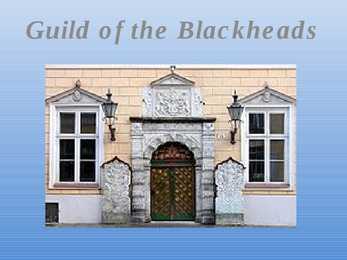
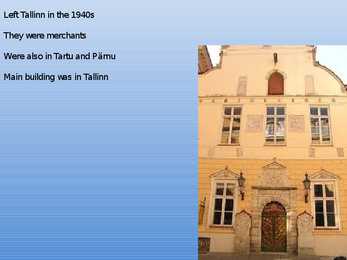
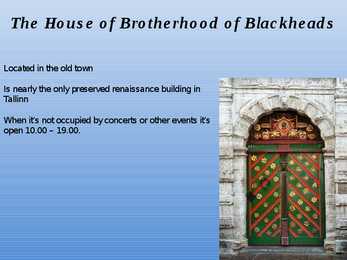
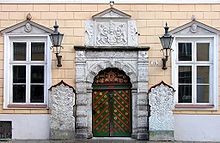
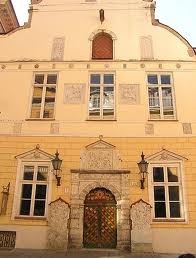
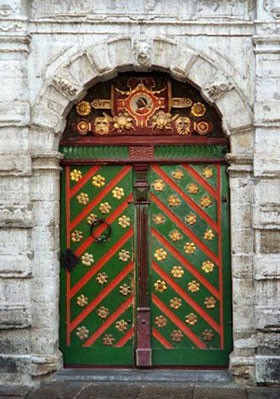
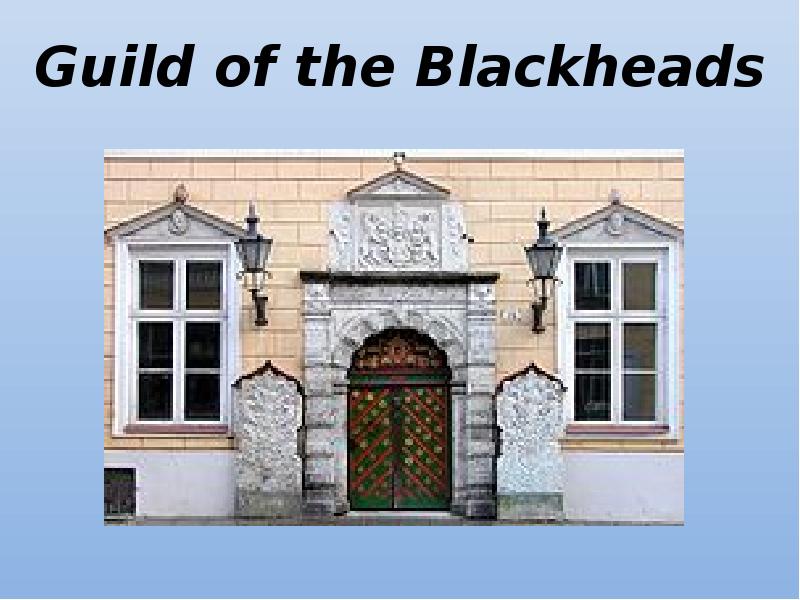
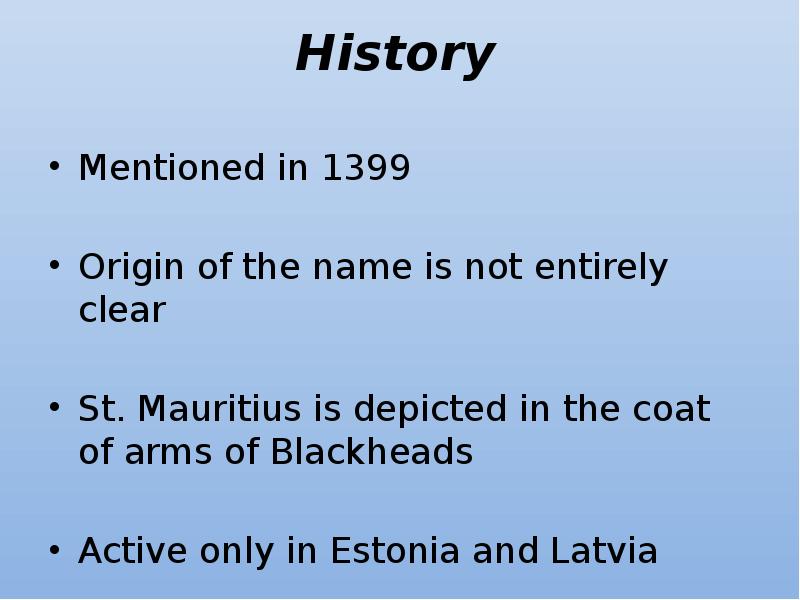
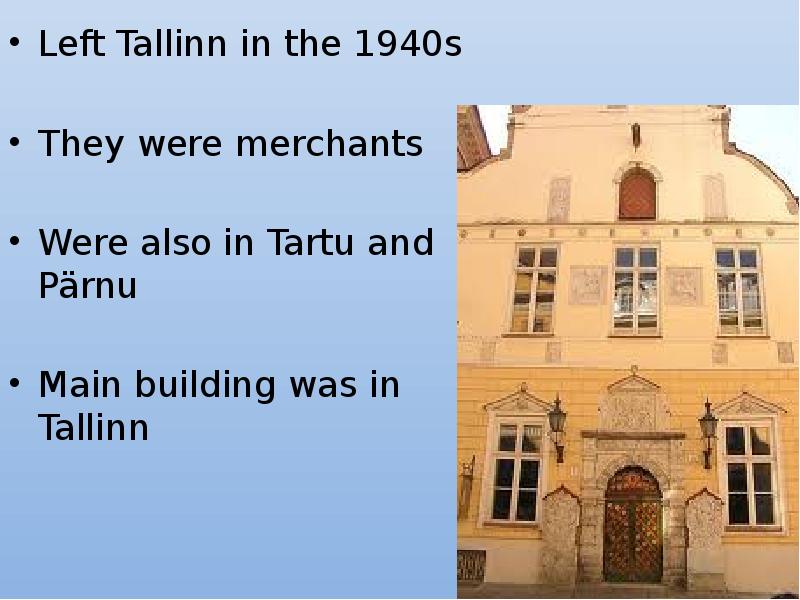
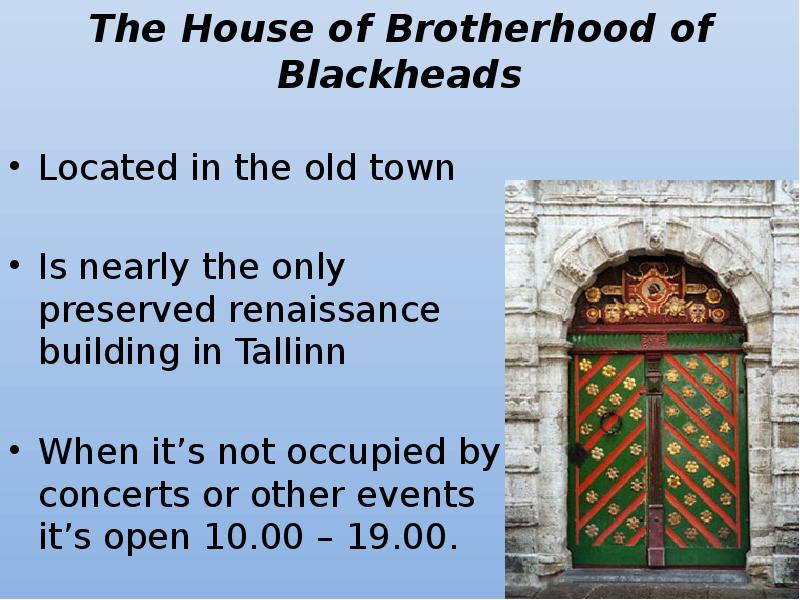
documents in 1422, but by some accounts, it may be older still. The town councilgoverned pharmacy sold many other goods besides medicine. Over the centuries, it has changed slightly, but it still retains the flavour of bygone days, while it sells modern medicines. Medieval medicinal ingredients like bat powder and snakeskin are no longer available, but you can still try the fine spiced claret, renowned already in the Middle Ages. The House of the Brotherhood of Blackheads is nearly the only preserved Renaissance building in Tallinn. The Brotherhood of Blackheads emerged in 1399. The Brotherhood united the young, single merchants before they could be accepted into the Great Guild, as well as foreign merchants who were residing in Tallinn for longer periods but not permanently. The name of the Brotherhood is associated with their patron, the black St. Mauritius, an early Christian martyr who died in Switzerland around 280300 A.D
there until 1970, its a concert hall and meeting place. Also a museum. Pharmacy - always been in business in the same exact house since the early 15th century. It is also the oldest commercial enterprise and the oldest medical establishment in Tallinn. Johann Burchart family longest ran it 60 years. Unicorn powder, burnt hedgehogs, worms. Also were a weighing house, well, pillory- Magistracy - consisted of 24 burghermaster and something, selected from the members of the great guild Guilds The Great Guild - the association of hansaetic merchants, married persons, Brotherhood of blackheads - association of local unmarried blackheads, when married went into the great guild. active from the 14th century til 1930. founded a military organisation, but became social one. Estonians were never accepted into guilds. Town Wall Fat margaret and great coastal gate They were built not only to defend the city from the seaward side of town, but also to impress
Grave monument of Ferdinand von Tiesenhausen 1806 12. Christian Ackermann Pulpit 1686 13. Johann Gustav Stockenberg Grave monument of Fabian von Fersen Last decades of the 17th century 14. Johann Gustav Stockenberg Grave monument of Otto Reinhold von Taube Last decades of the 17th century 15. Ciacomo Quarenghi Grave monument of Samuel Greigh 1788 16. Johann Gottfried Exner Grave monument of Adam Johann von Krusestern 1848 17. Grave slab of the Toompea butcher's guild 1760 18. Grave slab of the shoemaker's guild 1760 The cathedral of Saint Mary the Virgin in Tallinn .http://www.eelk.ee/~eelk109/english.htm The Organ The Tallinn Dome Church organ, that was built in 1878 by an organ builder of Weissenfeld Friedrich Landegast , rebuilt in 1913/14 by a famous German organbuilding enterprise Orgelwerkstatt Wilhelm Sauer and renovated by Christian Scheffler (Frankfurt/Oder), has an outstanding position in world organ-history. The organ is a
The Great Guild Liisbeth Kallakmaa The Great Guild Medieval Tallinn's social institutions were guilds and brotherhoods, whose main function was to provide members with social interactions and ensure their rights, but also played an important political and economic role. Tallinn had three important guilds - The Great Guild, St. Canute's Guild and St. Olaf's guild. The Great Guild was the youngest among them, founded in the 14th century, but soon became the biggest and most important. It was founded as an organization of the wealthiest merchants and shipowners. The name of the Great Guild was introduced in the late 15th century. There were close ties between the guild and the town rules: only members of the Great Guild had the right to belong to the town council and could be elected for mayor. Tallinn's small coat of arms is also the Great Guild's coat of arms
Tallinn English College Topic Estonia Tallinn 2008 1. Introduction Estonia is a small country about the size of Switzerland, or New Hampshire and Massachussetts combined. Estonia is named after the people called "Ests" who lived in the region in the 1 st century AD. The Republic of Estonia is one of the three countries commonly known as the "Baltic States". The other Baltic States are Latvia and Lithuania. 2. Geographical position Estonia is situated in northeastern Europe. Estonia is bounded on the north by the Gulf of Finland, on the east by Russia, on the south by Latvia and on the west by the Baltic Sea. In the north it borders on Finland. The coastline of the Baltic Sea in Estonia is characterized by numerous gulfs and bays, the biggest of them being the Gulf of Finland, the Gulf of Riga and the Gulf of Pärnu. Bays include the Narva Bay, Matsalu Bay, Kolga Bay, Kunda Bay, Tallinn Bay etc. Estonia has over 1500 islands, the largest being
TALLINN History Tallinn is one of the oldest cities in the Baltic Sea region. Tallinn was first mentioned in written sources of the 1154th, when the Arabian geographer Al Idris took a world map the city 'Kaleveny "/ Kolõvan. Through the years, the city of Tallinn had several names: Lindanisa, Kolõvan, Reval and eventually Tallinn. Tallinn was granted the Lübeck law in 1248 and became the member of the Hanseatic League in 1285. General Data l Country - Estonia l County - Harju County l First appeared on map - 1154 l Town rights - 1248 l Mayor - Edgar Savisaar l Aera - Total 159.2 km2 (61.5 sq mi) l Population - (1 Mar 2012) Total - 416,470 Denisty - 2,614.0/km2(6,766.6/sq mi) Tallinn Coat of arms Flag Top 5 Attractions 1. Kiek in de Kök Visitors to the museum will see examples of Medieval firepower, displays detailing how the city's system of walls and towers developed through the centuries and an exhibit on c
Small Coast Gate and the Nun´s Gate. The Viru Gate was first recorded in 1359 and it was considered one of the major gates. The Harju Gate was situated at the place where Müürivahe Street crosses Harju Street. Museums There are more than 20 museums in Tallinn. The oldest of them is the History Museum. It was founded in 1842. The museum is situated in the Gothic guildhall in Pikk Street built for the Great Merchants` Guild in the 15th century. The Town Museum has a permanent exhibition on the history of Tallinn from the 13th century. The museum is situated in a 14th century dwelling house in Vene Street. The Museum of Natural History in Lai Street offers a survey of Estonian geological past, mineral resources, plants and animal life. The Maritime Museum lies in the 16th century defence tower Stout Margaret in Pikk Street. There are displayed old nautical instruments, models of ships, maps and charts.
Middle Ages Cute miniature shop where the bakery was belonged to a former whose family coat of arms are still decorating the door. The Holy Spirit church It was built in 1360.This church plays an important role in Estonian cultural history. The first sermons in Estonian language were held in this church in order for the local people to understand the Bible stories. The church's altar is made by the famous Lübeck master Bernt Notke. The Great Guild house The impressive building of the Great Guild is in late Gothic style During centuries the building, has been used for merchants feasts and receptions, rented out for marriages and also used for court sittings and theatre performances. It has also been rebuilt many times The Great Guild Hall is the home of the Estonian History Museum, which houses a number of treasures, including porcelain, ethnography, antiques and art objects. St.Olaf church
 annaabi.ee










Kõik kommentaarid