 50 punkti
Autor soovib selle materjali allalaadimise eest saada 50 punkti.
50 punkti
Autor soovib selle materjali allalaadimise eest saada 50 punkti.
 ~ 1 leht
Lehekülgede arv dokumendis
~ 1 leht
Lehekülgede arv dokumendis
 2012-02-23
Kuupäev, millal dokument üles laeti
2012-02-23
Kuupäev, millal dokument üles laeti
 356 laadimist
Kokku alla laetud
356 laadimist
Kokku alla laetud
 2 arvamust
Teiste kasutajate poolt lisatud kommentaarid
2 arvamust
Teiste kasutajate poolt lisatud kommentaarid
 Smart Files
Õppematerjali autor
Smart Files
Õppematerjali autor
Verbs! Verb forms Review of tenses Chapter 12, Pg 215 1 Timeline Draw a timeline of your life. List 810 events on the time line. Make sure you list your future graduation date! Moved to Cali 2005 Was Born Traveled to Europe Husband 1978 School graduates @ Oxford 1999 Started Got married School 1983 2008 2 The Six English Verb Tenses Three Simple Tenses Simple continuous Present You walk. You are walking I run. I am running. Past You Walked You were walking. I ran.
I/we will ask I/we will not ask Will I ask? He/she/it will go He/she/it will not go Will he/she/it go? You/they will make You/they will not make Will we/you/they make? Pane tähele! Üldtuleviku moodustamiseks kasutatakse abiverbe will/shall. Traditsiooniliselt esineb shall ainsuse ja mitmuse 1. pöördes ( I, we ). Kaasaegses inglise keeles kasutatakse will kõigis pööretes ning shall, et küsida kellegi arvamust, kuid tendents on kasutada abiverbi will kõigis pööretes. Will/shalltuleviku asemel saab kasutada mitmetel juhtudel going totulevikku. Üldtulevik väljendab: · Ühekordset, korduvat või harjumuspärast tegevust tulevikus. I will meet John in the station. My birthday will come again. · Tegevust või situatsiooni, mis kestab tulevikus.
TENSES. ACTIVE VOICE. 1. Present Simple (üldolevik) I (he, she, it s) he works Eitav,küsiv do (I, you, we, they) he does not work does (he, she, it) does he work? Verbidele, mis lõpevad infinitiivis ss, -sh, -ch, -x või o, lisatakse ainsuse 3. pöördes es he touches, she goes Verbidel, mis lõpevad y-ga, mille ees on konsonant, muutub y->ies carry - he carries Vrdl: play he plays 1. Harjumuspärane, korduv tegevus või seisund olevikus. Tom drinks tea every day. He lives in Brussels. 2. Üldtuntud tõed, loodusseadused The earth goes round the sun. 3. Tulevikus toimuv tegevus a) Sõiduplaanid, planeeritud programmid. The train for Tallinn leaves at 10. The course begins on Monday. b) Tingimuslausetes
INGLISE KEELE PÕHITÕED C.K 2017 A – AN – SOME Singular: a or an Use some for things you can't count ◦ *a banana *a car *a monkey *a football ◦ *some milk *some water *some coffee ◦ *an egg*an accident *an umbrella *an *some sugar eagle ◦ *some tea *some juice*some money *some butter Plural: some Exercises: 1. http://www.english-4u.de/a_an_some_ex1.htm ◦ *some bananas *some cats *some monkeys *some 2. http://www.english-4u.de/a_an_some_ex3.htm balls ◦ *some eggs*some oranges *some umbrellas *some 3. http://www.english-4u.de/a_an_some_ex6.htm eagles We us the
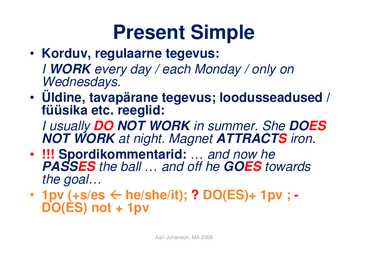
Present Simple · Korduv, regulaarne tegevus: I WORK every day / each Monday / only on Wednesdays. · Üldine, tavapärane tegevus; loodusseadused / füüsika etc. reeglid: I usually DO NOT WORK in summer. She DOES NOT WORK at night. Magnet ATTRACTS iron. · !!! Spordikommentarid: ... and now he PASSES the ball ... and off he GOES towards the goal... · 1pv (+s/es Å he/she/it); ? DO(ES)+ 1pv ; - DO(ES) not + 1pv Aari Juhanson, MA 2008 Present Progressive · Hetkel toimuv, pooleliolev tegevus: S/he IS TALKing on the phone now. I AM READing an interesting book. · Ajutine, regulaarsele ja tavapärasele vastanduv tegevus (tulevikku viitav): This summer they ARE not GROWing cucumbers as usual. They'RE GROWing tomatoes instead. · !!! Halvakspanu väljendus harjumuspärase tegevuse kohta: He IS always COMPLAINing! · BE (am/is/are) + 1pv-ing Aari Juhanson, MA 2008 Present Perfect ON -NUD ·
PRESENT SIMPLE (lihtolevik) Form: 1st form (+s) Use: 1. Things in general. Nurses look after patients in hospitals. 2. Things that happen all the time or repeatedly. She usually goes away at weekends. 3. Laws of nature (things that are true in general). The sun rises in the east. 4. Timetable events. The train leaves at 6.50 p.m. Negative form: I don't (do not) normally eat my lunch here. He doesn't (does not) like this film at all. Question form: Do you live here? How often does it rain around here? Signal words: always, every day/month, never, normally, often, seldom, sometimes, usually etc. PRESENT CONTINUOUS/PROGRESSIVE (kestev olevik) Form: am/is/are + ing Use: 1. Unfinished actions happening at or around the time of speaking. Listen! Somebody is crying. They are building a new bridge in our town. 2. Changes happening around now.
mis on kahepoolselt kokku lepitud: Loodusseadused My grandparents are celebrating Spordiülekanded their wedding anniversary next Juhised month. Pahameelt näitav sageli toimuv tegevus. Inglise keele ajavormid ja nende kasutamine (9. klassi seisuga) Past Simple Past Progressive/Continuous (lihtminevik) (kestev minevik) II vorm was played - reeglipärane I vorm+ing (playing) wrote - ebareeglipärane were did not I vorm was (didn't play / write) not I vorm+ing
Loodusseadused My grandparents are celebrating Spordiülekanded their wedding anniversary next Juhised month. Pahameelt näitav sageli toimuv tegevus. Inglise keele ajavormid ja nende kasutamine (9. klassi seisuga) Past Simple Past Progressive/Continuous (lihtminevik) (kestev minevik) II vorm was played - reeglipärane I vorm+ing (playing) wrote - ebareeglipärane were did not I vorm was (didn't play / write) not I vorm+ing
 annaabi.ee





Kõik kommentaarid