Leidsid 33 sarnast õppematerjali, mis on seotud failiga "British Literature". Need materjalid aitavad sul teemat sügavamalt mõista.
english, literature, saxon, beowulf, father, christian, poet, land, british, poem, pagan, language, hero, christianity, alfred, song, julius, years, saxons, angle, england, bede, latin, aulik, ideas, grendel, fate, between, country, first, religious, hymn, creation, oldest, important, early, settlers, celts, river, names, crude, caesar, romans, thanRevision questions for the test on Old English and Medieval Literature. 1.) How is literature analysed and studied? What is the difference between the diachronic and synchronic view? Literature is studied and analysed by reading the piece of work profoundly and work on all the aspects of the piece. Diachronic is development in history Synchronic is particular state at any given moment 2.) Give a general overview of Celtic Britain, Roman invasion in 55-54 BC, Anglo-Saxon invasion and the second Roman "invasion" of Great Britain, who were the leaders, what
History of English literature Periods: 1. Anglo-saxon or early literature (499 - 1066) 2. Second or Norman or late Medieval period (1066 - 13/14 century) 3. Renaissance or Modern period (13-14 century present) Anglo-Saxon period · All of the literature had its roots in folklore · Texts were orally transmitted, the anglosaxons had no written language · Two types of singers: 1) scop (attached to the royal court, wrote poetry and songs, performed them); 2) gleeman (travelled, mostly sang other peoples' songs, not their own songs; performers of scop songs) · The oldest known song Widsith (The Far Traveller/Wonderer); tells of a gleeman who travels in Europe, of his love of noble deeds, speaks of the shortness of life
Outstanding figures in British literature Eva Martina Põder 11.b British literature Refers to all literature produced by British authors from the United Kingdom, which includes England, Scotland, Northern Ireland, Wales, the Channel Islands, and Isle of Man Includes early works written in Gaelic, Welsh, and Latin, works in Old, Middle, and Modern English, each of which represents a different period Full of great works British works in Latin Venerable Bede He lived between 673 and 735 AD The greatest of all the AngloSaxon scholars He's the earliest English historian, whose work has shed light on a period of English history that would have otherwise been unknown ,,The Father of English History" Wrote / translated about 40 books on almost every area of knowledge, i.e. nature, astronomy, and poetry
headed openings. There are few remains of Anglo-Saxon architecture, with no secular work remaining above ground. All surviving churches, except one timber church, are built of stone or brick and in some cases show evidence of re-used Roman work. Art Anglo-Saxon art is mainly known today through illuminated manuscripts. Although they are the most well known to have survived. Perhaps the best known piece of Anglo-Saxon art is the Bayeux Tapestry which was commissioned by a Norman patron from English artists working in the traditional Anglo-Saxon style. The most common example of Anglo-Saxon art is coins, with thousands of examples extant. Anglo-Saxon artists also worked in fresco, ivory, stone carving, metalwork and enamel, but few of these pieces had survived. Literature Anglo-Saxon literary works include genres such as epic poetry, hagiography, sermons, Bible translations, legal works, chronicles, riddles, and others. The most famous works from this
1. Beowulf. The dating of Beowulf is still controversial. The poem is one of the earliest and greatest monuments of the Germanic literatures. The main stories of the poem (the fights of B.) are versions of common folk-tales, but the poet also introduces many incidental stories, some of which belong to the world of ancient Germanic legend. He writes his folk-tales and legends in a web of other events, mainly set in the Baltic Kingdoms. He shows a very rich and leisurely portrayal of this Baltic world, providing many customs like the close relationship between lord and man in the war-band and others. All this encouraged the supposition that the unknown author of the poem was himself a bard of the ancient type
ENGLISH LITERATURE Ancient Britain Lived on the British Isles in the 1st millenium. They most probably came from Eastern Europe and belonged to the Celtic race and also spoke Celtic. They were primitive hunters- gatherers, farmers. Some Celtic words are still used in modern English, however they are used mostly in place names. For example: · avon river · cumb valley · ford shallow place in the river Ancient Britons had their own religion and priests or druids and temples. In the year 55 BC Britain became a Roman province. Romans were highly developed and had their own language latin, which has also greatly influenced English. The military occupation of the Isles ended in 410 AD
THE ANGLO-SAXON PERIOD English literature came when the Angles, the Saxons, the Jutes and the Frisians invaded Britain. During this time English was called Anglo- Saxon or Old English. In the chronicles of Roman history (composed in Latin) is said that Britain makes its first appearance in written language when Romans invade the England. BEOWULF most important poem, surviving in a 10th-cent manuscript. The historical period of the poem's events can be dated in the 6th to 8th century. Much of the material of the poem is legendary and paralleled in other Germanic historical-mythological literature in Norse, Old English, and German. GEOFFREY CHAUCER (1340-1400) Politician and writer, fought in France during the 100 years war. He visited Genoa and Florence where he became acquainted with Italian
The Germanic Invasions Anglo-Saxon invasion During the 5th c. a number of Germanic tribes invaded The Angles, the Saxons, the Jutes Different peoples, but common language and customs Advance halted by King Arthur Distortions of popular history In folklore, myth (and films) a great English hero, an example of medieval nobility and chivalry In fact a Romanized Celt, lived before medieval times, fought the Anglo-Saxons (people who became "the English") Predominated by the end of the 6th c. Kingdoms established: Wessex, Essex, Sussex, Mercia, Northumbria, East Anglia etc. Kingdoms constantly at war with each other Celtic culture and language survived in Scotland, Wales and Cornwall
Officials were appointed (governors, procurators to collect taxes, look after the estates and mines and se that the gold, silver, iron and lead were exported back to Rome). Introduced schools,a new language Latin, large farms (villas), baths. In AD 410 they had to leave . roman occupation lasted nearly 400 years. They left behind very little. Roman province of Britannia covered most of present-day England and Wales. 4. Latin influence on English *The influence of Latin is noticeable also in the names of European cities: the Latin noun colonia (settlement, colony) may be found in numerous place-names: Lincoln, Colchester, Cologne ; from Latin word castrum (military camp) were derived English affixes -chester and -castle: Manchester, Lancaster, Newcastle; Latin word portus (seaport) in Portsmouth *-tor - person, doer, masculine form. The suffix is attached to the stem: victor (`winner', from the
The Saxons & Vikings Fragmentary knowledge of England in the 5th & 6th centuries comes from the British writer Gildas, the Anglo-Saxon Chronicle, saints' lives, poetry, archaelogical findings and place- name studies. British landlords ruled small, unstable kingdoms and continued some Roman traditions of governance. In the mid-5th cent, Vertigern, a British leader, hired Germanic mercenaries to help defend against peoples of the north (Picts & Scots). In the end they revolted & the process of invasion and settlement began. The first Saxon ,,kings" were Hengist & Horsa in Kent, Aelle in Sussex, Cerdic / Cynric in Wessex. So the first ,,English" became mainly from Northern Germany & Denmark. The resistance of the Celts was long. They were free at the time, not like other Roman provinces on the Continent.
English literature is one of the oldest literatures in Europe; dates back to the 6th century AD. Oral literature, i.e. not written down, spread from person to person. In 449 AD Anglo-‐Saxon tribes invaded England – beginning of the Anglo-‐Saxon period in English literature. The first form of literature was folklore, carried by scops and gleemen, who
материала, закрепление словаря и развитие навыков ведения беседы по тематике пособия. Пособие предназначено для студентов гуманитарных специальностей. Подготовлено на факультете лингвистики. The book contains an overview of the most important events in British history – from the first documented invasions of the island to the formation and fall of the British colonial empire. A series of exercises will help to remember the subject matter, practise the vocabulary and contribute to skills work. The book is intended for the Humanities students. Вавилов Н.А., 2008 3 4 Contents 5 ПРЕДИСЛОВИЕ
3) The Germanic Invasions I. The Anglo-Saxons o 5th century- 1066 o From Southern Denmark(angles); Germany(saxons); Jutland(jutes) o By the 7th c kingdoms had emerged and later KING ALFRED united the kingdoms o They were pagans and very rural people, built in wood rather than stone o It was the saxon farmstead that laid the foundations of the English village II. The Vikings o 8th century- 11th century o From Denmark, Norway o They were ship builders and sailors o In 886 the Danelaw peace treaty was made 4) The Normans/ the final conquest o 1066-1154 o From present-day France o In the battle of Hastings on 14.10.1066 the normans defeated the English and their leader, Duke William
why the south has been more populated.. Britain became an island only 5000 years BC after the Ice Age ended. Britain's prehistory The first evidence of human life on the island are dated back to 250 000 BC. 50 000 BC in a milder Ice Age period Britain became habitable again. People from that time were the ancestors of the modern British. 10 000 BC ige age ended and Britain became inhabited by small groups of hunters who probably followed herds of deer. 5000BC Britain became an island and deer died out. 3000BC the Neolithic people came (probably from Spanish peninsula or even North African coast). They may be the forefathers of the people from Cornwall and Wales. The building of Stonehenge started around that time. 2400BC the 'Beaker' people arrived in Britain. They had better
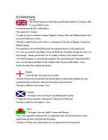
1) General facts The UK: * the United Kingdom of Great Britain and Northern Ireland was formed in 1801 * it covers 243,610 sq km * everybody from the UK is called British * the capital city is London * is made up of four constituent countries: England, Scotland, Wales and Northern Ireland which in turn are divided into counties * the flag is called the Union Jack which is a combination of the flags of England, Scotland and Northern Ireland * the population is about 60,000,000 people, the population density is 242 people/sq km * its coasts are washed by the Atlantic Ocean, the North Sea, the English Channel, the Celtic Sea,
th western Scotland, until 10 c Mysteriously disappeared Constantly fought with Romans Teir country- Caledonia- Pictland The Scots, Hibernia Raiders, Celts living in Ireland/Hibernia Migrated to Scotland Raided Roman Britain After Kenneth McAlpin united Scotland all inhabitants became Scots The Venerable Bede A monk in the Northumbrian monastery of Jarrow In 731 ,,The Great Ecclesiastical History of the English People"- overshaows all other sources of 7th, early 8th C Well-founded scraps of tradition, first work of history, where AD system is used Angles, Saxons, Jutes. Frisians 430´s onwards, Germans settlers arrived in large numbers. Anglo-Saxon invasions in 499 The Saxons- Saxon country to South and West The Angles- Angulus to East Anglia, Jutes in Kent Same culture as southern Scandinavia, Germany, northern France 600 they had founded their 7 kingdoms
and Julius Caesar never returned to Britain after that. The island was left undisturbed for nearly a century. *The Roman occupation of Britain 43-410 and its legacy Britain was conquered by Emperor Claudius, the Roman rule in England lasted up to 410. The Romans left behind a huge legacy: many types of animals and plants were brought to Britain in Roman times. Roman introduced theire measurements, Christianity, reading and writing. Also, many words in English and Welsh have been borrowed from the Latin language. An important legacy of the Romans was its roads, agriculture and cities. In the Roman times the land was dominated by rules and reguations. *Christianity in Roman Britain The Roman authorities were suspicious of Christianity because followers of Jesus Christ refused to take an oath of loyalty to the Roman emperor. For this reason the early Christians were regarded as dangerous enemies of the Empire. That
Suppletion Present in languages of different families. Present in Old, Middle and Modern English, though the general tendency is towards more regularity/iconicity so the number of suppletive forms has decreased.In the text: goon to go wenden - to turn Gan was suppletive in Old English, past form: eode.Eode was supplanted by went (past form of wenden) at the end of the Middle English period.To wend has survived in Modern English in phrases such as to wend one's way, we wended homewards (ironic usage). Thus: suppletivity- suppletion different parts of one and the same paradigm come from what were originally different paradigms (different words with close meanings or words in different but close dialects).Suppletion embraces verbs, adjectives, nouns. Be was/were been (Old English beon/wesan) (am, art, is, are); in Old English some suppletive
Tallinn English College Topic Great Britain 2007 1. Introduction The official name of Great Britain is `the United Kingdom of Great Britain and Northern Ireland (or short United Kingdom)' The population is about 60.4 million. The capital is London. Other biggest cities include Birmingham, Bristol, Portsmouth, Glasgow and Swansea. English is the main language of Great Britain, but Welsh is officially recognized in Wales and Gaelic in Scotland. 2. Geographical position The British Isles is the geographical term for a group of about 5000 islands off the coast of mainland Europe. The largest island is Great Britain, which is also the largest island in Europe. It consists of England, Wales and Scotland. The next largest island is Ireland, which is made up of Northern Ireland and the Irish Republic. Britain and
Poets spoke with the voice of celebrating the king and queen. King and court retreated into a self-perpetuating arcadia of their own. Civil War. Sense that past would never return. 1640s. Metaphysical poets were fond of imagery difficult to understand and complicated metaphors, Cavaliers preferred more straightforward expression. Valued elegance, were part of refined, courtly culture, but poetry often frankly erotic. Short lyric poem, favourite theme carpe diem. Very decent, like Charles’s court. Characteristic to Charles I’s court Carew: Sir John Suckling: The Constant Lover Richard Lovelace: celebrates the beauties of heroine, but against very different background. To Althea, from Prison: Song; The Grasshopper: To My Noble Friend, Mr Charles Cotton: Ode Waller: wrote of queen as the queen of love. Cowley: Robert Herrick: The Argument of His Book, Delight in Disorder 6. The Caroline „beauty of holiness”
Its capital is London. The population is about 50 million people and growing because of immigration. England is bordered to the north by Scotland and to the west by Wales. It is closer to continental Europe than any other part of Britain, divided from France only by a 38 km sea gap. The Channel Tunnel, near Folkestone, directly links England to the European mainland. The English/French border is halfway along the tunnel. London is by far the largest English city and one of the largest and busiest cities in the world. Birmingham is the second largest. A number of other cities, mainly in central and northern England, are of substantial size and influence. These include: Manchester, Leeds, Liverpool, Newcastle, Sheffield, Bristol, Coventry, Leicester, Nottingham and Hull. England features mostly low hills and plains. the Lake District in the north- west features some of England's most beautiful landscapes, and includes Scafell Pike
Literature of the 14th century The highpoint of medieval literature, the best writer of late medieval lived then. William Langland 1332-1376 the last important poet of alliterative verse. His masterpiece "The Vision of Piers Ploughman" how important working hard is, the labour of peasants is the base of the welfare of the people. A passionate protest against social injustice. A time when peasants were slowly rising against their feudal lords. Descriptions of different social classes. Religious mysticism. Two great principles: 1) all men are equal before God; 2) honest labour is dignified. It is a dream allegory
island situated to the northwest of Continental Europe. It is the ninth largest island in the world, the largest European island, and the largest of the British Isles. With a population of about 60.0 million people in mid-2009, it is the third most populous island in the world, after Java and Honsh. Great Britain is surrounded by over 1,000 smaller islands and islets. The island of Ireland lies to its west. Politically, Great Britain may also refer to the island itself together with a number of
to stay. In the 10th century England fell under Danish Rule, with King Canute finally managing to unite the Anglo-Saxons and Danes at the beginning of 11th century. Medieval England After defeating the Anglo-Saxon King Harold at the Battle of Hastings in 1066, William of Normandy (who became William I, also called William the Conqueror) introduced the Norman feudal system, rewarding his French-speaking followers with land in return for their continued support. French remained the language of the upper classes and administration until the 14th century. The power of these Norman Barons gradually increased and during the reign of the Plantagenets began the challenge the King's absolute power, which resulted in King John being forced to sign Magna Carta in 1215. It consisted of long list of limitations to the King's power and it gave more power to the origins of Parliament.
K Different Parts The United Kingdom is a short way of saying the United Kingdom of Great Britain and Northern Ireland. The UK is the political name for those countries which share a parliament in London. All of them were at one time independent kingdoms with their own monarch. Now they are all part of the same kingdom and share the same monarch. The UK consists of Northern Ireland, Scotland, England and Wales. The peoples of these countries are British subjects; they hold British passports and therefore their nationality is British. The british Isles is the geographical name for all the islands off the west coast of Europe. These islands also include The Republic of Ireland, which is politically independent of the Britsh government. Many people refer to the inhabitants of the British isles as 'the English', but England is only one of the countries. The other countries are Scotland, Wales and Northern Ireland.
The Romans gave us a language based on Latin, the calendar, law and legal system, the census and also straight roads, central heating and concrete. Anglo- Saxons around AD 400 Anglo- Saxons were warrior farmers from Germany, Denmark and the Netherlands. Later in the 5th century, Anglo-Saxons settled just west of Londinium, around the Strand, and formed the town of Lundenwic. The area of the old Roman city became a landing-place for ships and a centre for trade.The first English King to convert to Christianity, King Ethelbert, founded St Paul's Cathedral in 604. The Vikings 8th and 9th century By the 9th century, London was a very prosperous trading centre, and its wealth attracted the attention of Danish Vikings. The Danes periodically sailed up the Thames and attacked London. In 851 some 350 longboats full of Danes attacked and burned London to the ground. King Alfred the Great totally defeated the Danes in 878 and they split the country between them
M Mc`Donalds is good, there is a lot of food. N is for Nigga who pulled the trigger. O is for Osama who wears pyjamas. P is for Pamela who likes camera. Puritans The Puritans were a group of people who grew discontent in the Church of England and worked towards religious, moral and societal reforms. The writings and ideas of John Calvin, a leader in the Reformation, gave rise to Protestantism and were pivotal to the Christian revolt. They contended that The Church of England had become a product of political struggles and man-made doctrines. The Puritans were one branch of dissenters who decided that the Church of England was beyond reform. Escaping persecution from church leadership and the King, they came to America. Of Plymouth Plantation Of Plymouth Plantation is the single most complete authority for the story of the Pilgrims and the early years of the Colony they founded
The UK contains a number of small islands. The largest islands that belong to the United Kingdom are the Isle of Man in the Irish Sea and the Isle of Wight which lies off of England's southern coast. The largest groups of islands are the Shetland Islands, the Orkney Islands and the Hebrides. Geographical Position The UK is situated in the Northern Hemisphere. The United Kingdom is bordered by the Atlantic Ocean in the west, the North Sea in the east, the Norwegian Sea in the north, and the English Channel, also known as La Manche, in the south and it also separates the country from the continent of Europe. The neighbours of the United Kingdom are Iceland in the north-west, Norway in the east and France in the south. Britain also has many dependant territories which are scattered throughout the world and are the remains of the huge former British Empire. Today Britain assists them, but they may become independent whenever they wish
Country Study Mari-Liis Luukas 11c The British Isles Administrative / d'mnstrtv / haldus- Self-governing / self'gvn / isemajandav, iseseisev Legislative assembly/ 'ledsltv 'sembl/ seadusandlik kogu
century and the humanist period during the Renaissance, the Enlightenment took scientific reasoning and applied it to human nature, society, and religion. American Enlightenment a gradual but powerful awakening that established the ideals of democracy, liberty, and religious tolerance in the people of America. If there were just one development that directly caused the American Revolution and uplifted the intellectual culture of the continent while it was only a British colony, it would be the American Enlightenment. Broadly, the Enlightenment was an intellectual movement that changed the fundamental perspective of the masses, urging them to foster skepticism and apply scientific principles in matters of religion and morality. Its chief values were: Liberty, Democracy, Republicanism, Religious Tolerance. The movement gained momentum with the publication of landmark texts like Thomas
Science: Albert Einstein-general theory of relativity had a huge impact on culture as well. Everything is relative. Philosophy: Henri Bergson (French) came to challenge the immediate experience ad intuition are more significant than rationalism and science for understanding reality. Opposition to materialism and positivism. Opposition to abstract, untested theories &ideologies. Friedrich Nietzsche ,,God is dead"-through explaining and putting forward theories had killed Christian god. The essence of Freudian theory: the process in the human psyche Superego-society, conscience, morals, traditions, religion, a moral censor Ego-rational behavior, motivation, self-identification, conscious decisions Id-instincts, natural responses, the pleasure principle, aggressive instincts, the death wish Influence: In art and literature, Freud's theories influenced surrealism . Like psychoanalysis, surrealistic painting and writing explores the inner depths of the unconscious mind
The business on constitutional monarchy never ends. 3. Who is the present heir to the throne? Speak about his education. Who are the 2nd and 3rd in line? Present heir is Prince Charles, The Prince of Wales. Has been an exchange student in Australia. Graduated from the university of Cambridge with BA (honors). 2nd and 3rd in line are Prince William of Wales and Prince Henry of Wales, respectively. 4. Make up your list of 5 top British people. Give your motivation. The Queen, Adele, Elton John, Shakespeare, JK Rowling. 5. Which 5 places attract visitors in Wales and Scotland? Edinburgh, Loch Ness, The Highlands, Snowdonia, Cardiff. 6. Name 6 islands, 5 rivers, 3 lakes, 3 mountains in UK. Isle of Man, Isle of Wight, Isle of Lewis, Island of Mull, Island of Arran, Anglesey Island Severn, Thames, Tweed, Avon, Trent, Dove Ben Nevis, Snowdon, Ben Macdui 7. Stonehenge.
Charles Dickens Charles John Huffam Dickens was the foremost English novelist of the Victorian era, as well as a vigorous social campaigner. Considered one of the English language's greatest writers, he was acclaimed for his rich storytelling and memorable characters, and achieved massive worldwide popularity in his lifetime. Charles Dickens was born in Landport, Portsmouth in Hampshire, the second of eight children to John Dickens n 7 February 1812. The 12-year-old Dickens began working ten hour days in a Warren's boot-blacking factory. In May 1827, Dickens began work in the office of Ellis and Blackmore as a law clerk. At the age
 annaabi.ee