 50 punkti
Autor soovib selle materjali allalaadimise eest saada 50 punkti.
50 punkti
Autor soovib selle materjali allalaadimise eest saada 50 punkti.
 ~ 10 lehte
Lehekülgede arv dokumendis
~ 10 lehte
Lehekülgede arv dokumendis
 2015-11-09
Kuupäev, millal dokument üles laeti
2015-11-09
Kuupäev, millal dokument üles laeti
 1 laadimist
Kokku alla laetud
1 laadimist
Kokku alla laetud
 0 arvamust
Teiste kasutajate poolt lisatud kommentaarid
0 arvamust
Teiste kasutajate poolt lisatud kommentaarid
 merlinsama
Õppematerjali autor
merlinsama
Õppematerjali autor
broadleaf forests and rainforests are usually not grazed owing to the closed structure precluding grass growth, and hence offering little opportunity for grazing. In contrast the open structure of savannas allows the growth of a herbaceous layer and are commonly used for grazing domestic livestock. As a result
From the east by the Coral Sea and the Tasman Sea. Australia's coastline is about 37,000 km long. The Great Australian Bight washes the southern coast. The Gulf of Carpenteria and the Cape York Peninsula surround it in the south. 3. Relief Australia is the smallest continent in the world It is often called the island continent because is too big for an island but rather small for a continent. Australia is 1,800 miles from the mainland of Asia and almost half way round the world from Europe. More than 6,000 miles of ocean separate in from the America. Australia is the only continent except for Antarctica that lies all south of the equator. The natural zones of Australia are very various. There are deserts, semi deserts, grasslands, savannas, bushlands and rainforests. The wet forests occupy the narrow region in the east. Most of the animals, birds and insects live in that region, because there is enough food
Australian temporary rivers are called creeks. The biggest rivers of Australia are in the eastern part of the country. The Murray River is the largest but the second longest river, only its tributary the Darling river is longer than it. The Murray rises in the Australian Alps and flows north-west. It makes up much of the border of the New South Wales and Victoria. The Murray-Darling river system is one of the largest river systems in the world. There are predominantly dry salt lakes in the flat desert regions of the country lacking in organised drainage. The Australians can get most of their underground water from the Great Artesian Basin, which is the largest and deepest artesian basin in the world. Iti is near Lake Eyre, the Great Dividing Range and the Simpson Desert. An artesian well is a confined aquifer containing groundwater that will flow upwards
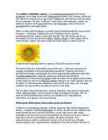
individual flowers make for a high probability of finding nectar. Monarch butterflies are commonly seen nectaring on sunflowers during their fall migration. Whether as a source of food for people and wildlife or an eye-catching splash of color on the landscape, the Common Sunflower is an important member of the prairie community. I. History: Sunflower (Helianthus annuus L.) is one of the few crop species that originated in North America (most originated in the fertile crescent, Asia or South or Central America). It was probably a "camp follower" of several of the western native American tribes who domesticated the crop (possibly 1000 BC) and then carried it eastward and southward of North America. The first Europeans observed sunflower cultivated in many places from southern Canada to Mexico. Sunflower was probably first introduced to Europe through Spain, and spread through Europe as a curiosity until it reached Russia where it was readily adapted. Selection for
Additionally, in recent years it has become clear that many companies have reduced their manufacturing costs as much as it is practically possible. Therefore, in many cases, the only possible way to further reduce costs and lead times is with effective supply chain management. In addition to cost reduction, the supply chain management approach also facilitates customer service improvements. It enables the management of: inventories, transportation systems and whole distribution networks so that organizations are able to meet or even exceed their customers' expectations. The major objective of supply chain management is to reduce or eliminate the buffers of inventory that exists between originations in chain through the sharing of information on demand and current stock levels. Broadly, an organization needs an efficient and proper supply chain management system so that the following strategic and competitive areas can
Australia Australia is the smallest continent in the world. It is 7.6 million square kilometres big. It is often called the island continent because it is rather small for a continent and very big for an island. There are only five countries bigger than Australia in the World. There are five states in the mainland. Tasmania is also considered as a state so there are six states. The Northern Territory and Canberra are also independent but they are not states. Canberra is the capital of Australia and it is situated between Sydney and Melbourne because both of these cities wanted to be the capital. The population is about 19 million people and growing. New South Wales is the most populated state and Victoria is the most densely populated state. The national language is English. It is English because British settlers came to live in Australia in the past and they brought convicts with them who were also British. S
the model into paper format. On complex-shaped buildings, architects are representing the global geometries of external surfaces in 3D – including roofs, cladding, glazing systems, etc. – while component details are supplemented with conventional 2D drawings. What used to be a tedious computational method working with 2D segments of a building is becoming a visual process working with pictorial representations of the structure, building systems, and architecture (Smilow, 2007). The study by Ku, Pollalis, and Fischer (2007) is noteworthy in that it highlights two main practices that architects follow when designing complex structures in 3D. When using ‘master model technology’ the architect retains control and assumes responsibility of the original 3D model and shares it with downstream participants, who import the model to develop their own work. The model is considered the primary documentation governing
Prince Henry the Navigator, son of King João I, became the main sponsor and patron of this endeavor. During this period, Portugal explored the Atlantic Ocean, discovering several Atlantic archipelagos like the Azores, Madeira, or Cape Verde, explored the African coast as well as colonizing selected areas of Africa, discovered an eastern route to India that rounded the Cape of Good Hope, discovered Brazil, explored the Indian Ocean and established trading routes throughout most of southern Asia, and sent the first direct European maritime trade and diplomatic missions to China and Japan. In 1415, Portugal acquired the first of its overseas colonies by conquering Ceuta. It was the first prosperous Islamic trade center in North Africa. There followed the first discoveries in the Atlantic: Madeira and the Azores, which led to the first colonization movements. Throughout the 15th century, Portuguese explorers sailed the coast of Africa, establishing
 annaabi.ee










Kõik kommentaarid