Leidsid 33 sarnast õppematerjali, mis on seotud failiga "The Irish Problem". Need materjalid aitavad sul teemat sügavamalt mõista.
land, cromwell, ireland, irish, catholic, place, army, west, body, curse, roman, could, never, 1652, settlement, munster, cruel, claimed, acting, behalf, reason, belief, fundamental, protestantism, hatred, church, religious, other, attempts, export, children, sugar, suffer, term, extreme, poverty, buried, westminster, abbey, parliament, laws, reverseThe Irish Problem ~the Irish can not be trusted~ In 1641, just prior to the Civil War, the Irish of Ulster had begun an uprising and attacked the planters who had been settled 30 years before. Between 10,000 and 15,000 Protestant planters were murdered by the Irish at places such as Portadown. Due to the war, the English did
1. The Queen’s official title. Elizabeth the Second, by the Grace of God, of the United Kingdom of Great Britain and Northern Ireland and of Her other Realms and Territories Queen, Head of the Commonwealth, Defender of the Faith. 2. The Queen’s working day. Starts after breakfast. Reads the newspapers which are prepared by the Press Secretary, and a report on the previous day’s proceedings in the Parliament and the letters she receives. Also phone calls. Once a month she attends the Privy Council in order to give Royal Assent to various items of government legislation.
to stay. In the 10th century England fell under Danish Rule, with King Canute finally managing to unite the Anglo-Saxons and Danes at the beginning of 11th century. Medieval England After defeating the Anglo-Saxon King Harold at the Battle of Hastings in 1066, William of Normandy (who became William I, also called William the Conqueror) introduced the Norman feudal system, rewarding his French-speaking followers with land in return for their continued support. French remained the language of the upper classes and administration until the 14th century. The power of these Norman Barons gradually increased and during the reign of the Plantagenets began the challenge the King's absolute power, which resulted in King John being forced to sign Magna Carta in 1215. It consisted of long list of limitations to the King's power and it gave more power to the origins of Parliament.
inhabitants became Scots The Venerable Bede A monk in the Northumbrian monastery of Jarrow In 731 ,,The Great Ecclesiastical History of the English People"- overshaows all other sources of 7th, early 8th C Well-founded scraps of tradition, first work of history, where AD system is used Angles, Saxons, Jutes. Frisians 430´s onwards, Germans settlers arrived in large numbers. Anglo-Saxon invasions in 499 The Saxons- Saxon country to South and West The Angles- Angulus to East Anglia, Jutes in Kent Same culture as southern Scandinavia, Germany, northern France 600 they had founded their 7 kingdoms The Anglo-Saxon kingdoms Kent-JUtes, Essex, Sussex, Vessex- Saxons East Anglia, Mercia, Nothumbria- Angles Series of over-kings from various kingdoms St Patrick Conversion of Irish- 432-461 Patron saint of Ireland, originally pagan, slave He escaped, became a Christian priest and
Emperor Claudius, the Roman rule in England lasted up to 410. The Romans left behind a huge legacy: many types of animals and plants were brought to Britain in Roman times. Roman introduced theire measurements, Christianity, reading and writing. Also, many words in English and Welsh have been borrowed from the Latin language. An important legacy of the Romans was its roads, agriculture and cities. In the Roman times the land was dominated by rules and reguations. *Christianity in Roman Britain The Roman authorities were suspicious of Christianity because followers of Jesus Christ refused to take an oath of loyalty to the Roman emperor. For this reason the early Christians were regarded as dangerous enemies of the Empire. That ceased when the emperor Constantine converted to Christianity. Christianity became the official state religion of the Roman Empire in the early fourth century A.D. As the century
ENGLISH LITERATURE Ancient Britain Lived on the British Isles in the 1st millenium. They most probably came from Eastern Europe and belonged to the Celtic race and also spoke Celtic. They were primitive hunters- gatherers, farmers. Some Celtic words are still used in modern English, however they are used mostly in place names. For example: · avon river · cumb valley · ford shallow place in the river Ancient Britons had their own religion and priests or druids and temples. In the year 55 BC Britain became a Roman province. Romans were highly developed and had their own language latin, which has also greatly influenced English. The military occupation of the Isles ended in 410 AD. The Romans eventually brought Christianity to Britain. Hadrian's wall on the border of Scotland and England. It began construction in 122 AD.
SEVENTEENTH-CENTURY ☄ When James I became the first English king of the Stuart dynasty, he was already king of Scotland, so the crowns of these two countries were united. ☄ The kind of Middle English spoken in lowland Scotland had developed into a written language known as Scots ☄ The Scottish Protestant church adopted English rather than Scots bibles ☄ Religion and politics are inextricably linked ☄ Some people tried to kill the king because he wasn't Catholic enough and another king had been killed, partly because he seemed too Catholic ☄ Anger grew in the country at the way that the Stuart monarchs raised money ☄ Puritanism- ideological Protestantism ☄ Some of them thought the luxurious lifestyle of the king and his followers was immoral. They were also fiercely anti-Catholic and suspicious of the apparent sympathy towards Catholicism of the Stuart monarchs. ☄ This led to The Civil War
1. Ancient Britain: the Celtic tribes. 2000 years ago there was an Iron Age Celtic culture throughout the Br Isles. It seems that the Celts, who had been arriving from Europe from the 8th cent BC onward, intermingled with the peoples who were already there. The Celts were extremely talented people, creative and artistic. More than 1 Celtic tribe invaded Br. The descendants of ancient Celts live in Wales, Scotland, Cornwall and Ireland. They lived in primitive society. Druids priests, more powerful than chiefs. Acted like prophets. 2. Stonehenge From prehistoric period. Was built on Salisbury plain between 2500 and 1500 bc. One of the most famous and mysterious archaeological sites in the world. One of the mysteries is how it was built at all with the technology of the time. Another is its purpose. It appears to function as a kind on
The British Isles is the name of a group of islands washed by the North Sea in the east and the Atlantic Ocean in the west. The British Isles are shared by two separate and independent countries: the United Kingdom of Great Britain and Northern Ireland
Years 1154-1485 Henry I was the first unquestioned ruler. One of the most important kings in the Middle Ages. He had lands in Britain & France. Then the government was the monarch, a person, not a place. He had more land than any pervious king. After his marriage to Eleanor of Aquitaine, he also ruled the lands south of Anjou. His empire stretched from the Scottish border to the Pyrenees. England provided most of its wealth, but the heart was Anjou. Henry II began to regain royal control. During the war some barons had become very powerful. He pulled down some of their castles. He tried to restore law & order. He wanted the same kind of justice to be used everywhere. He appointed his own judges to travel around
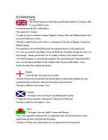
1) General facts The UK: * the United Kingdom of Great Britain and Northern Ireland was formed in 1801 * it covers 243,610 sq km * everybody from the UK is called British * the capital city is London * is made up of four constituent countries: England, Scotland, Wales and Northern Ireland which in turn are divided into counties * the flag is called the Union Jack which is a combination of the flags of England, Scotland and Northern Ireland * the population is about 60,000,000 people, the population density is 242 people/sq km * its coasts are washed by the Atlantic Ocean, the North Sea, the English Channel, the Celtic Sea, Saint George's Channel, and the Irish Sea. It is linked to France by the Channel Tunnel * the United Kingdom is a constitutional monarchy. The current monarch is Queen Elizabeth II, who is also the Queen and Head of State of fifteen other Commonwealth Realms, such as Canada, Australia, New Zealand and Jamaica.
invasion and settlement began. The first Saxon ,,kings" were Hengist & Horsa in Kent, Aelle in Sussex, Cerdic / Cynric in Wessex. So the first ,,English" became mainly from Northern Germany & Denmark. The resistance of the Celts was long. They were free at the time, not like other Roman provinces on the Continent. Around 500, the Britons seem to have won several victories. One of their leaders was Ambrosius Aurelianus and one of their victories was at the place called Mount Badon. The main leader of the Britons at this time may have been the warrior later called King Arthur. By the 7th cent. the invaders managed to conquer the greater part of the land. The invaders came from 3 powerful tribes: · The Saxons settled from the Thames Estuary westwards, in the south of England; they formed the kingdoms of Sussex, Wessex, Essex & Middlesex · The Angles settled in East Anglia, the Midlands & Northumbria
7 UNIT 1 THE ISLAND Pre-reading questions What is the name of the island group Britain belongs to? Where is it situated? What seas surround it? What kind of climate do you think Britain has? What is its surface like? What countries are situated on the islands? Which country are we going to study? Why? Location Land and climate affect life in every country. Britain is no exception. Britain is the largest island of the British Isles 1. It is just under 1,000 km long and just under 500 km across in its widest part. Britain is separated from the mainland of Europe by the North Sea on the east and the English Channel on the south – by only about 35 km of water at its closest point (the Strait of Dover 2). Most of the coastline is so broken by bays and inlets that no point on the island is more
1.)the Monarch is the Supreme Governor of the church, 2.)the Church performs a number of official functions, 3.)Church and State are linked. To disestablish Disestablishmentarianism refers to campaigns to sever links between church and state, particularly in relation to the Church of England as an established church. It was initially a movement in the United Kingdom in the 18th century. The established churches in Wales and Ireland could not count on even nominal adherence by a majority of the population of those countries. In Ireland, the predominantly Roman Catholic population campaigned against the position of the established Anglican Church of Ireland - eventually disestablished in Ireland from 1 January 1871. A broad church The Church of England is a broad church, representing a wide spectrum of theological thought and practice The Church of England is a broad church, representing a wide spectrum of theological
wikipedia.org/wiki/Emma_of_Normandy). He wast he penultimate Anglo-Saxon king of England. The family was exiled in Normandy after the Danish invasion of 1013 so Edward spent the first part of his life in Normandy. He grew up in deep religious views and gained the nickname ''Confessor''. As Edward was seperated from his family and grew up in a strange land, it is said that his childhood wasn't a happy one. After Ethelred's death in 1016 the Danes again took control of England. The throne of England passed to Canute the Great. The new king married Emma of Normandy and the couple had a son, Hardicanute. Edward lived in exile until 1041. At the death of Canute in 1035, Edward led an abortive attempt to
I Native Americans · Origin of Native Americans Origin is debatable Siberia->Alaska Crossed the land bridge around 14,000 years ago "ice-free corridor" Hunters, searching for fresh grounds · Different tribes and their way of life In tents, dark skin, hair is long, black and straight, women-agriculture, men- hunting. bands(chief. Travelled together) and tribes land was owned by the tribe that occupied it. 200 different tribes Apache- "enemy"- hunted buffalos, oil and natural gas from their land Cherokee- largest tribe Cheyenne- from Minnesota and S & N Dakota. High system of laws
the largest of the British Isles. With a population of about 60.0 million people in mid-2009, it is the third most populous island in the world, after Java and Honsh. Great Britain is surrounded by over 1,000 smaller islands and islets. The island of Ireland lies to its west. Politically, Great Britain may also refer to the island itself together with a number of surrounding islands which comprise the territory of England, Scotland and Wales. All of the island is territory of the sovereign state of the United Kingdom of Great Britain and Northern Ireland, and most of the United Kingdom's territory is in Great Britain. Most of England, Scotland, and Wales are on the island of Great Britain, as are their respective capital cities: London, Edinburgh, and Cardiff.
Although small settlements had been built on the banks of the Thames, the Romans were the ones who built the first city. They called their city Londinium. The Roman engineers noticed that the point where the swampy river narrowed would make an ideal crossing point, they built London Bridge. Less than 20 years later the native Iceni tribe, led by Queen Boudicca, rose up against the Romans in revenge for mistreatment and burnt Londinium to the ground. The well disciplined Roman army defeated her forces and Londinium was rebuilt. By AD 100 it had also become the capital of the Roman province. A massive wall was built to protect the city from further attacks. The Roman Empire came under increasing attack across Europe and in AD 410 they retreated. The Romans gave us a language based on Latin, the calendar, law and legal system, the census and also straight roads, central heating and concrete. Anglo- Saxons around AD 400
of duty. Jim is angry with himself, both for his moment of weakness, and for missing an opportunity to be a 'hero'. At the trial, he meets Marlow, a sea captain, who in spite of his initial misgivings over what he sees as Jim's moral unsoundness, comes to befriend him, for he is "one of us". Marlow later finds Jim work as a ship chandler's clerk. Jim tries to remain incognito, but whenever the opprobrium of the Patna incident catches up with him, he abandons his place and moves further east. Nostromo (1904)- Nostromo is set in the South American country of Costaguana (a fictional nation, though its geography as described in the book closely matches real-life Colombia). Costaguana has a long history of tyranny, revolution and warfare, but has recently experienced a period of stability under the dictator Ribiera. Charles Gould is a native Costaguanero of English descent who owns an important silver-mining concession near the key port of Sulaco
English literature is one of the oldest literatures in Europe; dates back to the 6th century AD. Oral literature, i.e. not written down, spread from person to person. In 449 AD Anglo-‐Saxon tribes invaded England – beginning of the Anglo-‐Saxon period in English literature. The first form of literature was folklore, carried by scops and gleemen, who sang in alliterative verse (a kind of simple poetry). Prose developed much later. The first form of recorded English literature was the epic Beowulf, which was produced sometime near the end of the 7th and beginning �
Witch-hunts Among the Catholics, Protestants, and secularleadership of the European Late Medieval/Early Modern period (in the 14th and 18th century), fears about witchcraft rose to fever pitch, and sometimes led to large-scale witch-hunts, especially in Germanic Europe. Throughout this time, it was increasingly believed that Christianity was engaged in an apocalyptic battle against the Devil and his secret army of witches, who had entered into a diabolical pact. The Malleus Maleficarum, an infamous witch-hunting manual used by both Catholics and Protestants, outlines how to identify a witch, what makes a woman more likely than a man to be a witch, how to put a witch on trial, and how to punish a witch. In the modern Western world, witchcraft accusations have often accompanied the satanic ritual abuse moral panic. Such accusations are a
........................ 9 2 Introduction Jamaica is an island nation of the Greater Antilles, 234 kilometres (146 mi) in length and as much as 80 kilometres (50 mi) in width situated in the Caribbean Sea. It is about 620 kilometres (385 mi) northeast of the Central American mainland, 145 kilometres (90 mi) south of Cuba, and 190 kilometres (120 mi) west of the island of Hispaniola, on which Haiti and the Dominican Republic are situated. Its indigenous Arawakan-speaking Taíno inhabitants named the island Xaymaca, meaning either the "Land of Springs," or the "Land of Wood and Water". Formerly a Spanish possession known as Santiago, it later became the British West Indies Crown colony of Jamaica. It is the third most populous anglophone country in the Americas, after the United States and Canada.
which was the essence of Charles I’s religious policy. High Anglican piety. Herbert celebrates wat Puritans wished to sweep away. Beauty and significance of ritual, of the mystery of the sacraments offering praise to the angles, to the saints and Virgin Mary. We are in Heaven that can only be Anglican, filled with deep inner piety which spoke of the anguish of heart in its search for God.Church resumed as holy place again, restoration, beautification, painting and sculpture aided liturgy. 7. 17th century philosophical writing (Burton, Browne, Hobbes) Thomas Hobbes: Leviathan – developed his political philosophy. Man by nature selfishly individualistic animal, constant war with other men. Fear of violent deat principle motive causes them to create state and submite to sovereign, whose power, though derived from people, is absolute and not subject to law. Though
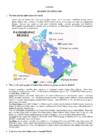
They are still legally categorized by the Canadian Government under the Indian Act as Status Indians. Those who have lost their legal status are called Non-Status Indians. Prime Minister Pierre Trudeau tried to get rid of the Indian Act, but First Nations political groups insisted on keeping it, because it defines their special status. The Inuit are the people who originally lived in the Arctic. Their language is Inuktitut, but it has several dialects the differ considerably from place to place. The Métis, are the group of people who resulted from the mixing of European and Native men and women. The Métis developed a unique culture that included elements of both European and Native ways and artifacts (clothes, tools, means of travel, etc.). They pride themselves on their distinctiveness from both the cultures from which they are descended. 3. From where have the Indians come to Canada? When?
Introduction The aim of this research is to get know more about the Netherlands history and its geographical facts. This report is describing one of most the most beautiful countries in the Europe - Netherlands. Netherlands is famous for its windmills and flowers. Netherlands is also known unofficially as Holland. Government is constitutional monarchy of north-western Europe. Netherlands is bordered on the north and west by the North Sea, on the east by Germany and on the south by Belgium. The European portion of the Netherlands has a total area of 41,528 sq km of which 33,939 sq km is land surface. Country's capital and largest city is Amsterdam. Population is about 16 million. 3 Chapter 1 The Netherlands 1.1 Mainly about the Netherlands Netherlands is also known unofficially as Holland
anyone to leave the Soviet Union. The major group of post-Soviet immigrants were the political refugees, persons who claim persecution or reasonable fear of persecution in Russia. Largest Russian communities today are in New York, California and Florida. 5. From where did the Indians come to America? *Native Americans aka. Indians, Red Indians, Redskins, American Indians, Amerindians, Namerind, First Nations people (Canada) *Origins of N-Am, theories = Bering Land Bridge theory = North American Indians are the people whose ancestors were living in North America when the Europeans discovered the Western Hemisphere. They often are called red men, or redskins, and they were named Indians because Columbus thought that he had reached the East Indies in his voyage across the Atlantic. Stone-age people who were to become American Indians began entering America at least 10,000 years ago. Most experts believe the first Indian
One has the right to kill a thief who is trying to rob one one has right to kill someone who is trying to make one his slave While one may kill a thief who is tring to rob one, after the robbery is over, one must submit one's case to judge who must decide between the two parties One is obligated to preserve ones life V Locke explains that the best theory of right to ownership is rooted in the fact that each person owns his or her own body and all the labor that he or she performs with that body. So, when an individual adds his own physical labor, which is his own property, to a foreign object or material, that object and any resulting products become his property as well. One converts a ting into one's property by adding labor to it (e.g. If there is a publick forst and one collects wood from it, the wood becomes your property) One has no right to waste(If you pick apple from a tree it becomes yours, but you cannot pick more apples than you can use)
Captain James Cook set the colonization of Australia into motion by exploring and mapping the fertile eastern coast of Australia, but he was not the first to visit Australia. There is evidence suggesting Aborigines in northern Australia maintained trade with some of the Indonesian islands closest to the coast. Chinese and Arab's may have had contact with the Aborigines in the 15th century. When British people came to live in Australia, they decided that the land was empty, that there were no people living there. This was called "Terra nullius", Latin words for "empty land".Under British law, all land belongs to the king,who is then able to sell it to other people. The sacred sites and other land which had belonged to aboriginal people for thousands of years were simply taken from them. If they did not leave peacefully then the new settlers used force to get them to leave. Many aboriginal people were killed during the settlement of Australia
preceding and during the Qiymah are described in the Qur'an and the hadith, and also in the commentaries of Islamic scholars. The Qur'an emphasizes bodily resurrection, a break from the preIslamic Arabian understanding of death. It states that resurrection will be followed by the gathering of mankind, culminating in their judgment by God. The Qur'an lists several sins that can condemn a person to hell, such as disbelief, usury and dishonesty. Muslims view paradise (jannah) as a place of joy and bliss, with Qur'anic references describing its features and the physical pleasures to come. There are also references to a greater joy--acceptance by God (ridwn). Mystical traditions in Islam place these heavenly delights in the context of an ecstatic awareness of God. 4|Page Predestination In accordance with the Islamic belief in predestination, or divine preordainment (alqad wa'l
Public opinion sth that most of the ppl in a society think of sth Simple majority - sth is voted for or against by not more than half of the votes altogether Absolute majority - when more than half of the ppl (voting) is for or against sth To be guilty of a crime to have done sth illegal Abuse - to use or treat someone or something wrongly or badly, especially in a way that is to your own advantage Property - an object or objects that belong to someone; a building or area of land, or both together Dangerous driving to drive recklessly and without any fear or respect Loss - when you no longer have something or have less of something International law - the set of rules that most countries obey when dealing with other countries Operating law the set of rules that one country and its people obey Legal system an area ( of countries) that follow the same kind of rules???? Retelling Explain and retell the text! Not examples, but the terms and expressions.
He was hostile against the social order in the usa. The central theme in his writings is the criticism of basic institutions of american society. Interestingly, he wasnt just a social critic but one of the best experimentalists. Anti war novel called ,,Three soldiers". Dos Passos went to Europe, served for a while. Three main characters, three young soldiers. One is Dan Fuselli, he is an optical worker from San Francisco, naively thinks that war is fun, Chris Field, farmboy, hates the army, was forced to join it. John Andrews, he is the intellectual of the three. He is also very sensitive young man and wants to be a musician. He and Chris Field desert the army. Andrews hides with a French girl and starts writing a symphony and is arrested later. War is hostile to the artist. And destructive of his art. This novel is written in more or less anti war. ,,Manhattan transfer"- truly modernist novel. Ruinous effect of capitalism on human lives. The scene of action is New York
his friends in the Second Company with questions about their postwar plans. Tjaden - One of Paul's friends in the Second Company. Tjaden is a wiry young man with a voracious appetite. He bears a deep grudge against Corporal Himmelstoss. Kantorek - A pompous, ignorant, authoritarian schoolmaster in Paul's high school during the years before the war. Kantorek places intense pressure on Paul and his classmates to fulfill their "patriotic duty" by enlisting in the army. Read an in-depth analysis of Kantorek. Corporal Himmelstoss - A noncommissioned training officer. Before the war, Himmelstoss was a postman. He is a petty, power-hungry little man who torments Paul and his friends during their training. After he experiences the horrors of trench warfare, however, he tries to make amends with them. Read an in-depth analysis of Corporal Himmelstoss. Franz Kemmerich - One of Paul's classmates and comrades in the war. After suffering a
in our physical build. I also seem to 4 Well, he would keep misbehaving 3 tip off 7 come to have inherited his big feet, unluckily in class. 4 come up with 8 mistake for for me. It was the first thing my parents 5 Well, you would keep eating too noticed when I was born! 3 1 Laura was offered a place at much. Personality-wise, I've got a lot of my Manchester University but she dad's traits in me. We're both quite bubbly and friendly (or so people 1C The origins of English turned it down.
 annaabi.ee