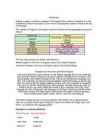
Introduction English is spoken on all five continents. With regard to the numbers of speakers it is only exceeded by Chinese and Spanish. But in terms of geographical spread it stands at the top of the league. The varieties of English in the modern world are divided into four geographical groups as follows. British Isles America United States (with African American England English) Wales Canada Ireland The Caribbean Africa Asia, Pacific West Africa South- and South-East Asia East Africa Australia and New Zealand South Africa ...
Class essay. Music is the Universal Language. Music is everywhere around us.. it is in the wind when it blows.. birds, who are loudly screaming now. The noise of cars.. the noise of humans, expecialli their laughing makes me a little happier everytime when I hear it. There're such beautiful voices. Sometimes we just must stand quiet in center on those voices, and catch their message. Music tells us stories wich were never known. Nowadays young people hear music on MP3. They're like in their own reality. Yes it's great to feel that, but a little bit strange, because when somebody wants to ask something at the bus stop, they can't hear anything. Thats sad. I listen to my iPod too, but sometimes it disturbes me, and then I want to hear the naturalmusic after hearing artificial music, which is just imitted that nature by humans. I like to create everything ...
Book Report Title ,,Othello" Author William Shakespeare Genre play, tragedy Setting time between 1489 and 1571 Setting place Venice and Cyprus Topics miscommunication, jealousy, revenge, hatred Othello was written in the 17th century and it is based on the Italian short story "Un Capitano Moro" (A Moorish Captain) by Cinthio (Giovanni Battista Giraldi). It was first published in 1565. The main characters of the play are Othello, Desdemona, Cassio and Iago. The play in this book has 91 pages and this book is published in 1996 by Dover Publications. Characters: Major characters: Othello he is the play's protagonist and hero. He has risen to high military prestige in Venice, after defeating the Turks and other enemies in battle. He is well-liked and honored, despite his racial difference. He moves to Cyprus after becoming a general and he marries Desdemona. He falls v...
Hobbies contribute to one's personal development Most people have hobbies for personal entertainment and interest. There are very many hobbies, some collect stamps, others might take photographs of architectural buildings or just play cards. Everything we do, gives us more experience at something, therefore hobbies contribute to our personal development a lot. The one hobby I will discuss and which is one of my own personal hobbies, is playing Texas Hold'em which is a form of poker. Although some people might just label it as gambling, poker is largely a skill game which has very little to do with luck rather than mathematics, reading people's body language and keeping track of people's previous behaviour. In able to play poker smart, you must be quick at calculating your odds and the value of your next move, just like in chess. Another very important skill is reading other people's reactions in the table,...
ELT Methodology (FLGR.01.041) 27.12.2012 Home Assignments. I Youtube clips: · A vision of K-12 students I personally think that Estonian learners are also digital learners. They spend more time at the computers or laptops or iPads etc. than read books or move outside. And another thing is that teachers are less capable in using technological appliances. But the latter mentioned fact is an advantage for us teachers as well. It gives us an opportunity to provide our students to experience success. They can help and assist us if we need some technological help. Another thing is that in schools, in classes generally students are not allowed to use their appliances, so it means they have to communicate verbally as well. I think that teachers ...
Book Report A Midsummer Night's Dream Introduction A Midsummer Night's Dream is a romantic comedy by William Shakespeare written sometime in the 1594-96.The play was first published in 1600 and became very popular.The play has 132 pages. It portrays the adventures of four young Athenian lovers and a group of amateur actors, their interactions with the Duke and Duchess of Athens, Theseus and Hippolyta, and with fairies who inhabit a moonlit forest. The play is one of Shakespeare's most popular works for the stage and is widely performed across the world. The Body Love and magic rule the world of this fanciful comedy set in ancient Athens and a nearby woods. The fair maiden Hermia loves Lysander, but her father insists that Demetrius be her mate. To escape a forced marriage, Hermia runs away with Lysander to the woods, followed by Demetrius (who is madly in love with H...
The Importance of Being Earnest The story is based on a book called "The Importance of Being Earnest" by Oscar Wilde. The play is directed by Peter Joucla and produced by Grantly Marshall. It is played by the American Drama Group Europe. This is a theatre group that travels around the world, so people can see many different plays and performances in English. The play tells the story of two men. One of them, Jack, lives in the country but loves to go to London once in a while. Jack's friend Algernon lives in London but, vice versa, likes to get away from the urbanism. Both of them fall in love with a woman, but the two men make a mistake, they lie about their name. Both say their name is Earnest and as it turns out, that is the name a man should have to marry those women. Of course the lie comes out and that is when the real drama starts. I really liked the play. It is witty and not so predict...
Art week Art week is a big event for students and teachers of Tallinn 21. School. It is a tradition that has been held for the last 30 years. Art Week is always organized by 11c class students who study Humanities and Social Sciences. Organizing class has to introduce the culture of the country they have picked to other students in school. The Art Week was originally initiated by Tiina Meeri, who is still working in our school and still organizes the week. At the beginning there were no countries, just certain time periods of history. The Art Week has some traditional events, such as the play "Moving Pictures" which tells the story of the theme country. At the opening ceremony, people from embassy come to congratulate and thank the students for their efforts of making such a big event happen. There´s also Art Week´s café where traditional food is served. Traditionally Art Week ends with costume party where organizing cla...
WALES . Wales is a country that is part of the United Kingdom , bordered by England to its east , and the Atlantic Ocean and Irish Sea to its west . It is also an elective region of the European Union . Wales has a population estimated at three million . The capital Cardiff is Wales's largest city with 317,500 people . For a period it was the biggest coal port in the world . Cardiff is the largest media centre in the UK outside of London . Wales is located on a peninsula in central-west Great Britain . Its area , the size of Wales , is about 20,779 km² . Wales is bordered by England to the east and by sea in the other three directions : The Bristol Channel to the south , St. George's Channel to the west , and the Irish Sea to the north . The main population and industrial areas are in South Wales ,consisting of the cities of Cardiff , Swansea and Newport and surrounding areas , with another signifi...
ENGLISH IDIOMS Nõmmik Vilian Apprentice 10 "A" class Ahtme Gymnasium Kohtla-Järve Relevance of the topic Ø The English language becomes the means of international communication, the language of trade, education, politics, and economics. People have to communicate with each other. It is very important for them to understand foreigners and be understood by them. Goal of my research work Ø Goal of my research work is to prove that idioms in the English language are integral part of it, which make our speech more colorful and authentically native. Tasks I like to achieve the following tasks: 1. To classify idioms; 2. To study the problem of the translation of idioms; 3. To understand the aim of the modern usage of idioms; 4. To distinguish different kinds of idioms; 5. To...
Words that ADD information · also · and · another · besides first, second, third, ... · furthermore · in addition · moreover The little girl put on her yellow shirt and brown overalls. Chris is on the basketball team this semester at Indiana School for the Deaf. In addition, he is on the soccer team. We will be here for one more week so we can finish up our work. Another reason we are staying longer is because we do not want to miss the Deaf Way conference. First of all, pour a half-cup of milk in the bowl; second, add two eggs; and third, stir the mixture. I admire I. King Jordan because he is the first deaf president of Gallaudet. Besides that, I admire him because he is a great long distance runner. Furthermore, he is a dedicated family man. All in all, there ís not much to dislike about the man, except he is too perfect! Crystal likes camping in the mountains. Also, Crystal is an experienced hiker. Texas Schoo...
When a world loses a language, it loses a unique treasure There are more than 7000 languages in the world and it is said that more than 50 % of the languages will be extinct by the end of the century. A language dies in every 2 weeks. So what will be lost when a language dies? Much of human knowledge hasn't been written down and it lives in people's memories. In fact, there are even laguages that haven't been written down. In the olden days people use to tell stories. They didn't write them down, just told or sang them to others, who passed them on the same way and so they spread from generation to generation. Now if a language dies, the folklore dies with it. So we will also lose our ancestors knowledge, in what they believed in, what they valued. We will lose the myths and legends, how the world or a certain place was made. In fairytales people learn about virtues, how to make a difference between right and...
Hamlet WILLIAM SHAKESPEARE Character List Hamlet - The Prince of Denmark, the title character, and the protagonist. About thirty years old at the start of the play, Hamlet is the son of Queen Gertrude and the late King Hamlet, and the nephew of the present king, Claudius. Hamlet is melancholy, bitter, and cynical, full of hatred for his uncle's scheming and disgust for his mother's sexuality. A reflective and thoughtful young man who has studied at the University of Wittenberg, Hamlet is often indecisive and hesitant, but at other times prone to rash and impulsive acts. Hamlet (In-Depth Analysis) Claudius - The King of Denmark, Hamlet's uncle, and the play's antagonist. The villain of the play, Claudius is a calculating, ambitious politician, driven by his sexual appetites and his lust for power, but he occasionally shows signs of guilt and human feeling--his love for Gertrude, for instance, seems sincere. Claudius (In-Depth Ana...
1.ÜLESANNE 1) My goalis to finish school with good marks. 2) Everybody was surprised because Ann performed so confidently. 3) Expeditions are a good oppurtunity to meet people with similar interests. 4) My sister has done a lot of voluntary work at our youth club. 5) Do you fancy going to a football match? 6) Parents should pass on their experience to the next generation. 7) Mary decided to challange herself and take part in the swimming competition. 2. ÜLESANNE ( sample answers ) 1) Would you like to go swimming tonight? Yes, i'd love to. What time shall we go? 2) Do you fancy going to the theatre on Saturday? Sorry, I'm afraid i can't. I'm looking after my little sister. 3) Do you want to play basketball this afternoon? Thanks for asking me, but I'm studying for my history test. 3. ÜLESANNE 1) Tina and Ann do aerobics, but James doesn't. 2) None of them has/ have won an award. 3) All of them can speak a foreign language. 4) Ann ...
Test 13 1 Translate. 1 Minu lemmiklill on maikelluke. My favourite flower is the lily of the valley. 2 Eesti rahvuslikud sümbolid on suitsupääsuke ja rukkilill. The Estonian national symbols are the barnswallow and the cornflower. 3 See kindlus on pärit 15. sajandist. This fortress dates from the 15th century. 4 Saaremaal on palju tuuleveskeid. There are lots of windmills on Saaremaa. 5 Eesti pinnas ei ole väga rammus. Estonian soil is not very rich. 6 Kas sa oled käinud paekivi muuseumis Porkunis? Have you been to the limestone museum in Porkuni? 7 Raekoja plats The Town Hall Square 8 millegagi võrdlema compare sth with sth 2 Write the questions. 1 in / longest / What / Estonia / is / the / river What is the longest river in Estonia? 2 ever / smoke / Have / a / had / sauna / you Have you ever had a smoke sauna? 3 language / of / is / official / What / the / Estonia What is the offici...
English structure revision for the exam 1. Terms Language → A systematic, conventional (tavakohane) use of sounds, signs or written symbols in a human society for communication and self-expression. Human language at all levels is rule- or principle- governed (valitsema) meaning that language corresponds to the grammar. Natural language is usually spoken, while language can also be encoded into symbols (such as letters, morse etc) For example: Estonian, English. Linguistics → The scientific study of human natural language. Broadly, there are three aspects to the study which are Pragmatics (studies the use of language → interested in the gap between the sentence’s meaning and the speaker’s meaning). Semantics (concerned with the meaning of the language aspects and the way they change, also how objects and language and thinking and language are related). ...
AUTISM Erki Viidalepp Ron Türnpu 10b Definition Autism is a developmental disability that results from a disorder of the human central nervous system. Autism manifests itself at a very early age, "before the age of three years". Causes of Autism Genetical diseases Other reasons - Fragile X Syndrome - Birthtraumas - Phenylketonuria - Diseases - Tuberous Sclerosis - Unknown reasons - Down's Syndrome - Rett's Syndrome Frequency China: ~ 1.8 million cases Japan: 55.8 per 10,000 (1991) USA: ~ 500 000 cases United Kingdom: 1 case in 110 children Symptoms Difficulty interacting with other people · Poor use of body language · Not responding to verbal cues · Lack of or abnormal social play · Dysfunction ¾ of cases are mentally disabled Treatment Therapy is used to treat audists. Goals: Improving health, communication, well-being. ...
LEL 2E Notes on Vocabulary One of the key facts about the lexicon of any language is that it reflects in various ways the physical and cultural environment in which the language is spoken. A people unfamiliar with, say, horses is unlikely to have a word for `horse'; similarly with ploughs, printing presses, and internet porn sites. For the most part this is trivial it's hard to imagine how it could be otherwise, given the general nature of human language. People tend to make a great deal of the alleged fact (see Pullum 1989) that "the Eskimos have lots of words for snow", but it doesn't take much thought to realise that any language spoken in a given physical and cultural environment is likely to have efficient ways of referring to distinctions that are important in that environment. That doesn't mean that you can read very much into individual words and individual facts about the lexicon of a given language (this topic has already c...
Navajo NAHvuhho Location Still living in their traditional territory Arizona, New Mexico, Utah and Colorado 17,5 million acres From low dry desert to mountains Tribes Navajo Nation has 300,048 tribal members 150,000 speak Navajo language (Athabaskan language) and others speak English Easy Word ''yi'it'eeh''(Yah-ah-t-ay) means hello `Ats'osi Dine' Feather People, Hasht['ishnii - Mud Clan, Kinyaa'1anii - Towering House People Beliefs Religion Christianity, Native American Church and traditional Navajo people(The Dines) belive that there is two classes of people: the Earth People and the Holy People Holy People taught the Dine how to live in harmony The number four permeats traditional Navajo philosophy Traditions There are more than 50 diffrent kinds of ceremonies. Some last several fours s...
Summary • Early history of translation studies – Cicero and St. Jerome (what did they do/how/why are they relevant to translation studies?) St. Jerome – Greek scholar, did some translation work. Lived during the 4th century. Jerome is best known as the translator of the Bible into Latin. A previous version (now called the Old Latin) existed, but Jerome's version far surpassed it in scholarship and in literary quality. Jerome was well versed in classical Latin (as well as Greek and Hebrew), but deliberately translated the Bible into the style of Latin that was actually spoken and written by the majority of persons in his own time. This kind of Latin is known as Vulgate Latin (meaning the Latin of the common people), and accordingly Jerome's translation is called the Vulgate. Cicero – Lived during the 1st century BC. Roman politician, philosopher & translator. Theory ‘‘word-for-word’’ & ‘‘sense-for-sen...
The Romans came to Britain nearly 2000 years ago and changed our country. The Romans lived in Rome, a city in the centre of the country of Italy .One day, some years before Jesus Christ was born, the Romans came to Britain. First invasion - Caesar's first raid In August 55 B.C. (55 years before Jesus was born) the Roman general, emperor Julius Caesar invaded Britain. He took with him two Roman legions. After winning several battles against the Britons in South-East England he returned to France. Second invasion - Caesar's second raid In 54 B.C. Julius Caesar came to Britain again landing at Walmer near Deal in Kent. This time he brought with him five legions (30,000 foot soldiers) and 2,000 cavalrymen (horse riders). This time the Romans crossed the River Thames. After more fighting, the British tribes promised to pay tribute to Rome and were then left in peace for nearly a century. Third and final invasion In 43 A.D. (43 years after Je...
British Literature in the 20th-21st Century REVISION QUESTIONS 1. The Contradictory, diverse, chaotic 20th century. New developments in science and philosophy. The essence and influence of Freudian theory. Contradictory, diverse, chaotic 20th c- simultaneous rejection and invocation of the past. While modernists apotheosized the creative geniuses of the past, they also rejected old poetic forms. Challenge old and established beliefs and more and more people had access to books and education more people went to universities. profound change in morals: · No universal value and perspective on things · Multiple truths, multiple perspectives · Nothing has inherent (kaasasündinud, sisemist) importance · Life lacks purpose Science: Albert Einstein-general theory of relativity had a huge impact on culture as well. Everything is relative. Philosophy:...
Canada is the second largest country in the world. Situated to the north of the United States, in North America, it has both English and French as its official languages. Even though its area is bigger than that of the United States, its population is only about 11% of that of the USA some 35 million. Because of that, Canada has one of the lowest population densities in the world. The capital of Canada is Ottawa the name of whose comes from the old Algonquin language, with the original word meaning `to trade'. Due to the country's huge size and position, it is very diverse. It is bordered by the Pacific Ocean to the west, the Atlantic to the east, and the Arctic to the north. The landscapes differ greatly from rolling plains and mountains to the cold tundra in the northern part of the country. Geographically, the country's split into 5 major regions the Pacific, the Prairie Provinces, Central Canada, the Atlantic Provinces and...
Tallinn- London Tallinn information: Train operators in Internal trains run by Edelarautee: www.edel.ee, Estonia: www.elektriraudtee.ee Sleeper train Tallinn to Moscow: www.gorail.ee Ferry operators to www.Tallink.ee (Stockholm-Tallinn, Helsinki-Tallinn) Estonia: www.tallinksilja.com/en/ (Rostock-Helsinki-Tallinn) Time: GMT+2 (GMT+3 from last Sunday in March to last Saturday in October) Currency: £1 = approx 16.5 Kroons. Tourist information: www.inyourpocket.com/Estonia/ & http://tourism.tallinn.ee. Hotels in Tallinn: www.hostelbookers.com Visas: UK citizens do not need a visa for Estonia for stays of up to 6 months. London information: Area: ...
1. Faithful and false friends a. How do you understand literal translation (based on this short text)? Literal translation is translating directly from source language into target language b. Which types of words are more/less literal? More literal: objects and movements Less literal: qualities and ways of moving c. What are the two views of translation that the author brings out? Explain. 1) A process of explanation, interpretation, reformulating ideas and words. 2) Impossible due to other definitions 2. Expressive function a. Name the three expressive text types. - Serious imaginative literature; Authoritative statements; Autobiographies, essays, personal correspondence. b. Why is it difficult to translate an expressive text? - Because of the used dialect may get lost in the translation. c. What constitutes the personal component in an expressive text? - original metaphors, unusual collocations d. What is a...
S C O T L A N D GENERAL OVERVIEW Territory: 31, 510 sq miles Highest peak: Ben Nevis 1343m Population: 5, 055, 000 National emblem: the thistle Capital: Edinburgh National flower: the bluebell Islands: About 790 National instrument: bagpipes Lakes: the best- known is Loch Ness, famous for National dish: haggis Nessie, its mythical monster Scotland is also famous for: whisky, kilts and sheep · One of the four constituent nations which form the UK · They have their own money, system of law, history, stamps, deep- rooted customs, traditions and ancient language- Gaelic · Most people speak the Scottish dialect becoming endangered language · Weather unpredictable · Breat...
As I'm writing this letter, I'm X years old. My birthday is on Xth X, beginning of summer here. In Estonia we have four very different seasons: warm summers, wet autumns, cold winters and blooming springs. I live in town X. Currently I'm attending Keila School ninth grade, which is last one of elemantary education. After finishing the exchange year I'll do trials to Tallinn Real School to get my secondary education there. After that I would like to go to univercity, but I don't know to what sepciality jet. I live with my mom X, dad X and two younger sisters: X and X (and dog X). My dad side grandparents live in X too. Even though were all quite busy, we still find time to talk and make music together. At the weekends we occasionally go to cinema, museum , nature to visit friends and relatives together. In summer we make longer trips and go to our summer house. My parents are always very supportive, they always give go...
Identity as a personal project How could be one identity created? Or is it creating itself? Or, maybe, every child is born with some kind of identity? There are many theories about what identity is and how it is developing, so in this essay I want to discuss A. Giddens´ text and my reflection about his theory. “It's like everyone tells a story about themselves inside their own head. Always. All the time. That story makes you what you are. We build ourselves out of that story.” Patrick Rothfuss When talking about identity, it´s creation is a very important moment. To understand it, I was always thinking practically – I created a character, like in a movie or a book. What should happen first with the character, what factors influence the creation of individual identity? I agree to Giddens – person isn´t born with identity, everyone has to build and deve...
Pirita Convent Anete Samelselg 10th grade About the convent It was founded by St. Birgitta in 1412 and consercrated in 1436. The area is 1360 square meters. It was the biggest church building in the Middle aged Estonia. Name Pirita is orginated from St. Birgitta. The idea and construction The history of the the Pirita Convent dates back to the 15 century. The idea to found a convent in Tallinn, the capital of Estonia, was initiated by some Tallinn merchants already in 1400. Building plot was donated from Livonian Order. The building were built in two different parts. One for nuns and one for monks. Church in the middle and it was used by both. St. Birgitta rules In the convent have to live both - nuns and also monks. Nuns and monks were seperated and did not see each other at all. The Convent could not have more than 85 members 60 sisters and 25 brothers. The leader of the co...
History of Philosophy James Thurlow, Ph.D. 01.02.2012 Books to read · Plato's Republic · G.W.F. Hegel's Philosophy of History 1. Greek philosophy 2. Republic 3. Philosophy of History Ancient Greece - Ancient Greece vs. Persia (300-Herodotus) Salamis - Ancient Greece vs. Troy (Homer-screen writer)Iliad o Achilles- Hero of the heroes (main hero in Greece)- handsome, strong, brave, fast, anger(tema viga), young, bad temper o Agamemnon- son of King Atreus - Olympics - Sculptures- more lifelike, human figures come out of the stone - Greek liked physical beauty - Development of medicine - Greeks are pirates, they steal- high technology - Bad tempered people Men's progress towards freedom. (Hegel) Persia is under emperor Xerxes- slaves, fighting for Xe...
microchips tiny pieces of silicon containing complex electronic circuits design to make or draw plans for something financial relating to money or how money is managed electronic involving the use of electric current in devices such as TV sets or computers Internet the large system of connected computers around the world print to produce text and pictures using a printer unformatted a disk that is completely blank, so information can't be recorded onto it Extranet a network that allows communication between a company and the people it deals with transmission the process of sending data over a communication channel reboot to restart the computer, without switching it off completely microbrowser a web browser designed for small screens on handheld devices software engineer a person who designs and maintains software applications IT (computer) consultant a person who gives expert, professional advice ...
Golden Grammar rules 1. Don't use an with own. Sue needs her own room. (NOT Sue needs an own room.) I'd like a phone line of my own. (NOT ... an own phone line.) 2. Use or rather to correct yourself. She's German or rather, Austrian. (NOT She's German or better, Austrian.) I'll see you on Friday or rather, Saturday. 3. Use the simple present play(s), rain(s) etc to talk about habits and repeated actions. I play tennis every Saturday. (NOT I am playing tennis every Saturday.) It usually rains a lot in November. 4. Use will ..., not the present, for offers and promises. I'll cook you supper this evening. (NOT I cook you supper this evening.) I promise I'll phone you tomorrow. (NOT I promise I phone you tomorrow.) 5. Don't drop prepositions with passive verbs. I don't like to be shouted at. (NOT I don't like to be shouted.) This needs to be thought about some more. (NOT This needs to be thought some more.) 6. Don'...
My languages I love different languages. I mean, I really, really love different languages. I also believe and have been told that I pick them up rather easily. That might be true, although I did not pick any Greek up in Greece but that might have been because they spoke so damn fast that I could not tell if it was a word or an entire sentence. The first foreign language I learned was Russian. Considering I was ten when Estonia became a Republic, it makes sense. We began studying Russian in first grade, though it was simplified – "koška" instead of "kot", "medvešonok" instead of "medved", "saichik" etc. Did not make much sense and we mostly played some games in Russian (Tare-tareke etc). Learned as much playing outside, since we had Estonian-Russian kids around as well. Not that we played with them. It's sad to say but it was not a nice time to be a Russian kid. We were mean to them, and we...
UNIT 17 TEST 1.ÜLESANNE 1) My goalis to finish school with good marks. 2) Everybody was surprised because Ann performed so confidently. 3) Expeditions are a good oppurtunity to meet people with similar interests. 4) My sister has done a lot of voluntary work at our youth club. 5) Do you fancy going to a football match? 6) Parents should pass on their experience to the next generation. 7) Mary decided to challange herself and take part in the swimming competition. 2. ÜLESANNE ( sample answers ) 1) Would you like to go swimming tonight? Yes, i'd love to. What time shall we go? 2) Do you fancy going to the theatre on Saturday? Sorry, I'm afraid i can't. I'm looking after my little sister. 3) Do you want to play basketball this afternoon? Thanks for asking me, but I'm studying for my history test. 3. ÜLESANNE 1) Tina and Ann do aerobics, but James doesn't. 2) None of them has/ have won an award. 3) All of them can speak a foreig...
NEUROBIOLOGY AUXILLARY GLOSSARY ACETYLCHOLINE – A neurotransmitter in both the brain and peripheral nervous system* (PNS). In the brain it helps regulate memory, whilst it controls the actions of skeletal and smooth muscle within the PNS. ACTION POTENTIAL – An electrical phenomenon which occurs when a neurone is activated and temporarily reverses the electrical state of its interior membrane from negative to positive. An electrical charge travels along the axon to the neurone’s ending (terminal) where it triggers the release of a neurotransmitter* and then disappears. ADRENALINE (U.S. - Epinephrine) – A hormone released by the adrenal medulla* and a neurotransmitter acting at the level of the autonomic nervous system and the brain. ADRENAL CORTEX – The outer layer of the adrenal, a small endocrine gland located near the kidney. It produces and secretes several horm...
Unit 1 Test 1 Translate. 1 Mida on sul ja su sõbral ühist? What do you have in common with your friend? 2 Ma mõistan su vaatenurka. I understand your point of view. 3 Mida sa selle all mõtled? What do you mean by this? 4 Missugune vapustavalt ilus pruutkleit! What a gorgeous bridal dress! 5 Kas sa oled kunagi pulmas käinud? Have you ever attended a wedding? 6 Jane rebis kutse kostüümipeole tükkideks. Jane tore the invitation to the fashion show into pieces. 7 Pinge Alice´i ja tema armukadeda poiss-sõbra vahel kasvas. The tension was building up between Alice and her jealous boyfriend. 8 Mis lahti? Su silmad on pisaraid täis. What´s up? Your eyes are filled with tears. 2 Write the verbs in the suitable tense. 1 I booked the tickets and in two weeks I will be off to Mexico. (book;be) 2 Did your sister Victoria get engaged when she was eighteen? (get; be) 3 When Uncle George died, Aunt Mary wor...
Fact from the last Irish census, Sean was the most popular boys name and Emma was the most popular girls name. Ireland has won the Nobel prize for literature on four occasions with George Bernard Shaw, William Butler Yeats, Samuel Beckett and Seamus Heaney. Irish aviation fact = Shannon became the worlds first duty free airport in 1947 There is no death penalty in Ireland. Ireland is a neutral state and is not a member of N.A.T.O. The famous Titanic ship was built in Belfast. Henry Ford of Ford Motor Company was the son of an Irish emigrant. John Kennedy, the thirtyfifth President of the U.S.A.was born in Massachusetts in 1917. The Kennedy family were descendants of Irish emigrants to the U.S.A. in the nineteenth century. Kilkenny born architect James Hoban designed the White House and also the official residence of the Irish president, Aras an Uachtarain. Bushmills, Couny Antrim is the Worlds Oldest Whiskey Distillery base...
1. STYLE The term "style" is polysemantic (has many meanings): a Latin word "stilus" originally meant a writing instrument used by ancient people. Already in classical Latin the meaning was extended to denote the manner of expressing one's ideas in written or oral form. Jonathan Swift defined style as "proper words in proper places". In present day English the word "style" is used in about a dozen of principle meanings: 1. the characteristic manner in which a writer expresses his/her ideas (e.g. style of Byron) 2. the manner of expressing ideas, characteristic of a literary movement or period 3. the use of language typical of a literary genre (e.g. the style of a comedy, drama, novel). 4. the selective use of language that depends on spheres / areas of human activity (e.g. style of fiction, scientific prose, newspapers, business correspondence, etc.). STYLISTICS Stylistics is the study of s...
This a little help they who play with Gameforge games, no fraud/there is not a ramp in him, not hack the side... The essence that Paypal we nag it. Your monthly premium may turn up with this little trick and maybe yet a little one other service what the pay part of the given game provides. So: The 1. As a step register onto PayPal side. On this link https://www.paypal.com/us/cgi-bin/webscr?cmd=_registration-run There will be a cell like this there: Your country or region let us put Ez in another place The one under it Your language leave it so on the factory setting. (U.S. English) Then vállasszuk who from among the 3 opportunities Personal Account -ot and push Get Startedre. ! On the appearing sheet got now much kitlteni truth data. (To grant worthy real data) ! Email address : Here grant your real email address. Choose the password : Select a password (there have to be at least 8 characters) First name : Your first name Last name : Y...
Review questions English lexicology Size of English vocabulary. Average speaker 45,000-60,000 words, a total of about 200,000. Core and periphery. English has been heavily influenced by other languages. 31.8 % comes from Old English, 45% comes from French, 16,7% comes from Latin, 4,2% other germanic languages and 2,3 other languages. The very core is mono-syllabic (93 of the first 100 words and the other seven are two-syllabic). The core vocabulary is predominantly germanic. Native and foreign element. Native words belong to very important semantic group (modal verbs-shall, will, can, may; pronouns- I, you, he, my, his; preps- in, out, under; numerals and conjunctions::but, till, as. Native words are head, arms, back; mother, brother, son, wife; snow, rain, wind, sun; cat, sheep, cow; old, young, cold, hot, dark; do, make, go, come, see. Many native words have developed many meanings (nt, hand, man, head). Most native words have become ...
Russian philology The meaning of the word "philology" is "love for word". This is love that unites teachers and researchers of modern and Classical languages and literature, interpreters and diplomats, journalists and publishers, writers and poets. Russian philologis are highly demanded in various spheres of scholarly research and education, in the mass media, in civil service at the Ministry of Foreign Affairs, in archives, libraries, museums, in travel agencies, as well as Russian and international companies. Curriculum within in philological faculty includes courses of Russian and European languages and literature, courses of Linguistics and Theory of Literature for students to familiarize themselves with various schools and trends of Russian and foreign philology. The core curriculum also includes a number of Liberal Arts courses (Philosophy, History, Psychology, Pedagogy), as well as courses of basic mathematics and compute...
Tallinna Mustamäe Humanitargümnaasium Valeria Jefremenkova ENGLISH AS A GLOBAL LANGUAGE INGLISE KEEL KUI ÜLEMAAILMNE KEEL Research work Supervisor: Jevgenija Kozlova Tallinn 2016 1 Table of Contents СONTENT…………………………………………………………………………………...2 INTRODUCTION…………………………………………………………………………...3 CHAPTER I……………………………………………………………………………….....5 1.1. A Brief History of the English Language…………………………………………...…..5 1.2. Origins of English as the Global Language……………………………………..……....6 1.3. Necessity of a Global Language...……………………………………………………....8 1.4. Criticism of a Global Language………………………………………………………....9 1.5. The Role of English Today……………………………………………………………..10 1.6. English Speaking Countries…………………………………………………………….11 1.7. Perspectives of English………………………………………………………………....13 CHAPTER I...
Anglo-Saxon period Celts-came from Germany,2000-1200BC began to migrate to Britain,spoke Celtic language,were known as Britons,lived in small villages,round wooden huts-mainly farmers-no towns,organised in tribes with a king/queen as a leader,intertribal wars were very common,the Ancient Britons:one of the Celtic tribes living in Britain 4thBC,believed in different gods,governed by a class of priests-druids who had great power. Romans in Britain:55BC came to conquer Britain(Julius Caesar),brought their own civilization,taught Britons to build roads,bridges,houses,baths,temples,protected Britain for several hundred years,4thBC Romans left Britain,43AD Queen Boadicea of Iceni tribe lost their battle with Romans. Who were the next invaders and where did they come from? Anglo-Saxons came from northern Germany,Denmark and northern Holland. What was their lifestyle like?Anglo-Saxons liked fighting,drinking,gambling,life expectancy not very lo...
Society and culture of english-sspeaking countries Introduction 1. The countries of the world where the English language is spoken. 2. Approximate number of mother tongue speakers of English approximately 350-400 million native speakers. Which place does English occupy in the world by its number of speakers?After which language? English occupies second place by its number of speakers after Mandarin Chinese. 3. What is the difference between English as a Second Language, English as a Foreign Language and English for Specific Purposes? Give examples of situations where they are used. English as a Second Language (ESL or TESL) is a traditional term for the use or study of the English language by non-native speakers in an English-speaking environment. That environment may be a country in which English is the mother tongue (e.g., Australia, the U.S.) or one in which English has an established role (e.g., India, Nigeria) English as a...
Cats C.Karus 2015 Cat independent Free Graceful the cat will always fall on his feet If the host has / owns a dog, a cat owns the master where the head goes through, there also goes the body through History It is known that people have been living with cats harmonically since 3000 BC in Ancient-Egypt. Cats, living along with humans, started to have sympathetic connection with humans. Probably thanks to cats' usefulness in protecting food, ancient Egyptian started to treats cats as saint animals. Cat was called "miw". Egyptian mourned and embalmed dead cats. They also made special wooden coffins for cats. Cat expressions Friendly Relaxed Fearful Negative Playful is most likely not open to contact ...
Cats C.Karus 2015 Cat independent Free Graceful the cat will always fall on his feet If the host has / owns a dog, a cat owns the master where the head goes through, there also goes the body through History It is known that people have been living with cats harmonically since 3000 BC in Ancient-Egypt. Cats, living along with humans, started to have sympathetic connection with humans. Probably thanks to cats' usefulness in protecting food, ancient Egyptian started to treats cats as saint animals. Cat was called "miw". Egyptian mourned and embalmed dead cats. They also made special wooden coffins for cats. Cat expressions Friendly Relaxed Fearful Negative Playful is most likely not open to contact ...
Tallinna Polütehnikum Automation Author: TomTom2 Group :AA-09 Instructor: Marina Zotikova Tallinn 2010 Contents Introduction......................................................................................................................3-4 Person Knowledge Technologies supports......................................................................4-6 Online Essay Evaluation Service.....................................................................................6-7 WordNet lexical database................................................................................................7-8 Practice Online (TPO)................................................................................................
Games Programming with Java and Java 3D Andrew Davison Dept. of Computer Engineering Prince of Songkla University HatYai, Songkhla 90112 E-mail: [email protected] Draft: 14th January 2003, #2 Abstract This article looks at the advantages and disadvantages of using Java and Java 3D for games programming. It assumes the reader is familiar with Java, but presents short overviews of gaming, the low-level APIs OpenGL and DirectX, and Java 3D. No programming examples are included here, although links to online code are supplied. 1. Background to Gaming Giving a definition for `computer game' is problematic, due to the wide range of game types. For example, the ArcadePod site (http://www.arcadePod.com) divides its hundreds of Java games into more ...
The Article Table of Contents General Rules....................................................................... 2 The Definite Article ............................................................... 5 Names that take the Definite Article...................................... 6 No article.............................................................................. 7 Countable and uncountable nouns ....................................... 9 General Rules There are two articles in the English language – the Indefinite Article and the Definite Article. The Indefinite Article has two forms – a and an (a precedes words beginning with a consonant sound and an precedes words beginning with a vowel sound). It comes from the Old English word ãn, which meant one. The Definite Article is the. It comes from the Old English word ţis, which meant this. Thus, in most general term...
Essay : What age you would choose to be if you could stay the same age forever ? Appearance Health Daily routine Health Independence Winsdom Do you really want to live forever, forever and ever? What’s the use of everlasting life if we can’t maintain a youthful spirit? Better to die with a hopeful eye on the future than to have such a long empty difficult life though eternity. To begin with ,if most of us one day have the opportunity to extend our lives indefinitely, how will that change the dynamics of society and culture? A typical person living to 80 years of age goes through several dramatic changes in his lifetime: his opinions and attitudes change, his interests, his friends, his career, sometimes even how he remembers the past. Imagine how much change would take place in a thousand years of life! We wouldn’t be a shado...
 annaabi.ee