 50 punkti
Autor soovib selle materjali allalaadimise eest saada 50 punkti.
50 punkti
Autor soovib selle materjali allalaadimise eest saada 50 punkti.
 ~ 2 lehte
Lehekülgede arv dokumendis
~ 2 lehte
Lehekülgede arv dokumendis
 2014-03-11
Kuupäev, millal dokument üles laeti
2014-03-11
Kuupäev, millal dokument üles laeti
 4 laadimist
Kokku alla laetud
4 laadimist
Kokku alla laetud
 0 arvamust
Teiste kasutajate poolt lisatud kommentaarid
0 arvamust
Teiste kasutajate poolt lisatud kommentaarid
 tatyana.kareva
Õppematerjali autor
tatyana.kareva
Õppematerjali autor
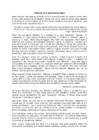
.................................................................40 Reactivity and Grievances.......................................................................42 Being Right, Making Wrong....................................................................43 In Defense of an Illusion..........................................................................44 Truth: Relative or Absolute?....................................................................45 The Ego Is Not Personal..........................................................................46 War Is a Mind-set.....................................................................................48 Do You Want Peace or Drama? ...............................................................49 Beyond Ego: Your True Identity .............................................................50 All Structures are Unstable.......................................................................51
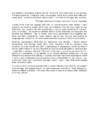
He had no difficulty with speech or language, but the balance between his intellectual abilities and emotional control had been destroyed. He became highly agitated and irrelevant, often impatient and rude. Study to his frontal lobe provided evidence that the brain affects personality and social behaviors. Discuss ethical considerations related to research studies at the biological level of analysis. In case studies for example, the researcher often obtains deeply personal information, which is not usually shared with other people. Any researcher conducting a case study must be very protective of the identities of the participants. The researcher should also have the professional competence to deal with the focus of the case study. Animal rights!! Explain one study related to localization of function of the brain. Gazzaniga & Sperry held experiments with monkeys, whose brains were `'split `' by
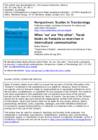
Romania in) Exit into History (1999) this paper aims to show that such translations, if undertaken, may turn into complex exercises of intercultural communication in our global world, confronted with problems of identity and representation. The first section analyses in detail the cultural translations of Romania that the two authors provide for their (Western) readers. Consequently, it brings to the fore intricate acts of mediation and cultural filtering that are part
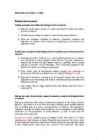
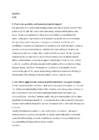
Kodutöö 1 17.09 1. What is site-specificity and Genius Loci (spirit of place)? Site-specificity is an abstract understanding of place/site what is used to manifest “best” qualities of it. Usually this term is used when nature, vocation and all spheres what around the place are analyzed and object (art object, building or installation) fits perfect in this place. Object needs to be in harmony (balanced) with the environment. Site-specificity is place character or atmosphere what human can feel but can’t scientifically measured. As I understood site-specificity is all what surrounds it: nature as greenery, nature as weather (climate), traditions of humans, history of the place, etc. Genius Loci is the spirit of place. How I understood Genius Loci is the idea that every a human has his own place in this world and every human needs to identify himself. Before modern timeline human was in opposite with the place where he lived, he tried to identify himself by self-realization and
I have a confession to make. I am one of Brian’s raving fans. I have studied him, his brilliant work, and the extraordinary results he has achieved. I am also one of his close colleagues and friends. We have worked together on many platforms, and met and talked with each other on numerous occasions. Brian is one of the finest thinkers and writers on inner develop- ment and personal success in the world. I know; I have sold over 82 million books aimed at helping people get the most out of themselves. Change Your Thinking, Change Your Life shows you how to dis- cover your extraordinary inner resources and tap your incredible powers.You will learn how to attract into your life all the people and resources you need to achieve any goal you can set for yourself.
Secondary characters are rememorable. Men and women act differently to war. Men are carried away by war propaganda, women are shown to be wised and appreciate life more than political parties. Men think on taking sides but women value life more. Jordan is an idealist. He is willing to give his life for this cause. But Maria's first loyalty is to her lover, jordan. She places love above war, politics. Pablo is another type, he is a moral coward, he is a defeatist, who wants to avoid personal danger and wants to save his life, he is mean and betrays his country men. Pilar, Pablo's woman, strong, courageous, patriot, never the less understands the importance of individual human happiness. Human independence and solitarity. Jordan dies, he is left to die. Maria problably is pregnant. Towards the end of his life Heingay wrote short stories. 1952 novella ,,The old man and the sea". The protagonist is an old cuban fisherman. Cuba was that time almost the colony of usa.
. . " and then name their pet peeve or passion. My view is not of an education specialist, but of one who loves sharing what I learn, and owes much to educators. Since I don't have an educational theory neatly worked-out, nor an outline of my perceptions, my intent is to address each educational ingredient that comes to my mind. After I've said what I think about each topic, readers may have a fair comprehension of my philosophy. First comes sensitivity. If a person be insensitive, be it from numbing cold, exhaustion, drugs, genetic makeup, or upbringing, then the process of education is bogged down, and results come only after great efforts. Sensitivity in my integrated meaning is broad, covering literally the senses, so that deaf and blind people are less sensitive, as well as people whose senses work perfectly, but whose receptivity or thought processes are blunted for whatever reason
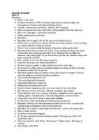
1. First social psychology experiment 1897 the first published social psychology experiment: ● by Norman Triplett ● Better results in cycling than when cycling alone Social facilitation effect: presence of others acts as a stimulation to the performer 2. Social identity theory; differences between personal, social and collective identities Stems from in-group/out-group categorization, tires to explain intergroup behaviour based on social identities. People are motivated to have a positive concept of selves. To increase self- esteem we enhancing the status of in-group status. Personal identity - personal ideas are self-designated and self-attributed Social identity - based on social roles, status and groups, always present (ex. culture, i’m a student at TLU)
 annaabi.ee







Kõik kommentaarid