Leidsid 33 sarnast õppematerjali, mis on seotud failiga "National Parks of USA". Need materjalid aitavad sul teemat sügavamalt mõista.
parks, greta, project, yellowstone, mountains, format, report, material, unite, states, areas, today, select, fill, signed, esitluse, sources, geothermal, look, filled, service, class, known, prairies, wild, attract, otepää, teach, english, myself, develop, skills, taken, money, aging, outline, find, otsin, koostan, work, kujundan, esitan, irelandRelief The continental part of the USA consists of two highland and two lowland regions. The highland regions are the Appalachians in the east and the Cordilleras in the west. The Appalachians run parallel to the Atlantic coast from the Gulf of Mexico to Canada; the highest peak is 2000 m high. The Cordilleras run along the Pacific coast with the Sierra Nevada in the south and the Rocky Mountains in the north; the highest peak is Mt. Whitney (4,540 m) in the Sierra Nevada. The Cordilleras are still an active region of the Earth. There are a number of active volcanoes there and often earthquakes shake the land. Hot springs and geysers are numerous in Yellowstone. Between the mountains there are many canyons. The most famous of them is probably the Grand Canyon. The highest peak in America is Mt. McKinley with its 6194m. The lowest point is the Death Valley - 86m.
Nature: Canada is also geologically active, having many earthquakes and potentially active volcanoes. The volcanic eruption of Tseax Cone in 1775 caused a catastrophic disaster, killing 2,000 Nisga'a people and the destruction of their village in the Nass River valley of northern British Columbia; the eruption produced a 22.5-kilometre (14.0 mi) lava flow, and according to legend of the Nisga'a people, it blocked the flow of the Nass River. As of 2008, there are 36 National Parks and six National Park Reserves.. The biggest natural parks are Banff National Park, Gros Morne National Park of Canada, Wood Buffalo National Park of Canada and Prince Edward Island. I will tell you more about Banff National Park: Banff National Park is Canada's oldest national park, established in 1885 in the Rocky Mountains. The park, located 110-180 kilometres west of Calgary in the province of Alberta, encompasses 6,641 square kilometres of mountainous terrain,
Tallinn English College Topic The United States of America Tallinn 2007 1. Introduction The United States of America's territory is over 3.7 million square miles (over 9.6 million km²) and population more than 300 million people. The capital city is Washington D.C. Although the United States has no official language at the federal level, English is the de facto national language. English is the most common language for daily interaction among both native and non-native speakers. Spanish is the second language. The largest city is the New York City. The Government is Federal constitutional republic and the president is George W. Bush. 2. Geographical position The United States of America is located on the continent of North America. It has borders with
Festival of Britain and the thanksgiving services for both the Golden Jubilee and 80th Birthday of Her Majesty the Queen. The Royal Family holds most of its important marriages, christenings and funerals at Westminster Abbey, but St Paul's was used for the marriage of Charles, Prince of Wales and Lady Diana Spencer. St Paul's Cathedral is still a busy working church, with hourly prayer and daily services. Hyde Park - Hyde Park is one of the largest parks in central London, England and one of the Royal Parks of London, famous for its Speakers' Corner. Hyde Park is one of several royal parks in London connected to each other, forming one large green lung in the center of the city. The other parks are the neighboring Kensington Gardens, Green Park and St. James's Park. Hyde park covers more than 360 acres (142 hectares) and hosts many large events, including celebrations and concerts. It is also a popular place for jogging, swimming, rowing,
Tallinn English College English Anita Kuprijanovits Form 8b THE UNITED STATES OF AMERICA Report Supervisor: Mare Kallas Tallinn 2009 Introduction Name: The United States of America Area: ~10 mln km2 Population: ~300 mln people Symbols: The American Flag- consists of 13 equal horizontal stripes of red alternating with white and represent the Thirteen Colonies. The 50 small, white stars represent the 50 U.S. states. The U.S. flag is commonly called ,,the Stars and Stripes".
Tallinna Inglise Kolledz Topic United States of America Mari-Liis Pakats Tallinn 2007 2 Introduction..................................................................................................................4 Geographical Position..................................................................................................4 Geographical Regions..................................................................................................5 Climate ......................................
green, but our swords are red with the blood of the enemy ". A banner refers to a cloth stretched between two anchor points bearing a slogan or a flag with heraldic arms, or a flag carried by a military unit. (Brown, 1994) It is thus evident from the first cloth flags in the Arab, Asian and Christian worlds that the practise of flagging one's community, beliefs and purposes has been in use for a very long time, regardless of material substance. Vexillology has also been looked upon as a branch of heraldry and many national flags, their colours and designs, have been influenced by preceding coats of arms which were originally used to identify soldiers on the battlefield. 7 The first badge used during the Crusades was the Cross, which could be worn as a garment on the chest or back of the warrior
Table of contents 1. Introduction 2. Geographical position 3. Mountains, lowlands 4. Rivers, lakes 5. The territories and provinces 6. Towns, economy, agriculture 7. Climate 8. Animals, plantlife 9. Population 10. Sports 11. Culture 12. History 13. Political system, symbols 14. Conclusion 15. Materials 1. Introduction If you had to use two words to describe Canada, they might be large and diverse. Canada is the second largest country in the world, bordered by three oceans, and across the country, Canadians experience many different landscapes from rolling
Only the south-east and south-west corners of the continent have a temperate climate. The northern part of the country, with a tropical climate, has vegetation consisting of rainforest, woodland, grassland, mangrove swamps and desert. Climate is highly influenced by ocean currents, including the El Niño southern oscillation. 4. Land regions Mountains The Great Dividing Range runs along the Pacific ocean. These mountains are very old and much of worn down but the Australian Alps are the highest of them. The highest top Mount Kosciusko is 2228 metres above sea level. It was named by the Polish explorer Count Paul Strzelecki in 1840 in honour of the Polish national hero General Tadeusz Kociuszko. Like many of Australia's highest peaks, Mount Kosciuszko is not particularly difficult to climb. There is a road to Charlotte Pass, from which it is a
spread of liquor distilling. The spirits sold in Russia, the mash from the distilleries was used to fatten the cattle, whose manure was fertilizing the fields. At the same time, the lifestyle of the nobility and other Baltic Germans became far more refined. Taking advantage of the economic boom, they erected grand neo-classical mansions surrounded by splendid parks which adorn the Estonian landscape even today. Influences of Pietism and the Moravian Brethren Being joined to Russia did not mean isolation for Estonia. It belonged to the German cultural sphere and was therefore able to participate in pan-European cultural and spiritual movements. During the first half of the 18th century, the influence of Pietism grew in strength, no longer hindered by the ideological pressure of the Swedish absolutist monarchy.
.....................................................................................9 2.5 Industrial and Manufacturing Energy Use..................................................................11 2.6 Transportation Energy Use.........................................................................................12 RENEWABLE ENERGY..................................................................................................14 3.1 What Role Does Renewable Energy Play in the United States?................................ 14 3.2 Why Don't We Use More Renewable Energy?..........................................................15 NONRENEWABLE ENERGY.........................................................................................16 SIGNFICANT EVENTS IN THE HISTORY OF ENERGY BY FUEL.......................16 5.1 Signficant Events in the History of Energy Uses....................................................... 18 SAVING ENERGY ...........................................
Unrecognized, unprotected, this priceless legacy of primitive art has endured the ravages of nature only to fall victim to wanton destruction by ,,civilized" man. Like the huge stone statues of Easter Island and prehistoric cave paintings of Altamira and Lascaux, North American Indian rock art is surrounded by an atmosphere of mystery. Although examples of rock art exist at some 15000 sites in canyons, deserts, caves and river gorges. Nowadays, however, primitive rock art in the United States has become a new field of scientific study. Klaus F Wellmann wrote two books about rock art. He is a professor of medicine. Rock art represents the history of aboriginal Americans. In the most cases the art is an expression of ideas and way of life, ritual ceremonies, hunting, fighting. The pictures of people and animals are often strikingly lifelike and artistic. Many of these ancient relics have been destroyed by the ravages of nature and of man
...............................................................................3 2.2. 1980s...................................................................................................................3 2.3. 1990s...................................................................................................................4 2.4. 2000s...................................................................................................................4-5 3. United States support for Iraq 3.1. During the Iran-Iraq war.....................................................................................5 3.2. After the Iraq war................................................................................................5-6 4. The Iraq war 4.1. Preparations.........................................................................................................6 4.2. Invasion......................................................
TartuWaldorf School FINLAND Report Johan Mähar Tartu 2008 Contents p. 1. Introduction....................................................................................................1 2. Nature and geography............................
confusion as it challenges the image of the incompetent child which is overwhelmingly prevalent in the Western society. The purpose of this dissertation is to critically explore this hotly debated tension between these two conflicting salient features that have often prevented the recognition of children as active citizens, entitled to respect and participation. With a particular interest in Wales, the following research project analyses the development of children`s active participation both in the Welsh Government and the County and Council of Swansea as they both have regarded the UNCRC on the basis of all its activity. Finally, the Cadle Primary School in Swansea has been used as a case study to investigate the potential change in attitudes in children after the school placed the UNCRC at the heart of its ethos and curriculum across all areas of the school. The primary goal is to critically analyse the
Public International Law is a system of law, different from domestic law. Why is this system unique? Usually law regulates relations between people, people and the state etc, PIL regulates relations between states. Thats why PIL is important for international relation students. PIL influences the life of everybody, it doesn't regulate people directly but indirectly (through the decisions of the states), because it's everywhere. It's like air. E.g. when you want to send a letter to Brazil, you put a stamp from your own country and send it from your post office and the letter gets delivered. Why is this so easy, because there are certain international conventions that regulate postal services
APPENDIX I. SELECTION OF PHOTOGRAPHS. APPENDIX J. MUSICAL EXAMPLES. PIANO ARRANGEMENTS AND SCORE SAMPLES. APPENDIX K. USEFUL ADDRESSES. ABOUT THE AUTHOR ESTONIA AND THE ESTONIANS Estonia is situated on the southern shore of the Gulf of Finland, between the Baltic Sea and Lake Peipsi. The country is populated by Estonians who belong to the Western Finnish group of nations, a branch of the Finno-Ugric stem, and speak the Estonian language. Estonia is the northernmost of the Baltic States. From west to east the length of the country is 360 kilometres and the width, from north to south, is 255 kilometres. The area is 45,227 square kilometres of which more than 4,000 square kilometres are made up by islands and islets (over 1,000); there are more than 1,400 lakes that form nearly 5% of the total area. More than 40% of the entire area is woodland. The country is flat; the average elevation is 50 metres above sea level. The
achieved, although not yet completely controlled. Building upon the nuclear transmutation experiments of Ernest Rutherford done a few years earlier, fusion of light nuclei (hydrogen isotopes) was first observed by Mark Oliphant in 1932, and the steps of the main cycle of nuclear fusion in stars were subsequently worked out by Hans Bethe throughout the remainder of that decade. Research into fusion for military purposes began in the early 1940s, as part of the Manhattan Project, but was not successful until 1952. Research into controlled fusion for civilian purposes began in the 1950s, and continues to this day. What is nuclear fission? Nuclear fission is a nuclear reaction in which the nucleus of an atom splits into smaller parts, often producing free neutrons and lighter nuclei, which may eventually produce photons (in the form of gamma rays). Fission of heavy elements is an exothermic reaction which can release large amounts of energy both as electromagnetic
Since the beginning of time, the goal of bridge builders has been to create as wide a span as possible which is commodious, firm, and occasionally delightful. Spanning greater distances is a distinct measure of engineering prowess. In terms of engineering, bridges are discussed by design or type (beam, arch, truss, cantilever, suspension, or moveable); length (usually expressed in terms of clear or overall span); and materials (stone, wood, cast and wrought iron, and what we use today - concrete and steel). The purpose of this contextual essay is to provide parameters of value and significance so that we can focus our attention on those bridges - globally - that best illustrate the history of bridge building, and to encourage their preservation. What is a World Heritage bridge? The World Heritage Committee states that to be of World Heritage status a monument or site must be of outstanding universal value. It must illustrate or interpret the
process of starting up and running a business in Georgia. The brochure consists of three parts Start up a Business, Privatization and the Labor legislation. Each part consists of chapters outlining in most comprehensible language the content of the leg- islative base regulating the corresponding field. Furthermore, relevant legislative acts and articles are provided at the end of each chapter. Unfortunately, the format of the brochure does not enable full incorporation of every relevant detail and information and can thus not serve as a substitute for professional legal advice. Nev- ertheless, we did our best to make the brochure comprehensive and catch main aspects and rules of Georgian legal framework which will hopefully be of use for the interested reader. 4 CYAN MAGENTA YELLOW BLACK 4 Table of contents
Table of contents.........................................................................................................................1 Introduction.................................................................................................................................2 ................................................................................................................................................2 The climate of the United States of America..............................................................................7 The people of the United States of America...............................................................................8 Famous Americans......................................................................................................................9 Economy................................................................................................................................... 12
.........................99 Appendix 6. Belarus. Chart of withholding tax rates. ...........................................................103 References .........................................................................................................................104 ABOUT TRADERUN PROGRAMME ..................................................................................106 3 INTRODUCTION The current reading material focuses on business peculiarities in Ukraine and Belarus. *** The aim of the Traderun programme course "FUNDING PROJECTS IN RUSSIA AND EASTERN PARTNERSHIP COUNTRIES" is to provide the students with comprehensive and practical overview of the fundraising possibilities in EU and Estonia. The course gives an overview of EU structural support and regional implementing agencies, that are available for a businessman to apply for a fund.
Danish 9th C invaded England, conquered all nothern, Feudalism, manor system Feudalism- social system of rights and dutie based on land tenure and personal relationship The basis- holding land, Main purpose- economy King was the owner of the whole land, land was held by vassals, greater nobles gave part of their land to smaller, system developed mailny in 9th C, loyal dynasties became independent and started to build up small territorial states Manor system- political, economical, social system, peasants depended on their land and lord The head of the society was the lord of the manor, part of his land was rent out or by military Peasants who held a land and field, were attached tot heir land, paid for in money or labour Edward the Confessor The king of England, inherited the srtongest government in 11th C Europe The royal writs appeared, was a brief
their predecessor institutes, gained university status before World War I and were initially established as civic science or engineering colleges.[2][3][4][5][6][7] Plate-glass universities = campus universities The term plate glass university (or plateglass university or plate-glass university) refers to a group of universities established or expanded in the United Kingdom during the mid-twentieth century. In 1963, the Robbins Report on higher education recommended a major expansion of the British university system, which was realised through the establishment of nine completely new universities and the conversion of the ten existing Colleges of Advanced Technology into full universities. Keele University was established in 1949 but has a similar history and is usually considered part of this group as well. While the Robbins Report was responsible for the broader
2006 1. Introduction If you had to use two words to describe Canada, they might be large and diverse. Canada is the second largest country in the world with a territory of about 10 million square kilometers and it is bordered by three oceans: the Arctic, the Pacific and the Atlantic Oceans. The population of Canada is about 31 million people. About 77% of the people live in cities which lie in a band about 100 miles wide above the border of the United States. The capital of Canada is Ottawa. Other large cities are Montreal, Toronto, Vancouver, Winnipeg and Quebec. 2. Geographical position Canada is a huge country in the continent of North America. It is bordered with the Atlantic Ocean in the east, the Pacific Ocean in the west, the United States of America in the south and the Arctic Ocean in the north. Canada is a vast country, with a territory of 3.8 million
Septemb you kn id o D January is the first month of the year. w ? Sunday is the first day of the week. A table that shows the months, weeks and days 16 The names of mountains, seas, rivers and lakes are proper nouns. Mount Everest the Thames Lake Michigan the Alps the Himalayas the Dead Sea the Pacific Ocean Niagara Falls Mount Fuji the Yellow River you kn id o D w You often use the before names of oceans, ?
Canada has constitutional monarchy. The head of state in Canada's government is the Queen of England. There are two main languages in Canada: English and French. Canada's curreny is Canadian dollar (1 dollar=100 cents[Can$]). The highest peak of Canada is Mount Logan, 5959 metres. The lowest point is sea level. The longest river is the Mackenzie. The climate and geography of Canada vary greatly from temperate in the south to arctic in the north and from islands and plains in the east to mountains in the west. Location Canada is located in the northern-most region of North America. It's geographical position in co- ordinates is 83°N north, 42°N south, 53°W east, 141°W west. Canada borders with United States of America by land; Pacific Ocean, Arctic Ocean and Atlantic Ocean by coastline. Canada is one of the largest countries in the world, second only to Russia in territorial size. It has a total area of 9.9 million square kilometers. This includes 755,170 square kilometers of water
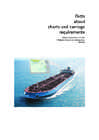
• The German Ministry of Transport, Building and Housing; • The Norwegian Maritime Directorate; • The Swedish Maritime Adminstration, Department for Maritime Policy and Public Affairs; and • The United Kingdom Maritime and Coastguard Agency. This document does not replace or amend national or international rules and regulations. Ship owners should always refer to their national administrations / flag states for the latest information. This compendium consists of a main document and a number of Annexes. The main document contains a description of various aspects of charts and electronic chart display equipment in the form of questions and answers in a short form. The main emphasis is on what can be used to satisfy the SOLAS carriage requirements for charts. The Annexes contain more detailed and additional information of the different types of
the Great Sandy Desert, the Gibson Desert, the Great Victoria Desert and the Nullarbor Plain. They are also called as the Western Australian Shield. The Nullarbor Plain is an uninhabited limestone plateau. It is characterized by amazing cave and tunnel systems, which contain valuable information about ancient Australia. The east is the mountainous part of the country. There is The Great Dividing Range. It runs along the Pacific coast and finds it end in Tasmania. The mountains are old and worn down. The highest mountains on the Australian mainland are in an area known as the Australian Alps. They are a small part of the Great Dividing Range. The Highest Peak on the mainland is 2228m high – Mt Kosciusko. One of the largest monoliths – Ayers Rock, also known as Uluru, can also be found in Australia. It’s located in the middle of the country. The monolith is 348 m high. The flat hot centre of Australia is called the outback. The Outback is more then two thirds
1. The Queen’s official title. Elizabeth the Second, by the Grace of God, of the United Kingdom of Great Britain and Northern Ireland and of Her other Realms and Territories Queen, Head of the Commonwealth, Defender of the Faith. 2. The Queen’s working day. Starts after breakfast. Reads the newspapers which are prepared by the Press Secretary, and a report on the previous day’s proceedings in the Parliament and the letters she receives. Also phone calls. Once a month she attends the Privy Council in order to give Royal Assent to various items of government legislation. Discusses domestic matters with the Master of the Household. Towards the end of the day, there is always another pile of official papers and reports waiting to be read or acted upon. The business on constitutional monarchy never ends. 3
Britain in the reign of Elizabeth 3 Elizabeth II (Elizabeth Alexandra Mary; born 21 April 1926) is the constitutional monarch of 16 sovereign states known as the Commonwealth realms, and head of the 54-member Commonwealth of Nations. In her specific role as the monarch of the United Kingdom, one of her 16 realms,
....................................................................................................16 Used materials:...............................................................................................................................17 2 Introduction With the advancement of technology ideas that used to be futuristic are nowadays already being researched with impressive headway made. One such research project is the railgun. I picked this topic because railguns are a childhood dream of every kid who watched sci- fi movies or something related to space. I wanted to learn more about how they're supposed to work and it is important because the research has done great leaps since 2009. Metaphorically it could be a crowbar used to break into a new military age in which the use of conventional guns changes drastically. And as a side effect new uses could be found in everyday life, not to mention
According to Cristal, there is no country which does not have some level of accessibility using telephone, radio, television, and air transport, though facilities such as fax, electronic mail and the Internet are much less widely available. The pressure to adopt a single lingua franca, to facilitate communication in such contexts, is considerable. The scale and recency of the development has to be appreciated. In 1945, the United Nations began life with 51 member states. By 1956 this had risen to 80 members. But the independence movements which began at that time led to a massive increase in the number of new nations during the next decade, and this process continued steadily into the 1990s, following the collapse of the USSR. There were 190 member states in 2002 – nearly four times as many as there were fifty years ago. And the trend may not yet be over, given the growth of so many regional nationalistic movements worldwide. [3, p. 14] 1
 annaabi.ee