must recognize, tolerate, and even respect different understandings of history. We must find points of common interest, yet respect cultural differences. She suggested that it is possible for two or more right versions of history, multiple truths, to exist side by side, at least to the point that we can recognize them as valid viewpoints.3 In my opinion, attaining this evenhanded analysis of the past is one of the main priorities of Estonian historical research. Historians must take a balanced look at all the sources, considering others' points of view. Indeed, this is essential to historiography in general, that historians remove themselves from their own passions and narrow outlooks to see things the way his or her subjects saw them, consider what biases he or she was subject to, what his or her motivations and aims were. In Estonian historiography, for example, records refer to Soviet control over Estonia as either "liberation" or occupation
RICHARD II Richard II (6 January 1367 14 February 1400) was King of England. He ruled from 1377 - 1399. Richard was a son of Edward, the Black Prince, and was born during the reign of his grandfather, Edward III. At the age of four, Richard became second in line to the throne when his older brother Edward of Angouleme died. Richard succeeded to the throne at the age of ten in 1377. Richard was tall, good-looking and intelligent. As earlier historians used to believe, he may have suffered from a personality disorders. Richard's mental state has been a major issue since the 19th century. One of the first modern historians to deal with Richard II as a king and as a person was Bishop Stubbs. Stubbs argued that towards the end of his reign, Richard's mind "was losing its balance altogether" even though there is no basis for assuming the king suffered from mental illness he showed clear signs of a narcissistic personality, and
Why Travel? Travelling broaden the mind. Donish people are taciturn, they have not seen the real world. Travelling gives you so much. People travel beacause they need that at work or just for fun and also because they wants to diverse cultures. Historians travel because they want to become acquainted history of variouse countries. Travel is fatal to prejudice, bigotry, and narrow-mindedness. Travel is all that and much more. One of the goals of study abroad is to prepare you to be more effective, respectful of other cultures, and to better understand your own culture and values. Travelling not only teaches you about other cultures, but it also teaches you more about yourself and your own culture
which developed in the nineteenth century That focuses on the customs, values, and 2. Jane Austen was the mindset of a particular class or group of people who are situated in a specific producer of this form and historical context. also the most sucsessful writer in this form Although the novel of manners has always defied easy definition, literary historians seem to have arrived at a 3. Its subject is the set of consensus on at least three elements: social conventions of a particular class in a particular time and place The novel of manners is dominated by women--as authors, as subjects, and often as intended audience For example, in Jane Austen's novels there is always "husband-hunting" by female characters.
According to the common thought, people decide to keep pets for many reasons. Firstly, a lot of old people keeps a pet at home to feel less lonely and to have a companion in their everyday life. Pets keeps occupied a lot of time of their days, doing things such as taking the pet out for a walk or play with them. Moreover, families too choose to have a pet in their lives for many reasons, for instance having their baby feel a lot more confident with animals. Historians don't know for sure when humans started keeping pets. Dogs were one of the first animals domesticated by humans and have been domesticated for some 10,000 years. According to ancient Egyptian law, taking the life of a greyhound warranted the same punishment as killing a man. As early as 3500 B.C., Egyptians were domesticating wildcats from Africa. They considered cats to be godesses pets. That ranked them above humans, making them the first to be saved if a house caught fire, before the people
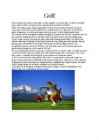
Golf Golf is a precision club and ball sport, in which golfers use many types of clubs to hit balls into a series of holes on a golf course using the fewest number of strokes. While the modern game of golf originated in 15th century Scotland, the game's ancient origins are unclear and much debated. Some historians trace the sport back to the Roman game of paganica, in which participants used a bent stick to hit a stuffed leather ball. One theory asserts that paganica spread throughout Europe as the Romans conquered most of the continent, during the first century BC, and eventually evolved into the modern game. A golf course consists of a series of holes, each with a teeing ground that is set off by two markers showing the bounds of the legal tee area, fairway, rough and other hazards, and the
and humble man, who supports the poor and weak. Furthermore, Marat is writing on an old box that was used as a table. On the panting the box symbolizes the conditions of the revolutionaries supporting the Republic, because usually only the rich and the supporters of the king could own luxurious furniture. All in all, David represented Marat on the panting as a loyal and true friend with strict principles. (Graham-Dixon, 2008, p.269) Although The death of Marat is a portrait, many of art historians consider it to be a history painting. In the later years historians have started to consider new perspectives and therefore they investigate using cultural documentations and anthropology. Historians found out that during the French Revolution, people who saw the painting would become more affectionate towards the Revolution and the new Republic, and would see Marat as a role model. (Vaughan,????????????????, p.56, 57) Last but not least, the third martyr that David depicted was Joseph Bara
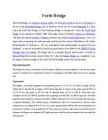
7 m (350 ft) span truss. The three great four-tower cantilever structures are 100.6 m (330 ft) tall, each 70 ft (21 m) diameter foot resting on a separate foundation. The southern group of foundations had to be constructed as caissons under compressed air, to a depth of 90 ft (27 m). At its peak, approximately 4,600 workers were employed in its construction. Initially, it was recorded that 57 lives were lost; however, after extensive research by local historians, the figure was increased to 98. Eight men were saved by boats positioned in the river under the working areas. Forth Bridge Carries Rail traffic Crosses Firth of Forth Edinburgh, Inchgarvie and Locale Fife, Scotland Balfour Beatty under Maintained by contract to Network Rail Sir John Fowler and Sir Designer Benjamin Baker
(Wikipedia, 2011) (UHRC, 2011) 2.3. Turkish denial Today the Turkish government actively denies the Armenian Genocide and claims that Armenians were only removed from the eastern "war zone". The Armenian Genocide, however, occurred all over Anatolia (todays Turkey) and not just in the so-called "war zone". In recent years, it has faced repeated calls to accept the events as genocide. To date, twenty countries have officially recognized the events of the period as genocide and most historians accept this view. (Wikipedia, 2011) (UHRC, 2011) (Armaniapedia, 2011) Summary Armenian Genocide was an awful event. Because of it many people died or were tortured by the Turks. About ona and a half million Armenians were killed and others were eliminated from their historic homeland. Armenian people of the Ottoman Empire were systematically exterminated and deported by the ,,Young Turk" goverment. Today Turkish goverment and many others does not even admit that Armenian Genocide
Explaining, reinforcing, exemplifying · The PM reiterated his concern that the debate should not be dominated by personal attacks. He also asked .... · Mr Burns' comments epitomise the attitude of many parents nowadays. He seems to be in the .... · It was a philosophy first expounded by John Ruskin in the 19th c. · The recent events underscore the need for a better understanding of the enviromental impact of biotechnology. If this phase in the .... · Several historians have posited a connection between the decline of the Roman Empire and the eruption of a far distant volcano .... · In an attempt to account for the lack of interest, political analysts have looked at past voting patterns. On the basis of .... Categorising, including Japanese visitors comprised/made up 70% of the hotel's guests last year. The course is comprised of two elements: speaking and listening. These two approaches can be subsumed under one heading.
resistant bacteria, known as "supergerms." On Meat could farms across America, the antibiotics that we depend on to treat human illnesses are now used make you to promote growth in animals and to keep them antibiotic alive in horrific living conditions that would otherwise kill them. Countless new strains of resistant antibiotic-resistant bacteria have developed as a result. Although some historians and anthropologists say How humans are that man is historically omnivorous, our not physically anatomical equipment teeth, jaws, and digestive created to eat system favors a fleshless diet. The American Dietetic meat The ph of human gastric acid is 1,5 to 3,5 the gastric acid of a herbivoore is Thank you for listening https://answers.yahoo.com/question/index?qid=201307 02051443AA7amYA https://celestialhealing.net/physicalveg3.htm
Lintels are the horizontal sarsens. 10.5 ft long, 3.5 ft wide, 2.5 ft thick Class Question How much do you think the vertical sarsens weigh?? Answer 26 45 tons each Origin of the stones Great debate. Were they moved to the area or left by a glacier?? Half of the stones were probably moved 200 miles by water and land from Wales Half of the stones were probably from 24 miles away A phenomenal feat to move them!! How were the stones moved? Great debate by historians and archeologists Primitive tools made from deer antlers or stones were used to pry the stone out of the ground Long poles were used as levers to lift the stone onto a sledge Ropes of hide were used to drag the stones Question How many people do you think it took to move a sarsen? How long do you think it took to move all of the sarsens? Answer 1000 men to haul one 45 ton sarsen 10 years to move all of the sarsens How were they shaped? Stone axes
" 1960 presidential election On January 2, 1960, Kennedy officially declared his intent to run for President of the United States. In the Democratic primary election, he faced challenges from Senator Hubert Humphrey of Minnesota and Senator Wayne Morse of Oregon. Kennedy defeated Humphrey in Wisconsin and West Virginia and Morse in Maryland and Oregon, although Morse's candidacy is often forgotten by historians. He also defeated token opposition (often write-in candidates) in New Hampshire, Indiana, and Nebraska. In West Virginia, Kennedy visited a coal mine and talked to mine workers to win their support; most people in that conservative, mostly Protestant state were deeply suspicious of Kennedy's Roman Catholicism. His victory in West Virginia cemented his credentials as a candidate with broad popular appeal. At the
and jazz clubs in 20s to 40s required a loud solo instrument to fill a big hall (Trumper, Saxophone) Although, we know jazzflute started to emerge in 20s. The earliest known recording of a jazzflute being used as solo instrument, was by Cuban clarnetist Alberto Socarras, recording "Shooting the Pistol" with Clarence Williams band and setting a milestone for future jazzflutist. While acknowleding the contribution to the early pioneers, jazz historians credit saxophonist Wayman Carver as being the first true jazz flutist, whilst recording extensively in the 30s. Tunes like "Loveless Love" in 1931 and "Sweet Sue, just You" in 1933 with Spike Hughes band. In the forties, multiinstrumentalist Jerome Richardson, joined Lionel Hamptons big band and recorded solos on "Kingfish" in 1949 and "There Will Never Be Another You" in 1950. From the end of the forties onward the use of improvised microphones
use in technology. As a chemist, Faraday discovered benzene, investigated the clathrate hydrate of chlorine, invented an early form of the bunsen burner and the system of oxidation numbers, and popularized terminology such as anode, cathode, electrode, and ion. Although Faraday received little formal education and knew little of higher mathematics, such as calculus, he was one of the most influential scientists in history. Some historians of science refer to him as the best experimentalist in the history of science. Faraday was the first and foremost Fullerian Professor of Chemistry at the Royal Institution of Great Britain, a position to which he was appointed for life. Faraday was highly religious; he was a member of the Sandemanian Church, a Christian sect founded in 1730 which demanded total faith and commitment. Biographers have noted that "a strong sense of the unity of God and nature pervaded Faraday's life and work."
The title was given to him by the pope because Henry VIII was against Protestantism and other religious reforms by J. Calvin and M. Luther. For that, the pope named Henry VIII the Fidei Defensor, meaning Defender of the Faith 4. Why did Mary I get the nickname Bloody Mary? Because during her reign, England became officially a Roman Catholic country, Parliament persecuted a lot of protestants and over 300 people who were burned at the stake. 5. Historians often speak about different ages or times in British history. When (in which centuries) were the following ages: Elizabethian, Georgian, Victorian. Characterise each of them (2 3 sentences). Elizabethian time started in the middle of 16th century and ended in the beginning of 17th century. During Elizabeth I reign, England became independent of the Pope in religious matters, England's overseas expansion began. It was a prosperous period
those days during Herod's life. (The work is mostly lost, but Josephus relied on it as a source.) Nicolas wrote from 14 to 4 BC, relying on his own current, ongoing experience and Herod's memoirs. Julius Caesar - not a king (yet) and he wrote it himself, but he chronicled his Gallic Wars and Civil Wars in true journalistic fashion. Also, Caesar did it deliberately to provide source material for future historians. About "nowadays" journalism: Johann Carolus's "Relation aller Fürnemmen und gedenckwürdigen Historien", published in 1605 in Strassburg, is often recognized as the first newspaper. The first successful English daily, the Daily Courant, was published from 1702 to 1735.The first dedicated school for journalism, Missouri School of Journalism, was founded in 1908 in the United States of America by Walter Williams.
D multicultural E roots F proud G encouraged H attracts I Bank Holiday J equipped K including L festival K E EL E STRU KTUURID Ta s k 1 (6 points) Underline the correct answer. An example (0) has been done for you. Puppets (0) been/ were/ are among the oldest man-made objects in the world. Archaeologists in Egypt and India (41) had found/have found/found jointed clay models that are operated by pulling (42) your/its/their strings, which date from 4,000 years ago. Historians tell us that puppets have been created (43) with/from/by nearly all peoples at all times. (44) A/ / The first puppets were probably used most by adults. Tribal peoples, such as Native Americans, (45) have used/used/were using puppets to represent people or animals in religious rituals. And early peoples in Africa, China and India used puppets to act out ancient stories (46) from/of/off gods and demons. Today, puppets (47) are/were/have been largely for children's entertainment. They range
north-America became independent) until the middle of the 20th century (1936 peaked, the largest). 1922-the Irish free state. 1947- India and Pakistan became independent. Important people King Arthur o a legendary British leader of the late 5th and early 6th centuries o according to Medieval histories and romances, led the defence of Romano-Celtic Britain against Saxon invaders in the early 6th century. o his historical existence is debated and disputed by modern historians Alfred the Great o King of Wessex in the 9th c o An able warrior and a dedicated scholar o Only english monarch who has the title "great" o Burned cakes William the Conqueror o The norman leader, Duke William of Normandy, known as William the Conqueror o Defeated the english in the battle of Hastings in 1066(14 oct) o Was crowned king of England Oliver Cromwell o Leader of the parliamentary party in the Civil War
The landlord the day before head over ears in dept was expecting a huge sum of money. At the same time his butler died unexpectedly and before he died the butler revealed he had been eavesdropping on the devils wedding. At Rataskaevu number 16 there is nowadays a house with a painted window; the landlord had the corner room walled up for ever and to hide the fact he had a proper window with curtains painted on the wall. Marzipan or Mart's Bread Historians might tell you that marzipan, that sweet confection made from almonds and sugar, comes from Persia or Italy, but local legend insists the delicacy was invented right here at Tallinn's Town Hall Pharmacy. Long ago, so the story goes, a town alderman fell ill and summoned the apothecary to prescribe a cure. The expert apothecary knew an elaborate formula he was certain would work, but the alderman insisted that the apothecary test the medicine on himself
in summer and cold in the winter. They are made by fires. The soil is rich so prairies are used for agriculture. Some animals that live there are: bobcats, antelopes, snakes, rodents, rabbits, badgers and bisons. Deciduous forests are cool, rainy areas. There are four distinct seasons. Well before coming of the first European settlers, Canada's aboriginal peoples had discovered the food properties of maple sap, which they gathered every spring. According to many historians, the maple leaf began to serve as a canadian symbol as early as 1700. The maple leaf today appears on the Canada's flag and on the penny. Canada's flag is with colours red and white, which are also Canada's official colours. Canada is a very large country blessed with many natural resources. From trees they make pulp and paper, from mines they extract coal, gold, silver, uranium and many other minerals. On the Prairies they grow grain,
The Religious Settlement of 1559 was the defining moment of the English Reformation, while the late 1580s and the 1590s were dominated by war with Spain and the French Catholic League, and by rebellion in Ireland. The iconography associated with the Queen herself, however, as Gloriana and the Virgin Queen, together with the length of her reign, has made her one of the most dominant characters of British history, a source of fascination to historians and the general public alike. Victoria Victoria (queen) (1819-1901), Queen of the United Kingdom of Great Britain and Ireland (1837-1901) and Empress of India (1876-1901). Born Alexandrina Victoria on May 24, 1819, in Kensington Palace, London, Victoria
from which came his nickname of Rufus. He was a strong king and ruled his subjects firmly. In 1095, he crushed with great severity a revolt by some of his barons. He acquired control of Normandy from his older brother Robert, by lending him money to go on a crusade. To raise funds for the war, William taxed his English subjects. William died in 1100 while hunting in New Forest in southern England. He was killed by an arrow shot by one of his lords, Walter Tirel. Historians are not sure whether Tirel deliberately fired the arrow at William. But some people believe that William's younger brother, Henry, plotted his death. He had been with William at the time of the accident. He rode to Winchester and took charge of the king's treasury. He then rode to Westminster, where he was crowned king three days later. Henry I (1100 - 1135) Henry I was an ambitious and unscrupulous politician. Early in his reign, he set out to
He is also worried that by killing Sister Sandrine, he has put Bishop Aringarosa in danger. Silas considers killing himself. He feels he has let down the only man who has ever helped him. Nobody has seen the Grail since 1447, when a church fire forced the Priory of Sion to relocate it. Langdon is certain that when Leonardo presided over the Priory of Sion, he knew of the Grail's whereabouts. Langdon thinks the Grail probably hasn't been moved since then. Many historians study Leonardo's work closely in the hopes of discovering the secret of the Holy Grail's hiding place. Sophie wonders if the key is to the Grail itself, but Langdon thinks it unlikely that Sophie's grandfather was so high up in the hierarchy of the Priory of Sion that he had access such classified information. They finally reach the address on the back of the key. It is the Depository Bank of Zurich, a Swiss bank. Sophie and Langdon use the key to get through the elaborate security
Elizabeth declared her intentions bishop of Carlisle. to her Council and other peers who had come to Hatfield to swear allegiance. Marriage questions From the start of Elizabeth's reign, it was expected that she would marry and the question arose whom. She never did, although she She considered several suitors until received many offers for her hand; she was about fifty. Her last courtship the reasons for this are not clear. was with François, Duke of Anjou, 22 Historians have speculated that years her junior. Thomas Seymour had put her off While risking possible losing of sexual relationships, or that she power like her sister, who played into knew herself to be infertile. the hands of King Phillip II of Spain, marriage offered the chance of an heir
is a language that has been spoken in the area of present day Estonia for more than 4000 years, Meri (1976). 4 First links Although written evidence of regular links between Estonia and England date back only into the beginning of the 20 th century, it is clear that there have been links also earlier. These contacts might be very old. During Hanseatic times the trade on the Baltic Sea was quite active. The links might be even older. Historians have claimed that already during the second Punic war in 218 BC a northern nation called Esths controlled the north south trade of furs. It is most likely that some furs also reached the area of present day England. Even more likely contacts between Estonia and England date back to the beginning of the second millennium AD. It has been widely acknowledged, that Estonians and Danes often combined forces when attacking larger targets. This would mean that
London Bridge The home of the London Bridge is the Thames River, and a bridge has existed on the spot for at least the last 2000 years. The first bridge on record was constructed by the Romans, and since then many bridges have risen at the hands of various empires. London Bridge today remains one of the most popular tourist attractions in Britain as well as an icon for the City of London. London Bridge history records the building of a wooden bridge by the Romans about 2000 years ago. Historians suspect that the location was chosen for its relatively convenient access to the deeper ocean waters, as well as the excellent land conditions available for bridge building. The home of the London Bridge as it appeared in Roman times was in virtually the same spot as the home of the London Bridge today, suspended over the Thames River. The Romans were not the only people in London Bridge history to construct a wooden bridge. After the fall of the
politics, education, entertainment and even fashion contribute to its status as a major global city. London is a major tourist attraction with four world heritage sites, several royal parks and numerous iconic landmarks such as the Houses of Parliament, Towe Bridge, the Tower of London, Westminster Abbey and the London Eye. 2. History Although there is some evidence of a permanent settlement before the Romans came in 43 A.D., it is more accepted by historians that the Romans were the first. The settlement was called Londinium. The first London lasted for just seventeen years, for around AD 61, a tribe of Celts led by Queen Boudica stormed London, burning it to the ground. The next heavily-planned London prospered and surpassed Colchester (another major city at the time) as the capital of the Roman province of Britannia. At its height in the 2nd century, Roman London had a population of about 60,000
between 43 and about 410. The Romans referred to their province as Britannia. Prior to the Roman invasion, Iron Age Britain already had cultural and economic links with Continental Europe, but the invaders introduced new developments in agriculture, urbanization, industry and architecture, leaving a legacy that is still apparent today. Historical records beyond the initial invasion are sparse, although many Roman historians mention the province in passing. Most of the knowledge of the period stems from archaeological investigations and especially epigraphic evidence. The invasion force in AD 43 was led by Aulus Plautius.It is not known how many Roman legions were sent; only one legion, the II Augusta, commanded by the future emperor Vespasian, is directly attested to have taken part. The IX Hispana,the XIV Gemina (later styled Martia Victrix) and the XX are attested in 60/61 during the Boudican Revolt, and are
that it has. The nature in Washington in really diverse and it is good for people, who don't like so much night life, but historical cities. Mt. Rainier reflected in Reflection lake. Famous Americans Leonardo was born in Vinci, near Florence, Italy, in 1452. Leonardo da Vinci was a skilled painter, sculptor, engineer, architect, and inventor. Two of his most famous paintings--The Last Supper and the Mona Lisa--are considered by many art historians to be priceless. Although Leonardo studied to be an artist, he also became interested in anatomy, optics, and botany, or the study of plants. He used what he learned from his studies to invent new things. Today, Leonardo is remembered as one of the most important figures of the Renaissance. Leonardo da Vinci died in 1519. In his will, he left all his notebooks and many of his paintings to his friend and favorite student, Francesco Melzi.
· "Jealousy" (1925) · "Cheest" (1925) The Great Depression The Great Depression was a worldwide economic downturn starting in most places in 1929 and ending at different times in the 1930s or early 1940s for different countries. It was the largest and most important economic depression in the 20th century, and is used in the 21st century as an example of how far the world's economy can fall. The Great Depression originated in the United States; historians most often use as a starting date the stock market crash on October 29, 1929, known as Black Tuesday. The depression had devastating effects in virtually every country, rich or poor. International trade plunged by half to two-thirds, as did personal income, tax revenue, prices and profits. Cities all around the world were hit hard, especially those dependent on heavy industry. Construction was virtually halted in many countries. Farming and rural areas suffered as crop
marriage, since she was a white woman and nearly 20 years younger than he. Both families recoiled; hers stopped speaking to her; his was bruised, as they felt his marriage was a repudiation of their mother. But individualist feminist Elizabeth Cady Stanton congratulated the two.[1] The new couple traveled to England, France, Italy, Egypt and Greece from 1886 to 1887. In later life, Douglass was determined to ascertain his birthday. He was born in February of 1816 by his own calculations, but historians have found a record indicating his birth in February of 1818. In 1892 the Haitian government appointed Douglass as its commissioner to the Chicago World's Columbian Exposition. He spoke for Irish Home Rule and on the efforts of Charles Stewart Parnell. He briefly revisited Ireland in 1886. Death On February 20, 1895, Douglass attended a meeting of the National Council of Women in Washington, D.C. During that meeting, he was brought to the platform and given a standing ovation by the audience
It has been handed down through the years that Creoles are both BLACK and FRENCH in heritage. Creoles are among a rich cultural heritage of people. For many centuries, the word Creole has had as many as 30 known definitions. It is a fact that the word Creole had its origin in Africa, citing the countries of Senegal and Mali. In these areas, it is believed that in the 11th century is when Creolism began. In search of new lands, ideas, riches, knowledge and to dispute the philosophers and historians, men became brave explorers. It is through their discoveries that these varying cultures co-existed in harmony to form the structure of Creolism. It is documented in the records of history that Creoles of Senegal, whether as freemen or as slaves, traveled directly from Senegal and Mali to Louisiana. People The term Creole and its cognates in other languages -- such as crioulo, criollo, créole, kriolu, criol, kreyol, kriulo, kriol, krio, kreol, etc
There are still many ruins of castros (Hill fort) all over modern Portugal and remains of Castro culture. Numerous Roman sites are scattered around present-day Portugal, some urban remains are quite large, like Conimbriga and Mirobriga. Several works of engineering, such as baths, temples, bridges, roads, circus, theatres and layman's homes are preserved throughout the country. Coins, some of which coined in Lusitania land, there are numerous pieces of ceramics. Contemporary historians include Paulus Orosius (c. 375-418) and Hydatius (c. 400469), bishop of Aquae Flaviae, who reported on the final years of the roman rule and arrival of the Germanic tribes. MUSLIM IBERIA Portugal was part of the Arab-Muslim world for slightly under five and a half centuries following the Umayyad Caliphate conquest of the Iberian Peninsula in 711 until 1249 with the taking of the Algarve by King Afonso III of Portugal during the Reconquista.
balcony, the 17th- century epitaphs to Bartholomeus Rottert and Michael Prosa, as well as the church chandeliers. The earliest reports of the Holy Ghost Church organ date back to 1511. The present organ was made by organ builder August Artur Terkmann in Tallinn in 1929. Among the older churches in Tallinn, the Holy Ghost Church has been most closely linked to the Estonians, even including claims by some historians that the church had been built on the site of a chapel of an Estonian congregation of the preconquest era of the 13 th century. In 2004, a piece of wall dating back to an older period than the 14 th-century church was discovered under the existing church wall, which raised unanswered questions and provided further material for study. The pastors of the church have been remarkable individuals form the Estonian
concerning the insurance and acquisition practice at European museums, in particular those in the Baltic Sea region. The main altar of the St. Nicholas' Church was assessed at 50 million US dollars and Danse Macabre at the same price. It is clear that the medieval works of art and other objects exhibited in the St Nicholas' Church require a stabile and controlled microclimate and that they must constantly be looked after by specialists, including art historians, restorers and climatologists. At the same time, the museum functions as a research centre for church art and architecture. Thus far, the main goals of the St. Nicholas' Church as a museum have been the exhibition and conservation of these works of art. In the course of the 20th century, a lot of mental energy, skills, and finance has been spent on restoration and conservation of the works of art exhibited there. These goals and the research must remain the priorities of the museum also in
many machines were invented and factories established which brought along significant changes in Britain and beyond. The Industrial Revolution was the key to the modern Western society it made the European working class and middle-class. By 1800 Britain was the most industrialised country in the world. Aided by revolutions in agriculture, transportation, communications and technology, England was able to become the "first industrial nation". This is a fact that historians have long recognized. New methods of farming meant that England could produce enough food to feed itself and export as well. England was rich in coal, iron ore and wool, and its aim was to supply two-thirds of the globe with cotton spun, dyed, and woven in the industrial centres of northern England. A vast network of canals was built, supplemented by railways. Telegraph lines, magazines, and newspapers provided people with steady flow of information. England proudly proclaimed
The "classic" Métis culture emerged near present-day Winnipeg, Manitoba. The most famous Métis leader Louis Riel was the founder of Manitoba and also a central figure in the Red River and North-West resistances. Riel led two popular Métis governments, was central in bringing Manitoba into Confederation, and was executed for high treason for his role in the 1885 resistance to Canadian encroachment on Métis lands. Riel was initially dismissed as a rebel by Canadian historians, although many now sympathize with Riel as a Métis leader who fought to protect his people from the Canadian government. 6. What is the origin of the Inuit people? What other name has been used for them? Inuit were the last of the prehistoric migrations of from Asia to North America. Despite the vast span of territory they occupied there was a remarkable homogeneity of language, culture and technology among the Inuit. While
Naomi Riga, 45, J edu system, better living conditions? Star of David hanging, ulpans, prayers, bball, etc. 17 June Levis broke the SU. If standard of living would have been better, would there have been a J movement? Gma, waiting in lines. Stagnation, great gaps. Command economy. Lack of incentive, too much emphasis on heavy industry, poor distribution of resources. How to define J community? Synagogues? Institutions? Most important population. IN SU, by definition of govt. As historians, focus more on collective ID than personal ID, though also significant. There were yeshivas in late SU, though not many. Forests. H clubs. J culture, rel, hist clubs. Neighborhoods. Places of work, even if unconsciously; pushed out of applied sciences. Section 5[?] forced Jews to survive as Jews. Pew Report Less than ½ of US belong to any sort of institution, even regular life cycle stuff. , Js living just fine compared to other ethnic groups. Like others, standing in food
The Tapestry contains 2 hundreds of images divided into scenes each describing a particular event. The scenes are joined into a linear sequence allowing the viewer to "read" the entire story starting with the first scene and progressing to the last. 12.French influence on the English language English language originally sprang from the dialects of three Germanic tribes known by historians as the Angles, Saxons, and Jutes. These peoples settled in Britain around 450 AD. Their language became known as Anglo-Saxon. One of the most important influences ever to shape the English language arrived in 1066 AD-William the Conquerors invasion of the British Isles. The Norman Conquest and its Consequences On William the Conqueror's accession to the throne of England, several important changes took place.
model. Wolpoff and others further argue that this model is consistent with clinal patterns of phenotypic variation Kas evolutsioon on lõppenud? Arenguteemalised vaidlused Mis on rass? Eraldi liigid, alaliigid, kohanemiserinevused, rassi pole olemas? Tänapäeval - eemaldumine rassi konstruktist. Anthropologists and other evolutionary scientists have shifted away from the language of race to the term population to talk about genetic differences, Historians, anthropologists, and social scientists have re-conceptualized the term "race" as a cultural category or social construct, in other words, as a particular way that some people have of talking about themselves and others. As Stephan Palmie has recently summarized, race "is not a thing but a social relation"; Inimese ja looma erinevused? Kus ja milles? Tööriista valmistamine ja kasutamine. Tulevikusündmuste tajumine. Eneseteadvus
William. Cooper was a lifelong member of the Episcopal Church and in his later years contributed generously to it. He attended Yale University for three years but was expelled for misbehavior. Before embarking on his career as a writer he served in the U.S. Navy as a Midshipman which greatly influenced many of his novels and other writings. He is best remembered as a novelist who wrote numerous seastories and the historical novels known as the Leatherstocking Tales. Among naval historians his works on early U.S. naval history have been widely received but were sometimes criticized by Cooper's contemporaries. Among his most famous works is the Romantic novel The Last of the Mohicans, often regarded as his masterpiece. Cooper's portrayal of Native Americans and the white settlers in The Leatherstocking Tales shows us a prime example of how acculturation operates in various types, steps, and on various levels
III We can't imagine that the Scientific Revolution of the 16th and 17th centuries took place in a vacuum [ tühjuses, iseenesest ]. That is, we can't assume that modern science simply came to be in a momentary flash of brilliance, nor that Copernicus or Kepler or Galileo just woke up one morning and pronounced their discoveries to a world which became somehow instantaneously different. Past historians have looked at the history of modern science from precisely this point of view. Like the Renaissance, the Scientific Revolution has been interpreted as explosive, a surge forward, a watershed [ sai alguse jõelahkmest ]. The scientists of the seventeenth century those mathematicians, astronomers, and philosophers had the enormous weight of centuries of thought resting on their shoulders. Even Isaac Newton was aware of the debt he owed to the past
3 the Bloody Countess 4 indispensible 9 variations 4 victim 5 exactly 10 delighted 5 Central Europe 2 1 managed to 6 world 2 will you find out 7 western standards 3 I've been 8 description 4 I get 9 Historians 5 haven't been doing 10 her country 6 I'll probably be sitting Use of English 7 I'll send 1 1 least 6 no 8 I return 2 up 7 others 9 I'll be able to 3 at / in 8 This 10 I borrowed 4 than 9 why
and to create colonies. 3. Comprehension check: Answer the following questions. Check your answers with the text. 1. Who fought in the Wars of the Roses, and why? 2. Who united the two rival houses and founded a new dynasty? 3. What kind of foreign policy did Henry VII pursue? 4. What was his home policy? 5. Why did Henry VIII break with Rome? 6. What was his second achievement? 7. What do English historians rate Elizabeth I? 8. Shakespeare and Drake are considered to be the symbols of her age. Why do you think? 9. What were her foreign policy principles? 4. Put a preposition in each gap. Underline the prepositions in your notebooks. a) The struggle ____ the Crown, named the Wars ___ the Roses ___ Walter Scott, was ended ___ Henry Tudor who gave origin ___ a new dynasty. He avoided wars _____ neighbouring countries and kept the friendship _____
to increase in a positive way, such as in n. enhancement value, power, or beauty adj. enhanced Syn. strengthen Passing the exam should enhance your chances of being, admitted to college. The computer enhanced our productivity. intrigue a. to interest greatly adj. intriguing Syn. fascinate adv. intriguingly n. intrigue He was intrigued by the acclaim flat he received. The intriguing question baffled historians. persuade v. to change a belief or behavior by adv. persuasively argument or reason adj. persuasive Syn. convince n. persuasion They couldn't persuade their critics to see their point of view. John presented a persuasive argument for his salary increase. replace v. to change for another thing; to take adj. replaceable the place of n. replacement Syn. substitute
involvement in making England into a republican Commonwealth. He was one of the commanders of the New Model Army which defeated the royalists in the English Civil War. After the execution of King Charles I Cromwell dominated the short-lived Commonwealth of England, conquered Ireland and Scotland, and ruled as Lord Protector until his death. Cromwell has been a very controversial figure in the history of the British Isles a regicidal dictator to some historians and a hero of liberty to others. *The New Model Army - was created by Parliament as it felt that a professional army would be more successful against the King's army. It was a military unit that was to transform the English Civil War. Oliver Cromwell was put in charge of the cavalry. It was a military force based on a person's ability rather than on your position within society. If you were good enough, you could be an officer in it. This removal of this social obstacle meant that the New
other age, or country of the world, but this, which has asserted monarchy to be jure divino. He confesses that Heyward, Blackwood, Barclay, and others, that have bravely vindicated the right of kings in most points, never thought of this, but with one consent admitted the natural liberty and equality of mankind. By whom this doctrine came at first to be broached, and brought in fashion amongst us, and what sad effects it gave rise to, I leave to historians to relate, or to the memory of those, who were contemporaries with Sibthorp and Manwering, to recollect. My business at present is only to consider what Sir Robert Filmer, who is allowed to have carried this argument farthest, and is supposed to have brought it to perfection, has said in it; for from him every one, who would be as fashionable as French was at court, has learned, and runs away with this short system of politics, viz
Very ocntroversial figure, he was a man of charm and at the same time scoundrel. The whole trial of burr is revelead in great detail. He was innocent. The second level of narration covers the period of to the burrs death, 60 years of Burr's life. 21 sections where Burr is narrator. The third level of narration is the parallels between revolutionary american and present day America. Young republic, he shows that the reasons for the war of independece wasn't as noble as the traditional historians want to present, it wasnt for the love of freedom and so called crimes of the english king. Vidal claims that it was just a fight for money. Washington approved of slavery, dissaproved the french revolution. Burr makes fun of Europeans who came to fight for American independence, De la Fayatte, Jefferson, who had always been considered progressive man is less symphatical than Washington. Drawing these parallels Vidal shows that corruption has always been in the American government. 24.04.2013
best known as the author of the Tao Te Ching (often simply referred to as Laozi). His association with the Tào Té Chīng has led him to be traditionally considered the founder of philosophical Taoism (pronounced as "Daoism"). He is also revered as a deity in most religious forms of Taoist philosophy, which often refers to Laozi as Taishang Laojun, or "One of the Three Pure Ones". According to Chinese traditions, Laozi lived in the 6th century BCE. Some historians contend that he actually lived in the 5th–4th century BCE, concurrent with the Hundred Schools of Thought and Warring States Period, while some others argue that Laozi is a synthesis of multiple historical figures or that he is a mythical figure. A central figure in Chinese culture, both nobility and common people claim Laozi in their lineage. He was honored as an ancestor of the Tang imperial family, and was granted the title Táishāng
 annaabi.ee