Leidsid 33 sarnast õppematerjali, mis on seotud failiga "English literature". Need materjalid aitavad sul teemat sügavamalt mõista.
land, came, king, come, became, dies, character, parliament, however, place, beowulf, period, year, england, part, shakespeare, renaissance, even, english, characters, fire, allow, britain, still, roman, language, ended, scotland, saxon, north, them, east, lear, first, night, years, wrote, comedies, there, light, puritan, ford, developed, politicalThe Renaissance In the history the Middle Ages were followed by the Renassance period. During this period a new class called bourgeoeisie came into being. This is the period when monarchies based on nationality were estabilished. The Renaessance started in Italy In the 14th century. Then it spread all over Europe, reached England in 16th century. The struggle for power culminated in a war called The War of Roses. It was a civil war between two dynasties, families. They had different emblems on one side the Yorks (white rose) other Lancasters (red). They couldn't decide who gets the throne. War ended 1485
BEOWULF most important poem, surviving in a 10th-cent manuscript. The historical period of the poem's events can be dated in the 6th to 8th century. Much of the material of the poem is legendary and paralleled in other Germanic historical-mythological literature in Norse, Old English, and German. GEOFFREY CHAUCER (1340-1400) Politician and writer, fought in France during the 100 years war. He visited Genoa and Florence where he became acquainted with Italian literature and in particular with the works of Dante, Petrarch and Boccaccio. The French period (up to 1370). early works were based mostly on French models. The Italian period (up to c. 1387). Was influenced by Italian literature, especially Dante and Bocaccio. The English period. Wrote Canterbury tales. CANTERBURY TALES This unfinished poem of about 17,000 lines was written mostly after 1387
into warrior aristocracy, agricultural commons and the priests, the druids. *Caesar in Britain - Britain was very rich in minerals but that wasn't the main reason Caesar wanted to defeat it. He could clearly see that Britain was a threat to his latest and greatest conquest - France. He invaded Britain twice, in 55 and 54 BC. The first invasion was unsuccessful - it gained a beachhead on the coast of Kent but achieved little else. The second was more successful, the Celts asked for truce. However it wasn't a victory he had imagined and Julius Caesar never returned to Britain after that. The island was left undisturbed for nearly a century. *The Roman occupation of Britain 43-410 and its legacy Britain was conquered by Emperor Claudius, the Roman rule in England lasted up to 410. The Romans left behind a huge legacy: many types of animals and plants were brought to Britain in Roman times. Roman introduced theire measurements, Christianity, reading and writing. Also, many words
Romans brought a lot with them. Their brought paved roads, the sites of important cities, the seeds of Christianity, the Roman law, Roman baths, language and advanced civilization. They also built Hadrian's Wall in 122 A.D. Romans occupied Britain for four centuries. The Roman way of life all vanished after the invasions from Northern Europe by the Angles, Saxons and Jutes from the 5th century onwards. They ruined Londinium, but they were easily turned into Christianity and religion became more and more important. The Vikings, who came in the 9th century, first raided England to plunder it, but then they decided to stay. In the 10th century England fell under Danish Rule, with King Canute finally managing to unite the Anglo-Saxons and Danes at the beginning of 11th century. Medieval England After defeating the Anglo-Saxon King Harold at the Battle of Hastings in 1066, William of Normandy (who became William I, also called William the Conqueror) introduced
with the technology of the time. Another is its purpose. It appears to function as a kind on astronomical clock and we know it was used by the Druids for ceremonies marking the passing of the seasons. It appears in number of novels. These days it is not only the interest of tourists but is also a gathering point of certain minority groups. It is now fenced off to protect it from damage. 3. The Roman conquest Julius Caesar's first raid was in 55 BC but the romans left. Ad 43- the Romans came to stay. The army established Roman rule in the south and SW of the country. The Romans started to introduce their laws to a new province of the Roman Empire and started to build good roads. Officials were appointed (governors, procurators to collect taxes, look after the estates and mines and se that the gold, silver, iron and lead were exported back to Rome). Introduced schools,a new language Latin, large farms (villas), baths. In AD 410 they had to leave
Brythons(gave name to Brittany) Fierce fighters,superb horsemen.Most of them farmers, lived in thatched houses Good at art, craftmanship, used iron Divided into tribes, ruled by kings, only in face of danger would they choose a single leader Legacy- hill-forts, farms, churches, field system, woodland, pasture, weapons, iron objects, langugae, culture Caesar in Britain The great Roman Emperor Firts came 55 BC to gather information, celts were doing agriculturally well,so romans wanted to get some food too In 54BC Caesar defeated Cassivelaunus Actual reasons why he made expeditions are unknown or wheteher he wanted to intend conquest The Roman Occupation 43-410 43 AD Emperor Claudius conquered Britain, it was easy, romans were more skilled and betetr equipped. Romans faced assaults of Picts, Scots, barbarians. 406-7 barbarians begin invasion
ведущим мировым языком, и парламентаризма, который переняли большинство стран мира. 6 INTRODUCTION Aspects of British History presents a brief outline of the most significant milestones in the long and eventful history of Great Britain, such as the five successful invasions of the island, the birth of Parliament and transformation of an absolute monarchy into a constitutional monarchy, the origin of the English language, the rise and fall of the British Empire. The units contain an informative reading text on an important issue, preceded by preparatory discussion questions and followed by notes offering some additional information, and a vocabulary with relevant language notes. The main reading text is accompanied by comprehension, vocabulary and grammar exercises and discussion activities
The foundation stones The Island Britain has a mild climate due to the Gulf Stream which brings warm waters from the Gulf of Mexico. The northern part of the island in average 5'C cooler and it's mountainous or hilly and that's why the south has been more populated.. Britain became an island only 5000 years BC after the Ice Age ended. Britain's prehistory The first evidence of human life on the island are dated back to 250 000 BC. 50 000 BC in a milder Ice Age period Britain became habitable again. People from that time were the ancestors of the modern British. 10 000 BC ige age ended and Britain became inhabited by small
BRITISH HISTORY 17TH-19TH CENTURY SEVENTEENTH-CENTURY ☄ When James I became the first English king of the Stuart dynasty, he was already king of Scotland, so the crowns of these two countries were united. ☄ The kind of Middle English spoken in lowland Scotland had developed into a written language known as Scots ☄ The Scottish Protestant church adopted English rather than Scots bibles ☄ Religion and politics are inextricably linked ☄ Some people tried to kill the king because he wasn't Catholic enough and another king had been killed, partly because he seemed too Catholic
name studies. British landlords ruled small, unstable kingdoms and continued some Roman traditions of governance. In the mid-5th cent, Vertigern, a British leader, hired Germanic mercenaries to help defend against peoples of the north (Picts & Scots). In the end they revolted & the process of invasion and settlement began. The first Saxon ,,kings" were Hengist & Horsa in Kent, Aelle in Sussex, Cerdic / Cynric in Wessex. So the first ,,English" became mainly from Northern Germany & Denmark. The resistance of the Celts was long. They were free at the time, not like other Roman provinces on the Continent. Around 500, the Britons seem to have won several victories. One of their leaders was Ambrosius Aurelianus and one of their victories was at the place called Mount Badon. The main leader of the Britons at this time may have been the warrior later called King Arthur. By the 7th cent. the invaders managed to conquer the greater part of the land
1. The Queen’s official title. Elizabeth the Second, by the Grace of God, of the United Kingdom of Great Britain and Northern Ireland and of Her other Realms and Territories Queen, Head of the Commonwealth, Defender of the Faith. 2. The Queen’s working day. Starts after breakfast. Reads the newspapers which are prepared by the Press Secretary, and a report on the previous day’s proceedings in the Parliament and the letters she receives. Also phone calls. Once a month she attends the Privy Council in order to give Royal Assent to various items of government legislation. Discusses domestic matters with the Master of the Household. Towards the end of the day, there is always another pile of official papers and reports waiting to be read or acted upon. The business on constitutional monarchy never ends. 3. Who is the present heir to the throne
Years 1154-1485 Henry I was the first unquestioned ruler. One of the most important kings in the Middle Ages. He had lands in Britain & France. Then the government was the monarch, a person, not a place. He had more land than any pervious king. After his marriage to Eleanor of Aquitaine, he also ruled the lands south of Anjou. His empire stretched from the Scottish border to the Pyrenees. England provided most of its wealth, but the heart was Anjou. Henry II began to regain royal control. During the war some barons had become very powerful. He pulled down some of their castles. He tried to restore law & order. He wanted the same kind of justice to be used everywhere. He appointed his own judges to travel around the country
Jacob, son of Issac, stole his brother's birthmark. Jacob was a partiarch who brought up his twelve sons to be partiarchs, but they did not take to it. One of Jacob's sons, Joseph, gave refuse to the Israelites. Pharaoh forced the Hebrew slaves to make bread without straw. Moses led them to the Red Sea, where they made unleavened bread, which is bread made without any ingredients. Afterwards, Moses went up on Mount Cyanide to get the ten commandments. David was a Hebrew king skilled at playing the liar. He fougth with the Philatelists, a race of people who lived in Biblical times. Solomon, one of David's sons, had 500 wives and 500 porcupines. Without the Greeks, we wouldn't have history. The Greeks invented three kinds of columns - Corinthian, Doric and Ironic. They also had myths. A myth is a female moth. One myth says that the mother of Achilles dipped him in the River Stynx until he became intolerable. Achilles appears in "The Illiad", by Homer. Homer also
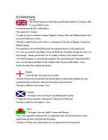
started during the days of the Industrial Revolution * the flag is of Wales bears a Red Dragon (it is not represented on the Union Jack) Northern Ireland: * the capital city is Belfast * 54% of people regard themselves as Protestants and 42% as Roman Catholics * the flag is called the Saint Patrick's Cross 2) History Prehistoric Britain, Roman Britain, Anglo-Saxon, Danish, Norman invasions (...-1066): Britain was part of the European land mass until the end of the last Ice Age. It became an island by about 6000 BC. From about 3000 to 2000 BC the British Isles were inhabited by a group of people called the Iberians. These Stone Age people lived in limestone caves, they used stone axes and fashioned antlers and bones into leather-working tools. Later groups of people from what are now Germany, the Netherlands and Brittany also settled in Briton. During the Bronze Age, they mined tin, gold and copper and made bronze tools
The Renaissance Between 14th and 16th century in Europe From French word rebirth It was an age of growth in Europe. New, powerful city states emerged. A new middle class had more and more money to spend. Great artists, writers and thinkers lived during this time. During the Middle Ages many people who lived in the countryside worked on the land that they got from the noblemen. In return, they were protected by them Between the middle and the end of the 14th century, the plague, also called "Black Death" killed almost half of Europe's population. It spread most rapidly in the larger cities where many people lived. This led to economic depression. When the plague slowly decreased in the 15th century, the population in Europe began to grow. A new middle class emerged --bankers, merchants and trades people had a new
Celtic and Glasgow Rangers. Scotland has a very picturesque landscape. It may be divided into two parts: the Lowlands (an are of gentle hills, fields and woodlands, more densely populated than other parts, they also include plenty of wild upland country) and the Northern Highland (which are considered by many people, especially mountain-lovers, to be the most beautiful part of Scotland and a real tourist Mecca; they say that there may even be small patches of land on which nobody has ever set foot). Britain's highest peak, Ben Nevis (1343 m) lies not far from Fort Williams. The Scottish flag has a white cross on a blue background. It is also on the Union Jack. Northern Ireland is the smallest part of the UK as it only covers about 5500 square kilometres. About half of the 1.7 million inhabitants live in or around Belfast, the capital, in the eastern coastal region.
world of ancient Germanic legend. He writes his folk-tales and legends in a web of other events, mainly set in the Baltic Kingdoms. He shows a very rich and leisurely portrayal of this Baltic world, providing many customs like the close relationship between lord and man in the war-band and others. All this encouraged the supposition that the unknown author of the poem was himself a bard of the ancient type portrayed within the poem (a lord's scoop). However, many people propose that the author could be Christian poet, perhaps a monk, versed not only in old native traditions, but also in the culture and literature of the Latin Church, and whose purpose of writing was highly moral. For example, the fate is a `providentia' and the monster Grendel is an embodiment of evil fighting against Christian militant. This contrast corresponds to the poem itself. The poet is looking back from his own Christian times to
o The Celtic language survives in the names of many places in England- Dover, Kent, Thames o The Celts are best known for their art- many bronze objects with elaborate designs; brooches; pins; mirrors; Celtic stone crosses o The Celts had 3 social orders: warriors, druids(priests) ordinary people 2) The Romans o (55 BC-Caesar) 43 AD- 410 AD- Claudius o From present-day Italy o Southern Britain became Britannia and was ruled by a roman governor o The Romans built over 20 towns: Colchester, Londinium, Winchester etc. They were good engineers and built roads and villas that had central heating, glass windows and mosaic floors o 122 AD- Hadrian's Wall; 138 AD- Antonine Wall o Druids(celtic priests) were banned and Britain was influenced by christianity 3) The Germanic Invasions I
40 lines. Talks about a scop who is not happy with his life. · A-S poetry was fatalistic in its nature (fate controls you, not you it) · The greatest known A-S song, the epic Beowulf. The oldest epic poem in Europe. Composed at the end of the 7th century, the only manuscript that has survived is from the 10th century. Contains references to real people and real events. Scene of the poem: Denmark, southern Sweden (the A-S tribes came from these places). The poem records the history of the A-S tribes and the Jutes, before they invaded the British Isles. It is written in Old English, the language is lofty (very poetic, formal), it has many supernatural elements and is filled with heroic warriors and their deeds. The hero of the story Beowulf is almost an ideal A-S warrior, the champion of freedom and justice, courageous, has supernatural strength, is loyal to his king and has a very
ideal crossing point, they built London Bridge. Less than 20 years later the native Iceni tribe, led by Queen Boudicca, rose up against the Romans in revenge for mistreatment and burnt Londinium to the ground. The well disciplined Roman army defeated her forces and Londinium was rebuilt. By AD 100 it had also become the capital of the Roman province. A massive wall was built to protect the city from further attacks. The Roman Empire came under increasing attack across Europe and in AD 410 they retreated. The Romans gave us a language based on Latin, the calendar, law and legal system, the census and also straight roads, central heating and concrete. Anglo- Saxons around AD 400 Anglo- Saxons were warrior farmers from Germany, Denmark and the Netherlands. Later in the 5th century, Anglo-Saxons settled just west of Londinium, around the Strand, and formed the town of Lundenwic
The Middle Ages started in 1066. with the Battle of Hastings and the Norman Conquest. William the Conqueror took all the lands from the Saxon English and gave these to French nobles. Normans were known as great builders. This is assured by the fact that many great castles and other buildings, including the Tower of London, were built during the Norman Conquest. In 1086. Domesday Book was compiled. It is a detailed survey of England ordered by William the Conqueror. The reign of King William Rufus who was the son of William started in 1087 and lasted until 1100. Next king was Henry I who was the brother of William Rufus. His reign was from 1100-1135. In 1135 Henry I nephew Stephen got to the throne of England and reigned the country for 19 years. He was the last Norman king of England and his reign ended in 1154. From 1154 until 1377 the Plantagenet Kings of England ruled the English. The first Plantagenet King was Henry II. He was the grandson of Henry I
archaeological investigations and especially epigraphic evidence. The invasion force in AD 43 was led by Aulus Plautius.It is not known how many Roman legions were sent; only one legion, the II Augusta, commanded by the future emperor Vespasian, is directly attested to have taken part. The IX Hispana,the XIV Gemina (later styled Martia Victrix) and the XX are attested in 60/61 during the Boudican Revolt, and are likely to have been there since the initial invasion. However, the Roman army was flexible, with units being used and moved whenever necessary, so this is not certain. Only the Legio IX Hispana is likely to have stayed there, as it is attested to being in residence at Eburacum (York) in AD 71 and on a building inscription there dated AD 108, before its eventual destruction fighting in the East, likely during the Bar Kochba Revolt. The invasion was delayed by a mutiny of the troops, who were eventually persuaded by an
1) INDIAN ROCK ART: A NATIONAL TREASURE IN DANGER Unrecognized, unprotected, this priceless legacy of primitive art has endured the ravages of nature only to fall victim to wanton destruction by ,,civilized" man. Like the huge stone statues of Easter Island and prehistoric cave paintings of Altamira and Lascaux, North American Indian rock art is surrounded by an atmosphere of mystery. Although examples of rock art exist at some 15000 sites in canyons, deserts, caves and river gorges. Nowadays, however, primitive rock art in the United States has become a new field of scientific study. Klaus F Wellmann wrote two books about rock art. He is a professor of medicine. Rock art represents the history of aboriginal Americans. In the most cases the art is an expression of ideas and way of life, ritual ceremonies, hunting, fighting. The pictures of people and animals are often strikingly lifelike and artistic. Many of these ancient relics have been destroyed by the ravages of nature and of man
capital. 3. What is Remembrance Day all about and why is it celebrated at that time? It is about the men (and women) who lost their lives fighting in the World Wars. It's celebrated then, because that's the day WWI was ended with a treaty. 4. Which powers does the Queen of the UK have? The Queen has to sign all the bills for them to pass. She is the one who opens the Parliament every fall for the next session. She is however more of a representative than an actual decision maker these days. 5. What is the British Parliament made up of? What are their roles? It's made of 3 parts: the monarch, the House of Commons and the House of Lords. The House of Lords can ask the House of Commons to rewrite parts of the bill. The bill needs the Queen's signature to pass. The House of Commons writes the bills. 6. What do you know about the Wars of the Roses?
loved theatre and plays. People had good lives and were entertained. Mary (catholic), The queen of Scots, was executed by Elizabeth I. Elizabeth had no heir. The power of the English monarch increased in this period. Bubonic plaguse killed one third of the population in England during its first outbreak and continued to reappear periodically for another 300 years. 1605 The Gunpowder plot The 17th century James I became the first English king of the Stuart dynasty, he was already James VI of Scotland so the crowns of these two countries were united The goverments continued to seperate, but the linguistic differences were lessened The kind of Middle English spoken in lowland Scotland had developed into a written language known as Scots Scottish Protesntant church adopted English Bibles. English became the written standard in Scotland as well
they deemed "inalienable." Democracy: The colonies had no say in the formation of the government, and had no representation in the lawmaking process. Consequently, they were attracted to the idea of democracy, where the government is "of the people, by the people, for the people," as Lincoln later expressed in his Gettysburg Address. Religious Tolerance: Much impetus for the ideas of religious tolerance came from the rule of King George II, who was a staunch Catholic and did not allow freedom of religion to Protestants in New England. Voltaire was among the first to denounce Christianity and other organized religions as mere ploys to support monarchy. What emerged was Deism, which was more or less a new religion that considered reason its foundation. In Deism, there is no interference by a deity, and man controls his own destiny.
Britain also has many dependant territories which are scattered throughout the world and are the remains of the huge former British Empire. Today Britain assists them, but they may become independent whenever they wish. There have been some difficulties with some of the territories. Argentina has made claims to the Falkland Islands and Spain to Gibraltar. History When the glaciers retreated from Britain about 10,000 years ago, Stone-Age men started to inhabit the isles. The early Britons came across the land bridge which joined Britain to the continent. They were cave-dwellers at first. This way of life was replaced by the invaders from the Mediterranean lands. These men were the first farmers. In about 500 BC came the people whose homeland was near the Rhine River. These were the Celts. The Roman invasion began in 43AD. The Romans were highly organized conquerors. They built good roads, baths and bridges. The Romans stayed in the British Isles up to the 5th century
The Pennine Chain runs from the north to south, splitting northern England into western and eastern parts. The Lake District in situated in the north-west of England and there are the most beautiful landscapes and the highest peak in England is Scafell Pike (978 m). The warmest part in England is the Peninsula of Cornwall in summer. Scotland Densely / 'densl / tihedasti Scotland features very wild landscapes, large areas of untouched land, mountains and lochs. Scotland can be divided into two parts: the Lowlands and the Northern Highlands. The highest peak in Scotland is Ben Nevis (1343 m) Wales Earthwork / :w:k / mullavall Beacon / 'bi:kn / tuletorn, majakas Peninsula / p'nnsjl / poolsaar Wales is surrounded by the sea on three sides and has two major mountain systems: the Black Mountains and the Brecon Beacons. The rivers offer a wide variety of fish.
students of Slavic studies. In the 1922/1923 academic year, an independent Section of Russian Language and Literature was founded within the School of Slavic Studies. The section was, from its foundation until 1945, headed by Valerij Alexandrovic Pogorielov. In 1945 another member of the post-revolutionary wave of Russian emigrants, Prof. Alexander Vasilievic Isacenko, was appointed Professor in Russian Philology. In 1946 Prof. A. V. Isacenko became the director of the newly established School of Russian, which transformed itself into the Department of Russian Literature and Modern Language Studies in 1948. Prof. Isacenko was still holding the leading post in 1950 when the Department of Russian Language and Literature came into being. In 1955, when Prof. A. V. Isacenko left Bratislava for Olomouc, the department already had ten full-time teachers. Russian studies continued developing in the second half of the 1950s and in the 1960s when
English literature is one of the oldest literatures in Europe; dates back to the 6th century AD. Oral literature, i.e. not written down, spread from person to person. In 449 AD Anglo-‐Saxon tribes invaded England – beginning of the Anglo-‐Saxon period in English literature. The first form of literature was folklore, carried by scops and gleemen, who sang in alliterative verse (a kind of simple poetry). Prose developed much later. The first form of recorded English literature was the epic Beowulf, which was produced sometime near the end of the 7th and beginning �
Jordan is an idealist. He is willing to give his life for this cause. But Maria's first loyalty is to her lover, jordan. She places love above war, politics. Pablo is another type, he is a moral coward, he is a defeatist, who wants to avoid personal danger and wants to save his life, he is mean and betrays his country men. Pilar, Pablo's woman, strong, courageous, patriot, never the less understands the importance of individual human happiness. Human independence and solitarity. Jordan dies, he is left to die. Maria problably is pregnant. Towards the end of his life Heingay wrote short stories. 1952 novella ,,The old man and the sea". The protagonist is an old cuban fisherman. Cuba was that time almost the colony of usa. Santiago is an old fisherman who isn't able to catch anything for several days. One day he catches enormous fish. He is exhausted from trying to fight that fish and has to tie the fish to the boat
worked towards religious, moral and societal reforms. The writings and ideas of John Calvin, a leader in the Reformation, gave rise to Protestantism and were pivotal to the Christian revolt. They contended that The Church of England had become a product of political struggles and man-made doctrines. The Puritans were one branch of dissenters who decided that the Church of England was beyond reform. Escaping persecution from church leadership and the King, they came to America. Of Plymouth Plantation Of Plymouth Plantation is the single most complete authority for the story of the Pilgrims and the early years of the Colony they founded. Written between 1620 and 1647, the journal describes the story of the Pilgrims from 1608, when they settled in the Netherlands, through the 1620 Mayflower voyage, until the year 1647. The book ends with a list, written in 1650, of Mayflower passengers and what happened to them.
He travelled to fight the Ottomans in the Greek War of Independence, for which Greeks revere him as a national hero died at 36 years in Greece Lived as a true aristrocrat, had huge debts, numerous love affairs, there were rumors of a scandalous incestuous romance with his halfsister and selfimposed exile It has been speculated that he suffered from bipolar disorder and was bisexual The Byronic hero The Byronic hero is a variant of the Romantic hero as a type of character, named after Lord Byron. Both Byron's life and writings have been considered in different ways to exemplify the type. The Byronic hero first appears in Byron's semi autobiographical epic narrative poem Childe Harold's Pilgrimage Many of Byron's characters are a similar specific type of the Romantic hero: An idealised but flawed character with great talent and passion, a distaste for society, disrispect towards rank and privilege, arrogance, overconfidence, selfdistructiveness.
 annaabi.ee