poorer countries to increase their food production. The final one is the United Nations Educational , Scientific and Cultural Organization UNESCO. Its help is more known more in the poorer parts of the world rather than the industrialized nations. 3. After the World War Two the United States and the USSR were the dominant military powers in the world, but they had very different forms of government and economy, the USA a capitalist democracy, USSR a communist dictatorship. The two nations were rivals who feared each other, each ideologically opposed. The war also left Russia in control of large areas of Eastern Europe, and the US led Allies in control of the West (each had atomic weapons) . Arguments also rose about Poland. The USSR wanted Poland to have a communist government while the others wanted a democratic. Finally they agreed on democratic elections but most of the candidates were communist so the communist still got to power
The Cuban Missile Crisis Vanessa Viira, Agris Janisk, Nikita Mikson 10 d Backround of Cuba Fidel Castro established Communist government in 1959 Took over the bussinesses of the US Castro was attempted to be overthrowed, April 1961, inavsion of Bay of Pigs Missile sites were built in Cuba in summer 1962 The USSRs sent a shipment full of military equipment in autumn 1962 Why was the USSR interested in helping Cuba? A Communist state A good launch base for the USSR Nikita Khrushchev wanted to test the strenght of John F. Kennedy and force him to bargain over the US missile in Europe What happened? Photos of missile sites on Cuba were taken by spy planes, October 14, 1962 Photos revealed to the Us the day after President Kennedy formed the EXCOMM (Executive Committee of the National Security Council) Possible courses of action 1)Do nothing 2)Diplomacy 3)Warning 4)Blockade 5)Air strike 6)Invasion
The state system of Cuba Timmo Kuuskla Introduction Socialist republic New constitution 1992 Communist Party "leading force of society and of the state" The first secretary President of Cuba Raul Castro Government February 24, 2008 Lot of duties Elected by National Assembly of People's Power For five years The National Assembly of People's Power Legislative parliament of the Republic of Cuba Supreme body of State power
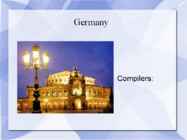
Frankfurt ● it is dedicated to homosexual people who were persecuted under Nazi rule ● The memorial is a statue of an angel and is the first of its kind in Germany. Freedom Memorial ● The Freedom Memorial was a memorial to the victims of the Berlin Wall in the vicinity of the Checkpoint Charlie Museum in Berlin. ● It opened on October 31, 2004, and was praised by both victims of the GDR communist regime and human rights advocates alike. The Tomb of Frederick the Great ● The Tomb of Frederick the Great was a subject to which Old Fritz, as he was popularly known, gave a great deal of thought. Frederick the Great died on August 17, 1786 in the armchair of his study in Sanssouci. ● He wished to be buried in a tomb next to his "Weinberghäuschen" and next to his favourite dogs.
Russia vs America. US first nuclear bomb everyday people their resources were given to armament etc. Very poor conditions for people. Soviet union put more effort into building more weapon etc. US put effort in building effective quality stuff · McCarthy era · 1950s period of political persecution. US senator Joe McCarthy: lots of people in the US have Soviet roots and sympathies ->fearful society (government might be communist etc ) 1940s and 50s US government began investigating federal workers and organizations McCarty caught popularity with his accusations (even though most didn't have any proof) he started a nationwide campaign to hunt down communists. Those who didn't like it or protected someone were marked as communist sympathisers People who had much influence in the media were suspected (writers, poets etc) End- a senate committee took action against McCarthy
Then moved to Salisbury and to work as a telphone operator-got married Both these marriages failed, she has not been married since... She moved to london with her youngest son. Other two sons she left with his father to south africa Published two novels under pseudonym- JANE SOMERS She have many awards- most important is the nobel prize, She was 87 then. Making the oldest winner of the literatur prize at the time of the award The communist theme- was writing radically on social issues ( the good terrorist- 1985) And when she left her family and moved to salisbury she joined Left Book Club , a group of Communists "who read everything, and who did not think it remarkable to read." ... and the sufi theme-which was explored in the Canopus in Argos sequence of science fiction ( sequence of five science fiction novels) But it was not popular,
American socialist Edward Bellamy writes Looking Backward, a utopian science- fiction novel depicting the United States in the year 2000; in Bellamy's world, all industry had been socialized, and wealth is equitably distributed. A Belgian woodcarver publishes the song L'Internationale, with lyrics written during the Paris Commune uprising: Arise, ye prisoners of starvation/ Arise, ye wretched of the earth.... The song is adopted by the Communist Party. Five London prostitutes die (they ate poisoned grapes and were then disemboweled). Jack the Ripper is blamed, but the killer is never caught; the rumor later circulates that Queen Victoria ordered the murders to distract attention from a scandal involving her son, Prince Albert. The Finnish epic Kalevala is published for the first time in the English Language by John Martin Crawford.
5. Conclusion 6. References Introduction- Russia Throughout the History Russia is a one of the biggest countries is the world. The first clues about Russian history are from as early as the 9th century. Russia has suffered through rough times in war, mad leaders and tough life amongst the locals. Over times the country has had several different names and political systems. They have been an empire ruled by a czar, a communist nation, and a democratic federation. Nowadays the country's official name is the Russian Federation ("Basic facts about,"). The head of the executive branch in Russia is the president who works with the prime minister. The legislative branch is the Bicameral Federal Assembly which consists of the Federation Council and State Duma. The Judicial branch consists of the Constitutional Court, Supreme Court, and the Superior Court of Arbitration ( M c C l e n a g h a n , 2 0 0 3 ) .
countries including the poor countries, lower prices of foods, drugs, clothes and shelter. Greater opportunities for skilled persons both locally and abroad and of course better understanding among the peoples of different countries. In spite of that the current rulers and dominators are not willing to agree with globalization, because they have their own vested interests, especially in socialist, communist and poor countries. Currently they don't have to compete with the efficient and skilled Word. They have arranged their own monopolies to make the best financial gains and most comfortable lives. With globalization they would have to work hard to maintain their income and they cannot exploit poor people as they will have better incomes and employment due to globalization and would not have to depend on politicians and governments. This behavior is
Another 14 electors from Mississippi and Alabama refused to support Kennedy because of his support for the civil rights movement; they voted for Senator Harry F. Byrd, Sr. of Virginia. Vietnam The extent of Kennedy's involvement in Vietnam remained classified until the release of the Pentagon Papers in 1971.In Southeast Asia, Kennedy followed Eisenhower's lead by using limited military action as early as 1961 to fight the Communist forces led by Ho Chi Minh. Proclaiming a fight against the spread of Communism, Kennedy enacted policies providing political, economic, and military support for the unstable French-installed South Vietnamese government, which included sending 16,000 military advisors and U.S. Special Forces to the area. Kennedy also authorized the use of free-fire zones, napalm, defoliants, and jet planes. U.S. involvement in the area escalated until Lyndon Johnson, his successor, directly deployed regular U.S
life for example Big Brother evokes to the cult of personality buillt up around Joseph Stalin, also Winston´s job „revising history“ is based on the Stalinist habit of airbrushing images of „fallen“ people from group photographs and removing references to them in books and newspapers. The thought police is based on the NKVD and the tortures of the Minstry of Love evoke the procedures used by the NKVD. Actually the statement „2+2=5“ that Winston had to beliece was a communist party slogan from the second five-year plan, in which they wanted to full five-year plan in four years. In my opinion it goeds together with nowadays- that people want to get more and faster, they do not have any patience and expect everything to happen very fast. In my opinion there were 3 main ideas which go very well together with nowadays society ideas, problems and fears. George Orwell wanted to show dangers of totalitarianism, but nowadays if a country limits people´s
MANDELA SAYS THEY KNEW ANC WOULD SOON BE BANNED EMPHASIS ON MULTI-RACIALISM INVITED 200 ORGANIZATIONS TO SEND REPRESENTATIVES FROM ALL RACE GROUPS ALL GROUPS ALSO ENCOURAGED TO SEND IN SUGGESTIONS FOR THE CHARTER AND THEY DID SEND IN IDEAS WRITTEN ON SCRAPS OF PAPER ETC 3000 DELEGATES TURNED UP CHARTER BECAME A REVOLUTIONARY DOCUMENT BECAUSE ITS BASIC DEMANDS ALTHOUGH SIMPLE, RADICALLY CHALLENGED THE APARTHEID STATE PARTIES The Pan Africanists were anti-communist opposed the multi-racialism of the Freedom Charter the PAC split from the ANC in 1959, led by Robert Sobukwe Banned in 1960 at the same time as the ANC Black Consciousness Movement Closely associated with Steve Biko Emerged out of the Students' Movement in the 1960s/70s Rejected the white liberal National Students' Association The apartheid state followed those in exile with spies and parcel bombs.
Hoffman: summer of 1990, summer of 1991) Á are undertaken at a particular time of Romanian (and Eastern European) history: the months that immediately followed the collapse of the communist regime(s). Before leaving their homes, the authors were exposed not only to detailed news on the political events from the global media but also to media-processed images, enveloping the country in a `tragic glamour' (Murphy, 1992, p. xv)
A second cause of the Civil War was the Czech Legion. These were some Czech prisoners of war being taken across Russia who in 1918 mutinied, took control of the Trans-Siberian Railway, and attacked towards Moscow. Finally, these groups within Russia were helped by the Great Powers, angry that Russia had dropped out of the First World War. They were afraid because the Bolsheviks believed in World Revolution, the Bolsheviks set up the Comintern, led by Zinoviev, which said it would cause communist revolutions all over the world. Consequently, the Allies sent armies to destroy the Bolsheviks, British, American and French armies attacked from Archangel, Ukraine, and Vladivostock. As an result Bolsheviks had their victory and a huge establishment of the Soviet Union. Also a lots of countries got their independence like Estonia, Finland, Latvia, Lithuania and Poland. Reason for Russian civil war in 1918 was basically the oppositional ideologies
19171991 Nõukogude Liidus toimunu ja tema poolt naaberriikides kordasaadetu on 20. sajandi üks suurimaid inimsusevastaseid kuritegusid, mis on kommunismi mainet väga tugevalt blameerinud kogu maailmas. 7 Sõna ajalugu Sõnad "kommunism" ja "kommunist" tulid kasutusele Prantsusmaal pärast 1830. aasta revolutsiooni. Tavakeelde jõudsid nad 1840ndatel. Aastal 1840 korraldati Pariisis esimene communist banquet. Terminit kasutati ka utoopilise sotsialisti Étienne Cabet' toetajate nimetamisel. Sõna 'kommunism' tuleb prantsuse keelest, kus seda võib tõlkida nii kommuun, omavalitsuslik küla ehk kogukond kui ka communauté, ühisomand. Hiljem marksistid kasutasid seda sõna nii, et selles sisaldusid mõlemad elemendid. Sõna 'kommunism' tuli kasutusele Inglismaal prantsuse kommunistidest maapagulaste kaudu ja sel oli võitluslik tähendus vastandina rahumeelsele
Good society needs three things. These things are: rudimentary democratic consent, universal access to human essentials and accessibility to other desirable items. If these aspects are not fulfilled; it is not a good society. In my opinion, good society is not the thing what suits for everybody, because if you will not agree with good society standards, you really are not the person who would be advantageous for this kind of society. Person who is not accepting these standards is communist and only fits in to the dictatorship supportive countries. For being appropriate member for food society you have to accept other people needs and at the same time sacrifice some of your own needs. Good society is not a paradise. Universal access to human essentials means that everyone have the rights to access elementary things for living, such as: air, water, food, protection from harsh weather (clothing and shelter), and safety from harm
Mexico: as economy developed did potential for democratic structures increase? South Africa: little apparent scope for change? Transitions theory 1. liberalization of authoritarian rule 2. civil society pushes the boundaries of change faster and farther 3. holding of fair elections of uncertain outcome. Elite vs mass West Germany 1950s mass element largely absent `guided' into democracy by Adenauer and economic success East Germany 1990 mass protests against communist rule undermine regime; when it crumbles no obstacle to unification `Wir sind das Volk' (we are the [East German] people becomes `Wir sind ein Volk' (we are one [united German] people) Mexico crises (economic, 1985 earthquake) brought gradual change. Ironically, pro-democratic electoral reform was greatest when ruling party (PRI) was strongest. PRI needed a credible opposition. Both bottom up and top down (though former was stronger). Pres Zedillo (1994-2000) accelerated reforms.
The new state along with its Baltic neighbors, Lithuania and Latvia enjoyed just two decades of independent statehood before the Soviet Union took control under the 1939 Nazi-Soviet Pact. Soviet ownership lasted barely 12 months before Estonia was conquered in the German invasion of the Soviet Union. It was retaken by the Red Army in 1944, after which Estonia was constituted as one of the 15 Soviet Socialist Republics. Four decades passed until Mikhail Gorbachev who, as Communist Party General Secretary, offered the prospect of change for the Baltic States. A key part of the perestroika (economic reform) program was the devolution of power to the republics. Estonia led the way among the Baltic States, assisted by the collaboration between nationalist groups and the Communist Party, who joined together in a People's Front (analogous bodies emerged in Latvia and Lithuania) to orchestrate change. Having asserted the right to make their own legislation, measures to
Lisaks sellele, tegin lahti Tartu Ülikooli õppejõu nimekirja ja vaatasin, kes on rahvusvahelise õiguse õppejõuks. Valituks osutusid 6 inimest: Rene Värk, Lauri Mälksoo, Elizabeth Teodora Kasa Mälksoo, Lehte Leesik, Katre Luhamaa ja Merilin Kiviorg. HeinOnline süsteemi „Full text“ alla panin otsingusse: „Õppejõu täisnimi + mass deportation“. Siis, kui panin otsingusse just „Lauri Malksoo maas deportation“, sain artikli üles leida: „Soviet Genocide? Communist Mass Deportations in the Baltic States and International Law“. Peale seda vajutasin artikli nimetusele ja sain täisteksti. Täistektsi link: https://heinonline-org.ezproxy.utlib.ut.ee/HOL/Page? collection=journals&handle=hein.journals/lejint14&id=766&men_tab=srchresults 2) Leida ühe saksa õigusteadlase saksakeelne artikkel ratsionaalsest õiguspoliitikast, milles ta viitab tema enda töödele 13 korda (viidete loendis artikli lõpus).
Võidupüha or Victory Day is a public holiday in Estonia, which has been celebrated on 23 June every year since 1934. The date recalls the victory in the 1919 Battle of Võnnu (near Csis, Latvia) of the Estonian military forces and their allies over German forces (Baltische Landeswehr) who sought to re-assert Baltic-German control over the region. The battle was part of the 1918-1920 Estonian War of Independence, where the main adversary of the newly independent Estonia was Communist Russia. Today, Võidupüha also marks the contributions of all Estonian nations in their fight to regain and retain their independence. Estonian celebration of June 23 is ceremonially tied to the following Midsummer Day celebrations on June 24. According to Estonian laws, the state flags are not to be lowered during the night between the days. Christmas Eve December 24 Christmas Eve is the evening or entire day before Christmas Day, the widely
Health Care Systems. In Saltman, R.B., Figueras, J. & Sakellarides(eds.), Critical Challenges for Health Care Reform in Europe. Buckingham & Philadelphia: Open University Press. 1998, lk.339-361. Lauristin, M. Estonia is Looking for its Own Welfare Model. In Pieters, D. (ed.), Social Protection of the Next Generation in Europe. London-Hague-Boston: Kluwer Law International. 1998, lk.277-289. Lauristin, M. Transformations of Public Sphere and Changing Role of the Media in Post- Communist Society. In Sztompka, P. (ed.). Building Open Society and Perspectives of Sociology in East-Central Europe. Pre-Congress Volumes of the 14th World Congress of Sociology. Montreal: International Sociological Association, 1998, lk. 117-129. Lauristin, M. & Vihalemm, P. with Rosengren, K.E. & Weibull, L. (toim), Return to the Western World: Cultural and Political Perspectives on Estonian Post-Communist Transition. Tartu: Tartu University Press. 1997, 390 lk. Lauristin, M., Vihalemm, P. (toim)
exist. On its ruins the formerly enchained nations founded their own states. Among them was the Estonian Republic, officially declared on February 24, 1918. When Germany surrendered to the Western Allies on November 11, 1918 a strategic vacuum arose in Eastern Europe. The new rulers of Russia the Bolsheviks decided to use it as a proper moment to re-conquer their lost territories. The ultimate goal was international communist revolution and Germany was the first standing on their way. Thus on November 13, 1918 the Government of Soviet Russia denounced peace with Germany. On November 16 the Commander-in-Chief of the Red Army, Jukums Vacietis, gave orders to start a massive attack on a long front from the Gulf of Finland to the Ukraine. On November 28, two divisions of the Red Army (altogether 12,000 troops) crossed the Estonian border. The War of Independence had begun.
France" International Journal of Integrated Care, 10, 1-9. Dobusch, L. & Kapeller, J. (2013) ,,Breaking New Paths: Theory and Method in Path Dependence Research" Schmalenbach Business Review, 65, 288-311. Kuuse, E. (2010) Arengukoostöö adressaatidest doonoriteks: mõjurid ja loogika Eesti, Läti, Leedu päästeametite näitel. Kättesaadav: http://www.terveilm.ee/leht/wp- content/uploads/2012/12/thesis_Kuuse.pdf, 23. oktoober 2013 Sarapuu, K. (2011) ,,Post-Communist Development of Administrative Structure in Estonia: From Fragmentation to Segmentation." Transylvanian Review of Administrative Sciences, 35(4), 54-73. Kättesaadav: http://rtsa.ro/en/files/TRAS-35E-SI-5- SARAPUU.pdf, 23. oktoober 2013 Peters, B. G. (2005) ,,Institutional theory in political science" Continuum, 25-46. Lowndes, V. (2002) ,,Institutionalism" Marsh, D., Stoker, G. (toim.) In Theory and Methods in Political Science. Palgrave Macmillan, 90-108.
His best known work is perhaps Hõbevalge, which translates into Silver White and was published in 1976. It reconstructs the history of Estonia and the Baltic Sea region. Lennart Meri as a politician In 1988, Meri became a founding member of the Estonian Popular Front, which cooperated with its counterparts in Latvia and Lithuania. During the ,,Augustputs", he was in Finland and he worked as hard as possible for the recognition of the Republic of Estonia. After the first non-communist-style multi-party election in 1990, Meri was appointed to the post of Foreign Minister. As Minister of Foreign Affairs, Lennart Meri's first task was to create the Ministry of Foreign Affairs. His goal was to establish an open communication channel to the West, and at the same time to represent Estonia more widely on the international scene. In 1992, Lennart Meri left his post as Minister of Foreign Affairs, and was the Estonian Ambassador to Finland for a short period of time
was published in 1976. It reconstructs the history of Estonia and the Baltic Sea region. Lennart Meri as a politician In 1988, Meri became a founding member of the Estonian Popular Front, which cooperated with its counterparts in Latvia and Lithuania. During the „Augustputš“, he was in Finland and he worked as hard as possible for the recognition of the Republic of Estonia. After the first non-communist-style multi-party election in 1990, Meri was appointed to the post of Foreign Minister. As Minister of Foreign Affairs, Lennart Meri’s first task was to create the Ministry of Foreign Affairs. His goal was to establish an open communication channel to the West, and at the same time to represent Estonia more widely on the international scene. In 1992, Lennart Meri left his post as Minister of Foreign Affairs, and was for a short period of time the Estonian Ambassador to Finland
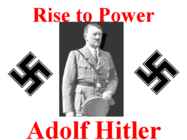
revolution and book to seize power legally • Spoke to mass audiences about making Germany a great nation again • Nazi Party: – 1930 = 18% of vote – 1932 = 30% of vote – Hitler becomes Chancellor in 1933 Appeal of Hitler • Germany was in the midst of an economic depression with hyper-inflation • Hitler was a WW I hero who talked about bringing glory back to the “Fatherland” • He promised the rich industrialists that he would end any communist threat in Germany • Constantly blamed Jews for Germany’s problems, not the German people. • Hitler was an excellent public speaker. Strong Arm Tactics • The “Brownshirts” or SA (Stormtroopers) • SA was used to put down opposition parties • Threatened and beat up Jews and ant-Nazi voters • Wore brownshirts, pants and boots • Numbered almost 400,000 by 1932 Dictator • “Reichstag fire” gives Hitler total power • In 1933, all parties
subordinate to the Chinese empire of the Qing Dynasty. The 13th Dalai Lama proclaimed Tibet independent in 1913, but this declaration was not accepted by China. Furthermore, Tibet was not recognized by any country as a de jure independent nation. As a measure of the power that regents must have wielded, it is important to note that only three of the fourteen Dalai Lamas have actually ruled Tibet; regents ruled during 77 percent of the period from 1751 until 1960.The Communist Party of China gained control of central and western Tibet after a decisive military victory at Chamdo in 1950. The 14th Dalai Lama fled to India in 1959. Today, Tibet is part of the People's Republic of China (PRC) in reality and claimed by the Republic of China (ROC) in its constitution , while a small part, according to the PRC and the ROC, is controlled by India. Both sides of Chinese government regard Tibet as part of China.
Somerset Maugham CHARACTERS: • Captain Bartlett – pilot, bald, alcoholic, queer fish • Captain Cook – discovered the Thursday Island on a Thursday. • Woman – a red flannel dressing-gown; holding a paraffin lamp; hair - a little bit over her shoulders, long black wisps, a little stoutish, keen eyes, a red nose. • French Joe aka Josep de Paoli – 93Y, Corsican, a lietutenant of artillery, French army in 1851, later communist, started new life many times, black shining eyes, really thin and old. • Boswell Johnson – really famous author, the ancestor of Joe. • Napoleon Bonaparte – a relative of French Joe, lietutenant of artillery • Russians + Prussians – Joe fougth against them in French army • Hospital Nurse PLACES: • Thursday Island in Torres Straits – where he went + Joe's final destination • Sydney – where he came from
? 47. What is the cause of alienation? The cause of this alienation is found in the economic structures that uphold society, and more specifically in the relations of production,which historically have been based on private property. 48. What should be the goal of Marxist revolution? To eliminate the causes of alienation in the hopes of creating the new man, redeemed from socioeconomic injustices. 49. Who said the phrase: “religion is the opium of the people”? Karl Marx 50. What is the communist paradise? To establish a society without classes, no private possessions and where everyone is equal.
within the Union. Membership presupposes the candidate's ability to take on the obligations of membership including adherence to the aims of political, economic and monetary union. Though the newly enforced Lisbon Treaty does not explicitly quote these criteria it makes a reference to those in the article 49 TEU: "the conditions of eligibility agreed upon by the European Council shall be taken into account". Bearing in mind the traditional lack of democratic principles in post-communist and post-soviet states, the political criteria of a functioning democracy, rule of law, and protection of human and minority rights met the strongest obstacles in the Central Eastern European countries and are currently the most problematic areas in the ENP countries. On the other hand after the dismay of planned economies, the requirement for a free market was relatively easier to meet despite some hardships in change of management styles and ownership in the process of transferring to free
Industrialism (the changes in the making of goods that resulted from substituing machines for hand labor) new kind of working class, wages extremely low, hours very long(14 a day) sufferers were women and children, families horribly crowded(unsanitary housing) severe economic depression in the early 1840s. Writers who speak about industrialism and its effects: Elizabet Barrett Browning(The Cry of the Chuldren), Friendrich Engels(The Condition of the Working Class), Karl Marx(The Communist Manifesto 1848), Elizabeth Gaskell(Mary Barton), Charles Dickens, Thomas Hardy, William Makepeace Thackeray. ``The Woman Question" women wanted more rights, the role of women changed, women did efforts to move beyond the home, women forced into new kinds of labour, Jane Eyre tyoe of women versus feminists(two types). Representatives: The Brontë sisters Emily, Anne, Charlotte, George Elliot.
Rahva elatustase võib langeda kuni näljahädade ja massilise suremuseni. Välispoliitika on reeglina endassetõmbunud, usaldamatu ja agressiivne. Mittekommunistlikke riike peetakse vaenlasteks. Sageli ei usaldata ka teisi kommunistlikke riike. Kommunism Sõna "kommunism" tulid kasutusele Prantsusmaal pärast 1830. aasta revolutsiooni. Tavakeelde jõudsid nad 1840ndatel. Aastal 1840 korraldati Pariisis esimene communist banquet. Terminit kasutati ka utoopilise sotsialisti Etienne Cabet' toetajate nimetamisel. Sõna 'kommunism' tuleb prantsuse keelest, kus seda võib tõlkida nii kommuun, omavalitsuslik küla ehk kogukond kui ka communauté, ühisomand. Hiljem marksistid kasutasid seda sõna nii, et selles sisaldusid mõlemad elemendid. Sõna 'kommunism' tuli kasutusele Inglismaal prantsuse kommunistidest maapagulaste kaudu ja sel oli võitluslik tähendus vastandina rahumeelsele mõistele 'sotsialism'
/.../ Either Fascism or Communism emerges victorious; if it be the latter, the story of Britain is told.") "Meie vaenlased on eelkõige praeguse parlamentaristliku süsteemi Vanad Olijad. Kui nende võim püsib edasi, saab meie homseks põhivaenlaseks Kommunistlik Partei. Vanad Olijad on katastroofi kujundajad, kommunistid on vaid selle elluviijad." ("The enemy today is the Old Gang of present parliamentarism. The enemy of tomorrow, if their rule persists much longer, will be the Communist Party. The Old Gang are the architects of disaster, the Communists only its executors.") Toodud tsitaadid tõestavad ilmekalt B.F.U. tegevuse uuenduslikku, kui mitte revolutsioonilist iseloomu, ning liikumise ideede üsna ühest vastavust fasismi peamistele kriteeriumitele. British Union of Fascist langus 1930. aastate keskel Suurbritannia majanduse jaluletõstmisel 1930. aastate keskel osutus võtmefiguuriks rahandusminister Neville Chamberlain. Lõuna-Inglismaal
of Iraq by the U.S. During the writing I am also going to find out how are the diplomatic relations between them nowadays. History Pre-1980s In 1963, the United States backed a coup against the government of Iraq headed by General Abdul Karim Qassim, who five years earlier had deposed the Western-allied Iraqi monarchy. The US was concerned about the growing influence of Communist Iraqi government officials under his administration, as well as his threats to invade Kuwait, which almost caused a war between Iraq and England. Former CIA Near East Division Chief James Chritchfield maintains that the CIA played no direct role in the 1963 coup, but that it viewed the Ba'ath Party favorably and offered support after they had taken over. In 1966 Salam Arif, the leader of the new Ba'athist government, died and
Eesti Ameerika Postimees (published in NY until 1911) · 1898 founded an Estonian Lutheran congregation in NY (still exists today) 2. Signficant waves of migration from Estonia to the US in the 20th century, their reasons. *The failure of the 1905 Revolution: The first significant wave of immigration · Brought a strong Socialist contingent to the United States; led to the formation of many Estonian American Socialist and Communist organizations. * The 1920s30s: · Establishment of independent Estonia · Tightening of American immigration laws · Estonian immigration to the United States slowed down dramatically 1924 The Estonian quota fixed at 116; even this small annual quota was not used up *After World War II = In the post World War II years, all three Baltic nations maintained consulates in the United States · About 15,000 Estonians came to the United States
most of them conducted by Raimund Kull (1882-1942). The Vanemuine Theatre orchestra was similarly quite actively engaged under the baton of Juhan Aavik (1884- 1982) and Juhan Simm (1885-1959) In literature and art we can observe numerous individual innovations, in symphonic music such qualities were still rare. The beginnings of using new ideas can be noticed in the smaller symphonic works of Artur Kapp and Heino Eller. Kapp, in response to the communist terror he witnessed in Astrakhan, composed the symphonic prelude Hauad (Tombs, 1917). The tone poems Videvik (Twilight, 1917) and Koit (Dawn, 1920) by Eller are gripping, expressive pictures inspired by Nature. In 1913 Rudolf Tobias wrote strikingly and prophetically: Still we cannot speak of a wholly developed typical Estonian image. This is hindered by a number of factors… our own national psyche expresses itself from a leaden grey stormy sky to
Most of the pre-war filmmakers and producers fled??. Lack of film stck due to important embargos. Soviet cinema after the october revolution: 1919 the first film school: bring the cinema to the countryside. Agit trains-theatergroup performing a pie ce of communism. New generation of filmmakers start to create avant-grade: verto, kuleshov, pudovkin dovzheno, eisenstein The age of soviet montage cinema: the classical perion 1920s. The idea behind montage cinema: · promotion of communist ideals via the means of film · editing is the tool to achieve new expression, a new cinematic language · two tendencis: eisenstein: reproduction of historiccal events in feature films. · Vertov: radical realism, only documentary films, feature films are ,,impotent" The kuleshov workshop Lev kuleshov was one of the few pre-revolutionary filmmakers who stayed in russia Gave a workshop at the VGIK that turned out to be influential for Soviet Cinema
existing parties and gathered a majority of the leading politicians into a new pro-Kremlin party called United Russia. While most of world's contemporary parties have been established by the politicians who seek either politics or public office, United Russia, as well as its predecessors were created by top politicians with the intention to maximize their already existing power and control over country's politics. Therefore, unlike in many other post- communist countries, Russia's party politics in the 2000s with its decline in party fragmentation has not led to the strengthening of democratic party competition. Instead, after the 2007 State Duma elections, it was clear that United Russia had turned into a "party of power" without any considerable opponent in the competition. That is to say, although the overall party system in Russia has remained fragile, within this fragile party system stands one considerably powerful party.
virtually annihilated by the Nazis during the Holocaust.There were approximately 4,000 Jews in the Czech Republic in 2005. The Czech prime minister, Jan Fischer, is of Jewish origin and faith. The fertility rate is a low 1.50 children per woman. Immigration increased the population by almost 1% in 2007. About 77,000 new foreigners settle down in the Czech Republic every year. Vietnamese immigrants began settling in the Czech Republic during the Communist period, when they were invited as guest workers by the Czechoslovak government. Today, there are an estimated 70,000 Vietnamese in the Czech Republic. In contrast to Ukrainians, Vietnamese come to the Czech Republic to live permanently. At the turn of the 20th century, Chicago was the city with the third largest Czech population, after Prague and Vienna. According to the 2006 US census, there are 1,637,218 Americans of full or partial Czech descent.
Although Estonian GDP returned to positive growth in 2010, unemployment continued to rise, reaching an alltime high of 19.8% in early 2010 (Central Intelligence Agency, 2012, ISSN 15538133). 2.3 Hungary 2.3.1 Background Hungary became a Christian kingdom in A.D. 1000 and for many centuries served as a bulwark against Ottoman Turkish expansion in Europe. The kingdom eventually became part of the polyglot AustroHungarian Empire, which collapsed during World War I. The country fell under Communist rule following World War II. In 1956, a revolt and an announced withdrawal from the Warsaw Pact were met with a massive military intervention by Moscow. Under the leadership of Janos KADAR in 1968, Hungary began liberalizing its economy, introducing socalled "Goulash Communism." Hungary held its first multiparty elections in 1990 and initiated a free market economy. It joined NATO in 1999 and the EU five years later. In 2011, Hungary assumed the six
been achieved before the Carnation Revolution, during the last decade of the previous regime. He initiated the process of accession to the European Economic Community (EEC) by starting accession negotiations as early as 1977. The country bounced between socialism and adherence to the neoliberal model. Land reform and nationalizations were enforced; the Portuguese Constitution (approved in 1976) was rewritten in order to accommodate socialist and communist principles. Until the constitutional revisions of 1982 and 1989, the constitution was a highly charged ideological document with numerous references to socialism, the rights of workers, and the desirability of a socialist economy. Portugal's economic situation after its transition to democracy, obliged the government to pursue International Monetary Fund (IMF)-monitored stabilization programs in 197778 and 198385. EUROPEAN INTEGRATION
enthusiasm for such contrasts resulted in such works as The Tree in the Ladder of 1943-44, and Romantic Landscape of 1946. A major work of 1944, Three Musicians (Museum of Modern Art, New York), reprises a composition of 1930. A folk-like composition reminiscent of Rousseau, it exploits the law of contrasts in its realistic juxtaposition of the three men and their instruments. Stained-glass window at the Central University of Venezuela, c.1950s Upon his return to France in 1945, he joined the Communist Party. During this period his work became less abstract, and he produced many monumental figure compositions depicting scenes of popular life featuring acrobats, builders, divers, and country outings. Charlotta Kotik has pointed out that Leger's "determination to depict the common man, as well as to create for him, was a result of socialist theories widespread among the avant-garde both before and after World War II. However, Léger's social conscience was not that of a fierce
Võib jääda mulje, et käesolev töö püüab ära teha seda, mida on loendamatud kirikute komisjonid, töörühmad ja nõukogud püüdnud teha juba aastakümneid - see on küsimus luterliku kiriku olukorrast ja 16 Vt Pollack, Detlef (ed). The social significance of religion in the enlarged Europe: secularization, individualization and pluralization. Farnham, Burlington, Ashgate, 2012 või Borowik, Irena, Tomka, Miklós (eds.) Religion and social change in post-communist Europe. Krakow, Nomos, 2001. Davie, Grace. The sociology of religion. Los Angeles, Sage, 2007; Barker, Eileen (ed) The Centrality of Religion in Social Life, 2008. identiteedist, aga eelkõige tulevikust. Mida üks monograafia suudab sellele kõigele juurde anda? Kas sellel on midagi pakkuda kiriku jaoks? Kas on veel midagi öelda, mida juba öeldud pole? Käesolev monograafia püüab kõik need laialivalguvad arutelud omakorda kokku võtta, olles sedasi vahekokkuvõtteks
IL just removed nationality from internal passports. DK party archives, municipal archives propiski, what's approved, what's denied. Tsvi's presentation was the USSR an anti-Semitic regime? Complexity. Not the same as 1881. Suffered along w many other nationalities in USSR. Arbitrariness, repression, etc. Govt saw some things as threat. Gitelman never a regime that tried to combat anti-Semitism more than early Bolsheviks. Antisemitism at odds w Communist ideals. Tried to distance self from tsarist regime. Lenin 1919, not Js who are enemy of working people, but capitalists. Among Js and Rs, kulaks and others. Stalin, '31. J schools and synagogues shut down. Trying to eliminate organized religion. Cohesion to distinctive entity. Catholicism most bitter enemy of SU, Bolshaya Sovietskaya Entsiklopedia. Stalin more anti-Semitic in 30s. Zinoviev, Kamenev, Trotsky all Js. Purges, affected all people, as did deportations at start of WWII. Gauge
23 June Victory Day Võidupüha or Victory Day is a public holiday in Estonia, which has been celebrated on 23 June every year since 1934. The date recalls the victory in the 1919 Battle of Wenden (near Csis, Latvia) of the Estonian military forces and their allies over German forces who sought to reassert BalticGerman control over the region. The battle was part of the 19181920 Estonian War of Independence, where the main adversary of the newly independent Estonia was the Communist Russia. Today, Võidupüha also marks the contributions of all Estonians in their fight to regain and retain their independence.
Ülemised kaelanärvid annavad kiude n hypoglossusele, mis edaspidi eralduvad sellest omaette harudena. Harud. Hüpoglossusekiududeta harud (mood kaelanärvide arvel) 1. Ramus meningeus dura materile. Pisike haru, mis suubub ülespoole. 2. Radix superior (C1-2-st) kaela eesmise rühma lihased: A) M. sternohyoideus, m. omohyoideus (seda innerveerivad 2 haru), m. sternothyroideus radix superior laskub mööda a. carotis communist alla, ühineb C2-3-st lähtuva radix inferioriga, moodustub kaelasilmus ansa cervicalis, mille harud (4 tk) innerveerivad neid lihaseid. B) M. thyrohyoideus saab XII närvilt otsese haru 3. Ramus geniohyoideus m. geniohyoideusele 4 Hüpoglossusekiududega harud e tõelised hüpoglossuseharud (pärinevad hüpoglossuse tuumast): 1. Rami linguales innerveerivad motoorselt keele lihaseid: m. genioglossus, m
–or – doctor, solicitor, governor, tremor, bachellor, manor, mirror, –eer – mutineer, profiteer, mountaineer –ier – collier, cashier, lawyer –ant – pendant, deodorant, assistant –ent – president, superintendent, student –ee – lessee, employee, refugee, escapee, devotee, absentee –ist – Marxist, communist, idealist, economist, perfectionist, racist, Buddhist o To form words of feminine gender -en – vixen -ess – princess, actress, seamstress, goddess, lioness, wife of ambassadress, mayoress, -ine – heroine, o Diminuatives -y - nicknames shorty, Johnny, Mummy, doggy -ie – birdie, doggie or independent formations – bookie, movie
One might try arguing that "Hooray!" really means, "I hereby cheer"; Lewis (1970: 57 8) proposed to understand "Hooray for Porky" as "I cheer Porky." Perhaps "Shame!" means "I hereby castigate you" and "Damn!" means "I hereby curse." But these hypotheses are not obviously correct. Austin grew far more deeply dissatisfied with the performative/constative distinction when he noticed another type of sentence. Consider: (8) I state that I have never traveled to a Communist country. (8) passes the "hereby" test, and so should be counted as performative. When I say it, I thereby do perform a certain speech act: an act of stating. But it is also indelibly fact-stating, descriptive. Indeed--whether or not the speaker has in fact ever traveled to a Communist country--that is its whole point; the operative verb is "state." The speaker's statement is true or false. If (8) is uttered under oath and the speaker has traveled to a Communist country, the
The attempts failed. In May 1918, Great Britain, France and Italy recognised the independence of Estonia de facto. On the basis of the Brest-Litovsk Peace Treaty's supplementary Berlin Treaty of 27 August 1918, Soviet Russia renounced its state sovereignty over Estonia. With the collapse of the German occupying regime, the Estonian Provisional Government started work on 19 November 1918. On the pretext of supporting the local bolsheviks, the Soviet Russian army, having tried to establish communist power within the tsarist empire, marched into Estonia on 28 November. The Estonian War of Independence broke out. On 29 November, the Estonian bolsheviks declared regional local government in Narva under the name of the Estonian Workers' Commune. By early January 1919, the Red Army had conquered two-thirds of Estonia. The Estonian national forces, having started their 16 | P a g e
rahuldamiseks, kogu maailma kasutamine loovalt. 8. Millisena näevad tarbijat ja tarbimisühiskonda Frankfurti koolkond? Mis probleeme tõstatab sellest tulenevalt Herbert Marcuse? The Frankfurt School gathered together dissident Marxists, severe critics of capitalism who believed that some of Marx's followers had come to parrot a narrow selection of Marx's ideas, usually in defense of orthodox Communist or Social-Democratic parties. Influenced especially by the failure of working-class revolutions in Western Europe after World War I and by the rise of Nazism in an economically and technologically advanced nation (Germany), they took up the task of choosing what parts of Marx's thought might serve to clarify social conditions that Marx himself had never seen. Herbert Marcuse- Kuna ühiskond on Marcuse arvates (ja teiste arvates) inimeste loodud, tuleb sellesse
 annaabi.ee