Leidsid 33 sarnast õppematerjali, mis on seotud failiga "The Vikings". Need materjalid aitavad sul teemat sügavamalt mõista.
viking, vikings, ship, knarr, crafts, wood, settled, wide, europe, other, ships, narrow, shallow, speed, than, cargo, battle, status, sword, sign, metal, meals, pirates, raided, explored, areas, asia, north, atlantic, islands, late, century, came, denmark, norway, sweden, during, period, left, such, britain, ireland, went, fight, steal, treasure, otherstraditions of governance. In the mid-5th cent, Vertigern, a British leader, hired Germanic mercenaries to help defend against peoples of the north (Picts & Scots). In the end they revolted & the process of invasion and settlement began. The first Saxon ,,kings" were Hengist & Horsa in Kent, Aelle in Sussex, Cerdic / Cynric in Wessex. So the first ,,English" became mainly from Northern Germany & Denmark. The resistance of the Celts was long. They were free at the time, not like other Roman provinces on the Continent. Around 500, the Britons seem to have won several victories. One of their leaders was Ambrosius Aurelianus and one of their victories was at the place called Mount Badon. The main leader of the Britons at this time may have been the warrior later called King Arthur. By the 7th cent. the invaders managed to conquer the greater part of the land. The invaders came from 3 powerful tribes:
the rise and fall of the British Empire. The units contain an informative reading text on an important issue, preceded by preparatory discussion questions and followed by notes offering some additional information, and a vocabulary with relevant language notes. The main reading text is accompanied by comprehension, vocabulary and grammar exercises and discussion activities. Some of the units include reading passages. The book is intended for university and school students as well as other English learners wishing to acquire more knowledge about the country whose tongue became the world’s leading language, and which is considered as the Mother of Parliaments. 7 UNIT 1 THE ISLAND Pre-reading questions What is the name of the island group Britain belongs to? Where is it situated? What seas surround it? What kind of climate do you think Britain has? What is its surface like?
western Scotland, until 10 c Mysteriously disappeared Constantly fought with Romans Teir country- Caledonia- Pictland The Scots, Hibernia Raiders, Celts living in Ireland/Hibernia Migrated to Scotland Raided Roman Britain After Kenneth McAlpin united Scotland all inhabitants became Scots The Venerable Bede A monk in the Northumbrian monastery of Jarrow In 731 ,,The Great Ecclesiastical History of the English People"- overshaows all other sources of 7th, early 8th C Well-founded scraps of tradition, first work of history, where AD system is used Angles, Saxons, Jutes. Frisians 430´s onwards, Germans settlers arrived in large numbers. Anglo-Saxon invasions in 499 The Saxons- Saxon country to South and West The Angles- Angulus to East Anglia, Jutes in Kent Same culture as southern Scandinavia, Germany, northern France 600 they had founded their 7 kingdoms The Anglo-Saxon kingdoms
the Roman empire. Hadrian's Wall was built, beginning in 122, to keep Roman Britain safe from hostile attacks from the Picts. The wall stretched from the North Sea to the Irish Sea. In addition to the wall, the Romans built a system of small forts called milecastles. Sixteen larger forts holding from 500 to 1000 troops were built into the wall, with large gates on the north face. To the south of the wall the Romans dug a wide ditch with high earth banks. *The Picts, Caledonia The Romans called Scotland 'Caledonia' because the dominant tribe of Picts they encountered was the Calidonii. Romans thought they were barbarian savages, but actually they had an advanced, cultured society. There was no slavery amongst them and women for instance had a higher standing than in Roman society. The Picts fought the Romans. The Picts- ,,The Painted Ones"- spoke Pict-Celtic.
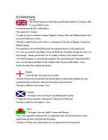
Northern Ireland * the population is about 60,000,000 people, the population density is 242 people/sq km * its coasts are washed by the Atlantic Ocean, the North Sea, the English Channel, the Celtic Sea, Saint George's Channel, and the Irish Sea. It is linked to France by the Channel Tunnel * the United Kingdom is a constitutional monarchy. The current monarch is Queen Elizabeth II, who is also the Queen and Head of State of fifteen other Commonwealth Realms, such as Canada, Australia, New Zealand and Jamaica. England: * it has 50 cities, the capital city is London * despite of the density of population and the high degree of urbanisation, England has many unspoilt rural and coastal areas which have been placed under protection * the flag is called the Saint George's Cross Scotland: * the biggest cities are Glasgow and Edinburgh (the capital)
1. Ancient Britain: the Celtic tribes. 2000 years ago there was an Iron Age Celtic culture throughout the Br Isles. It seems that the Celts, who had been arriving from Europe from the 8th cent BC onward, intermingled with the peoples who were already there. The Celts were extremely talented people, creative and artistic. More than 1 Celtic tribe invaded Br. The descendants of ancient Celts live in Wales, Scotland, Cornwall and Ireland. They lived in primitive society. Druids priests, more powerful than chiefs. Acted like prophets. 2. Stonehenge From prehistoric period. Was built on Salisbury plain between 2500 and 1500 bc. One of the most
During the archeological excavations in 1954 the Roman Temple of Mithras was revealed. It was a pagan temple dedicated to the Persian Sun-god. The Temple was later reconstructed only a short way from its original site and the relics are displayed in the Museum of London in the Barbican. At the end of the fourth century AD the Roman Empire began to crumble and the Roman armies were recalled from Britain to defend Rome itself. Once they had left Anglo-Saxons invaded and settled in Britain. They were farming people who preffered to live outside towns. For a while London probably lay in ruins, but it eventually developed again, partly because of its position on the river was good for trading. The Tower of London There is more of London's history in the Tower than anywhere else in London. It is the oldest surviving building in the capital. The Tower of London was begun by William the Conqueror in 1078 as a castle and a palace but even before the site
Friday, Thor Thursday, Angle-land England. The Anglo-Saxons divided the cuntry into small warring kingdoms Northumbria, Mercia, Wessex, Sussex, Essex, Kent, East Anglia. Due to constant conflict weakened the kingdoms. The political power was in Wessex, which was the most powerful of the kingdoms. The Anglo-Saxons were farmers and fishermen and lived in small communities. They deployed a crop rotation over three fields; used heavy ploughs. In 787 AD came the Vikings from Scandinavia, who set up their own state Danelaw. Had their own religion, however their rituals did not demand sacrifices. Introduced new words (1800). Placenames withe suffixes -by and -dale. They had their own customs and laws, which we know due to sagas (oral history). They had no written language. Beowulf Beowulf is an epic or a long poem describing the adventures of an hero. It belongs to the
Native Americans. ¤ over 500 nations/tribes ¤ closeness to nature ¤ europeans came for the free land ¤ less civilized ¤ they lived in teepee's ¤ they hunted buffalos for food, clothing BERENGIA- Land Bridge connecting Asia (Siberia) to Alaska 1500 km wide North to South 65 000 B.P (before the present) rised out of the sea to 40 000 B.P a wave when people came from west. 36 000-32 000 B.P arrived people CHEROKEE. Southeast U.S- their heartland, not on the ocean. Lanuage + customs + weapons-> related to IROQUIS family of nations (Iroquis lived around Great Lakes) 1300 A.D. established in South East U.S Classical Cherokee Civilization 16th-19th centuries MATERINEAL-(,,mother line") women controlled home, family, children,
London. All of them were at one time independent kingdoms with their own monarch. Now they are all part of the same kingdom and share the same monarch. The UK consists of Northern Ireland, Scotland, England and Wales. The peoples of these countries are British subjects; they hold British passports and therefore their nationality is British. The british Isles is the geographical name for all the islands off the west coast of Europe. These islands also include The Republic of Ireland, which is politically independent of the Britsh government. Many people refer to the inhabitants of the British isles as 'the English', but England is only one of the countries. The other countries are Scotland, Wales and Northern Ireland. Great britan is the name of the one island which is made up of Scotland, England and Wales. It is calles Great because in some languages the word for Britain is the same as the
to sell Alaska. The purchase of Alaska for $7.2 million ended Imperial Russia's colonial presence in the Americas. The Russian's legacy in Alaska (1784) can be seen in various forms. The introduction of new tools and technology helped with everyday tasks, and introduced new ideas to adopt. The use of larger farm animals can be beneficial in pulling larger sleighs and wagons, in comparison to the use of dogs. Iron and other metals brought to Alaska were prized for trading and making tools. Russia left a footprint in Alaska by establishing its first library and museums, as well as introducing Russian Orthodoxy to the locals(Alaska natives) (Russian Orthodox Church in Ninilchik, Alaska and also Chapel in Fort Ross, California). Some of the religious books were further translated into native languages. However, the Russians did great damage to the local environment by depleting the sea otter population. 4
Tallinn English College Topic Great Britain 2007 1. Introduction The official name of Great Britain is `the United Kingdom of Great Britain and Northern Ireland (or short United Kingdom)' The population is about 60.4 million. The capital is London. Other biggest cities include Birmingham, Bristol, Portsmouth, Glasgow and Swansea. English is the main language of Great Britain, but Welsh is officially recognized in Wales and Gaelic in Scotland. 2. Geographical position The British Isles is the geographical term for a group of about 5000 islands off the coast of mainland Europe. The largest island is Great Britain, which is also the largest island in Europe. It consists of England, Wales and Scotland. The next largest island is
1. The Queen’s official title. Elizabeth the Second, by the Grace of God, of the United Kingdom of Great Britain and Northern Ireland and of Her other Realms and Territories Queen, Head of the Commonwealth, Defender of the Faith. 2. The Queen’s working day. Starts after breakfast. Reads the newspapers which are prepared by the Press Secretary, and a report on the previous day’s proceedings in the Parliament and the letters she receives. Also phone calls. Once a month she attends the Privy Council in order to give Royal Assent to various items of government legislation.
B.C., but there was a rebellion in Gaul so they had to leave to fight against it. Next time they came in 43 A.D. and their leader was Emperor Claudius. Romans brought a lot with them. Their brought paved roads, the sites of important cities, the seeds of Christianity, the Roman law, Roman baths, language and advanced civilization. They also built Hadrian's Wall in 122 A.D. Romans occupied Britain for four centuries. The Roman way of life all vanished after the invasions from Northern Europe by the Angles, Saxons and Jutes from the 5th century onwards. They ruined Londinium, but they were easily turned into Christianity and religion became more and more important. The Vikings, who came in the 9th century, first raided England to plunder it, but then they decided to stay. In the 10th century England fell under Danish Rule, with King Canute finally managing to unite the Anglo-Saxons and Danes at the beginning of 11th century. Medieval England
ideal crossing point, they built London Bridge. Less than 20 years later the native Iceni tribe, led by Queen Boudicca, rose up against the Romans in revenge for mistreatment and burnt Londinium to the ground. The well disciplined Roman army defeated her forces and Londinium was rebuilt. By AD 100 it had also become the capital of the Roman province. A massive wall was built to protect the city from further attacks. The Roman Empire came under increasing attack across Europe and in AD 410 they retreated. The Romans gave us a language based on Latin, the calendar, law and legal system, the census and also straight roads, central heating and concrete. Anglo- Saxons around AD 400 Anglo- Saxons were warrior farmers from Germany, Denmark and the Netherlands. Later in the 5th century, Anglo-Saxons settled just west of Londinium, around the Strand, and formed the town of Lundenwic. The area of the old Roman city became a landing-place for ships and a centre for trade
letter gets delivered. Why is this so easy, because there are certain international conventions that regulate postal services. E.g. traffic signs are almost the same everywhere, why? Because of certain int conventions that require the states to have more or less unified traffic signs. States apply international regulations to national regulations and they have to be in accordance with each other, the states can always specify these regulations. Therefore, PIL regulates people indirectly. Another unique feature: domestic law sources have a clear pyramid (top to bottom: constitution, laws, individual contracts, they cannot contradict each other) and all sources are written. In PIL there is no such hierarchy, but there are primary sources (all are equally important) and secondary sources and all are not written. Primary sources: written documents
Canada, above tree line in Alaska (where people are called the Inupiat and Yupik), and in Russia (where people are called the Yupik people). In some areas, Inuit people are called "Eskimos" however many Inuit find this term offensive. The word "Inuit" means "the people" in the Inuktitut language. Inuit Homes In the tundra, where Inuit communities are found, there are not many building materials. No trees grow in the tundra so houses can not be made from wood unless it is transported from elsewhere. However, during a large part of the year, the cold part, there is a lot of snow in the tundra. And it turns out that snow can be a very good construction material. In the winter, Inuit lived in round houses made from blocks of snow called "igloos". In the summer, when the snow melted, Inuit lived in tent-like huts made of animal skins stretched over a frame. Although most Inuit people
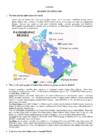
Tallinn English College 2006 1. Introduction If you had to use two words to describe Canada, they might be large and diverse. Canada is the second largest country in the world with a territory of about 10 million square kilometers and it is bordered by three oceans: the Arctic, the Pacific and the Atlantic Oceans. The population of Canada is about 31 million people. About 77% of the people live in cities which lie in a band about 100 miles wide above the border of the United States. The capital of Canada is Ottawa. Other large cities are Montreal, Toronto, Vancouver, Winnipeg and Quebec. 2. Geographical position Canada is a huge country in the continent of North America. It is bordered with the Atlantic Ocean in the east, the Pacific Ocean in the west, the United States of America in the south and the Arctic Ocean in the north. Canada is a vast country, with a territory of 3.8 million
The United Kingdom The United Kingdom consists of England, Scotland, Wales and North Ireland and it is situated in the Atlantic Ocean near the mainland of Europe. The population of the UK is 58.6 million and area is 244,110 sq km. Britain has a temperate humid climate. Its characteristic features are mild winters, warm summer, no temperature extremes, abundant rain all year round and frequent changes of weather. The mild climate is partly due to the warm Gulf Stream and partly to the south westerly winds. Occasional winds from the east in winter may bring cold and dry weather. The distribution of rainfall is influenced by the Atlantic Stream
Tallinn is one of the oldest cities on the Baltic Sea. It is unique for its well-preserved architecture from the 13-15 centuries. In contrast to the ancient town-walls and towers, Tallinn of today offers modern hotels, restaurants, sport and cultural centres. Every five years national song and folk dance festivals take place in Tallinn. The yachting regatta of the 1980 Moscow Olympic Games was held at Pirita. History Tallinn means in English "Danish town". The place is believed to have been settled by Finno-Ugric people about 2500 BC. It was first marked on a map of the world by the Arab geographer al-Idrisi in 1154. The Estonians were the first to build a stronghold on the spot of the Toompea Hill, but the real Tallinn was built by the Danes who conquered the north of Estonia in 1219. Legend has it that one day, when the Danes were about to lose a bloody battle, the sky suddenly opened and a red flag with a white cross on it dropped down upon them from the heaven
Afrikaner and British descent and their slaves and servants - this includes the cuisine of the Cape Malay people, which has many characteristics of Malaysia and Java, and recipes from neighbouring colonial cultures such as Portuguese Mozambique. Indigenous cookery traditional South African cuisine In the precolonial period, indigenous cuisine was characterized by the use of a very wide range of fruits, nuts, bulbs, leaves and other products gathered from wild plants and by the hunting of wild game. The domestication of cattle in the region about two thousand years ago by Khoisan groups enabled the use of milk products and the availability of fresh meat. However, during the colonial period the seizure of communal land in South Africa restricted and discouraged traditional agriculture and wild harvesting, and reduced the extent of land available to black people. Decline of indigenous cookery
lochs. Scotland can be divided into two parts: the Lowlands and the Northern Highlands. The highest peak in Scotland is Ben Nevis (1343 m) Wales Earthwork / :w:k / mullavall Beacon / 'bi:kn / tuletorn, majakas Peninsula / p'nnsjl / poolsaar Wales is surrounded by the sea on three sides and has two major mountain systems: the Black Mountains and the Brecon Beacons. The rivers offer a wide variety of fish. Wales gets a bit more rain than other parts of Britain. The highest peak in Wales is Snowdon (1085 m), one of the mountains of Snowdonia. Ireland Emerald / 'emrld / smaragdroheline Intensity / n'tenst / jõulisus, intensiivsus Tranquility / 'trækwliti / hingerahu, rahu ja vaikus
..................................................17 Appendix 1...................................................................................................................................18 2 Introduction The aim of this research is to get know more about the Netherlands history and its geographical facts. This report is describing one of most the most beautiful countries in the Europe - Netherlands. Netherlands is famous for its windmills and flowers. Netherlands is also known unofficially as Holland. Government is constitutional monarchy of north-western Europe. Netherlands is bordered on the north and west by the North Sea, on the east by Germany and on the south by Belgium. The European portion of the Netherlands has a total area of 41,528 sq km of which 33,939 sq km is land surface. Country's capital and largest city is Amsterdam. Population is about 16 million.
There is evidence suggesting Aborigines in northern Australia maintained trade with some of the Indonesian islands closest to the coast. Chinese and Arab's may have had contact with the Aborigines in the 15th century. When British people came to live in Australia, they decided that the land was empty, that there were no people living there. This was called "Terra nullius", Latin words for "empty land".Under British law, all land belongs to the king,who is then able to sell it to other people. The sacred sites and other land which had belonged to aboriginal people for thousands of years were simply taken from them. If they did not leave peacefully then the new settlers used force to get them to leave. Many aboriginal people were killed during the settlement of Australia. The aborigines that were left were made to live on in special areas, reservations, that the government set aside for them. One of these was at Lake Tyers, Victoria
Town Hall Square Raekoja plats (English: Town Hall Square) is a town square beside Tallinn Town Hall(Estonian: Raekoda) in the center of the Tallinn Old Town in Tallinn, Estonia. It is a venue for numerous small festivals or concerts like Tallinn Old Town Days. Also hosts regular market every christmas and has a tradition of christmas tree since 1441, making the tree display over 570 years old. Town Hall - first mentioned in 1322, the oldest gothic town hall in europe. magistracy existed there until 1970, its a concert hall and meeting place. Also a museum. Pharmacy - always been in business in the same exact house since the early 15th century. It is also the oldest commercial enterprise and the oldest medical establishment in Tallinn. Johann Burchart family longest ran it 60 years. Unicorn powder, burnt hedgehogs, worms. Also were a weighing house, well, pillory- Magistracy - consisted of 24 burghermaster and something, selected from the members of the
5. Which British colonies became dominions? What was their status? Is the name dominion used for these countries nowadays? The first dominions were Canada (1867), Australia (1901), and New Zealand (1907) The name "dominion" is not used anymore. 6. Which organisation unites Britain and most of its former colonies nowadays? The Commonwealth unites Britain with its former colonies. Ireland 1. Who were the early inhabitants of Ireland? Seafarers, fisheremen and hunter-gatherers from mainland Europe arrived around 8000 BC 2. When was Christianity established in Ireland? 432 AD Saint Patrick arrived in Ireland and began converting the Irish to Christianity. Who is Ireland's patron saint? Saint Patrick is Ireland's patron saint. When is his feast day? His feast day is on 17 March 3. When did the English conquest of Ireland begin? Henry II, with permission from tha Pope, sought to conquer Ireland. In 1171 he became the first English monarch to set foot on the isle. 4
Tallinn English College Topic Estonia Tallinn 2008 1. Introduction Estonia is a small country about the size of Switzerland, or New Hampshire and Massachussetts combined. Estonia is named after the people called "Ests" who lived in the region in the 1 st century AD. The Republic of Estonia is one of the three countries commonly known as the "Baltic States". The other Baltic States are Latvia and Lithuania. 2. Geographical position Estonia is situated in northeastern Europe. Estonia is bounded on the north by the Gulf of Finland, on the east by Russia, on the south by Latvia and on the west by the Baltic Sea. In the north it borders on Finland. The coastline of the Baltic Sea in Estonia is characterized by numerous gulfs and bays, the biggest of them being the Gulf of Finland, the Gulf of Riga and the Gulf of Pärnu. Bays include the
Then they evolved different cultures to suit different environments. Scientists now think that the ancestors of First Nations people may have come to North America from several different parts of Asia and Polynesia, following several different routes. Some may have come on woven reed rafts, or boats, across the Pacific from Asia and various islands. Still others may have crossed the ice fields that once connected Europe and North America. The Inuit, who live in the high Arctic, were probably the last to arrive. 4. How were the terms `Métis' and `half-breed' traditionally used? Métis French-speaking and Catholic. Half-breed English-speaking and Protestant. Half-breed is a term used almost exclusively by the federal government throughout the late nineteenth and early twentieth centuries. Race served to distinguish between populations or groups when describing an individual who
BOOKS (From Wikipedia, the free encyclopedia) A book is a set or collection of written, printed, illustrated, or blank sheets, made of paper, parchment, or other various material, usually fastened together to hinge at one side. A single sheet within a book is called a leaf, and each side of a leaf is called a page. A book produced in electronic format is known as an electronic book (e-book). Books may also refer to works of literature, or a main division of such a work. In library and information science, a book is called a monograph, to distinguish it from serial periodicals such as magazines, journals or newspaper
My Town I live in Tallinn. It's the capital and main seaport of Estonia. Tallinn is a very beautiful city that lies on the Baltic Sea. It covers 158 square kilometres. The Mayor of Tallinn is Jüri Ratas. The population of our capital is about 400000 people. About 55% of them are Estonian, 37% Russians and the other 8% are from different nations. The people here are mostly engaged in industry- mainly the food industry (23%), trade (16%) and transport and communication (14%). History. Tallinn has a great history. It was first marked on a map of the world by the Arab geographer al-Idrisi in 1154, its name then being Kolyvan. In the 13 th- century chronicle of Henricus de Lettis the town was called Lyndanise. Then it was
the same kind of justice to be used everywhere. He appointed his own judges to travel around the country. They dealt with crimes & disagreements over poverty. Serious offences were tried in the king's court. At first they had no special knowledge or training. They were trusted to use common sense. By the end of the 12th cent. They had real knowledge & experience of the law which became known as ,,common law", based on custom, comparison, previous cases & decisions. It was unlike in the rest of Europe. In England trial by ,,ordeal" was replaced with trial by jury. The work of juries gradually changed from giving evidence to judging evidence of others. Now the king's laws were in force everywhere. In 1157 he forced Malcolm IV of Scotland to give up border regions to England. In 1171 he went to Ireland, took it under his rule & made his son John, Lord of Ireland. When he got the throne there had been a civil war between his mother Matilda & uncle Stephen. There was
non-related ones. The most common words (`good', `to be', `to go', `much', "people", etc). General principle: the more frequently used a word, the more one can "afford" it to be irregular/non-iconic. Suppletion perhaps the most drastic form of irregularity/iconicity), covers mainly the most frequent words Metathesis-Two sounds, at least one of which is a consonant, change places inside a word. When one of the sounds is a vowel,the other is usually /r/. Fyrst/first/frist a typical case of metathesis.Another case in the passage: beorht/briht.Metathesis present in many languages, a universal phenomenon. For Instance, Proto-Indo-European had tworoots *spek- and the metathetical *skep-, both with the basic meaning of "look, observe, examine". The first is behind Latin words that produced such English loans as spectacle, spectator, expect, inspect, perspective, etc. The second is behind the Greek word for "examine" with the
charcoal, and sulphur. The sealed tubes would be thrown onto fires during celebrations because it was thought that the loud explosions would protect them. It was not long before the ancient Chinese realised the military potential of these devices and primitive rockets were used to repel a Mongol invasion in 1232 AD. Word of these new amazing weapons quickly spread around the world and soon rockets were being used in military operations in North Africa and Europe. During the 15 th and 16th centuries they were widely used in naval battles to set fire on enemy ships. Around this time they also started being used for more peaceful purposes again. In the 16th and 17th century Europe fireworks displays using rockets became a very popular form of public entertainment. In the late 18th century the British army suffered two serious defeats at battles in Seringapatam, in India
 annaabi.ee