Leidsid 33 sarnast õppematerjali, mis on seotud failiga "The Estonian Green Party". Need materjalid aitavad sul teemat sügavamalt mõista.
green, part, party, members, greens, political, able, marek, date, movement, parliament, comm, formed, soviet, vote, today, environmental, candidate, success, membership, than, deputies, seats, program, committee, place, birth, secondary, activity, during, massive, plans, deposits, first, independent, popular, rule, march, merger, wing, approximatelyUniversity of Tartu Faculty of Social Sciences and Education Institute of Government and Politics Marie Allikmaa The strategies of creating a dominant party the case of United Russia Tartu 2011 After the collapse of USSR in 1991, many observers expected Russia to develop into a competitive party system. Yet, the reality quickly challenged this view. The developments of party politics in post-Soviet Russia have accurately been described in terms of a pendulum effect, as in the 2000s, Russia's party system did finally begin to take for, but with a remarkable twist. Following the break of one-party rule, Russia's party system became strongly fragmented - during the 1995 parliamentary elections, 43 parties competed for popular votes (McFault 1996: 90)
Established church The Church of England is the established church, which means that: 1.)the Monarch is the Supreme Governor of the church, 2.)the Church performs a number of official functions, 3.)Church and State are linked. To disestablish Disestablishmentarianism refers to campaigns to sever links between church and state, particularly in relation to the Church of England as an established church. It was initially a movement in the United Kingdom in the 18th century. The established churches in Wales and Ireland could not count on even nominal adherence by a majority of the population of those countries. In Ireland, the predominantly Roman Catholic population campaigned against the position of the established Anglican Church of Ireland - eventually disestablished in Ireland from 1 January 1871. A broad church The Church of England is a broad church, representing a wide spectrum of theological thought and practice
countries to the IMF lead rescue package for Latvia. The central bank uses a currency board system and has independent reserves, which are big enough to buy back all the currency in circulation. Estonia today is mainly influenced by developments in Germany, Finland and Sweden - the three main trade partners. The government recently increased greatly its spending on innovation. The prime minister of Estonian Reform Party has stated its goal of bringing Estonian GDP per capita into the TOP 5 of EU by 2022. Ireland is sometimes seen as a model for Estonian economic future. However, the GDP of Estonia decreased by 1.4% in the 2nd quarter of 2008, over 3% in the 3rd quarter of 2008, and over 9% in the 4rd quarter of 2008. History The Estonians, an ancient people, originally came from a region just west of the Ural Mountains. Historical references to Estonia begin in the 1100's. At that time the
At the beginning of the 19th century Napoleon started his invasions to The Russian Empire. The czar at that time was Alexander I. Napoleon made a big mistake with attacking Russia in the winter, because the army was not used to the merciless climate. Napoleon's army had to retreat and go back to France. The whole world understood now how powerful and strong the Russian empire was ( " I n v a s i o n o f r u s s i a , " ) . Russian empire became more industrialized and the political system stronger and stronger. The country increased its areas. The government was extremely conservative. By the 20th century people noticed that a czar is not the best choice any more. The next ruler Nicholas started to make some changes in the country ( " H i s t o r y a n d c u l t u r e , " ) . These changes brought together the working class which gave a start to the Social Democratic party. In 1905 Nicholas was forces to accept with the new reforms. Later the Social
17101850 The century and a half following the Great Northern War, which ended with the Peace of Uusikaupunki, was a relatively static period in Estonian history with few momentous events. This was the time of the crystallization and the culmination of serfdom, when various socio- political and cultural undercurrents were also active, preparing the ground for the industrial society and the national-democratic movement in the second half of the 19th century. The 1710 of the corporations of knights and towns, until Alexander II (18551881), established the relationships between Estonia, Livonia and the Russian Empire. The Baltic Landesstaat reached its full development. The freedom of action in the new provinces was naturally granted to one of the most firm ideological pillars of the tsarist empire -- the Russian orthodox church; though as the
7.The Anglo-Saxon Chronicle The Anglo-Saxon Chronicle is a collection of annals in Old English chronicling the history of the Anglo-Saxons. The annals were initially created late in the 9th century, probably in Wessex, during the reign of Alfred the Great. Multiple manuscript copies were made and distributed to monasteries across England and were independently updated. In one case, the chronicle was still being actively updated in 1154. Nine manuscripts survive in whole or in part, though not all are of equal historical value and none of them are the original version. 8. Beowulf Beowulf is the most famous heroic poem (written down 8-9cc) Beowulf is a war-leader from Scandinavia.He rescued the land of the Danes from a man-like monster Grendel. The monster kills the hero.The poet describes the funeral and how warriors mourned their king. 9. The Vikings, their way of life. Sutton Hoo
1975 Launch of ERDF - The ERDF aims to strengthen economic and social cohesion in the European Union by correcting imbalances between its regions 1978 European Council establishes the European Monetary System based on a European currency unit (the ECU) and the Exchange Rate Mechanism (ERM). The Ecu has some characteristics of a real currency and is used in travellers’ cheques and bank deposits. ERM gives national currencies a central exchange rate against the Ecu. All the community’s members apart from the UK join the ERM. 1975 Launch of European Monetary System June 1979 – First election of the EP 1981 January: Greece becomes 10th member of the European Community. 1984 February: draft Treaty on the establishment of the European Union passed by the European Parliament. 1985 European Council in Luxembourg agrees to amend the Treaty of Rome and to revitalise integration by drawing up a Single European Act – bigger EU Schengen Agreement 1986
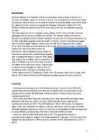
event. The Flag Museum attracts tourists who take an interest in the history of the flag. After about half a century, during which it was prohibited by the Soviet authorities, the flag was sen again in public for the first time in Tartu. Many elderly people were carrying the flags they had kept in secret hiding places durin the Soviet years; tears were rolling down their cheeks. On 24 February 1989, Estonia, still part of the Soviet Union, hoisted its tricolour on the tower of Pikk Hermann in Tallinn. Since then the flag has always been hoisted with ceremony on that day, which is the national holiday the anniversary of the Republic. According to Estonian tradition the national flag is hoisted at sunrise and lowered at sunset exept on June 23 when it is left out for the shortest night of the year. NATIONAL ANTHEM The Estonian national anthem, entitled "My Native Land, My Pride and
literacy, inviting scholars from neighboring nations and Europe to his court during the lulls in fighting. Alfred was not only a great military leader but a ruler with foresight. Thanks to his actions, Wessex became a cultural pre-eminence. King Alfred encouraged his subjects to learn to read English, and saw to it that books were made available in the language. *Danelaw and other Viking territories in the British Isles The Danelaw is a historical name given to the part of Great Britain in which the laws of the "Danes" dominated those of the Anglo-Saxons. The prosperity of the Danelaw led to its becoming a target for the Vikings. The Vikings also made raids in Ireland and founded the cities of Cork, Dublin and Limerick. The Vikings and Scandinavians settled down and intermixed with the Irish. By the mid-ninth century they had also settled in parts of mainland Scotland, for example Shetland and the Isle of Man
Tallinn Järveotsa Gymnasium MARGARET THATCHER Maria Ignatenko Form 11.B Tallinn 2008 Margaret Thatcher (1925-...) General Data Margaret Hilda Thatcher was born on the 13th of October, 1925 in London. She is a British politician who served as Prime Minister of the United Kingdom and Leader of the Conservative Party. Margaret is the first woman who has ever held these posts. Childhood and Education Margaret Hilda Roberts was born on the 13th of October, 1925 in Grantham in Lincolnshire, England. Her parents were Alfred Roberts and Beatrice Stephenson Roberts. Thatcher spent her childhood in the town of Grantham in Lincolnshire. The Roberts family ran a grocery business, bringing up their two daughters in a flat over the shop. Her father was active in local politics and
invasion was small-scale. On 14 October 1066, an invading army from Normandy defeated the English at the Battle of Hastings. The battle was close and extremely bloody. At the end of it, most of the best warriors in England were dead, including their leader, King Harold. On Christmas Day that year, the Norman leader, Duke William of Normandy, was crowned king of England. He is known in popular history as “William the Conqueror” and the date is remembered as the last time that England was successfully invaded. There was no such thing as a Norman area of settlement. Instead, the Norman soldiers who had invaded were given the ownership of land and of the people living on it. A strict feudal system was imposed. 12. Magna Carta. In 1215 King John was forced to sign the document, drawn up by the noblemen of England. It limited his power and extended the rights of his subjects. The Magna
Estonian. The currency is Eesti kroon. The main religion is Lutheran. Anniversary of the republic is celebrated on February 20. The national flower is cornflower, national bird is barn swallow and national stone is limestone. It is a land of great natural beauty with a long and varied history and rich culture. It has served as a junction of international trade routes for centuries. History. The oldest marks of habitation on the territory of Estonia date from the 8th millennium BC. Fortified settlements were established in the 1 st century BC. The ancestors of Estonians formed several independent states headed by elected elders. Until the beginning of the 13th century Estonia was politically independent. Then began a long chain of occupation and control by foreign powers. In the 1200s the German crusaders converted Estonia into a Christianity by force and took control over South Estonia.
3 Chapter 1 The Netherlands 1.1 Mainly about the Netherlands Netherlands is also known unofficially as Holland. Netherlands is bordered on the north and west by the North Sea, on the east by Germany and on the south by Belgium. With Belgium and Luxembourg, the Netherlands forms the Low, or Benelux, Countries. The Netherlands Antilles and Aruba, islands in the Caribbean, are part of the Netherlands. Country's capital and largest city is Amsterdam (see also Appendix 1). National holiday is Queen's Day on 30 th April. And the mother tongue is Dutch. (5) The Kingdom of the Netherlands has three parts and two countries in the Caribbean, the Netherlands Antilles and Aruba. With an area of 41,528 kilometers and a population of 16 million, The Netherlands (the European part of the Kingdom) is one of the world's smaller countries. (6)
being the Gulf of Finland, the Gulf of Riga and the Gulf of Pärnu. Bays include the Narva Bay, Matsalu Bay, Kolga Bay, Kunda Bay, Tallinn Bay etc. Estonia has over 1500 islands, the largest being Saaremaa and Hiiumaa, Muhu and Vormsi. Saaremaa and Muhumaa are connected to each other with a bridge. The best- known smalles islands are Naissaar, Aegna, Ruhnu, Kihnu, Väike-Pakri, Suur-Pakri etc. 3. Relief Lying in the north-western part of the East-European Plain, Estonia is mostly flat with an average elevation of about 50 metres above sea level. South-eastern and eastern parts of Estonia are higher than the western parts. The relief of the present-day landscape was shaped during the Ice Age. Ice sheet has carried large boulders and limestone blocks here, not to mention that the hilly terrain in Estonia was also shaped by the continental ice and the melting water. The land is rising 25 cm every one hundred years
7. Universal respect for, and observance of, human rights and fundamental freedoms for all (environmental norms Lege ferenda norm which is in the process of establishment) To use war as a legal object to resolve conflict, there has to be either self-defence or the agreement of the security council of UN (if there's a threat to peace etc). State (def) "Inter-American convention on the rights and Duties of States!" (Montevideo 26.12.1933) A permanent population biggest part are citizens of the state, + citizens of other states, who have a residence permit, stateless person (apatrid), people with multiple citizenships (bipatrid). How to get citizenship by birth: lex sanguinis blood principle, by birth, given to the child according to the citizenship of the parents (if parents are citizens of different countries different
Organisations Merilin Tamme Xa Tallinna Järveotsa Gymnasium 2008 The schedule · 04.04.1949 establishment of NATO. · 1951 Supreme Headquarters Allied Power Europe (SHAPE) was created near Paris in France. Later, SHAPE was relocated to Mons in Belgium. · 1952 Greece and Turkey join NATO. · 1955 Western Germany joins NATO. · 1982 Spain joins NATO. · 1991 Rome summit. Estonia is one of the founding members of the NACC. · January 1994 Brussels summit. Estonia joins PFP on 3 February. · March 1995 Estonia submits the first Individual Partnership for Peace (IPP) to NATO. It contains priority areas of cooperation with NATO and future cooperation events, altogether in 23 subject fields. · March 1997 beginning of involvement of Estonia in peacekeeping mission in SFOR (Stabilisation Force) in Bosnia Herzegovina (ESTPLA).
Other important towns are Tartu, Kohtla-Järve, Narva and Pärnu. Estonia is a developed industrial and agricultural country. In industrial output: oil shale, electrical energy, mineral fertilisers, paper, chemicals, building material, and textile production are prominent. In agriculture: milk, milk products, meat, grain, potatoes, fruits and vegetables. Estonian cultural life is manifold and intense, initiated by the National Awakening movement during the second half of the 19th century. Estonian folk arts date back to the remote past. In Estonia there are 27 higher educational establishments, among them seven universities with more than 25,000 students and post-graduates (1996); the oldest is Tartu University (founded in 1632), which enjoys a high international reputation. In Estonia there are unions of writers, artists, composers, actors, cinematographers etc; ten professional theatres, two film studios, and the state
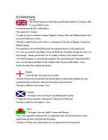
started during the days of the Industrial Revolution * the flag is of Wales bears a Red Dragon (it is not represented on the Union Jack) Northern Ireland: * the capital city is Belfast * 54% of people regard themselves as Protestants and 42% as Roman Catholics * the flag is called the Saint Patrick's Cross 2) History Prehistoric Britain, Roman Britain, Anglo-Saxon, Danish, Norman invasions (...-1066): Britain was part of the European land mass until the end of the last Ice Age. It became an island by about 6000 BC. From about 3000 to 2000 BC the British Isles were inhabited by a group of people called the Iberians. These Stone Age people lived in limestone caves, they used stone axes and fashioned antlers and bones into leather-working tools. Later groups of people from what are now Germany, the Netherlands and Brittany also settled in Briton.
11.02.09 INGLISE KEEL Palju aega läheb. 10 nädalat aint. One of the ESP courses. What we are going to do, what is needed: · What we do - 1 test, on words. · 2 Essays, that means that we have to look into academic writing · Homereading we read a case from European Court of Justice thingy. · Oral thing. · 90% you have to attend · Have to prepare for class and take part of it etc What we learn: Terms Expressions / collocations (nt obey/abide by the law) Explaining AWOL absence without a leave Legal English can be divided into 3 levels. We learn the first one, which is needed for the other two! You have to know the vocabulary etc. Second level has to do with legal contracts... The third level both 1 and 2 and explaining... We learn the vocabulary + explaining.
hundred different beers from around the world can be tasted at Õllesummer.Food is offered at a number of different cuisine restaurants and cafes. Over the years many performers and starts have appeared at the festival. In 2007 more than a hundred performers appeared at more than ten stages. The selection of music varies from jazz to rock and disco. It is a great Estonian party which cannot be found anywhere else in the world. Estonian Song Festival (Laulupidu) The AllEstonian Song Festival (Laulupidu) happens in Tallinn every five years, and gives a privileged insight into Estonian music and culture. Its aim is to bring together all the traditional songs and singers from across the country, as well as guest singers from other countries. The first AllEstonian Song Festival was held in 1869 in the town of
region, because there is enough food. The savannas which are grasslands with some trees are mostly in the west. Farther west are the bushlands. The real deserts occupy the centre of the Western Plateau. In the very south west there are thin forests of evergreens trees. Australia is the driest inhabited continent, the flattest, and has the oldest and least fertile soils. Only the south-east and south-west corners of the continent have a temperate climate. The northern part of the country, with a tropical climate, has vegetation consisting of rainforest, woodland, grassland, mangrove swamps and desert. Climate is highly influenced by ocean currents, including the El Niño southern oscillation. 4. Land regions Mountains The Great Dividing Range runs along the Pacific ocean. These mountains are very old and much of worn down but the Australian Alps are the highest of them. The highest top Mount Kosciusko is 2228 metres above sea level
emergencies *Maret Maripuu Sotsiaalminister secures the financial subsistence and a good job, secures social subsistence and sevelopment *Urmas Paet Välisminister is responsible for the relations between Estonia and foreign states, safeguards Estonia's security and welfare Parlament: it is a permanently functioning unicameral legislative body consisting of 101 members, the Parlament sits in Toompea Castle, members of the Parlament are elected for a 4- year term by private ballot in free elections. Government: it wields executive power, it issues orders and regulations, submits bills to the Parlament for passage into law and foreign treaties for ratifications, drafts the state budget for submission to the Parlament abd effects it after adoption. The President nominates a minister candidate for the post of Prime Minister. Court system: it is a 3-tier system
the Volga and Oka rivers. They migrated westward to the Baltic shores some 5, 000 years ago. In the ninth century A.D. Viking ships invaded Estonia and the country became a vital link in the sea-trade between East and West. By the 12th century, the Arabian geographer al-Idrisi had placed the city on his maps. In the 13th century, Tallinn joined the Hanseatic League, the union of European commercial towns that stretched from London to Novgorod. Pärnu, Viljandi and Tartu were also members. Estonia became a vital link in the sea-trade between East and West. The oldest preserved book written in Estonian, a catechism, dates from 1535. Tartu University was established in 1632, on orders from Sweden's King Gustav II Adolf. Literacy spread. The Bible was translated into Estonian in 1739(pole vaja teada). A period of wars began in the 16th century, bringing parts of Estonia under the control of Russia, Denmark, Poland and Sweden. For most of the 17th century, Sweden ruled Estonia. In
barbarians. 406-7 barbarians begin invasion Legacy- new types of animals, plants; miles, feet, inches-roman measurements;christianity; Roman basilica in curches; reading, writing; buildings, roads Christianity in Roman Britain Until 4th C christians were persecuted 313 AD Emperor Constantine legalised christianity 380 AD Emperor Theodosius I made it the official religion of the empire Paganism had been eclipsed but continued to pose a political, religious challenge Boudicca Queen of Iceni people of Eastern England, led an uprising against Roman forces Prasutagus(ruler) was first allowed to rule when romans conquered England, after his death, romans decided to rule Iceni and flogged Boudicca and raped her daughters 60-62 AD Iceni rebelled, Boudicca´s warriors defeated Roman Ninth Legion, destroied capital-Colchester Finally Boudicca was defetated, she poisoned
Claim they are the forefathers of USA aristocracy- FALSE They saw little chance of England becoming a proper country Wished to live free of English laws and oppressing church religious freedom In may (had time before winter!!!) · Mayflower Compact First governing document of Plymouth Colony Agreement composed by a consensus among new Settlers Composed for the sake of their own survival Fair and equal laws, for the general good Signed by 41 adult male members on the Mayflower Free of English law foundation of the USA constitution · Puritan Colony in Plymouth, New England America's first permanent puritan settlement Along with Jamestown, the most successful colony Originally 105 colonists First home in an empty Indian village Concluded a peace treaty with neighbouring tribes Aided by natives +++ (how to grow corn etc) went there to find relogious freedom · Puritan ethics and ideology God has a preordained plan for everybody
ideological enemies. Also religious enemies, rabbis, cultural leaders, writers. Another group rounded up were refugees from Germ-occupied Poland, tens of thousands of mostly young Js. Couldn't go S, Czechoslovakia annexed, Romania fascist and anti-Semitic, sea lanes closed, mostly E. SU identifies as suspect, could be a spy. J identity very different from SU J, more use of Yiddish, more traditional, state of mind diff. Germs had dumped Js on the border, green border policy. Registered as they came over the border, porous. 6 mill SU citizens deported internally, 1920-1952, policy for suspect groups. What about everybody else? Sovietization mostly on urban centers, more keenly felt than on periphery. Farmers in Bessarabia, barely felt Sovietization, have a talk, mainly to get wine, gratice. 60,000 Polish Js removed, 39-41. 150,000 Js from annexed territories arrive in unoccupied parts. Birobidzhan? Political theater. Where to resettle millions of Js
The highest point in Estonia and also in the Baltic region is Suur Munamägi. It is 318. above sea level. Estonia is a country of a thousand lakes. The Largest one is Lake Peipsi which is also the fourth biggest freshwater lake in Europe. Lake Peipsi and Lake Võrtsjärv are rich in fish. Estonia has many rivers but only nine of them are longer than 100km. The most important ones are Pärnu River and Emajõgi River Climate Estonia lies in the northern part of the temperate climate zone and in the transition zone between maritime and continental climate. Because Estonia is continuously warmed by the Gulf Stream it has a milder climate despite its northern latitude. Northern latitude means long summer daylight hours (the longest summer day stretches to 19 hours), and dark winters when daylight lasts sometimes only six hours. Being on the Baltic Sea the country is subjected to sea breezes and humidity.
was created with the Treaty of Paris (1951) and was signed by France, Italy, Belgium, Netherlands, Luxembourg and West Germany (total of 6 countries). European Economic Community (EEC) was created with the Treaty of Rome (1958), establishing a customs union (tolliliit). The European Union (EU) was created by the Maastricht Treaty which came into effect on November 1st 1993. Introduction The European Union (EU) is an economic and political union.EU policies aim to ensure the free movement of people, goods, services, and capital, enact legislation in justice and home affairs, and maintain common policies on trade, agriculture, fisheries, and regional development. Within the Schengen Area, passport controls have been abolished.The monetary union was established in 1999 and came into full force in 2002. It is currently composed of 18 member states that use the euro as their legal tender. At the moment there are 28 member states in the EU. To become a member, a country must
Moorish invaders professing Islam, who were later expelled by the Knights Templar. During the Christian Reconquista, Portugal established itself as an independent kingdom from León in 1139, claiming to be the oldest European nation-state. In the 15th and 16th centuries, as the result of pioneering the Age of Discovery, Portugal expanded western influence and established the first global empire, becoming one of the world's major economic, political and military powers. In addition, the Portuguese Empire was the longest-lived of the modern European colonial empires, spanning almost 600 years, from the capture of Ceuta in 1415 to the handover of Macau in 1999 and grant of sovereignty to East Timor in 2002. The empire spread throughout a vast number of territories that are now part of 53 different sovereign states. However, the country's international status was greatly reduced during the 19th
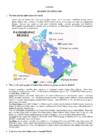
According to Canadian census 2011, 1.4 mln people of Aboriginal origin (4.3%): 852,000 First Nations persons, 452,000 Métis, 59,000 Inuit. Indian (First Nations) - No written history before the contact with Europeans. Chief historical sources European priests, travellers and traders not interested in the preservation of "pagan"myths. Different estimates about their number in Canada when Europeans reached North America from 300,000 to 1 mln. Saw themselves as part of nature, not as its masters. The First Nations were called "Indians" by Christopher Columbus when he landed in North America, because he thought he had reached India. Many now prefer to call themselves First Nations, though many still call themselves Indians in everyday conversation. They are still legally categorized by the Canadian Government under the Indian Act as Status Indians. Those who have lost their legal status are called Non-Status Indians
decimating. Another example is the destruction of coral reefs in the various oceans, which support the rich marine life. FIND OUT 5 WAYS HOW TO HALT THE LOSS OF BIODIVERSITY 6. Deforestation: Our forests produce fresh oxygen and help in regulating temperature and rainfall. At present forests cover 30% of the land but every year tree cover is lost amounting to the country of Panama due to growing population demand for more food, shelter and cloth. Deforestation simply means clearing of green cover and making that land available for residential, industrial or commercial purpose. FIND OUT 5 WAYS HOW TO STOP DEFORESTATION. 7. Ocean Acidification: It is a direct impact of excessive production of CO2. 25% of CO2 produced by humans. The ocean acidity has increased by the last 250 years but by 2100, it may shoot up by 150%. The main impact is on shellfish and plankton. Acid Rain: Acid rain occurs due to the presence of certain pollutants in the atmosphere. Acid rain can be
definitely vist an Old Town, Charles University Botanical Garden, Praguage COMPENDIUM ABOUT PRAGUE Prague is the capital and largest city of the Czech Republic. Nicknames for Prague have included Praga mater urbium/Praha matka mst ("Prague Mother of Cities") in Latin/Czech, Stovzatá Praha ("City of a Hundred Spires") in Czech or Zlaté msto/Goldene Stadt ("Golden City") in Czech/German. Situated on the Vltava River in central Bohemia, Prague has been the political, cultural and economic centre of the Czech state for more than 1100 years. For many decades during the Gothic and Renaissance eras, Prague was the permanent seat of two Holy Roman Emperors and thus was also the capital of the Holy Roman Empire. 4 Today, the city proper is home to about 1.3 million people, while its metropolitan area is estimated to have a population of over 1.9 million.
m²) and 179,584 islands to be precise. One of these lakes, Saimaa, is the fifth largest in Europe. The Finnish landscape is mostly flat with few hills and its highest point, the Halti at 1,324 metres, is found in the extreme north of Lapland at the border between Finland and Norway. The landscape is covered mostly (seventy-five percent of land area) by coniferous taiga forests and fens, with little arable land. The most common type of rock is granite. It is a ubiquitous part of the scenery, visible wherever there is no soil cover. Moraine or till is the most common type of soil, covered by a thin layer of humus of biological origin. The greater part of the islands are found in southwest in the Archipelago Sea, part of the archipelago of the Åland Islands, and along the southern coast in the Gulf of Finland. Finland is one of the few countries in the world whose surface area is still growing.
 annaabi.ee