Leidsid 33 sarnast õppematerjali, mis on seotud failiga "Stonehenge kohta inglise keelne powerpointi esitlus!". Need materjalid aitavad sul teemat sügavamalt mõista.
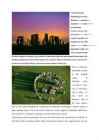
stone, stonehenge, period, stones, tour, north, mystery, construction, location, west, ditch, bank, structure, land, place, 2900, holes, circle, south, england, miles, between, wooden, centre, monument, domain, dead, woodhenge, living, observatory, temple, views, 2950, aubrey, station, banks, heel, 2400, brought, create, 2550, altar, horseshoe, settingStonehenge Stonehenge is a prehistoric monument located in the English county of Wiltshire, about 3.2 kilometres (2.0 mi) west of Amesbury and 13 kilometres (8.1 mi) north of Salisbury. One of the most famous prehistoric sites in the world, Stonehenge is composed of earthworks surrounding a circular setting of large standing stones. Archaeologists had believed that the iconic stone monument was erected around 2500 BC, as described in the chronology below. However one recent theory has suggested that the first stones were not erected until 2400-2200 BC,[1] whilst another suggests that bluestones may have been erected at the site as early as 3000 BC (see phase 1 below). The surrounding circular earth bank and ditch, which constitute the earliest phase of the monument, have been dated to about 3100 BC
STONEHENGE Stonehenge is surely Britain's greatest national icon, symbolizing mystery, power and endurance
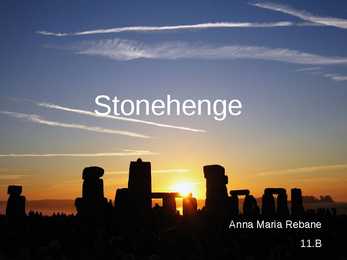
Stonehenge Anna Maria Rebane 11.B Facts about Stonehenge · 5000 year old prehistoric ritual monument · the most famous prehistoric monument in Europe · one of the most ancient and mysterious structures in the world · 3.2 kilometers west of Amesbury and 13 kilometers north of Salisbury · south-western England; in the English county of Wiltshire · built in the late Stone Age (Neolithic) and the Bronze Age The History of Stonehenge · "The Mystery of Stonehenge" · the building began in 3000 BC by semi-nomadic peoples · The first stone to be placed - Heel Stone. · some stones weigh about 45 tons each and are 7m high · the largest stone weights as much as 50 tons · no wheels and no metals · their tools - stones, bones and wood · built in several stages
Stonehenge Hort 4000 Mary Laine What is Stonehenge? Derived from words that mean hanging stones, circle of stones, or stone hinges 162 stones originally and about half remain today Southern England, eight miles north of Salisbury and 30 miles north of the English Channel Nearby hillsides are covered with hundreds of burial pits known as barrows 80% of the barrows face east towards where the sun rises on the horizon There are at least 900 circles in Wales, Scotland, England, and Ireland. Most are made of stone, but wood was also used. Soil was also piled up to create banks, ditches, and circles. Many of these structures are of archaeological interest and are found throughout the countries.
1) INDIAN ROCK ART: A NATIONAL TREASURE IN DANGER Unrecognized, unprotected, this priceless legacy of primitive art has endured the ravages of nature only to fall victim to wanton destruction by ,,civilized" man. Like the huge stone statues of Easter Island and prehistoric cave paintings of Altamira and Lascaux, North American Indian rock art is surrounded by an atmosphere of mystery. Although examples of rock art exist at some 15000 sites in canyons, deserts, caves and river gorges. Nowadays, however, primitive rock art in the United States has become a new field of scientific study. Klaus F Wellmann wrote two books about rock art. He is a professor of medicine. Rock art represents the history of aboriginal Americans. In the most cases the art is an expression of ideas and way of life, ritual ceremonies, hunting, fighting. The pictures of people and
White Cart Water.Crookston is surrounded by a defensive ring-ditch that dates back to the 12th century when Sir Robert de Croc, built a timber and earth castle. Remains of a chapel founded by de Croc in 1180 have been uncovered. Evidence of an even earlier fortification on the same site has also been found. The lands of Crookston were bought by Sir Alan Stewart in 1330, and passed to Sir John Stewart, 1st Lord Darnley, in 1361. The Darnley Stewarts replaced the early castle with the present stone structure around 1400.In 1489 the Stewart Earl of Lennox rebelled against James IV. James responded by bringing the cannon Mons Meg from Edinburgh, and bombarding the castle, virtually destroying its western end, and ensuring a quick surrender. In 1544 the castle was besieged and taken by the Earl of Arran and Cardinal Beaton, while the then Earl of Lennox was defending Glasgow Castle.Charles, the Earl of Lennox.The castle passed through several owners, until in 1757 it
It must illustrate or interpret the heritage of the world in terms of engineering, technology, transportation, communication, industry, history, or culture. World Heritage industrial sites and monuments must meet one or more of the following criteria and pass the test of authenticity: Represent a masterpiece of human creative genius; Have exerted great influence, over a span of time or within a cultural area of the world, on developments in engineering theory, technology, construction, transportation, and communication; Be an outstanding example of a type which illustrates a significant stage in bridge engineering or technological developments. A World Heritage bridge, like other properties, must meet the test of authenticity in design, materials, workmanship, or setting (the Committee has stressed that reconstruction is only acceptable if carried out on the basis of complete and detailed documentation of the original artefact and to no extent on conjecture)
The United Kingdom The United Kingdom consists of England, Scotland, Wales and North Ireland and it is situated in the Atlantic Ocean near the mainland of Europe. The population of the UK is 58.6 million and area is 244,110 sq km. Britain has a temperate humid climate. Its characteristic features are mild winters, warm summer, no temperature extremes, abundant rain all year round and frequent changes of weather. The mild climate is partly due to the warm Gulf Stream and partly to the south westerly winds. Occasional winds from the east in winter may
Make up your list of 5 top British people. Give your motivation. The Queen, Adele, Elton John, Shakespeare, JK Rowling. 5. Which 5 places attract visitors in Wales and Scotland? Edinburgh, Loch Ness, The Highlands, Snowdonia, Cardiff. 6. Name 6 islands, 5 rivers, 3 lakes, 3 mountains in UK. Isle of Man, Isle of Wight, Isle of Lewis, Island of Mull, Island of Arran, Anglesey Island Severn, Thames, Tweed, Avon, Trent, Dove Ben Nevis, Snowdon, Ben Macdui 7. Stonehenge. Stonehenge was produced by a culture that left no written records. Built on Salisbury Plain, in Wiltshire, England some time between 5,000-4,300 years ago. One of the most famous megaliths in the world, dating from prehistoric times. Stonehenge consists of circles of stone arranged in complex patterns, and their origin is still being explored. Some of the stones come from over 200 miles away in Wales
* it covers 243,610 sq km * everybody from the UK is called British * the capital city is London * is made up of four constituent countries: England, Scotland, Wales and Northern Ireland which in turn are divided into counties * the flag is called the Union Jack which is a combination of the flags of England, Scotland and Northern Ireland * the population is about 60,000,000 people, the population density is 242 people/sq km * its coasts are washed by the Atlantic Ocean, the North Sea, the English Channel, the Celtic Sea, Saint George's Channel, and the Irish Sea. It is linked to France by the Channel Tunnel * the United Kingdom is a constitutional monarchy. The current monarch is Queen Elizabeth II, who is also the Queen and Head of State of fifteen other Commonwealth Realms, such as Canada, Australia, New Zealand and Jamaica. England: * it has 50 cities, the capital city is London
London History The Romans AD 43- AD 410 The Romans finally invaded Britain in AD 43 from Kent. The Romans lead by Julius Caesar attempted to invade Britain twice before that in 55 and 54 BC but the invasions were unsuccessful. They made their way to the river Thames and sailed up it. The Romans knew it was important to control a crossing point at the river Thames, so they decided to build a settlement on the north bank. Although small settlements had been built on the banks of the Thames, the Romans were the ones who built the first city. They called their city Londinium. The Roman engineers noticed that the point where the swampy river narrowed would make an ideal crossing point, they built London Bridge. Less than 20 years later the native Iceni tribe, led by Queen Boudicca, rose up against the Romans in revenge for mistreatment and burnt Londinium to the ground
History exam *Stonehenge - is a monument located in England. It is one of the most famous prehistoric sites in the world and is composed of earthworks surrounding a circular setting of large standing stones. The surrounding circular, earth bank and ditch, have been dated to about 3100 BC. Stonehenge was produced by a culture with no written language. Many aspects of Stonehenge remain subject to debate. There is little or no direct evidence for the construction techniques used by the Stonehenge builders. *The Celts in Britain and their legacy The Cets lived in Britain in The Iron Age. They were warring tribes who were battleful amongst themselves as well as inter-tribal war. They were not centrally governed. The Celts brought iron working, iron ploughs and metal swords, horses, wheels and chariots - all these things gave them an instant superiority over the native tribes. The Celts built a number of hill forts throughout the region
Other rivers are short and have water only after rains. The Climate Australia stretches from the tropics to the temperature region. It is a hot and dry country. The northern part has a hot tropical climate with heavy rainfall. It has two seasons - wet summer and dry winter. The south and the east of Australia have warm summers and winters. The southeastern coast gets rains all year around. The southwest area has hot, dry summers and mild moist winters. In the west and in the outback the temperature is often 35 degrees in the summer months. The outback receives almost no rainfall. Tasmania is cooler and wetter than the rest of Australia. The only places where snow falls are in the southeast and Tasmania. History Sixty million years ago Australia and its nearby islands were separated from the rest of the world by a great upheaval. They were cut off from Asia by the ocean. Almost no animals
It seems that the Celts, who had been arriving from Europe from the 8th cent BC onward, intermingled with the peoples who were already there. The Celts were extremely talented people, creative and artistic. More than 1 Celtic tribe invaded Br. The descendants of ancient Celts live in Wales, Scotland, Cornwall and Ireland. They lived in primitive society. Druids priests, more powerful than chiefs. Acted like prophets. 2. Stonehenge From prehistoric period. Was built on Salisbury plain between 2500 and 1500 bc. One of the most famous and mysterious archaeological sites in the world. One of the mysteries is how it was built at all with the technology of the time. Another is its purpose. It appears to function as a kind on astronomical clock and we know it was used by the Druids for ceremonies marking the passing of the seasons. It appears in number of novels. These days it is not only the interest of tourists but is also a
The capital city is Washington D.C. Although the United States has no official language at the federal level, English is the de facto national language. English is the most common language for daily interaction among both native and non-native speakers. Spanish is the second language. The largest city is the New York City. The Government is Federal constitutional republic and the president is George W. Bush. 2. Geographical position The United States of America is located on the continent of North America. It has borders with two countries Mexico and Canada. There are also the Atlantic Ocean, the Pacific Ocean and the Gulf of Mexico surrounding the big country. There are 50 states in America. Most of the people live in towns. The biggest state is Alaska; next by size are California, Alaska and Montana. Six states - Maine, Vermont, New Hampshire, Connecticut, Rhode Island and Massachusetts are called New England. They are all small states in the USA that lie in the north- east
EHITUSTEADUSKOND Ehitustootluse instituut KUIDAS MUUDAB MUDELPROJEKTEERIMINE TERASKONSTRUKTSIOONIDE PROJEKTEERIMIST, VALMISTAMIST JA EHITAMIST? HOW ARE 3D AND BIM CHANGING THE DESIGN, FABRICATION AND CONSTRUCTION OF COMPLEX STEEL STRUCTURES? EPJ 60 LT Üliõpilane: Tanel Friedenthal Juhendaja: Prof. Roode Liias Kaasjuhendaja: Prof. Carrie S. Dossick Tallinn, 2010.a. Olen koostanud lõputöö iseseisvalt. Kõik töö koostamisel kasutatud teiste autorite tööd, olulised seisukohad, kirjandusallikatest ja mujalt pärinevad andmed on viidatud.
· Estonian immigration to the United States slowed down dramatically 1924 The Estonian quota fixed at 116; even this small annual quota was not used up *After World War II = In the post World War II years, all three Baltic nations maintained consulates in the United States · About 15,000 Estonians came to the United States · This group was strongly anti-Communist and nationalistic 3. Russian colonization of America. What has preserved from this period to the present? The Russian colonization of the Americas covers the period, from 1732 to 1867, when the Tsarist Imperial Russian Empire laid claim to northern Pacific Coast territories in the Americas. The Russians were primarily interested in the abundance of fur-bearing mammals on Alaska's coast, as stocks had been depleted by overhunting in Siberia. By the middle of the 19th century, profits from Russia's American colonies were in steep decline
· By the end of the 18th century the naturalism depicts in europe, but stars to become the literature method no 1 in america · Naturalism appealed American authors because they found it very right to describe what was going on in the turn of century in America · They wanted something fresh, new · They were disgusted by romantics · Showed the harsh tone in moral life · Refleced the development of science · Period of intense urbanisation, the city is in the center of the novel, often · New characters were businessmen, salesman, immigants, poor farmers · These characters were in new settings, skyscrapers, departments store, apartment building, ghetto, stockyard (cattle, cows were slaughtered), commercial trust · Their world is not one of culture or high moral standards · For these new writers controlling new american social experience
Stonehenge One of the best known ancient wonders of the world, 5000 years old Megalith monument, built by western mediterraneans during 3000-1600 BC Circular structure, large standing stones, aligned with rising sun at teh solstice Attlers and bones were sued to dig pits that hold the stones The Celts in Britain and their legacy 700-200 BC celts invade Britain Gaels or Goehls(Ireland and Scotland),Cymri(Wales) and Brythons(gave name to Brittany) Fierce fighters,superb horsemen.Most of them farmers, lived in thatched houses Good at art, craftmanship, used iron Divided into tribes, ruled by kings, only in face of danger would they choose a single leader Legacy- hill-forts, farms, churches, field system,
............................................................ 5 Enlightenment and enlightened absolutism...................................................................... 6 18501918.............................................................................................................................. 8 The national awakening................................................................................................... 8 The russification period.................................................................................................... 9 Emergence of parties and the 1905 revolution............................................................... 11 The post-revolutionary situation and World War I (19071917)...................................... 14 Our opinion............................................................................................................................ 18 References...................
7 UNIT 1 THE ISLAND Pre-reading questions What is the name of the island group Britain belongs to? Where is it situated? What seas surround it? What kind of climate do you think Britain has? What is its surface like? What countries are situated on the islands? Which country are we going to study? Why? Location Land and climate affect life in every country. Britain is no exception. Britain is the largest island of the British Isles 1. It is just under 1,000 km long and just under 500 km across in its widest part. Britain is separated from the mainland of Europe by the North Sea on the east and the English Channel on the south – by only about 35 km of water at its closest point (the Strait of Dover 2). Most of the coastline is so broken by bays and inlets that no point on the island is more
2.5%). Official language: Ukrainian (although Russian is widely used in business communication). Currency: Hryvnya (UAH). Government type: republic. Membership: the United Nations, the International Monetary Fund (IMF), the World Bank, the European Bank for Reconstruction and Development (EBRD), the World Trade Organization (WTO), etc. Ukraine is bordered by Russia in the east, the Black Sea in the south, Moldova, Romania, Hungary, Slovakia and Poland in the west, and Belarus in the north. The country is rich in mineral resources: iron ore, coal, manganese, natural gas (shale costly and dangerous to extract), oil, sulfur, graphite, titanium, magnesium, kaolin, nickel, mercury, timber and others. It's commonly known that Ukraine is politically divided between its Western and Eastern regions. Ukraine's geography and history have played an important role in the country's current political crisis
(1895). Ideas of early modernism. Hardy depicts the journeys of the protagonists that are initially hopeful, momentarily ecstatic, but persistently troubled and eventually end in deprivation and death. 20th century Modern period. Contradictory in many ways, diverse and chaotic. Scientific developments; Einstein – theory of relativity. Friedrich Nietzsche – God is dead, multiple truths/perspectives, life lacks purpose; Übermensch. (Nietzsche was mad.) Freud – psychoanalysis
Cowley: Robert Herrick: The Argument of His Book, Delight in Disorder 6. The Caroline „beauty of holiness” Sermons and religious verse, witty preaching. George Herbert, Caroline piety expressed. His verse is sensitive and decorous, monument to „beauty of holiness”, practice of liturgy with good order and ritual which was the essence of Charles I’s religious policy. High Anglican piety. Herbert celebrates wat Puritans wished to sweep away. Beauty and significance of ritual, of the mystery of the sacraments offering praise to the angles, to the saints and Virgin Mary. We are in Heaven that can only be Anglican, filled with deep inner piety which spoke of the anguish of heart in its search for God.Church resumed as holy place again, restoration, beautification, painting and sculpture aided liturgy. 7. 17th century philosophical writing (Burton, Browne, Hobbes) Thomas Hobbes: Leviathan – developed his political philosophy. Man by nature selfishly individualistic
( ). It arose in the beginning of the 18th century with the modernization reforms of the Russian state under the rule of Peter the Great, and developed from the Moscow (Middle or Central Russian) dialect substratum under the influence of some of the previous century's Russian chancellery language. Mikhail Lomonosov first compiled a normalizing grammar book in 1755; in 1783 the Russian Academy's first explanatory Russian dictionary appeared. During the end of the 18th and 19th centuries, a period known as the "Golden Age", the grammar, vocabulary and pronunciation of the Russian language was stabilized and standardized, and it became the nationwide literary language; meanwhile, Russia's world-famous literature flourished. Until the 20th century, the language's spoken form was the language of only the upper noble classes and urban population, as Russian peasants from the countryside continued to speak in their own dialects
Some of the things you will learn in THE CODEBREAKERS • How secret Japanese messages were decoded in Washington hours before Pearl Harbor. • How German codebreakers helped usher in the Russian Revolution. • How John F. Kennedy escaped capture in the Pacific because the Japanese failed to solve a simple cipher. • How codebreaking determined a presidential election, convicted an underworld syndicate head, won the battle of Midway, led to cruel Allied defeats in North Africa, and broke up a vast Nazi spy ring. • How one American became the world's most famous codebreaker, and another became the world's greatest. • How codes and codebreakers operate today within the secret agencies of the U.S. and Russia. • And incredibly much more. "For many evenings of gripping reading, no better choice can be made than this book." —Christian Science Monitor THE
Five years later the debate had moved on, from exclusively feminine concerns to the wider issues of gender in social and cultural contexts. Patriarchy and capitalism should be examined more closely, perhaps as Althusser had attempted, and sophisticated models built to integrate the larger web of economics, education, division of labour, biological constraints and cultural assumptions. Literature will often reflect the cultural assumptions and attitudes of its period, and that of course includes attitudes towards women: their status, their roles, their expectations. But a literature doctored of male-orientated views would be failing in its first requirement, to present a realistic or convincing picture of the world. Moralizing, which includes political correctness, has its dangers. Feminists have argued for positive discrimination as the only way to correct centuries of bias.
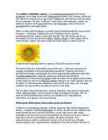
mittesöödav, kest, aganad ; kroovima, koorima) Heliotropism (heliotropism (taime päikese poole pöördumine) Sunflowers in the bud(pung, õienupp ; tärkama, punguma) stage exhibit(välja panema, näitama ; eksponaat, asitõend) heliotropism. At sunrise, the faces of most sunflowers are turned towards the east. Over the course(kurss, suund, kulg, kursus, käik, väljak, müürilade) of the day, they move to track(jälitama) the sun from east to west, while at night they return to an eastward(ida suunaline, ida poole) orientation. This motion(liikumine, esildis) is performed by motor cells in the pulvinus, a flexible segment(segment, lõik ; segmenteerima, tükeldama) of the stem just below the bud. As the bud stage ends, the stem(tüvi) stiffens(kangestuma, jäigastuma) and the blooming stage is reached. Sunflowers in the blooming stage are not heliotropic anymore. The stem has frozen, typically in an eastward orientation
Ergo Pikas Integration of Lean Construction and Building Information Modelling DISSERTATION Tallinn 2010 2 UNIVERSITY OF APPLIED SCIENCES Author: Ergo Pikas- Civil Engineering student, Faculty of Construction, Tallinn University of Applied Sciences Supervisor: Rafael Sacks- Associate Professor, Faculty of Civil and Env. Engineering, Technion Israel Institute of Technology Consultant: Roode Liias- Professor and Dean, Faculty of Civil Engineering, Tallinn University of Technology Title: Integration of Lean Construction and Building Information Modelling
This is why hybrid-electric vehicles can get more miles per gallon of gasoline compared to vehicles that run on gasoline alone. 13 Picture 2.12. Fuels used for transportation The people in the United States have always had a love affair with the automobile. Personal vehicles (like cars and light trucks) consume 63 percent of the total energy used for transportation, while commercial vehicles (like large trucks and construction vehicles), mass transit (like airplanes, trains, and buses), and pipelines account for the rest. Picture 2.13. Energy use by type of vehicle RENEWABLE ENERGY Renewable energy sources can be replenished in a short period of time. The five renewable sources used most often are: · biomass - including wood and wood waste, municipal solid waste, landfill and biogas, ethanol, and biodiesel; · water (hydropower); · geothermal;
centuries) molecule The plurals of nucleus, verterbra, corpus, etc. Latin abbreviations in English i.e. = id est that is to say viz = namely etc = et cetera Latin adjectives for English nouns nose – nasal sun – solar son – filial mother – maternal mouth – oralmoon – lunar daughter – filial father – paternal stone – lithic 5. Greek borrowings The Greek language has contributed 50,000 words to the world. Christianity: New Testament in Greek. Catholic Church – Scclesiastical Latin. Examples: abbot, angel, apostle, bishop; school, cylinder, cycle, criterion, dialogue, cardiac, phonetic, gymnasium, marathon (pentathlon, biathlon), athlete, diagnosis, prognosis, analysis, epic, drama, poem, comedy, poetry, theatre, epilogue, prologue, metaphor. 6. Celtic borrowings
registration of the founders of the money is transferred to the main account of the company; estate - by transferring the property to the Head of the company (CEO) under the act temporarily, and after checking company founders made by the head of the property is transferred by an act of the company. 1.5. Address of the company The law does not require documentary evidence of the location of the enterprise (exact address) in the territory of Russia in his account, but later on, in the course of business, the company will need to have the document on the basis of which its registration is made at a specific address specified in the statute. Such a document can be: certificate of ownership of any non-residential premises lease office (production) of non-residential premises (usually with a copy of the certificate of ownership of the lessor's premises);
CONTENTS ESTONIA AND THE ESTONIANS FOREWORD IN THE FOLD OF TSARIST RUSSIA. EMERGENCE AND FIRST STEPS ON THE CLASSICAL-ROMANTIC PATH. HISTORICAL INTRODUCTION I. MUSICAL LIFE IN TARTU AT THE TURN OF THE CENTURY. TRAILBLAZERS: ALEKSANDER LÄTE, RUDOLF TOBIAS, ARTUR KAPP. II. THE FIRST DECADE OF THE 20TH CENTURY. ARTUR LEMBA: THE BEGINNING OF ESTONIAN SYMPHONY AND OPERA. III. NEW DEVELOPMENTS IN CULTURAL AND MUSICAL LIFE: THE END OF THE TSARIST PERIOD. THE INDEPENDENT REPUBLIC OF ESTONIA: THE INTRODUCTION OF INNOVATIONS FROM WESTERN ART AND THE EVOLUTION OF NATIONALLY ORIENTED MUSICAL TRENDS. IV. THE TWENTIES. ARTUR KAPP: ROMANTICIST AND DRAMATIST. V. THE INFLUENCE OF NEW WESTERN MUSICAL TRENDS. HEINO ELLER: A PROGRAMME PAINTER. VI. THE THIRTIES. THE WIDENING OF NATIONAL SYMPHONISM. THE RISE OF ATTENTION TO HISTORY AND FOLKLORE: JUHAN AAVIK, EDUARD TUBIN, EUGEN KAPP. VII
 annaabi.ee