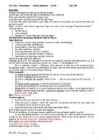
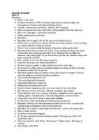
Rhyme is regular sound repetition occurring at the end of poetic lines (rhyming words have similar or identical sound combinations). Full rhyme identical sounds (last stressed vowel and following consonant) tide-side, cold-gold. Incomplete rhyme derived from full rhyme. Vowel rhyme identical vowels and different consonants pen-best. Consonant rhyme identical consonants and different vowels love-live. Compound rhyme made up of 2 or more words united by single stress women=two men.
Regan’s is Stephen Cooper’s Philip Larkin: Subversive Writer (2004). 1.2. LARKIN STYLISTIC MAP When approaching the poems of Larkin as if were compressed stories, John Bayley emphasizes his value of epiphanies. When describes (referring to territory of poem anecdotal that is almost story) about what entirely consists his “new way of exploring that territory” (1988, 272), Bayley does not do more than reform the poetic text definition that we have handled in the present work - a text in which the information highly is concentrated and organized in the following terms: “I have you use the shorthand of poetry to block in a situation in a way that prose would have to do much dwells laboriously, and AT to much to greater length” (1988, 272). It is as if the text, when concentrating itself, aspired to the
and France, until 1847 He died on the 9 June 1870 after a stroke. Much of his work first appeared in periodicals and magazines in serialised form, a favoured way of publishing fiction at the time. Other writers of the time would complete entire novels before serial publication commenced, but Dickens often wrote his in parts, in the order in which they were meant to appear. His writing style was florid and poetic, with a strong comic touch. He satired of British aristocratic snobbery Dickens is famed for many things--his depiction of the hardships of the working class, his intricate plots, his sense of humour. But he is perhaps most famed for the characters he created. His novels were heralded early in his career for their ability to capture the everyday man on paper and thus create a memorable character to whom readers could relate, and envision as a real person.
Christian Poetry · 55 B.C. Julius Ceasar - christianity to British Isles · 449 A.D Anglo-Saxons - pagans = christianity declined · 597 A.D. St. Augustine - within 100 years all country into christianity Caedmon and Alfred the Great Ceadmon · first religious poet of British literature · "the father of English song" · Hymn of Creation - between 658 and 680 - the oldest preserved · turned the Bible stories into verse from = poetic paraphrase Alfred the Great · first notable written literature in Anglo-Saxon · Anglo-Saxon Chronicles, 892 The Chronicle · most important source for England's history up to 892 · changes into spelling of the language · history - 1st national continuous history of a Western country - own language · literature - 1st great book of English prose To sum up · Beowulf - the oldest and the most important - pagan literature
Words or phrases may be used with quot marks to imply that they belong to other characters and the author himself feels ironic about them. Sometimes quot marks are used to show that words are used in some specific or narrower meaning. Capital letters are involved in personification and antonomasia. Words may contain only capital letters for emphatic purposes. E.g. WILL YOU BE QUIET! He shouted. It is a tradition to begin every poetic line with a capital letter. It has been a tradition in every language but nowadays it is chopped either partly or altogether to create intimacy with the reader. Even in headings small letters tend to be used. E.g. under milk wood (by dylan thomas). The arrangement of lines on a page has become very significant in poetry. The so called figure poems have appeared. There are poems having shape of a figure (star, fly) depending on a context.
1819 Mazeppa; The Prophecy of Dante 1820 Marino Faliero 1821 Sardanapalus; The Two Foscari; Cain 1819-1824 Don Juan a long, digressive satiric poem, based on the legend of Don Juan, which Byron reverses, portraying Juan as someone who is easily seduced by women. Characteristics of Byron's poetry: Strength and masculinity Unflowery and colloquial language Strong feelings Little use of imagery P.B.Shelley major works: 1813 Queen Mab; A Philosophical Poem; With Notes was the first large poetic work a foundation to his theory of revolution brought along by nature and the virtuousness of humans. 1815 Alastor, or The Spirit of Solitude Alastor comes from Roman mythology, meaning "evil genius". The name does not refer to the hero or Poet of the poem, but instead to the spirit who divinely animates the Poet's imagination. 1817 Hymn to Intellectual Beauty 1817 The Revolt of Islam is a poem cantered on two characters named Laon and Cythna, who initiate a bloodless
patronage,he gave hands and privileges to people who were loyal to him when he needed it. The Domesday Book was the record of the great survey of England, executed for 'William the Conqueror'. The survey was similar to a census by a government of today. Magna Carta is an English legal charter. The Magna Carta required King John of England to proclaim certain rights, respect certain legal procedures, and accept that his will could be bound by the law. Anglo-Saxon poetic forms:Didactic poems-stories from Bible about saints` lives and moral lessons Chivalric romances-plot is centred around a single knight who fought at tournaments,slayed dragons and underwent a series of adventures in order to win the heart of his heroine. Courtly love-lover idealised and idolised his beloved. Romances are divided:1)the matter of Britain:stories that centre on the pseudo-historical King Arthur2)the matter of Troy:tales of the classical world3)English Breton lays:short poems or
alienation. Themes of death-in-life, especially being buried alive or returning from the grave, appear in many of his works ("The Fall of the House of Usher"). His most famous stories are his ,,ratiocinative" stories, known as detective tales ("The Murders in the Rue Morgue"). · His verse was very musical and strictly metrical. The poems essence should be beauty and that sadness was the mood most in keeping with the poetic beauty. Poe's poetry did not tell on American tradition. ,,Out of space and out of time" this is what Poe himself said about his work. He made it a rule never to write long epic poems. He thought that "a poem must be comfortably read at one sitting, for, if two sittings are required, the affairs of the world interfere" ("To Helen"; "Annabel Lee"; "The Raven")
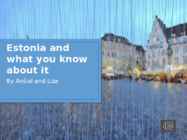
number of noun cases than typical. • According to comparative grammar studies, Estonian is one of the most sophisticated languages among the world languages. Holidays and Celebrations • Jaanipäev(Jaans day) • Mardi ja kadripäev(Kadri and Mardi’s day) • Laulupidu ja tantsupidu(Song and dance festival) Music • The history of music in Estonia dates back as far as the 12th century. The older folksongs, referred runic songs, are in the poetic metre regivärss the tradition shared by all Baltic Finns. These were gradually replaced by rhythmic folksongs in the 18th century. • Music as a whole is important for the Estonian people because it’s been a way for us to express our need for freedom and eventually getting this freedom this way. • The Estonian Hymn was written by Finnish Composer Fredrik Pacius who used the same notes for both writing the Finnish and Estonian Hymns. Other stuff/additional facts
· verse · verse When the first novelists began writing what were later called novels, they thought they were writing "prose epics." Daniel Defoe, Henry Fielding, and Samuel Ruichardson attempted the comic form. Yet what they wrote were true novels, not epics, and there are differences. Serious epic Comic epic oral and poetic language · written and referential language public and remarkable deeds · private, daily experiencer historical or legendary hero · humanized "ordinary" characters collective enterprise · individual enterprise generalized setting in time and place · particularized setting in time and place
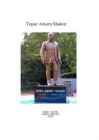
Ta maeti Peace Garden kalmistule Stone Mountainis Georgias. Diskograafia 1991 - 2Pacalypse Now (Kuld) 1993 - Strictly 4 My N.I.G.G.A.Z... (Plaatina) 1994 - Thug Life Vol. 1 (Kuld) 1995 - Me Against the World (2x Plaatina) 1996 - All Eyez on Me (9x Platinaa) (USA-s müünud üle 12 miljoni) 1996 - The Don Killuminati: The 7 Day Theory (4x Platinaa) Filmograafia 1991 Nothing But Trouble 1992 Juice 1993 Poetic Justice 1994 Above the Rim 1996 Bullet 1997 Gridlock'd 1997 Gang Related 2003 Tupac: Resurrection 2008 Live 2 Tell 2009 Untitled Tupac Shakur Biopic Kasutatud leheküljed : Google.com www.alleyezonme.com/ www.imdb.com Youtube.com Starpulse.com Wikipedia.com
main role. Emigrated to the United States in 1940, took American citizenship in 1946. 32 films The silent period ,,La Fille de l'eau" bug budget film. Emile Zola book ,,Nana". The film was shot in germany and became a commercial failure. In the following years Renoir directed smaller, more experimental films, where he developed is in depth composition skillls and started to work on the visual connection of differnet spaces. 1930 Poetic realism-whole film movement that was popular in France 1930. Contradiction, reality can't be poetic. Realism lies in the subject. Subjects are not glamorised. Stories are not about a dishwasher who becomes a star or something. Showed social group, social class. Showed everyday failures and so on in well composed style. Had strong fatalism. His films were very complex. 3 classical films ,,Le grande illusion", ,,La bete humaine", La regle du Jeu". Renoir in the American Studio-system
Normally it does not appear alone: it is accompanied by other means of sound orchestration. There have also been attempts to relate vowel sounds to the meaning they convey. · The sound [I] is said to produce the impression of lightness, airiness, brightness. · The length of vowels is also relevant--long vowels tend to sound more peaceful and solemn than short ones. Rhyme--is a special kind of regular sound repetition occurring at the end of poetic lines or at other, symmetrically placed stretches of a poem. Rhyming words are often situated at a regular distance from each other. Rhyme is the most obvious regular sound pattern in poetry that helps to structure ideas by linking lines together through similarities in the sounds of correlated words. Rhyming words have either similar or identical sound combinations. Full rhymes--repetition of the last stressed vowel and the following consonant (miss- kiss, mellow-yellow)
Voc. Syntagm Epithet: Special Lit. Voc. Monotonous rhythm Syntactic Terms Jerky rhythm Phrase Barbarisms / Alternating rhythm Sentence foreign w. Rambling rhythm Metaphorical Archaic w. Grading rhythm Transferred Poetic diction Oxymoron Neologisms Functional styles / registers Hyperbole STYLE AND STYLISTICS FGI 1081 Stylistics (I. Ladusseva) 2 The term "style" is polysemantic (has many meanings): a Latin word "stilus" originally meant a writing instrument used by ancient people. Already in classical Latin the meaning was
Comparison of P. B. Shelley's and W. Wordsworth's "To a Skylark" Poems The Skylark is a bird whose singing is very melodical. It is an inspiration to many poets, two of them being P. B. Shelley and W. Wordsworth. The Skylark is a common nature metaphor for pure poetic expression. Shelly Shelley's poem is all about praising the birds singing and how the lark can create such beautiful songs unintentionally. For the bird, singing is effortless and comes out naturally. Still the creation is harmonic and spreads joy. The poem starts with Shelly calling the bird a "blithe spirit" and expressing his admiration of how the song comes from the bird's heart without any effort. "Bird thou never wert-/ That
The sound [i], for example, either alone or in diphthongs, is said to produce the impression of lightness, airiness, and brightness. The length of vowels is also relevant. "... Long vowels tend to sound more peaceful than short ones, which tend to give an impression of quick movement" (M. Boulton). The predominance of long vowels and diphthongs is said to render the sense of slow pace or slowness, heaviness. RHYME - is a special kind of regular sound repetition occurring at the end of poetic lines or at other, symmetrically placed stretches of a poem. Rhyming words are often situated at a regular distance from each other. Rhyme has a twofold nature, it plays an important role in sound orchestration. Rhyme is the most obvious regular sound pattern in poetry that helps to structure ideas by linking lines together through similarities in the sounds of correlated words. The rhyming words have either identical or similar sound combinations. Identity of sounds results in full
The oldest epic poem in Europe. Composed at the end of the 7th century, the only manuscript that has survived is from the 10th century. Contains references to real people and real events. Scene of the poem: Denmark, southern Sweden (the A-S tribes came from these places). The poem records the history of the A-S tribes and the Jutes, before they invaded the British Isles. It is written in Old English, the language is lofty (very poetic, formal), it has many supernatural elements and is filled with heroic warriors and their deeds. The hero of the story Beowulf is almost an ideal A-S warrior, the champion of freedom and justice, courageous, has supernatural strength, is loyal to his king and has a very strong sense of duty. http://en.wikipedia.org/wiki/Beowulf · A-S were converted to Christianity. A lot of religious poems and hymns. Caedmonian.
His reputation grew at the beginning of the 20th c, when his passionate, dramatic poetry became popular again, and it is only since then that he has been widely recognised as one of the great poets of the English language. JOHN MILTON (1608-1674) born in London, wealthy family, smart. Political views : supporter of Cromwell and Parliament. He eventually went totally blind. Phase I: Early poems and a masque. Phase II: Prose writings. Phase III: Poetic masterpieces. Metaphysical poetry Donne was a great literary innovator and is widely considered to be the founder of the metaphysical school of poetry. The features of Metaphysical poetry are: · The use of conceits (Figures of speech which draw a comparison between two strikingly different things. Metaphysical poets made wide use of conceits in which the comparison was drawn with subjects from fields such as astronomy, mathematics and geography
According to Poe the universe has a mathematical beauty and precision in which one can see the hand of God. Art is man's instrument for making some order out of the chaos of existence. Opposite side of Poe's art is his aestheticism. The purpose of art is pleasure not the truth. The object of poetry is "rhythmical creation of beauty". Informational poetry, poetry of ideas, didactic was illegal according to Poe. Essay "the poetic principal". Principals are mostly symbolist. A poem is just a poem and nothing else, written only for the poem's sake, for the sake of beauty. Poe the prose writer was forced to starts writing shot stories because he was poor. It was a success. Won a competition "MS. Found in a bottle" (MS manuscript). The story is characteristic of his art in general. The opening is almost realistic, becomes weirder and weirder. Closing passages are fantastic. Poe's favourite trajectory. The
his lady love). 1) The matter of Britain about King Arthur and his court called Camelot 2) The Matter of Troy about the myth of Britain's lineage from the ancient city of Troy, by way of Britain's Trojan founder, Brutus 3) Breton Lays about unearthly magic The most famous collection of the King Arthur legends is Geoffrey of Monmouth's History of the Kings of Britain. Ballads short poetic folk tales that tell a story. Origins are in the oral tradition of story telling. They are of Anglo-Saxon origin. The author is usually unknown and the end is unhappy 9.) Definitions to the following terms: Ballad, beast epic, Chivalric romance, didactic poem, epic, alliteration, assonance, alliterative verse, kenning, metaphor, Anglo-Saxon heroic code, antagonist, protagonist, setting. Beast Epic humorous allegorical stories that contain a moral lesson, usually the main characters are
" In present- day english, the world style is used in about half a dozen basic meanings. 1. the characteristic manner in which a writer expresses his ideas. Some speak about the style of Hemingway, Dickens etc. 2. the manner of expressing ideas, characteristic of a literary movement or period. Style of symbolism, romanticism 3. the use of language to pick a literary genre-comedy, novel, drama, O.D (poetic form) etc. 4. the selective use of language that depends on spheres of human activity fiction, scientific prose, newspapers, official documents, business correspondenc etc. Style bears the stamp of indivual usage, that is every writer has a unique pattern/habit and abilities that form his style. This approach is best illustrated in the well-known victum of the french poet Georges-Louis de Buffon ,,Style is the man himself." Stylistics
was kept in power by the will of Parliament. 13. Restoration poetry (Rochester, Sackville, Sedley, Dryden) After 1660. 2 main themes: sex (whoring), drinking.Charles II’s court wa despite of its cloak of Anglican conformity, far more inclined to accept and enjoy sexual, religious and verbal licence. Cultured but lusty court. Sexual hints flourished. Stimulated and fostered the stricter disciplines of poetic satire, which fed on contradictions, the ironies and hypocrisies of society. Sharpness of wit, degree of profanity (pühaduseteotus) or ribaldry (nilbus), cultivated laziness, ministerially abetted (õhutatud) twists of laws and distractions of his mistresses. John Wilmot, Earl of Rochester: writer of satirical and bawdy poetry. To a Lady in a Letter, Song, A Song Charles Sackville: The Advice, from the Latin Sir Charles Sedley: Song Dryden: 14
more than we have been able to say, while at the same time seeming to say less."(452) In 1953, Jacques Maritain, a French philosopher, theologian, educator, and essayist, wrote "The Three Epiphanies of Creative Intuition", in his book, Creative Intuition in Art and Poetry. He wrote about how Dante's Divine Comedy is at the same time poetry of the song, poetry of the theater, and poetry of the tale. They are the three epiphanies of poetic intuition. Maritain believes that the essence of the song appears everywhere in the Divine Comedy, but more so in Paradiso, while drama appears everywhere, especially in Purgatorio, and novel is found everywhere, but especially in the Inferno. (386-387) Maritain observes that Dante combines feelings, distinct images, and a continuous and complex narrative of a world of an adventure and destiny in the Inferno. He feels that the entire poem clearly shows,
Edward is the eldest son of a man who died very rich; now his entire fate depends upon his mother's will. Although he is shy and not particularly handsome, he has an open, affectionate heart. His mother and sister want him to distinguish himself and earn prestige, but Edward is a simple man, who longs only for domestic comfort. In her discussions with her mother and her older sister, Marianne Dashwood expresses her disappointment that Edward is not a more striking, artistic, poetic man. She can tell that Elinor has feelings for Edward but becomes frustrated when Elinor concedes only that she "likes" and "esteems" him; Marianne longs to hear her sister profess her passionate devotion. However, Elinor remains timid because she is still unsure that Edward reciprocates her affection; such things are not usually openly expressed until after the engagement. Six months after Fanny installs herself as mistress at Norland, Mrs. Dashwood receives a letter from her cousin Sir John
even it was taken from some source it should not have quotation marks. We know this topic quite a large part of information will become our common knowledge, but we do not need to write about who married whom and when all it happened). If you quote a piece of prose a quotation of more than 4 lines should be presented differently (longer quotation (more than 4 lines) should be a separate paragraph and it should be indented (NB! 10 spaces from left margin). Quoting poetry: a poetic piece of 3 lines is a part of your paragraph, you are presenting it as prose only that you need to indicate the end of the line by a slash ( / ), more than 3 lines should have 10 spaces from left margin. MECHANICS Punctuation: full stop (.) has space after it, comma (,) should have a space after it too. Quotation marks ("...") have no space ( "Author X ..... about this fact" ), also there is no space between last quotation marks and a punctuation mark (e.g. ".....", ).
was different. He is more optimistic, believes that life goes on and that is indestructable. Although many individual lives were ruined, the life goes on, everything is not material success. Racial minorytis, who do not have all the rights, the have nots, the simple, the poor, the idiots. His method is very interesting. A lot of naturalistic elements, unpleasant details, not pure naturalist. Narrator's point of view, his style is more poetic of the style, rhythm and repetition. Steinberg is fascinated in foreign elements, includeing immigrants. He is a believer of the superiority to the country people to the city people. Because when his characters manage to establish themselves on the land they are usually good hearted and hard working, but when they have to abandon their land the trouble comes. Like a naturalist, great cruelty and passion. Very often the characters are simple, when they do commit crimes they do it out
literature of several independent nations once a part of what was historically Rus', the Russian Empire or the Soviet Union. The roots of Russian literature can be traced to the Middle Ages, when epics and chronicles in Old Russian were composed. By the Age of Enlightenment, literature had grown in importance, and from the early 1830s, Russian literature underwent an astounding golden age in poetry, prose and drama. Romanticism permitted a flowering of poetic talent: Vasily Zhukovsky and later his protégé Alexander Pushkin came to the fore. Prose was flourishing as well. The first great Russian novelist was Nikolai Gogol. Then came Ivan Turgenev, who mastered both short stories and novels. Leo Tolstoy and Fyodor Dostoyevsky soon became internationally renowned. In the second half of the century Anton Chekhov excelled in short stories and became a leading dramatist. The beginning of the 20th century ranks as the Silver Age of Russian poetry
isolation detached from events of her time. Her poems are extremely personal and intimate. Recurring themes include nature and death and, although she had rejected orthodox religion, much of her work contains a strong sense of spirituality. Many of her poems, however, are ironic and witty suggesting that their creator was a woman of great humour. Dickinson's style was completely unconventional and showed a total disregard for standard poetic forms. Her technique is so innovative that her work was considered unacceptable for publication. Apart from a few poems, most of her work was published posthumously. Emily Dickinson (1830-1886) Life Family background She was born in Amherst, Massachusetts. Her father was a successful lawyer and a prominent member of community who raised his children according to austere Puritan principles. During her early years Emily was witty and
adressaadile oleks operatiivne, nõuab teade viidatavat konteksti, mis on adressaadi poolt haaratav ning kas verbaalne või verbaliseerimisvõimeline. See oleks keel üldises mõttes, mitte aga konkreetne, mis kuuluks juba metakeelelise funktsiooni valdkonda. Põhimõtteliselt võib öelda, et teised viis funktsiooni on kõik selles (viitelises funktsioonis) osalised vähemal või suuremal määral. 6. Poeetiline (poetic) funktsioon on suunatus teatele kui niisugusele. See projitseerib ekvivalentsuse printsiibi selektsiooni teljelt kombinatsiooni teljele. Ekvivalentsus sarnasus ja erinevus on siin järgnevuse ülesehitust loovaks vahendiks. Kuigi me eristame keele kuut põhiaspekti, võime me paraku vaevalt leida verbaalseid teateid, mis täidaksid vaid ühte funktsiooni. Bloomfieldi põhimeetod on distributiivne analüüs ühiku eristamine ütluses segmenteerimine (morfid ja foonid)
Military was romanticized by scenes of battle and theatrical postures. Artists: Charles Willson Peale, Gilbert Stuart, John Trumbull, Thomas Sully, Rembrandt Peale. History. History painters had to create a demand for their paintings. History paintings encapsulated the patriotic duty to memorialize the country's struggle for independence and human rights. Allston was America's first truly Romantic artist and expressed the themes of mystery, terror and poetic daydreaming. Artists: John Trumbull, John Vanderlyn, Washington Allston. Landscape, Genre and Still Life. In late-C18, these were almost entirely neglected. Guy painted city life, Birch painted the seascape. The "Peale formula" was adhered to: objects along tableware against a dark background. Also, trompe-l'oeil persisted via Charles Willson's Peale's sons. Artists: Ralph Earl, Francis Guy, Thomas Birch, James Peale, Raphaelle Peale. Mid-C19 Landscape
Military was romanticized by scenes of battle and theatrical postures. Artists: Charles Willson Peale, Gilbert Stuart, John Trumbull, Thomas Sully, Rembrandt Peale. History. History painters had to create a demand for their paintings. History paintings encapsulated the patriotic duty to memorialize the country's struggle for independence and human rights. Allston was America's first truly Romantic artist and expressed the themes of mystery, terror and poetic daydreaming. Artists: John Trumbull, John Vanderlyn, Washington Allston. Landscape, Genre and Still Life. In late-C18, these were almost entirely neglected. Guy painted city life, Birch painted the seascape. The "Peale formula" was adhered to: objects along tableware against a dark background. Also, trompe-l'oeil persisted via Charles Willson's Peale's sons. Artists: Ralph Earl, Francis Guy, Thomas Birch, James Peale, Raphaelle Peale. Mid-C19 Landscape
British Literature in the 20th-21st Century REVISION QUESTIONS 1. The Contradictory, diverse, chaotic 20th century. New developments in science and philosophy. The essence and influence of Freudian theory. Contradictory, diverse, chaotic 20th c- simultaneous rejection and invocation of the past. While modernists apotheosized the creative geniuses of the past, they also rejected old poetic forms. Challenge old and established beliefs and more and more people had access to books and education more people went to universities. profound change in morals: · No universal value and perspective on things · Multiple truths, multiple perspectives · Nothing has inherent (kaasasündinud, sisemist) importance · Life lacks purpose Science: Albert Einstein-general theory of relativity had a huge impact on culture as well. Everything is relative.
returning to her family's house in Amherst. Thought of as an eccentric by the locals, she became known for her penchant for white clothing and her reluctance to greet guests or, later in life, even leave her room. Dickinson was a prolific private poet, though fewer than a dozen of her nearly eighteen hundred poems were published during her lifetime. The work that was published during her lifetime was usually altered significantly by the publishers to fit the conventional poetic rules of the time. Dickinson's poems are unique for the era in which she wrote; they contain short lines, typically lack titles, and often utilize slant rhyme as well as unconventional capitalization and punctuation. Many of her poems deal with themes of death and immortality, two subjects which infused her letters to friends. Walter Whitman Walter Whitman (May 31, 1819 March 26, 1892) was an American poet, essayist, journalist, and humanist
playwright Arthur Miller, whom she first met in 1951, in a civil ceremony in White Plains, New York. City Court Judge Seymour Robinowitz presided over the hushed ceremony in the law office of Sam Slavitt (the wedding had been kept secret from both the press and the public). In reflecting on his courtship of Monroe, Miller wrote, "She was a whirling light to me then, all paradox and enticing mystery, street-tough one moment, then lifted by a lyrical and poetic sensitivity that few retain past early adolescence".[40] Nominally raised as a Christian, she converted to Judaism before marrying Miller. After she finished shooting The Prince and the Showgirl with Laurence Olivier, the couple returned to the United States from England and discovered she was pregnant. However, she suffered from endometriosis, and the pregnancy was found to be ectopic. A subsequent pregnancy ended in miscarriage.
These were romantically inspired scenes from the heroic and desperate struggle against the German knightly orders in the 13th and 14th centuries. Under the harsh conditions of the Russification programme initiated in the 1880s such books stimulated the national spirit and willpower to resist all alien oppression. The poetess and playwright Lydia Koidula (1843-1886, daughter of Johann Voldemar Jannsen) played an exceptionally important role in the two decades before her death; her poetic talent emotionally and inspirationally expressed the national spirit, glorifying her homeland and its people. Koidula’s song, Mu Isamaa on Minu Arm (My Country is My Love) with the music written by Gustav Ernesaks (1908-1993) finished every song festival since 1947 (a tradition still very much alive), and became the unofficial anthem during the Soviet occupation when her father’s Mu isamaa, mu õnn ja rõõm (My Country is My Pride and Joy), the anthem of the first independent
In part appeared a reaction to romanticism. Realists strove (1) to understand what exists, determined to learn the truth; an exploration of reality, i.e. everyday life. Represents life with all its faults, documenting facts and details accurately. Realist authors (2) avoid poetic language, exaggerations, emotions and melodrama. They (3) oppose all idealisation in art, writing instead about the average and common. The common man, heroes of working class origin with no special talents. Charles Dickens, William Makepeace
Rivers: the Severn-longest, 354 km, flows through both Wales and England. The longest rivers in the UK by country are: England-river Thames, Scotland- river Tay, Northern Ireland-river Bann, Wales- river Tywi. Lakes: the deepest lake in the UK is Loch Morar-309 m deep. Largest lakes in the UK by country are: Northern Ireland- Lough Neagh, Scotland-Loch Lomond, England- Windermere, Wales- Llyn Tegid (Bala Lake). 26. Albion. a word used in some poetic or rhetorical contexts to refer to England. It was the original Roman name for Britain. It may come from the Latin word `albus', meaning `white'. The white chalk cliffs around Dover on the south coast are the first part of England to be seen when crossing the sea from the European mainland. 27. Britannia. the name that the Romans gave to their southern British province. It is also the
fantasy is revealed to be the conclusion of Joan Wilder's romance novel, which she is writing in her cluttered N e w York apartment. T h e opening fantasy sequence serves a dual purpose. It tells us a great deal about Joan W i l d e r and her unrealistic notions of romance, and also predicts the problems and situations she will face in the Special W o r l d of Act Two, when she encounters real villains and a less than ideal man. Foreshadowing can help unify a story into a rhythmic or poetic design. RAISING T H E DRAMATIC QUESTION Another important function of the Ordinary W o r l d is to suggest the dramatic question of the story. Every good story poses a series of questions about the hero. W i l l she achieve the goal, overcome her flaw, learn the lesson she needs to learn? Some questions relate primarily to the action or plot. W i l l Dorothy get home from Oz? W i l l E.T get home to his planet? W i l l the hero get the gold, win the game, beat the villains?
2. Do not just drop the weight when you hit failure. Attempt to move it, millimeter by millimeter, and then hold it at the limit for five seconds. Only after that should you slowly (take five to ten seconds) lower the weight. The biggest mistake novice trainees make is underestimating the severity of complete failure. "Failure" is not dropping the weight after your last moderately strenuous rep. It is pushing like you have a gun to your head. To quote the ever poetic Arthur Jones: "If you've never vomited from doing a set of barbell curls, then you've never experienced outright hard work." If you feel like you could do another set of the same exercise a minute later, you didn't reach failure as we are defining it. Remember that the last repetition, the point of failure, is the rep that matters. The rest of the repetitions are just a warm-up for that moment. 3. Do not pause at the top or bottom of any movements (except the bench press, as noted), and
nonpropositionality. Searle's account is propositional to the core, since all speaker-meaning is meaning that so-and-so. If Davidson is right that what we notice or see in metaphor "is not, in general, propositional in character," then by Searle's own principle aforementioned it is not a linguistic meaning of any kind, not even a speaker-meaning. Davidson's "in general" makes his claim fairly ambitious, indeed false. Perhaps many poetic and other literary metaphors are so rich as to be Metaphor 187 nonpropositional in their purport, but everyday metaphors used casually by ordinary people are often perfectly paraphrasable in context. Quite often, just as Searle says, the speaker certainly does mean something, possibly something quite specific. Hans comes into his apartment and finds it a dis-
 annaabi.ee