 50 punkti
Autor soovib selle materjali allalaadimise eest saada 50 punkti.
50 punkti
Autor soovib selle materjali allalaadimise eest saada 50 punkti.
 ~ 7 lehte
Lehekülgede arv dokumendis
~ 7 lehte
Lehekülgede arv dokumendis
 2017-06-20
Kuupäev, millal dokument üles laeti
2017-06-20
Kuupäev, millal dokument üles laeti
 1 laadimist
Kokku alla laetud
1 laadimist
Kokku alla laetud
 0 arvamust
Teiste kasutajate poolt lisatud kommentaarid
0 arvamust
Teiste kasutajate poolt lisatud kommentaarid
 Neit-Eerik Nestor
Õppematerjali autor
Neit-Eerik Nestor
Õppematerjali autor
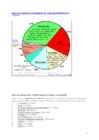
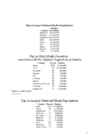
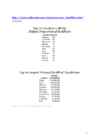
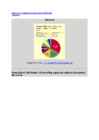
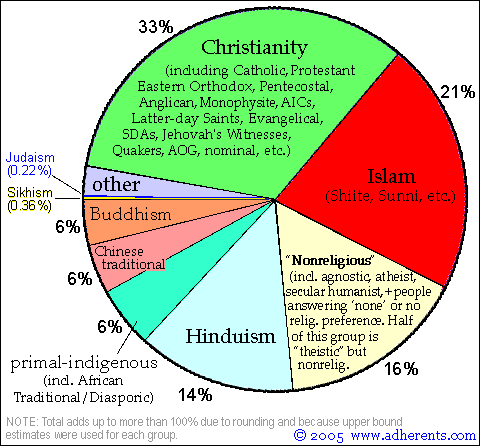
http://www.religioustolerance.org/worldrel.htm 4.08.2016. Pie-chart Image from the U.S. Center for World Mission Geographical distribution of prevailing organized religions throughout the world: 3 This map shows the most popular organized religion in each country of the world. So, for example, The Netherlands is shown as steel blue (mixed Catholic and Protestant) even though the largest group in the country are NOTAs (persons NOT Affiliated with any organized religion). Similarly, the UK is shown as Protestant Christianity even though weekly church attendance is in the single digits. Sponsored link: Basic information on various religions: Date % of Religion Sacred Texts Membership 4 Founded World 5
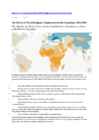
http://www.pewforum.org/2015/04/02/religious-projections-2010-2050/ APRIL 2, 2015 The Future of World Religions: Population Growth Projections, 2010-2050 Why Muslims Are Rising Fastest and the Unaffiliated Are Shrinking as a Share of the World’s Population The religious profile of the world is rapidly changing, driven primarily by differences in fertility rates and the size of youth populations among the world’s major religions, as well as by people switching faiths. Over the next four decades, Christians will remain the largest religious group, but Islam will grow faster than any other major religion. If current trends continue, by 2050 … The number of Muslims will nearly equal the number of Christians around the world. Atheists, agnostics and other people who do not affiliate with any religion – though increasing in countries such as the United States and France – will make up a declining share
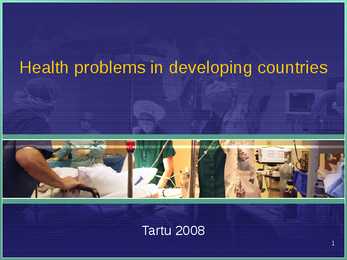
Health problems in developing countries Tartu 2008 1 Table of Contents · 1. Title · 2. Table of Contents · 3. Introduction · 4. List of Developing Countries · 5. Access to Health Services · 6. Equipment & Conditions · 7. Water PollutioN · 9. Environment · 10. HIV/AIDS · 12. Education of Health Care Workers · 13. Used webpages 2 Introduction · In many developing countries, including China and India, two of the most populous countries in the world, these are now the main sources of illness and death in the population. · Diseases are caused mainly by changes in lifestyle and environment as diets have become less healthy and the rural poor have moved into crowded and polluted cities. · Funding for health research worldwide has grown dramatically in the past 20 years, only a fraction is spent on
Tallinn 2013 Ott Speek Subject: English Geodesy Study group: GI-21b PETROLEUM PRESENTATION Petroleum (L. petroleum, from Greek: Πέτρα (rock) + Latin: oleum (oil) is a naturally occurring flammable liquid consisting of a complex mixture of hydrocarbons of various molecular weights and other liquid organic compounds, that are found in geologic formations beneath the Earth's surface. The name Petroleum covers both naturally occurring unprocessed crude oils and petroleum products that are made up of refined crude oil. A fossil fuel, it is formed when large quantities of dead organisms, usually zooplankton and algae, are buried underneath sedimentary rock and undergo intense heat and pressure. Petroleum is recovered mostly through oil drilling. This comes after the studies of structural geology (at the reservoir scale), sedimentary basin analysis, reservoir characterization (mainly in terms of porosity and permeable structures). It is refined and separated
Tallinn English College Topic The United States of America Tallinn 2007 1. Introduction The United States of America's territory is over 3.7 million square miles (over 9.6 million km²) and population more than 300 million people. The capital city is Washington D.C. Although the United States has no official language at the federal level, English is the de facto national language. English is the most common language for daily interaction among both native and non-native speakers. Spanish is the second language. The largest city is the New York City. The Government is Federal constitutional republic and the president is George W. Bush. 2. Geographical position The United States of America is located on the continent of North America. It has borders with two countries Mexico and Canada. There are also the Atlantic Ocean, the Pacific Ocean and the Gulf of Mexico surrounding the big country. There are 50 states in America.
SOCIETY AND CULTURE OF ENGLISH-SPEAKING COUNTRIES Introduction 1. Nowadays, English is so widely spoken that it can hardly be considered "a one nation's" language. The main countries where English is spoken are: the U.K, the U.S, Canada, Australia, the Republic of Ireland, New Zealand, West Indies 2. There are approx. 300-400 million speakers of English in the world. English occupies the 3rd place by its number of speakers; it is right behind Mandarin and Spanish. 3. ESL (English as a Second Language) used in your own country (e.g. India) EFL (English as a Foreign Language) used in a foreign country ESP (English for Specific Purposes) used in business, airlines, hotels etc. 4. Settlement colonies people migrated into them from Britain and started their own communities, they are the present English-speaking countries (USA, Australia, Canada, New Zealand) Trading Empire (dependencies
Population 1. Size, its changes 2. Distribution 3. Towns 4. Ethnic makeup 5. Age breakdown 6. Religion(s) 1. Size. 1 July 2006 population estimates by UK National Statistics: % (mid- Part Population (mid-2006) 2006) England 50,762,900 83.8 Scotland 5,116,900 8.4 Wales 2,965,900 4.9 Northern Ireland 1,741,600 2.9 United Kingdom 60,587,300 100 Although Britain is quite small in terms of land area (245,000 sq km), it has a large population of nearly 61 million, which ranks the 21st in the world (Britain is the 21st most populous state in the world) and the third largest in the European Union. The size of population is changing very slowly. Natural change is the difference
Society and culture of english-sspeaking countries Introduction 1. The countries of the world where the English language is spoken. 2. Approximate number of mother tongue speakers of English approximately 350-400 million native speakers. Which place does English occupy in the world by its number of speakers?After which language? English occupies second place by its number of speakers after Mandarin Chinese. 3. What is the difference between English as a Second Language, English as a Foreign Language and English for Specific Purposes? Give examples of situations where they are used. English as a Second Language (ESL or TESL) is a traditional term for the use or study of the English language by non-native speakers in an English-speaking environment. That environment may be a country in which English is the mother tongue (e.g., Australia, the U.S.) or one in which English has an established role (e.g., India, Nigeria) English as a foreign language A traditional term for the use o
 annaabi.ee








Kõik kommentaarid