Leidsid 33 sarnast õppematerjali, mis on seotud failiga "Gerunds and infinitives". Need materjalid aitavad sul teemat sügavamalt mõista.
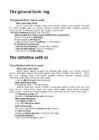
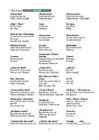
infinitive, verb, mean, verbs, means, remember, action, bear, stand, agreepen, forget, forming, before, avoid, express, hope, hear, passive, allowed, parents, stay, late, forgetting, sorry, something, dream, neti, habakuk, mölder, fixed, expressions, good, prepositions, enjoy, admit, consider, deny, understand, prevented, look, forward, adjectivesThe gerund form -ing The gerund form -ing is used: After some main verbs. (admit, appreciate, consider, delay, deny, detest, dislike, enjoy, escape, face, feel like, finish, forgive, give up, imagine, involve, mention, mind, miss, postpone, practise, prefer, put off, recommend, resent, risk, suggest, understand) I do not recommend going to that restaurant. After an adjective, verb or noun followed by a preposition. She is really good at swimming. He apologised to arriving late. I quite like the thought of working in a travel agency. In some fixed expressions I can not bear listening to people who complain. I can not help feeling that he is cheating us. That book is not worth reading. The infinitive with to The infinitive with to is used: After some main verbs
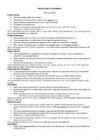
Gerunds (to) and infinitives (-ing) 7.1 Verbs followed by the gerund form ing. I considered buying a flat in Monte Carlo, but they were too expensive. Here are some common verbs which are followed by the gerund: Admit, appreciate (hindama), avoid, can´t help, can´t stand, consider, delay (viivitama), deny, detest (jälestama), dislike, enjoy, escape, excuse, face, feel like, finish, forgive, give up, imagine (ette kujutama), involve (sisaldama), mention (mainima), mind, miss, postpone (edasi lükkama), practise, put off, recall, resent, risk, suggest, understand 7.2 Verbs and phrases followed by the infinitive without ´to´ You must answer all the questions. Here are some common verbs/phrases which are followed by the infinitive without to:
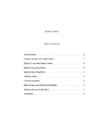
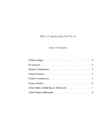
Modal Verbs Table of Contents Introduction ......................................................................... 2 Characteristics of Modal Verbs ............................................. 2 When to use the Modal Verbs ............................................... 3 Expressing permission.......................................................... 3 Expressing obligation ........................................................... 3 Making offers........................................................................ 5 Making requests ................................................................... 6 Expressing possibility/probability......................................... 7
consider, considers, considered Open vs. Closed class words: In linguistics, a closed class (or closed word class) is a word class to which no new items can normally be added, and that usually contains a relatively small number of items. Typical closed classes found in many languages are adpositions (prepositions and postpositions), determiners, conjunctions, and pronouns.[1] Contrastingly, an open class offers possibilities for expansion. Typical open classes such as nouns and verbs can and do get new words often, through the usual means such as compounding,derivation, coining, borrowing, etc. [2] Syntax: studies how words group together to make phrases and sentences. Sentences are not simply random strings of words; they conform to specific patterns determined by the syntactic rules of the language. The syntactic rules in a grammar must account for the grammaticality of sentences, word
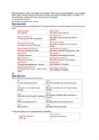
3 TALLEGG 11 MIZDE 4 VESITERM 12 LADA 5 STOW 13 SCHWUNG 6 KALEV 14 MAIASMOKK 7 YAMAHA 15 ISKU 8 ESTRAVEL 2 Affirmative tense Use Signal Words Negative/Questions · action in the present taking always, Present Simple A: He speaks. place once, never or several every ..., N: He does not speak. normally, often, Q: Does he speak? times seldom, · facts sometimes,
1 Anne Seaton · Y. H. Mew Three Watson Irvine, CA 92618-2767 Web site: www.sdlback.com First published in the United States by Saddleback Educational Publishing, 3 Watson, Irvine, CA 92618 by arrangement with Learners Publishing Pte Ltd, Singapore Copyright ©2007 by Saddleback Educational Publishing. All rights reserved. No part of this book may be reproduced in any form or by any means, electronic or mechanical, including photocopying, recording, or by any information storage and retrieval system, without the written permission of the publisher. ISBN 1-59905-201-6 Printed in the United States of America 13 12 11 10 09 08 07 9 8 7 6 5 4 3 2 1 Introduction Grammar is a very old field of study. Did you know that the sentence was first divided into subject and verb by Plato, the famed philosopher from ancient Greece? That was about 2,400 years ago
3. Use the simple present play(s), rain(s) etc to talk about habits and repeated actions. I play tennis every Saturday. (NOT I am playing tennis every Saturday.) It usually rains a lot in November. 4. Use will ..., not the present, for offers and promises. I'll cook you supper this evening. (NOT I cook you supper this evening.) I promise I'll phone you tomorrow. (NOT I promise I phone you tomorrow.) 5. Don't drop prepositions with passive verbs. I don't like to be shouted at. (NOT I don't like to be shouted.) This needs to be thought about some more. (NOT This needs to be thought some more.) 6. Don't use a present tense after It's time. It's time you went home. (NOT It's time you go home.) It's time we invited Bill and Sonia. (NOT It's time we invite Bill and Sonia.) 7. Use was/were born to give dates of birth. I was born in 1975. (NOT I am born in 1975.) Shakespeare was born in 1564. 8. Police is a plural noun.
de/a_an_some_ex3.htm balls ◦ *some eggs*some oranges *some umbrellas *some 3. http://www.english-4u.de/a_an_some_ex6.htm eagles We us the • when we talk about a specific thing. • when it is clear which thing or person we mean. A – AN - THE • when there is only one of something. Examples: What is the highest building in the world?
FUTURE SIMPLE BE GOING TO Will + infinitive (will go) Am/is/are going to + infinitive (is going to rain) 1.A decision at the moment of 1.Future plans made before the speaking: moment of speaking: A: 'I'm cold'. A: 'We've run out of milk.' B: 'I'll close the window'. B: 'I know, I'm going to buy some.' 2.Prediction based on opinion: 2.Prediction based on present I think the Conservatives will win the evidence: next election
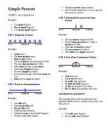
affirmative negative interrogative every day something happens repeatedly sometimes how often something happens always I work. I don't work. Do I work? one action follows another often Infinitive He works. He doesn't work. Does he work? Simple Present things in general usually he/she/it + -s I go. I don't go. Do I go? after the following verbs (to love, seldom to hate, to think, etc
7. Verb: The principal forms of the verbs: Verbil on 4 põhivormi: Regular verb Irregular verb 1. the base form Talk Speak üldoleviku tüvivorm 2. the past form/ -ed form Talked Spoke üldmineviku vorm 3. the past participle (-ed Talked Spoken participle) mineviku kesksõna 4. the present participle (- Talking Speaking ing participle) oleviku kesksõna The tenses: Expressing the future:
Concrete nouns refer to physical entities that can be observed and measured (cat, garage, soldier). Abstract nouns refer to abstractions that cannot be observed and measured (competition, conscience). verb tegusõna, In a clause, the verb is an obligatory and the most walk, put, do, be, must pöördsõna, verb central element. It denotes actions, events, processes and states. Verbs are either regular (cough, coughs, coughing, coughed) or irregular (speak, speaks, spoke, speaking, spoken). There are three main grammatical
that aquel aquella those aquellos aquellas El is also used with feminine nouns beginning with a or ha when the accent is on the first syllable. Words that end in -o and -or are generally masculine, with a few exceptions: la mano (hand), la foto (photo). Words that end in -a are generally feminine, with a few exceptions: el mapa (map), el problema (problem). Other feminine words end in -ción, -tad, -dad, or -tud. Use the ese forms to mean that when what you are talking about is near the person you are addressing. Use the aquel forms when what you are talking about is far from both you and the person you are addressing. Esto and eso are the neuter forms of this and that. They can be used in general and abstract ways. Demonstrative adjectives (listed above) are used before a noun; if you want to use the demonstrative pronouns, which are used before a verb, add an accent on all of the
etc, at night/the weekend, on Fridays etc. Present Continuous · Actions taking place at or arount the moment of speaking (The kids are watching TV..) · Fixed arrangements in the near future (I'm going to the dentist tomorrow) · Currently changing ang developing situations (The number of burgularies is increasing) · With ,,Always" to express anger or irritation at a repeated action (You're always forgetting..) TIME EXPRESSIONS USED WITH PRESENT CONTINUOUS: now, at the moment, at present, these days, nowadays, still, today, tonight etc. Present Perfect · Action happened at an unstated time in the past. Emphasis on the action, time is unimportant or unknown. (I have washed the car) · Action started in the past and continues up to the present, especially with stative verbs (I have known her for six years)
B R I A N T R AC Y JOHN WILEY & SONS, INC. ccc_tracy_fm_i-xviii.qxd 7/7/03 3:22 PM Page iv Copyright © 2003 by Brian Tracy. All rights reserved. Published by John Wiley & Sons, Inc., Hoboken, New Jersey. Published simultaneously in Canada. No part of this publication may be reproduced, stored in a retrieval system, or transmitted in any form or by any means, electronic, mechanical, photocopying, recording, scanning, or otherwise, except as permitted under Section 107 or 108 of the 1976 United States Copyright Act, without either the prior written permission of the Publisher, or authorization through payment of the appropriate per-copy fee to the Copyright Clearance Center, Inc., 222 Rosewood Drive, Danvers, MA 01923, (978) 750-8400, fax (978) 750-4470, or on the web at www.copyright.com
Modals Sandra Haar Form 11 I am going to talk about... Can Could May Might Must Should Would Ought to Excercises References How do we use modal verbs? Affirmative: Subject + modal + infinitive, Example: She should stay Negative: Subject + modal(n`t) + infinitive, Example: She shouln`t stay Interrogative: (Wh) Modal + Subject + Infinitive, Example: Why should she stay? Can Ability to do something in the present-I can speak English. Permission to do something in the present-Can I go to the cinema? Request - Can you wait a moment, please? Offer- I can lend you my car till tomorrow. Suggestion- Can we visit Grandma at the weekend?
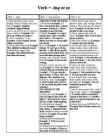
Verb + -ing or to Verb + -ing Verb + -ing and to Verb + to 1) Stop, postpone, admit, avoid, CHANGE IN THE MEANING: 1) Offer, decide, hope, deserve, imagine, finish, consider, deny, risk, 1) Remember Example: 1. I promise, agree, plan, manage, afford, fancy. Example: Suddenly know I locked the door. I clearly threaten, refuse, arrange, fail, forget, everybody stopped talking. remember locking it. 2. Please learn. Example: It was late, so we 2) Give up, put off, go on / carry on, remember to post the letter. decided to take a taxi home. keep or keep on. Example: I've 2) Regret Example: 1
Moved to Cali 2005 Was Born Traveled to Europe Husband 1978 School graduates @ Oxford 1999 Started Got married School 1983 2008 2 The Six English Verb Tenses Three Simple Tenses Simple continuous Present You walk. You are walking I run. I am running. Past You Walked You were walking. I ran. I was running. Future You will walk. You will be walking. I will run. I will be running. Three Perfect Tenses Perfect continuous
speaker the way the language should be written or spoken in order for the speaker to appear correct or educated. It could be said that this is an academic and strictly correct language use. For example: Never use ain’t Don’t split an infinitive (To quickly run) Descriptive grammar → Underlies the actual usage of speakers of the language. Grammar also has many components: Phonetics → The study of the acoustic detail of speech sounds and how they are articulated. Phone is a smallest unit of sound in human
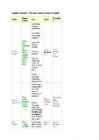
English Grammar - The most common tenses in English Signal Example Tense Use Form words s something happens repeatedly how often something happens every one action day follows sometim another es I work always infinitive Present things in he/she/it he works often Simple general + s I go usually he goes seldom
adjective + preposition omadussõna + eessõna proud of, good at, married to adverb particle Some verbs are followed by adverb particles. Examples are: put on, take off, give away, bring up, call in. Sometimes the particle is detached from the verb and put after the object. •He took his boots off. •They called the doctor in. apposition a grammatical construction in which two usually adjacent nouns having the same referent stand in the same syntactical relation to the rest of a sentence (as the poet and Burns in “a biography of the poet Burns”) back-reference In grammatical analysis, the term reference is often used to state a relationship of identity which exists between grammatical units, e.g. a pronoun 'refers' to a noun or noun phrase. When the reference is to an earlier part of the discourse, it may be called a 'back-reference' (or anaphora); collective noun
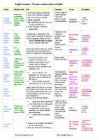
English Grammar - The most common tenses in English Tense Signal words Use Estonian Form Examples · something happens repeatedly *korduv tegevus every day · how often something happens *püsiv olukord sometimes, *tulevikus · one action follows another I work Present twice a week toimuv, seotud · things in general infinitive he works Simple always, often sõiduplaanidega · after the following verbs (to love, he/she/it + s I go
Manufacturing Buyer: JoAnne Sweeney Electronic Composition: Modern Graphics, Inc. Interior Design: Modern Graphics, Inc. Photo Researcher: Rachel Lucas Cover Design: Joel Gendron For related titles and support materials, visit our online catalog at www.pearsonhighered.com Copyright © 2009, 2001 Pearson Education, Inc. All rights reserved. No part of the material protected by this copyright notice may be reproduced or utilized in any form or by any means, electronic or mechanical, including photocopying, recording, or by any information storage and retrieval system, without written permiSSion from the copyright owner. To obtain permission(s) to use material from this work, please submit a written request to Pearson/Allyn and Bacon, Permissions Department, 501 Boylston Street, Suite 900, Boston, MA 02116 or fax your request to 617-671-229°. Between the time website information is gathered and then published, it is not unusual
In this type of conditional we can use when instead of if. E.g., If/When you mix blue and red, you get purple. If/When you don't water flowers, they die. (present simple in both parts of the sentence) If/When I asked her to come with us, she always said no. (past simple in both parts of the sentence) 1 First conditional If-clause present simple; Main clause future tense (or: can, must, may, etc., + bare infinitive) Used to talk about the consequences of a possible action (a real or very probable situation in the present or future). E.g., If I write my essay this afternoon, I will have time to go out tonight. (or: I might go out tonight). (It is still morning, and it is quite possible that I will do this.) NOTE: With type 1 conditionals we can use unless + affirmative verb (= if + negative verb). E.g., I will not be able to come unless Joe gives me a lift. (= If Joe does not give me a lift, ...)
complain, request something, etc. The paragraph or paragraphs in the middle of the letter should contain the relevant information behind the writing of the letter. Most letters in English are not very long, so keep the information to the essentials and concentrate on organising it in a clear and logical manner rather than expanding too much. 3. Last Paragraph The last paragraph of a formal letter should state what action you expect the recipient to take- torefund, send you information, etc. 4. Yours faithfully, - kui sa ei tea, kellele kirjutad Yours sincerely, kui sa tead, kellele kirjutad SINU NIMI a. Informal letter May 5th, 2010 Dear Sam, It's nice to hear.... Sincerely, NIMI a. Formal letter vs informal letter
Tests Superstar 1 Luke Prodromou Test 1 Name____________________ Class_______ Use your English 1 Complete these sentences using the correct form (present simple or present continuous) of the verb in brackets. _ 1 She is in a band and she _________________________________ (record) a CD at the moment. _ 2 She is an actress and often _________________________________ (appear) on television. _ 3 At the moment she _________________________________ (have) a rest because she is tired. _ 4 Mike is a doctor and he _________________________________ (live) in Manchester. _ 5 I _________________________________ (start) work at 8.30 every morning.
Simple Present Present Progressive/Continious (99%) infinitive form of 'be' and verb + ing (3rd person singular: infinitive + 's') I speak I am speaking you speak you are speaking he / she / it speaks he / she / it is speaking we speak we are speaking they speak they are speaking
It was raining earlier. He said it had been raining earlier. past perfect past perfect The play had started when I arrived. NO CHANGE POSSIBLE past perfect continuous past perfect continuous I'd already been living in London for five NO CHANGE POSSIBLE years. Other verb forms Other verb forms also sometimes change: will would I'll come and see you soon. He said he would come and see me soon. can could I can swim under water for two He said he could swim under water for two minutes. minutes. had to must
· She is always coming to class late. · Why aren't you doing your homework? · He is constantly talking. I wish he would shut up. USE 2 Longer Actions in Progress Now · I don't like them because they are always complaining. REMEMBER Non-Continuous Verbs/ Mixed Verbs Examples: (All of these sentences can be said while Examples: eating dinner in a restaurant.) · She is loving this chocolate ice cream. Not · I am studying to become a doctor. Correct · I am not studying to become a dentist. · She loves this chocolate ice cream. Correct
....................... 3 Present Simple ..................................................................... 4 Future Continuous ............................................................... 4 Future Perfect....................................................................... 6 Other ways of referring to the future ..................................... 7 Other future references......................................................... 8 Future Simple In Future Simple we use the modal verb will + the verb. It is the same in all persons. I will work I’ll work you will study you’ll study he will come he’ll come Negative I/you/he/we/they will not write I/you/he/we/they won’t write Question Will you/he/she/we/they come? 1. We often use will as a neutral way of expressing the future. We use will to say what we know or think about the future.
Kirjastus Studium, 2009 Kõik õigused on kaitstud. Ilma autoriõiguse omaniku eelneva kirjaliku loata pole lubatud ühtki selle töövihiku osa paljundada ei elektroonilisel, mehaanilisel ega muul viisil. Töövihik on kooskõlas 2009. a uuendatud õppekomplektiga I Love English 6. Tartu, 2014 ISBN 978-9949-436-59-0 Kirjastus Studium Riia 15b, Tartu 51010 www.studium.ee Trükitud OÜ Greif trükikojas Lohkva, Luunja vald Tartumaa 62207 --- 3 xxx 1. The Big Apple 1. Write the verbs in the present continuous or the past continuous tense. Do you remember? am is are was were verb -ing 1 Sorry. I ... (write) a report at the moment. I can't come with you. 2 When Peter arrived, his friends ... (play) football. 3 I ... (sleep) when the alarm went off in my sister's room. 4 Dad's mobile phone is switched off because he ... (fly) to Paris. He's on the plane at the moment. 5 I ... (read) an interesting book. It's a collection of memories. 6 Leo was late again. He ..
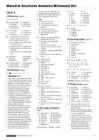
Maturita Solutions Advanced Workbook Key stand bananas and coffee! It's a bit 3 1 to 8 of Unit 1 uncanny really. Is it something she's 2 about 9 century passed on to me genetically, or is it 3 like 10 assumed / 1A Memories page 3 learned behaviour? Who knows? 4 of thought /
we need an apple some butter some apples some milk - We don't need a tomato any rice Any tomatoes any sugar ? Do we need a tomato? any rice? any tomatoes? any sugar? Past Simple irregular verbs Infinitive past+ past- Go went didn't go Have had didn't have Get got didn't get Buy bought didn't buy Leave left didn't leave Drive drove didn't drive Meet met didn't meet
 annaabi.ee