Leidsid 33 sarnast õppematerjali, mis on seotud failiga "German Federal Election, 2009". Need materjalid aitavad sul teemat sügavamalt mõista.
german, christian, democratic, merkel, social, party, vote, angelina, popular, parliament, angela, went, shape, before, suggested, keep, intention, centre, government, biggest, poker, face, politics, four, years, country, economy, recession, safe, pair, hands, might, result, gone, conclusion, germany, nearly, linke, strong, voice, left, means, takenUniversity of Tartu Faculty of Social Sciences and Education Institute of Government and Politics Marie Allikmaa The strategies of creating a dominant party the case of United Russia Tartu 2011 After the collapse of USSR in 1991, many observers expected Russia to develop into a competitive party system. Yet, the reality quickly challenged this view. The developments of party politics in post-Soviet Russia have accurately been described in terms of a pendulum effect, as in the 2000s, Russia's party system did finally begin to take for, but with a remarkable twist. Following the break of one-party rule, Russia's party system became strongly fragmented - during the 1995 parliamentary elections, 43 parties competed for popular votes (McFault 1996: 90)
Estonian history between 1710-1850 and 1850-1918 Contents Contents.................................................................................................................................. 2 17101850.............................................................................................................................. 3 Population and social structure........................................................................................ 4 Serfdom and the intensifying manorial economy ............................................................. 4 Influences of Pietism and the Moravian Brethren............................................................. 5 Enlightenment and enlightened absolutism...................................................................... 6 18501918..................................
The country was not called Russia at that time, but it was working its way of becoming an empire. During the 9th century the Scandinavian people who were called the Varangians crossed the Baltic Sea and went to the Eastern Europe. They settled in the city of Novgorod. They also gained control over Kiev, which is in modern day Ukraine. This city became a big trading centre between Scandinavia and the big Russian empire. The empire became very well-known and popular.Over the next couple hundred years the Varangians conquer more areas and the empire grows fast. The ruler of the empire, Vladimir, decided that the main religion is going to be Greek Orthodoxy. The next ruler Yaroslav started making basic laws for the empire ( " H i s t o r y a n d c u l t u r e , " ) . Over the next few hundred years, new invaders- Mongols settled in on the Russian territories. They made big improvements in the empire. For the first time the city Moscow
Netherlands Antilles and Aruba. With an area of 41,528 kilometers and a population of 16 million, The Netherlands (the European part of the Kingdom) is one of the world's smaller countries. (6) The Netherlands is a constitutional monarchy with a parliamentary system, in which the government consists of the queen and the ministers. For historical reasons, The Hague is the seat of government, but Amsterdam is the capital. The current government is a coalition between the Christian democrats (CDA), the liberal democrats (VVD) and the Pim Fortuyn List (LPF). Jan Peter Balkenende (CDA) is the Prime Minister. Queen Beatrix is the head of state. (6) 1.2 Land & Climate The Netherlands is very flat. Nearly a quarter of its surface area is below sea level. The lowest point in the Netherlands, near Rotterdam, is 6.7 metres below sea level. Its highest point, the Vaalserberg, is 312 meters above sea level. The Vaalserberg is in the southeast of the country,
West The Angles- Angulus to East Anglia, Jutes in Kent Same culture as southern Scandinavia, Germany, northern France 600 they had founded their 7 kingdoms The Anglo-Saxon kingdoms Kent-JUtes, Essex, Sussex, Vessex- Saxons East Anglia, Mercia, Nothumbria- Angles Series of over-kings from various kingdoms St Patrick Conversion of Irish- 432-461 Patron saint of Ireland, originally pagan, slave He escaped, became a Christian priest and later bishop. Ireland was largely christian by 6th C Monasteries multiplied, monastic lines, provinces were ruled by abbots St Columba 6th, 7th C Irish sent missionaries to Gaul, Germany, Scotland and England St Columba went to Scotland, converted Picts, 563 founded a monastery of island Iona Credited with major role in converting Scotland to Christianity St Aidan Irish missionary, King Oswalds of Northumbria
wanted to defeat it. He could clearly see that Britain was a threat to his latest and greatest conquest - France. He invaded Britain twice, in 55 and 54 BC. The first invasion was unsuccessful - it gained a beachhead on the coast of Kent but achieved little else. The second was more successful, the Celts asked for truce. However it wasn't a victory he had imagined and Julius Caesar never returned to Britain after that. The island was left undisturbed for nearly a century. *The Roman occupation of Britain 43-410 and its legacy Britain was conquered by Emperor Claudius, the Roman rule in England lasted up to 410. The Romans left behind a huge legacy: many types of animals and plants were brought to Britain in Roman times. Roman introduced theire measurements, Christianity, reading and writing. Also, many words in English and Welsh have been borrowed from the Latin language. An important legacy of
Calls for major changes in the Common Agricultural Policy (CAP), "fairer methods of financing the Community budget" and solutions to monetary problems. December: the Community’s heads of state or government decide to hold meetings three times a year as the European Council, agree direct elections to the European Parliament, resolve to set up the European Regional Development Fund and establish economic and monetary union. 1975 Launch of ERDF - The ERDF aims to strengthen economic and social cohesion in the European Union by correcting imbalances between its regions 1978 European Council establishes the European Monetary System based on a European currency unit (the ECU) and the Exchange Rate Mechanism (ERM). The Ecu has some characteristics of a real currency and is used in travellers’ cheques and bank deposits. ERM gives national currencies a central exchange rate against the Ecu. All the community’s members apart from the UK join the ERM. 1975
with the technology of the time. Another is its purpose. It appears to function as a kind on astronomical clock and we know it was used by the Druids for ceremonies marking the passing of the seasons. It appears in number of novels. These days it is not only the interest of tourists but is also a gathering point of certain minority groups. It is now fenced off to protect it from damage. 3. The Roman conquest Julius Caesar's first raid was in 55 BC but the romans left. Ad 43- the Romans came to stay. The army established Roman rule in the south and SW of the country. The Romans started to introduce their laws to a new province of the Roman Empire and started to build good roads. Officials were appointed (governors, procurators to collect taxes, look after the estates and mines and se that the gold, silver, iron and lead were exported back to Rome). Introduced schools,a new language Latin, large farms (villas), baths. In AD 410 they had to leave
educational structure. I find that Estonian schools should pay more attention to teaching our children current state in our political landscape. Kids, who go to school, are our future and soon-to-be full- right voters in national elections. They will become old and independent enough to be a part of deciding process over their country's future. So, it is very important that they would know which political party stands for what beliefs and who are the politicians in Estonia who are leading our country. Youth, especially youngsters aged 15-18 should know or find out what is their political affiliation. Politics, elections, new laws, different kinds of reforms are constant part of our lives and that is why it is vital for also young people to be well-educated about those subjects. At present, the youngsters spend most of their free time staring at computer
The territory of Estonia covers 45,227 km² and is influenced by a temperate seasonal climate. The Estonians are a Finnic people closely related to the Finns, with the Estonian language sharing many similarities to Finnish. The modern name of Estonia is thought to originate from the Roman historian Tacitus, who in his book Germania (ca. AD 98) described a people called the Aestii. Similarly, ancient Scandinavian sagas refer to a land called Eistland, close to the German term Estland for the country. Early Latin and other ancient versions of the name are Estia and Hestia. Until the late 1930s, the name was often written as Esthonia in most English speaking countries. Estonia is a democratic parliamentary republic and is divided into fifteen counties. The capital and largest city is Tallinn. With a population of only 1.4 million, it is one of the least-populous members of the European Union. Estonia was a member of the League of Nations from 22
Resolve the Georgia crisis (dispute with Cherokee) Move of over 70,000 natives (vabatahtlik-sunniviisiline) Reservations (kaitsealad)1851- the Indian Appropriations Act About 310 reservations 55,7 million acres Unevenly distributed Tribal sovereignty (iseseisvus) Poverty and unemployment · Indian citizenship Act of 1924 Granted citizenship to 300,000 indigenous people, to friendly tribes State support was limited Absorb Indians into the mainstream Didn't have the right to vote · Trail of Broken Treaties of 1972 Took place in 1972 Cross-country protest by American Indian organizations Intended to bring attention to American Indian issues such as treaty rights, living standards, and inadequate housing. Huge media coverage "20-Point Program" · Present situation 1 Reservations situated west of the Mississippi 1% of the population Minority group, less privileged Social problems Self-awareness Mixture of old and new
- Ei saa algatada eelnõusid vaid hääletab Euroopa Komisjoni esitatud eelnõud üle - 1992 Maastrichti ja 1997 Amsterdami leping muutsid EP seadusandlikuks parlamendiks - Õigus anda seadusandlikke akte - Rahandusalased volitused - Järelvalve täidesaata võimu üle - On president, juhatus ja esimeeste konverents, komisjonid, fraktsioonid ja delegatsioonid - 751 liiget, 750 max + president Party groups - Group of the European People’s Party (Christian Democrats) - Group of the Progressive Alliance of Socialists and Democrats in the European Parliament - Group of the Alliance of Liberals and Democrats for Europe - Group of the greens/european free Alliance - European conservatives and reformists group - Confederal group of the european united left – nordic green left - Eruope of freedm and direct democracy group - Europe of nations and freedom European Comission
Guthrum, Danish king of East Anglia. England was divided. Later, the Anglo-Saxon dynasty was restored and lasted until 1066. The last famous Saxon king of England was Edward the Confessor. In 1066 at the battle of Hastings the Norman Duke William defeated the Saxon King Harold and was crowned the king of England. In Norman times three languages were spoken: Latin (by the clergy and the university scholars), Norman-French (by the aristocracy and the king), Anglo- Saxon German (by common people). By the 14th century Norman-French and Anglo-Saxon German formed one language called Middle English. Medieval Britain (1066-1485): 1066 the Battle of Hastings between the Anglo-Saxons and the Normans. The Anglo-Saxons were defeated, Harold II was killed, William of Normandy became William I of England (William the Conqueror). 1215 the Magna Carta: king John was forced to sign a document which limited his power. 1337 the Hundred Years' War with France
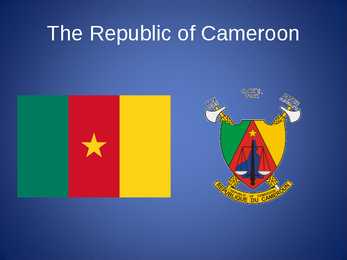
the Central African Republic to the east; and Equatorial Guinea, Gabon, and the Republic of the Congo to the south. · Cameroon's coastline lies on the Bight of Bonny, part of the Gulf of Guinea and the Atlantic Ocean. · The country is called "Africa in miniature" for its geological and cultural diversity. History · The territory of present day Cameroon was first settled during the Neolithic · Portuguese sailors reached the coast in 1472 · The German Empire claimed the territory as the colony of Kamerun in 1884 and began a steady push inland. · An economic crisis took effect in the mid-1980s to late 1990s as a result of international economic conditions, drought, falling petroleum prices, and years of corruption, mismanagement, and cronyism. Politics and Government · The President of Cameroon has broad, unilateral powers to create policy, administer government agencies, command
There are offices, committee rooms, restaurants, bars, libraries and even some places of residence. Two large rooms: The House of Lords meet in one and the House of Commons in the other. The British Parliament is divided into two houses, but the House of Commons is obviously more important and only they are considered to be the MPs. In the House of Commons there are just two rows of benches facing each other. On the left sit the members of the governing party and on the right sit the opposition. The Speaker sits between them and controls the action. The arrangement of the benches encourages confrontation between the government and the opposition. There is no place for somebody who isn't neither in the opposition nor in the government side. Usually peeps like this sit in the opposition furthest from the Speaker. || There are no tables for the MPs. They also have no obvious place to address each other from. They can walk in and out during the debates
British Parliament Structure and Functioning of the British Parliament today Britain is a parliamentary monarchy . The British Parliament is a bicameral parliament , that is to say that it is made up of two chambers, or two "Houses"; above the two Houses, but in an essentially formal role , there is the Sovereign - king or queen - also known as "the crown." Role of the Sovereign The British monarch has all authority, but no power. The Sovereign appoints the Prime Minister, and every year opens the sessions of parliament, in a historical and ritual ceremony called the State Opening of Parliament . Historically, this ceremony used to take place in the
In June 1934 he was admitted to the Mayo Clinic in Rochester, Minnesota and diagnosed with colitis. When Kennedy graduated from Choate in June 1935 his superlative in The Brief, the school yearbook (of which he had been business manager), was"Most likely to Succeed." 1960 presidential election On January 2, 1960, Kennedy officially declared his intent to run for President of the United States. In the Democratic primary election, he faced challenges from Senator Hubert Humphrey of Minnesota and Senator Wayne Morse of Oregon. Kennedy defeated Humphrey in Wisconsin and West Virginia and Morse in Maryland and Oregon, although Morse's candidacy is often forgotten by historians. He also defeated token opposition (often write-in candidates) in New Hampshire, Indiana, and Nebraska. In West Virginia, Kennedy visited a coal mine and talked to mine workers to win
She also restored national unity and made England Protestant again. The discovery of America placed Britain in the centre of the world's trading routes and brilliant naval commanders (Sir Francis Drake, Sir Walter Raleigh) enabled England to dominate these trade routes. Sir Walter Raleigh is known for being the person who first brought potatoes and tobacco to Britain. The Stuarts In 1602 the Pilgrim fathers left England on Mayflower because of religious reasons and established colonies in America. On 5th November 1605 English Catholics, with Guy Fawkes as their leader attempted to blow up king James I and the Parliament. They failed at their attempt and that day is nowadays called Guy Fawkes Night. The Stuarts king James I and Charles I followed the medieval notion of monarchy, ignoring parliament. James I united England and Scotland. Charles I raised taxes without its
Portuguese territory as well. The country is named after its second largest city, Porto, whose Latin name was Portus Cale. SETTLEMENT The land within the borders of the current Portuguese Republic has been continuously settled since prehistoric times. In the 8th century most of the Iberian Peninsula was conquered by Moorish invaders professing Islam, who were later expelled by the Knights Templar. During the Christian Reconquista, Portugal established itself as an independent kingdom from León in 1139, claiming to be the oldest European nation-state. In the 15th and 16th centuries, as the result of pioneering the Age of Discovery, Portugal expanded western influence and established the first global empire, becoming one of the world's major economic, political and military powers. In addition, the Portuguese Empire was the longest-lived of the modern
Like popes, patriarchs, metropolitans, cardinal bishops, diocesan bishops, and suffragan bishops, archbishops are in the highest of the three traditional orders of bishops, priests, also called presbyters, and deacons. An archbishop may be granted the title, or ordained as chief pastor of a metropolitan see or another episcopal see to which the title of archbishop is attached. Bishop is an ordained or consecrated member of the Christian clergy who is generally entrusted with a position of authority and oversight. Some Protestant churches including the Lutheran and Methodist churches have bishops serving similar functions as well, though not always understood to be within apostolic succession in the same way. One who has been ordained deacon, priest, and then bishop is understood to hold the fullness of the (ministerial) priesthood, given responsibility by Christ to govern, teach and sanctify the Body of Christ,
THE U.K Different Parts The United Kingdom is a short way of saying the United Kingdom of Great Britain and Northern Ireland. The UK is the political name for those countries which share a parliament in London. All of them were at one time independent kingdoms with their own monarch. Now they are all part of the same kingdom and share the same monarch. The UK consists of Northern Ireland, Scotland, England and Wales. The peoples of these countries are British subjects; they hold British passports and therefore their nationality is British. The british Isles is the geographical name for all the islands off the west coast of Europe.
Ukrainians, Belarusians and Finns. Rest are of unknown nationality. 68.5% of population speaks Estonian as a mother language, 29.6% speaks Russian as a mother language and 0.6% Ukrainian. Estonia has only one official language which is Estonian. According to information by the Institute of the Estonian Language there are about 75% of Estonian people who speak Estonian. The most common foreign languages learned by Estonian students are English, Russian, German and French. Other popular languages include Finnish, Spanish and Swedish. Tallinn is the capital and largest city of Estonia. In Estonia there are 47 cities/towns. More than 70% of the population lives in towns. The largest cities are Tallinn, Tartu, Narva, Pärnu. According to the information from tallinn.ee there are 439 517 people living in Tallinn of the 1th of January. In 2013 there where 621 300 people employed across all industry sectors. 26 500 of them
tobacco in Maryland and Virginia. California is famous for its fruit, and the west for its cattle-farming. Poultry farming is highly developed in the countryside near all big cities. The United States is rich in various metals and minerals. It holds first place in the capitalist world. The Great Lakes and the rivers, especially the Mississippi, are important waterways. For Americans, democracy means more than majority rule. It also means minority rights. The American democratic government was established in March 1789 in the Constitution of the United States. In this system, rights and powers are divided between the individual states and the central, or Federal government. To prevent any political party from becoming too powerful, the powers of the Federal Government are divided. The Federal government has 3 branches - the executive, the legislature and the judiciary. The power of each branch is carefully balanced by the powers of each of the others. The Congress
The Queen, Adele, Elton John, Shakespeare, JK Rowling. 5. Which 5 places attract visitors in Wales and Scotland? Edinburgh, Loch Ness, The Highlands, Snowdonia, Cardiff. 6. Name 6 islands, 5 rivers, 3 lakes, 3 mountains in UK. Isle of Man, Isle of Wight, Isle of Lewis, Island of Mull, Island of Arran, Anglesey Island Severn, Thames, Tweed, Avon, Trent, Dove Ben Nevis, Snowdon, Ben Macdui 7. Stonehenge. Stonehenge was produced by a culture that left no written records. Built on Salisbury Plain, in Wiltshire, England some time between 5,000-4,300 years ago. One of the most famous megaliths in the world, dating from prehistoric times. Stonehenge consists of circles of stone arranged in complex patterns, and their origin is still being explored. Some of the stones come from over 200 miles away in Wales. There is little or no direct evidence revealing the construction techniques used by the Stonehenge builders
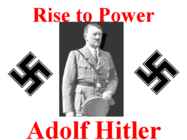
Rise to Power Adolf Hitler Objectives: • The objective of this presentation is to give students an understanding of Adolf Hitler’s early, pre-adult years. • Students will also become familiar with how this seemingly unimportant Austrian rose to power in post World War I Germany. Overall Purpose: The overall purpose of this presentation is to explain how this little boy on the left became the man on the right who was ultimately responsible for the death of about 50 million people all over the world!! Birth • Adolf Hitler was born on April 20, 1889 in Braunau, Austria. • Adolf was 1 of 6 children - 3 of who died at early ages Parents Alois Schickelgruber Hitler was a customs official who was illegitimate by birth. His father, Adolf’s grandfather, may have been Jewish
Science: Albert Einstein-general theory of relativity had a huge impact on culture as well. Everything is relative. Philosophy: Henri Bergson (French) came to challenge the immediate experience ad intuition are more significant than rationalism and science for understanding reality. Opposition to materialism and positivism. Opposition to abstract, untested theories &ideologies. Friedrich Nietzsche ,,God is dead"-through explaining and putting forward theories had killed Christian god. The essence of Freudian theory: the process in the human psyche Superego-society, conscience, morals, traditions, religion, a moral censor Ego-rational behavior, motivation, self-identification, conscious decisions Id-instincts, natural responses, the pleasure principle, aggressive instincts, the death wish Influence: In art and literature, Freud's theories influenced surrealism . Like psychoanalysis, surrealistic painting and writing explores the inner depths of the unconscious mind
Its chief values were: Liberty, Democracy, Republicanism, Religious Tolerance. The movement gained momentum with the publication of landmark texts like Thomas Paine's The Age of Reason, and the Jefferson Bible, but the most influential thinker was undoubtedly John Locke, whose ideas spread to the colonies and across Europe. Main Ideas of the American Enlightenment: The Enlightenment caused a shift in the cultural and social attitudes of the people, bringing in some new and radical ideas. Republicanism: The doctrine of republicanism asserts a system of a government that is elected by the people of the nation. The roots of this ideology go back to ancient Greece, when the concept of a democratic government was examined by philosophers such as Plato and Aristotle. Individual Liberty: "Life, Liberty, and the pursuit of Happiness" developed as the motto of this era, which forms the cornerstone of the U.S
from which large numbers immigrated such as Ireland, Germany, Poland, and Italy; the Native American people; Africa, especially the western part, from which came the ancestors of most African Americans; and young groups of immigrants. American culture also has shared influence on the cultures of its neighbours in the New World. Music Rock and roll, country, rhythm and blues, jazz, and hip hop are among the country's most internationally renowned genres. Since the beginning of the 20th century, popular recorded music from the United States has become increasingly known across the world, to the point where some forms of American popular music are listened almost everywhere. Folk music in the United States is varied across the country's numerous ethnic groups. The Native American tribes each play their own varieties of folk music, most of it spiritual in nature. African American music includes blues and gospel; descendants of West African music brought
Tallinn Järveotsa Gymnasium MARGARET THATCHER Maria Ignatenko Form 11.B Tallinn 2008 Margaret Thatcher (1925-...) General Data Margaret Hilda Thatcher was born on the 13th of October, 1925 in London. She is a British politician who served as Prime Minister of the United Kingdom and Leader of the Conservative Party. Margaret is the first woman who has ever held these posts. Childhood and Education Margaret Hilda Roberts was born on the 13th of October, 1925 in Grantham in Lincolnshire, England. Her parents were Alfred Roberts and Beatrice Stephenson Roberts. Thatcher spent her childhood in the town of Grantham in Lincolnshire. The Roberts family ran a grocery business, bringing up their two daughters in a flat over the shop. Her father was active in local politics and
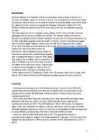
flag has always been hoisted with ceremony on that day, which is the national holiday the anniversary of the republic. According to the Estonian tradition, the national flag is hoisted at sunrise and lowered at sunset except on June 23, Victory Day, when it is left out for the shortest night of the year, followed by another public holiday, Midsummer Day. The Estonian national anthem - entitled My Native Land, My Pride and Joy, was composed in 1848 by Friedrich Pacius, a Finn of German descent. The Estonian- language words were written by Johann Voldemar Jannsen. In 1869 it was performed at the first all-Estonian Song Festival in Tartu and gained popularity during the period of the national movement. After World War I the melody became the national anthem of Estonia and Finland. It was officially adopted in Estonia after the War of Independence in 1920. The anthem was banned during Soviet occupation and another song, My Native Land, My Dearest Love by Gustav
At least 10 per cent of the Estonian territory is subject to the environment protection. The most important protection areas are resting and recreation areas for migratory birds. Mainly seashore wetlands and chaste woodland and wetland areas. The preservation of traditional cultural landscapes is important as well. 5 History To the Nineteenth Century The Estonians settled in their present territory before the Christian era. They were mentioned by Tacitus 1st century A.D., who called them Aesti. In the 13th cent. the Danes and the German order of the Livonian Brothers of the Sword formed an alliance to conquer the pagan Estonian tribes. The Danes founded Reval (now Tallinn) in 1219 and introduced Christianity and Western European culture to Estonia. While Denmark took the northern part of Estonia, the knights occupied the southern portion. In 1346
the EU and its member countries. European Union law is applied by the courts of member states and where the laws of member states provide for lesser rights European Union law can be enforced by the courts of member states. European Union institutions The European Union is governed by seven(7) institutions. Article 13 of the Treaty on European Union lists them in the following order: 1) the European Parliament 2) the European Council 3) the Council of the European Union (simply called "Council") 4) the European Commission 5) the Court of Justice of the European Union 6) the European Central Bank 7) the Court of Auditors Most EU institutions were created with the establishment of the European Coal and Steel Community (ECSC) in the 1950s. Much change since then has been in the context the shifting of the power balance away from the Council and towards the Parliament.
There are 650 Members of Parliament in the House of Commons. Leaders of the Government and the Opposition sit in the front row and their supporters sit behind them. The House is presided over by the Speaker. He/she is elected by the MPs. The members of the House of Lords are not elected. This chamber consists of the Lords Spiritual. The House of Lords is presided over by the Lord Chancellor. There are about 1200 members there. There are 2 main parties: the Labour Party and the Conservative Party. The Labour Party has been in power from 1997 and have had some shorter spells before too. The leader of them is Tony Blair. He's also the Prime Minister as the leading figure of the party in power becomes also the Prime Minister and he can appoint himself his Government. The Labour Party is popular amongst the middle classes and the Conservative Party has the support of the wealthier people. Economy. Britain has a wide range of industries
 annaabi.ee