Leidsid 33 sarnast õppematerjali, mis on seotud failiga "What is levels of formality". Need materjalid aitavad sul teemat sügavamalt mõista.
formal, language, levels, friend, informal, friends, letter, facelang, importanteriousocial, internetuchubjects, communication, possible, draw, conclusion, almost, everywhere, understanding, often, first, routine, delivered, humor, phone, call, pronouns, other, correct, completeentences, withoutimilarly, casual, usually, best, membersRoman politician, philosopher & translator. Theory ‘‘word-for-word’’ & ‘‘sense-for-sense’’. • Martin Luther – his role in the history of translation studies. Lived during the 15th century. He was a priest, theologian & translator. During that time, the Bible’s were only available in either Latin or Hebrew, which made it very difficult for common people to understand. He came out with a radical plan to translate the Bible into local languages (the first language was German – translated by Martin Luther). This inspired many other translators during that period. • What happened in the 19th and 20th century in translation studies? When and who created the term ‘translation studies’? Translation Studies – James S. Holmes - 1972 Ferdinand de Saussure – Lived during the 19th and 20th century. He was a Swiss linguist and a semiotician. He is widely considered one of the
their contractual obligations. By reversing the order in which the two problems are described, the secretary ensures that this piece of information receives the maximum amount of emphasis, or focus, and thus leads logically into the recommendation. We will be looking again at the idea of linguistic focus in Unit 6. 3 Grammar, Spelling and Sentence Construction As well as reorganizing the information in the report the secretary also made a number of changes to the language which the writer had used. You probably noticed that Text 1 contained a number of grammatical and spelling mistakes. If not, look for them now before continuing with this Discussion section. Grammar `AMC's works have gone down' AMC's work has really gone down. (Work is a singular, uncountable noun.) `since five days' for five days (Since is used only with a
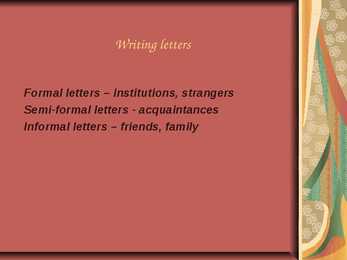
Writing letters Formal letters institutions, strangers Semi-formal letters - acquaintances Informal letters friends, family Layout Always in paragraphs A paragraph starts with a space, which is as wide as your finger No empty rows Block style in the content of the letter Greeting and farewell on the left side The greeting and farewell have the same style Dear..................... ........................................................................ ............................................................................. ......................................................... ........................................................................ ............................................................................. ...............
References: Kahny, Jim. Classroom dynamics: An interview with Jill Hadfield. Available at http://ltprofessionals.com/journalpdfs/vol1no1/features/winter2000kahny.pdf accessed 27.12.2012 ESOL Teaching Skills TaskBook. Classroom dynamics: unit 1 a). Available at http://akoaotearoa.ac.nz/download/ng/file/group-4/n2431-esol-teaching-skills- taskbook-unit-1-a---classroom-dynamics.pdf accessed 27.12.2012 III Language teaching methods. · (Traditional: the grammar-translation method/ classical method.) · Traditional: the direct method Youtube: http://www.youtube.com/watch?v=XiQvG-fvzLM Kids lesson (direct method) Language is primarily speech Reading skills are developed through practice with speaking Realia is used to convey the meaning Demonstration instead of translation or explanation Complete sentences instead of vocabulary lists The purpose of language learning is communication
Letters Letters FORMAL, INFORMAL, TRANSACTIONAL TASK 1 Read the extracts and answer the questions. · Where are the extracts from? · What is the purpose of each letter? · How do they differ? · Which extracts are examples of formal letters? · How is the reader addressed in a formal letter? · What are the closing remarks for formal letters? · What is the salutation in a friendly letter? · How would you end extracts 1,2,3 ? · How would you begin the extracts 4 and 5? 1. Dear Mr Miller, I received your kind invitation to the reception. Unfortunately, owing to other commitments. I will be unable to attend ... 2. Dear Ralph, l just got your invitation to the company's event. l `m afraid I can't make it because I've a/ready made plans which l can "t change ... 3. Dear Sirs,
HOW TO WRITE AN ARGUMENTATIVE ESSAY An argumentative essay is a formal, impersonal piece of writing in which the writer is either expected to give a balanced consideration of a particular topic, or to state their own opinion clearly and then support it by giving reasons. An essay should begin with an introduction in which some background information is given about the problem that is going to be discussed. The angle from which the problem is going to be looked upon in the essay is also stated. In
I must ask you to… I feel that I am entitled to a refund… I hope that this matter will receive your prompt attention and that my TV set will be replaced. I would appreciate it if you could look into this matter as soon as possible. I hope that this matter can be resolved/dealt with promptly. I look forward to your reply on the matter. Sign-of Yours faithfully – if you don’t know the name Yours sincerely – if you now the name Style Formal language: no slang, foul language, informal words, contractions. This is a piece of academic writing. Clear paragraphs (indented lines OR block style) Transactional letters/letter of inquiry Transactional letters require a reply which may be based on advertisements, other writing input, letters, etc. For example, a letter which is asking for further information about summer camp based on an advertisement. Use an appropriate style.
ancient people. Already in classical Latin the meaning was extended to denote the manner of expressing one's ideas in written or oral form. Jonathan Swift defined style as "proper words in proper places". In present day English the word "style" is used in about a dozen of principle meanings: 1. the characteristic manner in which a writer expresses his/her ideas (e.g. style of Byron) 2. the manner of expressing ideas, characteristic of a literary movement or period 3. the use of language typical of a literary genre (e.g. the style of a comedy, drama, novel). 4. the selective use of language that depends on spheres / areas of human activity (e.g. style of fiction, scientific prose, newspapers, business correspondence, etc.). STYLISTICS Stylistics is the study of style. The very term "stylistics" came in more common use in English only some 45 years ago.
12. Special literary vocabulary 13. Special colloquial vocabulary 14. Metre in English poetry. Modifications of metre ("Rhythm and Text") 15. Typically English stanzas ("Rhythm and Text") 16. Rhythm in poetry and in prose ("Rhythm and Text") Study independently 17. Varieties of language (I. Galperin "Stylistics") 18. Emotive prose (I. Galperin "Stylistics") 19. Scientific prose style (I. Galperin "Stylistics") 20. Language of the drama (I. Galperin "Stylistics") 21. Publicistic style (I. Galperin "Stylistics") 22. The style of official documents (I. Galperin "Stylistics") 23. Newspaper style (I
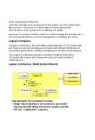
– Add additional attributes, operations, relationships – Redefine inherited operations (use caution!) • Common attributes, operations, and/or relationships are shown at the highest applicable level in the hierarchy IV Relationships: Realization • One classifier serves as the contract that the other classifier agrees to carry out • Found between: – Interfaces and the classifiers that realize them – Use cases and the collaborations that realize them 5. UNIFIED MODELING LANGUAGE Use Case Analysis is a technique to capture business process from user’s perspective. What is the UML? • UML stands for Unified Modeling Language • The UML combines the best of the best from – Data Modeling concepts (Entity Relationship Diagrams) – Business Modeling (work flow) – Object Modeling – Component Modeling • The UML is the standard language for visualizing, specifying, constructing, and documenting the artifacts of a software-intensive system
) Can be considered somewhat culture-free (not really true?) Universal: not confines to one speech community Characteristic features: Terminology (5-10%), only that much, but it makes the text hard to translate Format: technical report, but also instructions, manuals, notices, publicity Grammatical features in English: passives, third persons, empty verbs, present tenses. Technical Style Free from emotive language, connotations, sound-effects, original metaphor Part of technical translator’s job often is to rephrase poorly written language and convert metaphor to sense. Varieties of Technical Style Academic or scientific style: very formal with transferred Latin and Greek words; used in academic papers Professional or workshop: formal terms used by experts Popular or everyday: layman vocabulary which may include familiar alternative terms.
1. Be ready to explain the terms (lecture 1): language, linguistics, synchronic approach to language, diachronic approach to language, linguistic competence, linguistic performance, what is grammar?, prescriptive grammar vs. descriptive grammar; phonology, phonetics, phone, allophone, phoneme; morphology, morphemes (types of morphemes), morphs, allomorphs, types of affixes, derivational affixes, inflectional affixes; open vs closed class words; syntax. Language: a systematic, conventional use of sounds, signs or written symbols in a human society for communication and self-expression.
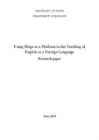
UNIVERSITY OF TARTU DEPARTMENT OF ENGLISH Using Blogs as a Platform in the Teaching of English as a Foreign Language Research paper Tartu 2010 ABSTRACT This work analyses the usefulness of blogging in teaching English as a foreign language. The definition of the term `blog' is provided along with the advantages and disadvantages of blogs' usage in practice. The analysis of language skills developed by students throughout the use of blogs for learning purposes is given in the paper with possible limitations that blogs have. Author of this paper also shares personal comments about the experience in the field. In this paper it is also described which research methods are planned to be employed for the conduction of research project. 2 ABSTRACT..............................
A report is based on facts/data etc. The writer knows more than the reader. The reader needs the information. A report should be clear and easy to follow. The person who reads it should find the information quickly. THINK: why you are writing the report, why the reader needs your report and what she might be interested in. Think about the best way to present the facts. If it’s a report of events (e.g. a traffic accident), describe them in chronological order. It should NOT be written like a letter! NO salutation/sign-off. Impersonal style (PASSIVE!), unless you make suggestions or give personal opinion – then you can use “I”. Formal language –no contractions, slang, etc. You can use the following format at the beginning of the report: To: From: (DO NOT write your own name. A member of the student committee etc. is fine) Subject: Basic structure 200 (+/- 10%) Introduction: Aim of the report
English structure revision for the exam 1. Terms Language → A systematic, conventional (tavakohane) use of sounds, signs or written symbols in a human society for communication and self-expression. Human language at all levels is rule- or principle- governed (valitsema) meaning that language corresponds to the grammar. Natural language is usually spoken, while language can also be encoded into symbols (such as letters, morse etc) For example: Estonian, English. Linguistics → The scientific study of human natural language. Broadly, there are three aspects to the study which are Pragmatics (studies the use of language → interested in the gap between the sentence’s meaning and the speaker’s meaning). Semantics (concerned with the meaning of the language aspects and the way they
Transformations into New Applications The success of AES and short-answer scoring (Leacock & Chodorow, 2003) has set the stage for a number of new capabilities developed for text-based analysis for enhanced feedback related to technical and organizational writing quality to help both native and non-native English speakers, and applications that incorporate text-analysis capabilities to provide reading comprehension support for English language learners (ELLs). Until now, the majority of AES and related capabilities have focused on text. However, speech-based capabilities are also making their way into commercial applications. In light of this, the second half of this section is focused a discussion of a speech-based, instructional capability currently used for scoring the speech of ELLs. Online Essay Evaluation Service As mentioned above, automated essay scoring engines are typically combined
2) Middle English – 100,000 – 125,000 words) English becomes heterogeneous (Norman French, • 21,000 words English, Latin), hybrid of Germanic and Romance languages Norman French influence – about 10,000 words, 75 % are still in use (Baugh) Latin influence continues 3) Early Modern English – 200,000 – 250,000 English becomes a polycentric language; polyglot, cosmopolitan language 4) Modern English – 500,000 words (OED) At present at least 1 billion lexical units 2. Core and periphery Core vocabulary – often short (monosyllabic) words of Germanic and Old Norse origin = ie core vocabulary of most frequent words, and vague fuzzy peripherial words. Core meaning is the meaning which is at the centre of the word.periphery – vague. Formal usage (often polysyllabic words) from Norman French (rank, courtliness,refinement).
The term ,,stylistics"came into more common use in English only some 35 years ago. It was recorded much earlier; in 1882 as "the study of literary style, the study of stylistic features" Stylistics is a branch of linguistics that studies principles of selecting different linguistic means for passing on thoughts and emotions. It studies: · Different functional styles, styles of genres, individual styles · Expressive, emotional features of different language units Stylist--a writer or a speaker skilled in a literary style Stylistition--a scholar who studies stylistics The word "style" is applied to many things. A linguistic style is a variety of subsystem of lg with its peculiar vocabulary, phraseology, grammatical and phonetic features that are used selectively and purposefully to express ideas in a given situation. The stylistics of language studies different styles, including registers, stylistic devices and shades of meaning.
BASIC ENGLISH BASIC ENGLISH GRAMMAR GRAMMAR BASIC ENGLISH GRAMMAR Book 1 Book 1 Younger students at beginning to intermediate levels will greatly benefit from this step-by-step approach to English grammar basics. This is the ideal supplement to your language arts program whether your students are native English speakers or beginning English language learners. Skill-specific lessons make it easy to locate and prescribe instant reinforcement or intervention. · Illustrated lessons are tightly focused on core concepts of grammar · Nearly 70 practice exercises are included for ready reinforcement
1) Standard and non-standard varieties of English Standard varieties of English are the varieties of the English language that are considered to be a norm and are spoken and written by the minority (educated people). This is the optimum for educational purposes. The standard varieties of English are: BrEng (British), EngEng (English), NAmEng (North-America), USEng (United States), CanEng (Canada), AusEng (Australia), NZEng (New Zealand). Standard English (British English) is the most widely accepted and understood among native speakers, learned by foreigners. It is used in broadcasting, TV, news etc. It doesn't
Philosophy of Language Philosophy of Language: a Contemporary Introduction introduces the student to the main issues and theories in twentieth and twenty-first-century phi- losophy of language, focusing specifically on linguistic phenomena. Topics are structured in four parts in the book. Part I, Reference and Referring, includes topics such as Russell's Theory of Descriptions, Donnellan's distinction, problems of anaphora, the description theory of proper names, Searle's cluster theory, and the causalhistorical theory. Part II, Theories of Meaning, surveys the competing theories of linguistic mean- ing and compares their various advantages and liabilities. Part III, Pragmatics
peopled by "noble savages", similar to the philosophical theory of Rousseau, exemplified by Uncas, from The Last of the Mohicans. There are picturesque "local color" elements in Washington Irving's essays and especially his travel books. Edgar Allan Poe's tales of the macabre and his balladic poetry were more influential in France than at home, but the romantic American novel developed fully with the atmosphere and melodrama of Nathaniel Hawthorne's The Scarlet Letter (1850). Later Transcendentalist writers such as Henry David Thoreau and Ralph Waldo Emerson still show elements of its influence and imagination, as does the romantic realism of Walt Whitman. The poetry of Emily Dickinson--nearly unread in her own time--and Herman Melville's novel MobyDick can be taken as epitomes of American Romantic literature. By the 1880s, however, psychological and social realism was competing with romanticism in the novel.
Tallinna Mustamäe Humanitargümnaasium Valeria Jefremenkova ENGLISH AS A GLOBAL LANGUAGE INGLISE KEEL KUI ÜLEMAAILMNE KEEL Research work Supervisor: Jevgenija Kozlova Tallinn 2016 1 Table of Contents СONTENT…………………………………………………………………………………...2 INTRODUCTION…………………………………………………………………………...3
on the spectacular side, such translations could compensate for this `loss' and turn into instructive, thought-provoking exercises of complex intercultural communica- tion, at various levels and between different protagonists. Here, we will refer to intercultural communication as relating to processes of interaction, translation, and mediation among people from differing cultural backgrounds. In the first section
The stream of consciousness. Allusiveness. Virginia Woolf's Modern Fiction as a theoretical platform for Modernism. Criticism of Realist literary method. Literary modernism: end of the 19th century-1920 (reached its height) and ended 1940s. A self- conscious break with traditional aesthetic forms. Rejecting the sentiment and discursiveness typical of Romanticism and Victorian literature for poetry that instead favored precision (täppis) of imagery and clear, sharp language. Modernist writers embraced the unconscious fears of a darker humanity. Sub movements: surrealism, formalism, avant-garde, symbolism, imagism Structuralism: Writers used myth and music as a part of the books structure. J. Joyce "Ulysses". Deep structure is the same as in "odyssey" and T.S. Elliot "the fisher king"-more complicated experiment. Aldous Huxley ,,point counter point"-builds his chapters on principles of music. R. Aldington ,,death of a hero"-a jazz novel. Polyphony-harmony
A feeling of helplessness. Delay or refusal to learn the lg of the host country. Excessive fear of being cheated. Excessive concern over minor pains. Terrible longing to be back home. Reverse CS- re-entry shock- the unexpected confrontation with the familiar. Cultural dimensions. Non-verbal communication Nonverbal communication is usually understood as the process of communication through sending and receiving wordless messages. Such messages can be communicated through gesture; body language or posture; facial expression and eye contact; object communication such as clothing, hairstyles or even architecture; symbols and infographics. Speech may also contain nonverbal elements known as paralanguage, including voice quality, emotion and speaking style, as well as prosodic features such as rhythm, intonation and stress. 1
THE ANGLO-SAXON PERIOD English literature came when the Angles, the Saxons, the Jutes and the Frisians invaded Britain. During this time English was called Anglo- Saxon or Old English. In the chronicles of Roman history (composed in Latin) is said that Britain makes its first appearance in written language when Romans invade the England. BEOWULF most important poem, surviving in a 10th-cent manuscript. The historical period of the poem's events can be dated in the 6th to 8th century. Much of the material of the poem is legendary and paralleled in other Germanic historical-mythological literature in Norse, Old English, and German. GEOFFREY CHAUCER (1340-1400) Politician and writer, fought in France during the 100 years war
Etiquette in england *meeting and greeting · The British are reserved, which may cause them to appear cool and indifferent or overly formal. In fact, they are very friendly and helpful to foreigners. · Shake hands with everyone present men, women, and children at business and social meetings. Shake hands again when leaving. · Use last names and appropriate titles until specifically invited by your British hosts or colleagues to use their first names. *body language · The English tend to keep about an 23 feet between them while speaking. · Touching is usually kept to a minimum.
but ultimately produces more bad consequences than beneficial results, and · A refactored solution that is clearly documented, proven in actual practice and repeatable. Often pejoratively named with clever oxymoronic neologisms, many anti-pattern ideas amount to little more than mistakes, rants, unsolvable problems, or bad practices to be avoided if possible. Sometimes called pitfalls or dark patterns, this informal use of the term has come to refer to classes of commonly reinvented bad solutions to problems. Thus, many candidate anti-patterns under debate would not be formally considered anti-patterns. By formally describing repeated mistakes, one can recognize the forces that lead to their repetition and learn how others have refactored themselves out of these broken patterns. 7. The Zachman Framework is a framework for enterprise architecture, which provides a formal and highly
informal and ostensive. Exceptions are ignored and the host of minor terms are not defined—the text covers these when they come up. The plaintext is the message that will be put into secret form. Usually the plaintext is in the native tongue of the communicators. The message may be hidden in two basic ways. The methods of steganography conceal the very existence of the message. Among them are invisible inks and microdots and arrangements in which, for example, the first letter of each word in an apparently innocuous text spells out the real message. (When steganography is applied to electrical communications, such as a method that transmits a long radio message in a single short spurt, it is called transmission security.) The methods of cryptography, on the other hand, do not conceal the presence of a secret message but render it unintelligible to outsiders by various transformations of the plaintext. Two basic transformations exist
NOMINATIVE SENTENCES strengthen the dynamic nature of the narrative. NT: London. Parks. Horse rides. Noisy streets. Noisy traffic. Policeman. Such sentences evoke a more or less isolated idea of an object without any connection with other objects. These sentences appeal to reader's imagination, and thus makes the reader active. ASYNDETON ASYNDETON means intentional omission of conjunctions between parts of a sentence or between sentences, disregarding norms of the literary language. ASYNDETON is used mostly to describe an energetic (objectic?) activities us to show exession (succession) of minute immediately following each of the actions. Opening the story of chapter, A helps to give a laconic ... and at the same time detailed information into the action proper. NT: The motion of the camp at night was everywhere. People sang. People cried. People fought. People loved. People hated. Some were sad. Others gay. Others with friends. Others lonely
- the ability to classify it (grouping ability); - the ability to describe the material ("some say this ..., they are not wrong, but other say that ...." Etc.); - the ability to draw conclusions (on theoretical and practical materials); - your personal contribution (do something that no one has done before); - talking about the material (as if you are speaking to the first year student avoid sophistication in language, that may sound unnatural). Comment on examples (from where the example is taken how it is used explain all). NB! Comments everywhere. You have right to: · Supervisor discusses and specifies the topic with you; · Supervisor gives a tutorial where the supervisor sets general directions for your paper and recommends a book (source) for your study; · Supervisor reads your rough sketch (and if necessary checks faults); BUT
ages for the speech of communities whose lives, trade and occupations were determined by a river). To conclude, linguists argue that (1) London influence on English is not only apparent on the Thames estuary (Rosewarne himself wrote: "it seems to be the most influential accent in the south-east of England", not only in the Thames estuary), and (2) `Estuary English' is not a felicitous or adequate name. Nonetheless, it is now so solidly entrenched in the English language, particularly in the academic circles, that it would be unwise to struggle against it. 2. Historical background-a myth destroyed - Estuary English - a result of certain long-lasting processes People who have had a chance to read newspaper articles concerning Estuary English, might have had the impression that it is a relatively new Cockney influenced language variety making its way into various regions of the country at a rapid pace.
 annaabi.ee