 50 punkti
Autor soovib selle materjali allalaadimise eest saada 50 punkti.
50 punkti
Autor soovib selle materjali allalaadimise eest saada 50 punkti.
 ~ 1 leht
Lehekülgede arv dokumendis
~ 1 leht
Lehekülgede arv dokumendis
 2017-11-28
Kuupäev, millal dokument üles laeti
2017-11-28
Kuupäev, millal dokument üles laeti
 1 laadimist
Kokku alla laetud
1 laadimist
Kokku alla laetud
 0 arvamust
Teiste kasutajate poolt lisatud kommentaarid
0 arvamust
Teiste kasutajate poolt lisatud kommentaarid
 baranovva
Õppematerjali autor
baranovva
Õppematerjali autor
• Martin Luther – his role in the history of translation studies. Lived during the 15th century. He was a priest, theologian & translator. During that time, the Bible’s were only available in either Latin or Hebrew, which made it very difficult for common people to understand. He came out with a radical plan to translate the Bible into local languages (the first language was German – translated by Martin Luther). This inspired many other translators during that period. • What happened in the 19th and 20th century in translation studies? When and who created the term ‘translation studies’? Translation Studies – James S. Holmes - 1972 Ferdinand de Saussure – Lived during the 19th and 20th century. He was a Swiss linguist and a semiotician. He is widely considered one of the fathers of 20th-century linguistics and one of two major fathers (together with Charles Sanders Peirce) of semiotics/semiology. Saussure's most
ample opportunity to explain the deterioration in the quality of Autocheck's services. However, he has failed to reply to our letters (copies of these are attached) and whenever one of our representatives attempts to contact him, either personally or by telephone, he is always unavailable. In view of this, it is recommended that the contract with AMC should be examined and that the legal department should be asked what action can be taken against them. Discussion 1 You will probably notice quickly the first two changes that the secretary made. 1 Subject Heading By adding the word deterioration at the beginning of the subject heading, she made it a much more precise and accurate summary of the topic of the report. 2 Organization of Information The way the information in Text 1 was organized was not very logical: The writer told us about the inspections which were made by MCC mechanics before he
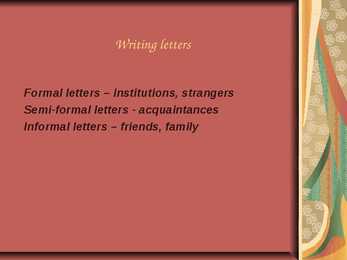
Name Tips Always proofread your letter after writing it, check for sentence structure, grammar, spelling mistakes... Proofread your letter again (and again) after you have revised it. Keep the recipient in mind, and write in a way that he/she can easily understand the letter. Don't use abbreviated dates, i.e. use November 19, 2004, and not 11/19/04 Be respectful when you write, even if you are writing a letter of complaint. Formal letter Greeting if you know the name of the receiver: Dear Mr./Mrs./Ms + first and second name Farewell if you know the name of the receiver: Yours sincerely signature Mr./Mrs./Ms + first and second name Greeting - if you do not know the receiver: Dear Sir/Madam Farewell - if you do not know the receiver: Yours faithfully signature Mr./Mrs./Ms + first and second name Semiformal letter
use their appliances, so it means they have to communicate verbally as well. I think that teachers should be creative to blend so-called digital learning/teaching with old-fashioned learning/teaching. · Sir Ken Robinson: Do schools kill creativity? Sir Ken Robinson claims in the clip that " creativity in education is as important as literacy, we should treat it with the same status." I totally agree with all what he said. We have very strict education systems that don't allow a room for mistakes and they categorize people based on their achievements in exams. There is nothing like potentials, creativeness, possibilities or even 2nd chances. Families put high expectations on academic achievements and they always compare their kids with other's kids. A minority in each community will be really dedicated to help their kids explore their horizons.
Letters Letters FORMAL, INFORMAL, TRANSACTIONAL TASK 1 Read the extracts and answer the questions. · Where are the extracts from? · What is the purpose of each letter? · How do they differ? · Which extracts are examples of formal letters? · How is the reader addressed in a formal letter? · What are the closing remarks for formal letters? · What is the salutation in a friendly letter? · How would you end extracts 1,2,3 ? · How would you begin the extracts 4 and 5? 1. Dear Mr Miller, I received your kind invitation to the reception. Unfortunately, owing to other commitments. I will be unable to attend ... 2. Dear Ralph, l just got your invitation to the company's event. l `m afraid I can't make it because I've a/ready made plans which l can "t change ... 3. Dear Sirs,
• Discuss different approaches with learners in order to understand their preferences and needs, and to find out what approaches are most helpful to them. • At the end of the guide, there are some real samples of assessed writing from the C1 Advanced exam
HOW TO WRITE AN ARGUMENTATIVE ESSAY An argumentative essay is a formal, impersonal piece of writing in which the writer is either expected to give a balanced consideration of a particular topic, or to state their own opinion clearly and then support it by giving reasons. An essay should begin with an introduction in which some background information is given about the problem that is going to be discussed. The angle from which the problem is going to be looked upon in the essay is also stated. In
Letter of application Salutation Dear Sir or Madam Dear Sir/Madam Dear Mr/Mrs/Ms Paragraph 1 Reason for writing, name of the available position (+add the source, if available) I am writing to apply for the post advertised in... I am writing in response to your advertisement in... Paragraph 2, 3 What are you doing now, previous experience Qualifications (also personality traits, if necessary) NB! Relevant information I have graduated from... (with honors) My degree is in... I attended a.... course Final paragraph + closing sentence Closing remarks: thank the person for considering your application, ask the person to consider you for the job, mention the possibility of further communication. I have enclosed my CV..
 annaabi.ee







Kõik kommentaarid