Leidsid 33 sarnast õppematerjali, mis on seotud failiga "TEXT The Irish Problem". Need materjalid aitavad sul teemat sügavamalt mõista.
land, cromwell, irish, civil, ireland, army, soldiersem, part, protestant, parliamentan, catholic, settled, english, became, 1649, endedere, having, paid, fact, munster, given, belief, wars, rather, religious, among, partly, held, 1641, prior, ulster, begun, years, before, between, places, such, nothing, death, toll, landed, dublin, intentionEmperor Claudius, the Roman rule in England lasted up to 410. The Romans left behind a huge legacy: many types of animals and plants were brought to Britain in Roman times. Roman introduced theire measurements, Christianity, reading and writing. Also, many words in English and Welsh have been borrowed from the Latin language. An important legacy of the Romans was its roads, agriculture and cities. In the Roman times the land was dominated by rules and reguations. *Christianity in Roman Britain The Roman authorities were suspicious of Christianity because followers of Jesus Christ refused to take an oath of loyalty to the Roman emperor. For this reason the early Christians were regarded as dangerous enemies of the Empire. That ceased when the emperor Constantine converted to Christianity. Christianity became the official state religion of the Roman Empire in the early fourth century A.D. As the century
Prasutagus(ruler) was first allowed to rule when romans conquered England, after his death, romans decided to rule Iceni and flogged Boudicca and raped her daughters 60-62 AD Iceni rebelled, Boudicca´s warriors defeated Roman Ninth Legion, destroied capital-Colchester Finally Boudicca was defetated, she poisoned herself to avoid capture Hadrian´s wall A defensive barrier builtin 122 AD by Roman emperor Hadrian to guard the northern part of Britain against barbarian invaders Most imposing frontier of Roman Empire, controlling peoples mobements Building took several years, builders kept changing minds about the size 119 km lenght, 5m high, 3m deep The Picts, Caledonia The painted ones, northern tribes, part of the Scots Inhabited an area known as eastern and th western Scotland, until 10 c Mysteriously disappeared Constantly fought with Romans
1. The Queen’s official title. Elizabeth the Second, by the Grace of God, of the United Kingdom of Great Britain and Northern Ireland and of Her other Realms and Territories Queen, Head of the Commonwealth, Defender of the Faith. 2. The Queen’s working day. Starts after breakfast. Reads the newspapers which are prepared by the Press Secretary, and a report on the previous day’s proceedings in the Parliament and the letters she receives. Also phone calls. Once a month she attends the Privy Council in order to give Royal Assent to various items of government legislation.
to stay. In the 10th century England fell under Danish Rule, with King Canute finally managing to unite the Anglo-Saxons and Danes at the beginning of 11th century. Medieval England After defeating the Anglo-Saxon King Harold at the Battle of Hastings in 1066, William of Normandy (who became William I, also called William the Conqueror) introduced the Norman feudal system, rewarding his French-speaking followers with land in return for their continued support. French remained the language of the upper classes and administration until the 14th century. The power of these Norman Barons gradually increased and during the reign of the Plantagenets began the challenge the King's absolute power, which resulted in King John being forced to sign Magna Carta in 1215. It consisted of long list of limitations to the King's power and it gave more power to the origins of Parliament.
The Irish Problem "The curse of Cromwell on you" Oliver Cromwell... Detested Roman Catholicism Believed that the Irish could never be trusted Used Irish land as a way to pay 1652 "Cromwellian Settlement" in Munster and and Leinster Was a cruel man: claimed to be acting on God's behalf and expelled about 1000 Catholic priests from Ireland The main reason for this was Cromwell's belief in fundamental Protestantism and hatred of Catholicism A church place for religious people to meet each other Oliver Cromwell Attempts to 'solve' the Irish problem New Model Army Coerce the Irish into obedience export children from Ireland to the sugar plantations in the West Indies, so that Ireland would suffer from a long term population loss Extreme poverty Dissolving of the problem In 1660, Cromwell died and was
BRITISH HISTORY 17TH-19TH CENTURY SEVENTEENTH-CENTURY ☄ When James I became the first English king of the Stuart dynasty, he was already king of Scotland, so the crowns of these two countries were united. ☄ The kind of Middle English spoken in lowland Scotland had developed into a written language known as Scots ☄ The Scottish Protestant church adopted English rather than Scots bibles ☄ Religion and politics are inextricably linked ☄ Some people tried to kill the king because he wasn't Catholic enough and another king had been killed, partly because he seemed too Catholic ☄ Anger grew in the country at the way that the Stuart monarchs raised money ☄ Puritanism- ideological Protestantism ☄ Some of them thought the luxurious lifestyle of the king and his followers was immoral
Years 1154-1485 Henry I was the first unquestioned ruler. One of the most important kings in the Middle Ages. He had lands in Britain & France. Then the government was the monarch, a person, not a place. He had more land than any pervious king. After his marriage to Eleanor of Aquitaine, he also ruled the lands south of Anjou. His empire stretched from the Scottish border to the Pyrenees. England provided most of its wealth, but the heart was Anjou. Henry II began to regain royal control. During the war some barons had become very powerful. He pulled down some of their castles. He tried to restore law & order. He wanted the same kind of justice to be used everywhere. He appointed his own judges to travel around
I was spread orally until it was written down in the 10th century. The author is unknown and the manuscript is kept in the British Museum (near Trafalgar Square). The story is very important as it allows us to lear about the way of life in the 4th century. The characters can be divided into two groups fictitious and historical. The epic deploys many metaphors - e.g. the sea = the swan's road, body = a house for bones and alliteration. It is structured as two parts. In the first part King Hroghtgar, king of Danes built a palace Hereot near a lake. He disturbed the lake monsters sleep with his racuous parties. Grendel then goes to the castle every night and kidnaps a man. This went on for 12 years. Beowulf, a young viking, decides to put an end to it. He chooses 14 men to join him and sails across the strait with no weapns, mind you, because Grendel fought unarmed and Beowulf was an idiot however according to the rules of fiction he defeats Grendel
1. Ancient Britain: the Celtic tribes. 2000 years ago there was an Iron Age Celtic culture throughout the Br Isles. It seems that the Celts, who had been arriving from Europe from the 8th cent BC onward, intermingled with the peoples who were already there. The Celts were extremely talented people, creative and artistic. More than 1 Celtic tribe invaded Br. The descendants of ancient Celts live in Wales, Scotland, Cornwall and Ireland. They lived in primitive society. Druids priests, more powerful than chiefs. Acted like prophets. 2. Stonehenge From prehistoric period. Was built on Salisbury plain between 2500 and 1500 bc. One of the most famous and mysterious archaeological sites in the world. One of the mysteries is how it was built at all with the technology of the time. Another is its purpose. It appears to function as a kind on
today. The word 'parliament', which comes from the French word parler (to speak), was first used in England in the thirteenth century to describe an assembly of nobles called together by the king. It was divided into two houses during the reign of Henry VII: the House of Commons and the House of Lords. The class system o After the norman invasion, a strict feudal system was imposed: norman soliders who had inavaded were given the ownership of land and of the people living on it o Nobles, or barons, were responsible directly to the king, lesser lords, were directly responsible to a abaron. Under them were the peasants who had strict duties and obligations and were forbidden to travel without permission.(anglo-saxons) o This was the start of the english class system The Tudor dynasty o 1485-1603, Henry VII, Henry VIII, Mary I, Elizabeth I o Wars of the Roses
The United Kingdom The United Kingdom consists of England, Scotland, Wales and North Ireland and it is situated in the Atlantic Ocean near the mainland of Europe. The population of the UK is 58.6 million and area is 244,110 sq km. Britain has a temperate humid climate. Its characteristic features are mild winters, warm summer, no temperature extremes, abundant rain all year round and frequent changes of weather. The mild climate is partly due to the warm Gulf Stream and partly to the south westerly winds. Occasional winds from the east in winter may bring cold and dry weather
of the American feminist movement, and was a signatory of its Declaration of Sentiments. Douglass later became the publisher of a series of newspapers: North Star, Frederick Douglass Weekly, Frederick Douglass' Paper, Douglass' Monthly and New National Era. The motto of The North Star was "Right is of no sex--Truth is of no color--God is the Father of us all, and we are all Brethren". Douglass' work spanned the years prior to and during the Civil War. He was acquainted with the radical abolitionist Captain John Brown but did not approve of Brown's plan to start an armed slave revolt. However, Brown visited Douglass' home for several days shortly before the Harpers Ferry incident, in which Brown attacked the federal Arsenal there. After the incident, Douglass fled for a time to Canada, fearing he might be arrested 4 as a co-conspirator
Germany & Denmark. The resistance of the Celts was long. They were free at the time, not like other Roman provinces on the Continent. Around 500, the Britons seem to have won several victories. One of their leaders was Ambrosius Aurelianus and one of their victories was at the place called Mount Badon. The main leader of the Britons at this time may have been the warrior later called King Arthur. By the 7th cent. the invaders managed to conquer the greater part of the land. The invaders came from 3 powerful tribes: · The Saxons settled from the Thames Estuary westwards, in the south of England; they formed the kingdoms of Sussex, Wessex, Essex & Middlesex · The Angles settled in East Anglia, the Midlands & Northumbria · The Jutes settled mainly in Kent, Hampshire & the Isle of Wight The name Jutes died out & the conquerors are generally referred to as the Anglo-Saxons. At
The British Isles are shared by two separate and independent countries: the United Kingdom of Great Britain and Northern Ireland and the Republic of Ireland. All the islands have administrative ties with the mainland, except some islands which have their own legislative assemblies and systems of law, but the UK Government is responsible for their international relations and defence. Great Britain Across / 'krs / risti, läbi, põiki
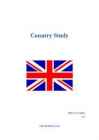
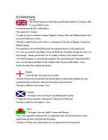
1) General facts The UK: * the United Kingdom of Great Britain and Northern Ireland was formed in 1801 * it covers 243,610 sq km * everybody from the UK is called British * the capital city is London * is made up of four constituent countries: England, Scotland, Wales and Northern Ireland which in turn are divided into counties * the flag is called the Union Jack which is a combination of the flags of England, Scotland and Northern Ireland * the population is about 60,000,000 people, the population density is 242 people/sq km * its coasts are washed by the Atlantic Ocean, the North Sea, the English Channel, the Celtic Sea, Saint George's Channel, and the Irish Sea. It is linked to France by the Channel Tunnel * the United Kingdom is a constitutional monarchy. The current monarch is Queen Elizabeth II, who is also the Queen and Head of State of fifteen other Commonwealth Realms, such as Canada, Australia, New Zealand and Jamaica.
The foundation stones The Island Britain has a mild climate due to the Gulf Stream which brings warm waters from the Gulf of Mexico. The northern part of the island in average 5'C cooler and it's mountainous or hilly and that's why the south has been more populated.. Britain became an island only 5000 years BC after the Ice Age ended. Britain's prehistory The first evidence of human life on the island are dated back to 250 000 BC. 50 000 BC in a milder Ice Age period Britain became habitable again. People from that time were the
7 UNIT 1 THE ISLAND Pre-reading questions What is the name of the island group Britain belongs to? Where is it situated? What seas surround it? What kind of climate do you think Britain has? What is its surface like? What countries are situated on the islands? Which country are we going to study? Why? Location Land and climate affect life in every country. Britain is no exception. Britain is the largest island of the British Isles 1. It is just under 1,000 km long and just under 500 km across in its widest part. Britain is separated from the mainland of Europe by the North Sea on the east and the English Channel on the south – by only about 35 km of water at its closest point (the Strait of Dover 2). Most of the coastline is so broken by bays and inlets that no point on the island is more
The early middle ages The Norman Conquest Since William was crowned king, there were many rebellions against the Normans. A small Norman army marched from village to village and destroyed the ones it couldn't control. The Normans took away the Saxon lords' land. Only a few Saxons who supported William could keep their land. Feudalism William gave parts of his conquered land to his captains around the country to avoid rebellions and uprisings. He also kept some land to himself to make sure his was much stronger than his nobles. Of all the farmland half went to his nobles, quarter to church and fifth he kept to himself. William organised the English kingdom according to feudal system. The main purpose of using that system was economic. King gave the land to "vassals" in return of army services and goods. When a noble dies, his son took over the estate. When there was no family, the
..................................................................... 8 Population and Ethnicity..............................................................................................9 3 Introduction The official name of the country is the United Kingdom. The United Kingdom is an island country. It consists of the island of Great Britain and Northern Ireland. Great Britain can be divided into three parts England, Wales and Scotland. Each of them has their own capital city. Glasgow in Scotland, Cardiff in Wales and London in England. The country is situated in the north-western Europe. The territory of the United Kingdom is about 244,000 square kilometres and about 60 million people live there. The UK contains a number of small islands. The largest islands that belong to the United
SOCIETY AND CULTURE OF ENGLISH-SPEAKING COUNTRIES Introduction 1. Nowadays, English is so widely spoken that it can hardly be considered "a one nation's" language. The main countries where English is spoken are: the U.K, the U.S, Canada, Australia, the Republic of Ireland, New Zealand, West Indies 2. There are approx. 300-400 million speakers of English in the world. English occupies the 3rd place by its number of speakers; it is right behind Mandarin and Spanish. 3. ESL (English as a Second Language) used in your own country (e.g. India) EFL (English as a Foreign Language) used in a foreign country ESP (English for Specific Purposes) used in business, airlines, hotels etc. 4
Ireland is the third largest island in Europe. It lies in between the Atlantic Ocean and the Irish Sea. Politically it is divided into a sovereign state, the Republic of Ireland, that covers about five-sixths of the island (south, east, west and north-west), and Northern Ireland, which is part of the United Kingdom, covering the northeastern sixth of the island.[1] The name 'Ireland' derives from the name Ériu (in modern Irish, Éire) with the addition of the Germanic word 'land'. The population of the island is just under 6 million (2006); just over 4.2 million in the Republic of Ireland[2] (1.6 million in Greater Dublin[3]) and just over 1.7 million in Northern Ireland[4] (0.6 million in Greater Belfast[5])). Politics Politically, Ireland is divided into:
the Normans had better military tactics and won in the end thanks to a clever strategy William I, also known as William the Conqueror, replaced King Harold on the throne The invasion was completed by 1071 - The Norman invasion is depicted on the Bayeux Tapestry a long embroidered cloth The death of King Harold embroidered on the Bayeux Tapestry The Norman England William I ensured his power by dividing the land into parts and making 1/7 of it a royal domain He made his nobles swear an oath of allegiance and become his vassals Died in 1087 while fighting in France, was succeeded by his third son, William II Rufus William II was very unpopular: - Problems with the church - Increased taxes and claimed the money of many positions of the church William the Conqueror began building the Tower of London one of the most notorious prisons in the world
I Native Americans · Origin of Native Americans Origin is debatable Siberia->Alaska Crossed the land bridge around 14,000 years ago "ice-free corridor" Hunters, searching for fresh grounds · Different tribes and their way of life In tents, dark skin, hair is long, black and straight, women-agriculture, men- hunting. bands(chief. Travelled together) and tribes land was owned by the tribe that occupied it. 200 different tribes Apache- "enemy"- hunted buffalos, oil and natural gas from their land Cherokee- largest tribe Cheyenne- from Minnesota and S & N Dakota. High system of laws
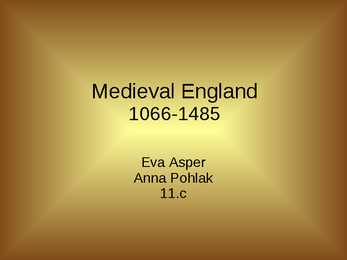
In 1382 the Bible was translated into English by John Wycliffe. In 1399 Richard II was succeeded by his grandson Henry IV. He lead England until 1413 and was then succeeded by his son Henry V. Henry V reign lasted until 1422. In 1422 his son Henry VI got on the throne. In 1453 the Hundred Years War ends. The only English possession on Continental Europe was Calais. Already in 1455 the Wars of the Roses began. The Wars of the Roses were a series of civil wars fought in medieval England from 1455 to 1487 between the House of Lancaster and the House of York. In 1461 the youngest son of Edward III, Edward IV, was crowned as the new king of England. He lead England until 1483 and was succeeded by Edward V. Edward V's reign lasted only for a few months. In 1483 Richard III got the power. He brought the Middle Ages to an end. In 1485 Henry VII succeeded Richard III. He was the first king of the Tudor dynasty. Key events The Norman invasion
the largest of the British Isles. With a population of about 60.0 million people in mid-2009, it is the third most populous island in the world, after Java and Honsh. Great Britain is surrounded by over 1,000 smaller islands and islets. The island of Ireland lies to its west. Politically, Great Britain may also refer to the island itself together with a number of surrounding islands which comprise the territory of England, Scotland and Wales. All of the island is territory of the sovereign state of the United Kingdom of Great Britain and Northern Ireland, and most of the United Kingdom's territory is in Great Britain. Most of England, Scotland, and Wales are on the island of Great Britain, as are their respective capital
The population density is about 27 people per square kilometre. Most of the people live in towns. There are 50 states in America. The biggest of the state is Texas, next by size are California, Alaska and Montana. Six states - Maine, Vermont, New Hampshire, Connecticut ,Rhode Island and Massachusetts are called New England. They are all small states in the U.S. that lie in the north-east. The first colony of immigrants settled down in Virginia, in the eastern part of the U.S.A. The biggest cities are New York, Washington, Chicago, Los Angeles, San Francisco, etc. The flag of America was adopted on 14 th June 1777. It is called the "Stars and Stripes". It is said that Betsy Ross sewed the first flag. It features 13 horizontal red and white stripes (for the first colonies which formed the U.S.A.) and 50 stars on the blue background. Red means courage, blue justice and white innocence. There is a star for every state of the USA.
Historical records beyond the initial invasion are sparse, although many Roman historians mention the province in passing. Most of the knowledge of the period stems from archaeological investigations and especially epigraphic evidence. The invasion force in AD 43 was led by Aulus Plautius.It is not known how many Roman legions were sent; only one legion, the II Augusta, commanded by the future emperor Vespasian, is directly attested to have taken part. The IX Hispana,the XIV Gemina (later styled Martia Victrix) and the XX are attested in 60/61 during the Boudican Revolt, and are likely to have been there since the initial invasion. However, the Roman army was flexible, with units being used and moved whenever necessary, so this is not certain. Only the Legio IX Hispana is likely to have stayed there, as it is attested to being in residence at Eburacum (York) in AD 71 and on a building inscription there dated AD 108, before its
a second language. 5. Which British colonies became dominions? What was their status? Is the name dominion used for these countries nowadays? The first dominions were Canada (1867), Australia (1901), and New Zealand (1907) The name "dominion" is not used anymore. 6. Which organisation unites Britain and most of its former colonies nowadays? The Commonwealth unites Britain with its former colonies. Ireland 1. Who were the early inhabitants of Ireland? Seafarers, fisheremen and hunter-gatherers from mainland Europe arrived around 8000 BC 2. When was Christianity established in Ireland? 432 AD Saint Patrick arrived in Ireland and began converting the Irish to Christianity. Who is Ireland's patron saint? Saint Patrick is Ireland's patron saint. When is his feast day? His feast day is on 17 March 3. When did the English conquest of Ireland begin? Henry II, with permission from tha Pope, sought to conquer Ireland
Believed in the trimph of working man (marx), but at the same the in the necessity of of the survival of the strongest. Was attracted to the Nietzches theory of the superman- the true aristocrats. The rest are the slaves. Morality, conscious, christianity-are the inventions of the slaves. Because this is how slaves tried to control the masters. 27.02.13 1920-jazz, post war euphoria, people were more less ,,From whom the bell tolls" Hemingway. Spanish civil war. Franco vs the Republicans. Three days are described. Protagonist is Robert Jordan. American, but teaches Spanish, joins the Spanish guerillas-the spanish partisans, in the fight against the facist. He is wounded and left to die. We get this sense of betrayal-most powerful emotions. The bell tolls for everybody, the bell is symbolically the funeral bell, it conserns everybody. The message of the novel is presented through inner monologue
Day relaxing holiday. On new years day people talk about turning a new leaf. Many Americans make new years resolutions promising themselves to improve their behaviour. Typical resolutions are to spend less money, give up smoking, begin a diet or control one's temper 7) HALLOWEEN Every year on October 31, Hallowe'en, or all souls' eve is celebrated in the United States and Canada. In Great Britain it is a popular night, too. In the north of England, Scotland and Ireland people celebrate it more than in the south. At Halloween people have parties and play Halloween games. One of the most popular games is ,,bobbing for apples". Americans like to dress up in costumes and go trick-or-treating. If grownups refuse to supply a treat, the children may play a trick. The typical tricks are: soaping windows, turning over dustbins and sticking pins into doorbells to keep them ringing. This celebration goes back to hundreds of years, to the Celtic times when it
in the field of medicine. Against the background of such political moderation, two critics of serfdom clearly stand out. They represent two generations of the Livonian Enlightenment -- pastor Johann Georg Eisen (17171779) and the man of letters Garlieb Merkel (17691850). Eisen was not merely concerned with the Baltic provinces, but he was the first to demand the abolition of serfdom and the peasants' right to land throughout Russia. He laid his hopes on enlightened absolutism, trying to convince the empress Catherine II and the Russian high nobility of the social-economic inefficiency of serfdom. Merkel treated the ancient Livonian and Estonian peoples, or Latvians and Estonians, not only as suppressed peasants, but as nations forced into serfdom whose development had thus been artificially hampered. 6|Page
The Renaissance In the history the Middle Ages were followed by the Renassance period. During this period a new class called bourgeoeisie came into being. This is the period when monarchies based on nationality were estabilished. The Renaessance started in Italy In the 14th century. Then it spread all over Europe, reached England in 16th century. The struggle for power culminated in a war called The War of Roses. It was a civil war between two dynasties, families. They had different emblems on one side the Yorks (white rose) other Lancasters (red). They couldn't decide who gets the throne. War ended 1485. A new dynasty came to throne, Tudor, the first king in this dynasty was Henry Vll. When he came to throne a period of stability followed because he built a nation based state. He was good at diplomacy.He could avoid quarrels and wars with neigbouring countries. France, Spain - greatest enemies.So he could save much
These two chapters highlight the kinds of commentary Swift makes throughout the novel. By describing a society that chooses its highest officials with silly competitions like seeing who can jump the highest on a tightrope, Swift is poking fun at the way officials are chosen in England. He is also commenting on the disturbing trend of politicians who are willing to do whatever it takes to gain favour in the courtincluding humiliating themselves. The danger of ambition is also figured here; jumping badly can lead to death. Having Gulliver stand with his legs apart so that the Lilliputian armies can walk through is also a ridiculous idea. It is a comment on the pomp and circumstance of English armies. To Swift it seems that armies are often more concerned with looking impressive than with being impressive. This scene might also be an allusion to the Colossus of Rhodes, described in Julius Caesar by Shakespeare as a largerthanlife figure that men could walk through the legs of. Th
 annaabi.ee