Leidsid 33 sarnast õppematerjali, mis on seotud failiga "Tallinn in the 20th century". Need materjalid aitavad sul teemat sügavamalt mõista.
first, soviet, russia, independent, building, tram, airport, east, song, came, 20th, century, russian, theatre, started, station, german, during, became, there, tondi, april, festival, hold, report, introduction, beginning, occupation, conclusion, subject, hard, local, power, newspaper, estonians, mayor, workers, meeting, postimees, established, bekkerTallinn English College English Sergo Vainumäe 9A TALLINN Report Supervisor: Inge Välja Tallinn 2006 Order of contents: 1.Introduction 2.Toompea 3.Lower Town 4.Kadriorg and Pirita 5.Museums 1. Introduction Tallinn, the capital of Estonia, lies on the Baltic Sea. It is on almost the same latitude east St. Petersburg in Russia, Stockholm in Sweden and Stavanger in Norway, and covers 158 sq km. Tallinn was first marked on a map of the world by the Arab geographer al-Idrisi in 1154, its name then being Kolyvan (probably derived from the name Kalev). In the 13th-century Chronicle of Henricus de Lettis the town was called Lyndanise. Later came Reval (presumably after the old county of Rävala), the name used by the Germans who ruled the country for seven centuries. Russians then modified Reval to Revel
labour. The rapid development of the manorial economy in the mid- 18th century was founded on the spread of liquor distilling. The spirits sold in Russia, the mash from the distilleries was used to fatten the cattle, whose manure was fertilizing the fields. At the same time, the lifestyle of the nobility and other Baltic Germans became far more refined. Taking advantage of the economic boom, they erected grand neo-classical mansions surrounded by splendid parks which adorn the Estonian landscape even today. Influences of Pietism and the Moravian Brethren Being joined to Russia did not mean isolation for Estonia
Tallinn is a very beautiful city that lies on the Baltic Sea. It covers 158 square kilometres. The Mayor of Tallinn is Jüri Ratas. The population of our capital is about 400000 people. About 55% of them are Estonian, 37% Russians and the other 8% are from different nations. The people here are mostly engaged in industry- mainly the food industry (23%), trade (16%) and transport and communication (14%). History. Tallinn has a great history. It was first marked on a map of the world by the Arab geographer al-Idrisi in 1154, its name then being Kolyvan. In the 13 th- century chronicle of Henricus de Lettis the town was called Lyndanise. Then it was called Reval for some time and finally Estonians started to call the town Tallinn from Taanilinn (Danish town) after the Danish conquest in the 13th century. The Knights of the Sword took Tallinn from the Danes in 1227 and made Toompea their fortress
Musical shows, dances and contests of strength and skill will be held all over town. This festival is held in August and it is said that Haapsalu, Estonia's most famous ghost, appears during this festival Black nights film festival http://www.tourism.tallinn.ee/fpage/events/newwinprint/ Beerfestival ( Õllesummer) The beer festival "Õllesummer" is one of the largest festivals in the region--bringing together 80,000 people each year. Õllesummer is located in the Tallinn Song Festival grounds which is located 15 minutes walking time from the center of the city. The program includes Estonian bands and international acts as well featuring over a 100 concerts on more than 10 stages. Õllesummer is a friendly, safe and joyful event that attracts many tourists and visitors of Tallinn. Next Õllesummer festival will take place between 8-12 July 2009 in Tallinn Song Festival Grounds and offers again a huge variety of Estonian and International artists, special projects for
Tallinn Tallinn is situated on the southern coast of the Gulf of Finland, in north-western Estonia. A limestone cliff runs through the city. It is exposed, for instance, at Toompea and Lasnamäe. However, Toompea is not a part of the cliff, but a separate hill. Coastline is 46 kilometres long.The highest point of Tallinn, at 64 meters above the sea level, is situated in the district of Nõmme, in the south-west of the city. The first human steps, that archeologists found, are about 5000 years old. Tallinn`s first fortress was built in Toompea, in 1050. As an important port for trade between Russia and Scandinavia, it became a target for the expansion of the Teutonic Knights and the Kingdom of Denmark during the period of Northern Crusades in the beginning of the 13th century when Christianity was forcibly imposed on the local population. Danish rule of Tallinn and Northern Estonia started in 1219.
Tallinn The first traces of human settlement found in Tallinn's city center by archeologists are about 5000 years old. In 1050 the first fortress was built on Tallinn Toompea.[3] In 1285 the city became the northernmost member of the Hanseatic League. Medieval Tallinn enjoyed a strategic position at the crossroads of trade between Western and Northern Europe and Russia. On 24 February 1918, the Independence Manifesto was proclaimed in Tallinn, followed by Imperial German occupation and a war of independence with Russia. On 2 February 1920, the Tartu Peace Treaty was signed with Soviet Russia, wherein Russia acknowledged the
It has nearly half a million inhabitants and covers an area of almost 160 sqkm. It is also an important economic and cultural centre and one of the main ports in the Baltic States. Tallinn is one of the oldest cities on the Baltic Sea. It is unique for its well-preserved architecture from the 13-15 centuries. In contrast to the ancient town-walls and towers, Tallinn of today offers modern hotels, restaurants, sport and cultural centres. Every five years national song and folk dance festivals take place in Tallinn. The yachting regatta of the 1980 Moscow Olympic Games was held at Pirita. History Tallinn means in English "Danish town". The place is believed to have been settled by Finno-Ugric people about 2500 BC. It was first marked on a map of the world by the Arab geographer al-Idrisi in 1154. The Estonians were the first to build a stronghold on the spot of the Toompea Hill, but the real Tallinn was built by the Danes who conquered
1. Introduction Estonia is a small country about the size of Switzerland, or New Hampshire and Massachussetts combined. Estonia is named after the people called "Ests" who lived in the region in the 1 st century AD. The Republic of Estonia is one of the three countries commonly known as the "Baltic States". The other Baltic States are Latvia and Lithuania. 2. Geographical position Estonia is situated in northeastern Europe. Estonia is bounded on the north by the Gulf of Finland, on the east by Russia, on the south by Latvia and on the west by the Baltic Sea. In the north it borders on Finland. The coastline of the Baltic Sea in Estonia is characterized by numerous gulfs and bays, the biggest of them being the Gulf of Finland, the Gulf of Riga and the Gulf of Pärnu. Bays include the Narva Bay, Matsalu Bay, Kolga Bay, Kunda Bay, Tallinn Bay etc. Estonia has over 1500 islands, the largest being Saaremaa and Hiiumaa, Muhu and Vormsi.
Term Paper Compiler: Tallinn 2013 Introduction Tallinn is the capital city of Estonia. In Estonia there are many theatres. Tallinn has 8 theatres. Most of them are located in the Old Town or near the Old Town. These 8 theatres are: Estonian National Opera, Tallinn City Theatre, Estonian Drama Theatre, Estonian State Puppet & Youth Theatre, Russian Drama Theatre, VAT Theatre, Theatre NO99 and Von Krahl Theatre. Estonian National Opera The song and drama society `'Estonia'' was founded in 1865. Play-acting started in 1871. The following theatre activites were relatively haphazard, theatre as a tradition really came into being since 1895, when the society began to direct song plays, folk plays and comedies, usually with singing and dancing; in the start of the XX century already saw more serious drama on the stage. In year 1906 Paul Pinna and Theodor Altermann founded a professional theatre called `'Estonia''.
and academic conferences, science, technology, diplomacy and sport. Perhaps even more important contributor to the dominant role of the English language in the world is that over two-thirds of the world's scientists are able to read in English. Three quarters of the world's mail is written in English and eighty per cent of the world's electronic information is stored in English. The biggest countries where English is spoken as the first language are: Great Britain, Canada, United States of America and Australia. Estonian on in comparison to English is a language that is spoken only by approximately 1 million people. On the other hand English in comparison to Estonian is a very young language. According to Wikipeia online dictionary, English is an Anglo-Frisian language brought to south-eastern Great Britain in the 5th century AD by Germanic settlers from various parts of northwest Germany (Saxons, Angles)
Milestones in Estonian History The Estonians are a Finno-Ugric people who came from the area near the Urals and the Volga and Oka rivers. They migrated westward to the Baltic shores some 5, 000 years ago. In the ninth century A.D. Viking ships invaded Estonia and the country became a vital link in the sea-trade between East and West. By the 12th century, the Arabian geographer al-Idrisi had placed the city on his maps. In the 13th century, Tallinn joined the Hanseatic League, the union of European commercial towns that stretched from London to Novgorod. Pärnu, Viljandi and Tartu were also members. Estonia became a vital link in the sea-trade between East and West. The oldest preserved book written in Estonian, a catechism, dates from 1535. Tartu
Estonia lies on the eastern shores of the Baltic Sea on the level northwestern part of the rising east European platform. Estonia is a flat country covering 46 226 square kilometers.Estonian's neighbours are Finland, Sweden, Latvia and Russia. Estonia is rich in islands. The two largest are Saaremaa and Hiiumaa . Saaremaa is famous for its big meteorite crater called Kaali and Hiiumaa is famous for its nature and plants. The countries highest point Big Egg hill ( Suur- Munamägi) reaches 318 meters above sea level. Estonia has many uplands too. The uplands are: Pandivere upland, Otepää upland, Vooremaa upland, Karula upland Haanja upland, Sakala upland. Estonia is covered by about 18 000 square kilometers of forest
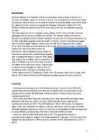
Facts and figures The Republic of Estonia is a small country. Covering only 45, 228 sq km it is slightly bigger than Denmark, Belgium or Switzerland. Estonia's population is under 1.4 million. The official language is Estonian but since very many Russians live here Russian is also wide spread. The capital of Estonia is Tallinn. The currency used in Estonia is Eesti kroon. The Estonian national flag is blue-black-white. It was originally the flag of the Estonian Students' Society. The flag was first consecrated in Otepää Church in 1884. For a while, during the Soviet occupation, the flag was banned but it was again seen in public in Tartu in May 1988. The national flower is cornflower, the national bird is barn swallow and the national stone is limestone. The Estonian national anthem called "My Native Land, My Pride and Joy" was composed in 1848 by Friedrich Pacius. The Estonian language words were written by J. V. Jannsen. It was officially adopted after the War of Independence in 1920
Estonia. Estonia, officially the Republic of Estonia is a country in Northern Europe. It is the smallest of the three Baltic countries. Estonia has land borders with Latvia (339 km) to the south and Russia (229 km) to the east. It is separated from Finland in the north by the narrow Gulf of Finland and from Sweden in the west by the Baltic Sea. Estonia has been a member of the European Union since May 1, 2004 and of the NATO since March 29, 2004. The area of Estonia is about 45000 square kilometres and the population is about 1.4 million people. The capital of Estonia is Tallinn and the official language is Estonian. The currency is Eesti kroon. The main religion is Lutheran. Anniversary of
The city's pride and joy is without a doubt its Medieval Old Town, but equally enchanting is the Kadriorg district, a throwback to the time when Estonia was ruled by the Russian Tsars. Tallinn is the capital and largest city of Estonia. It occupies an area of 159.2 km2 with a population of 416,470. It is situated on the northern coast of the country, on the shore of the Gulf of Finland, 80 km south of Helsinki, east of Stockholm and west of Saint Petersburg. Tallinn's Old Town is in the list of UNESCO World Heritage Sites. It is ranked as a global city and has been listed among the top 10 digital cities in the world.The city was a European Capital of Culture for 2011, along with urku, Finland.Tallinn is the oldest capital inNorthern Europe. The city was known as Reval from the 13th century until the 1920s. http://en.wikipedia.org/wiki/Tallinn Old Tallinn
I choose this topic because I want to get know more about local Theatres I hoped to get more information about their location, for whom each theatre is designed and a little overview about their history. The history of Estonian theatre does not differ much from that of the neighbor countries. The first play was performed in the 16th century at the Tallinn Town Hall. The town school children, who were Germans, staged Terence's The Andria in Latin. The first theatre house in Tallinn was mentioned in written materials which date from the late 17th century; the house was used by travelling theatre groups. Tallinn was already known then as a theatre-loving city. The first prominent name in Estonian history of theatre, August von Kotzebue, dates from the same period. The Russian authorities sent him from St. Petersburg to Tallinn to work as an official. Kotzebue's entertaining productions became famous all over Europe. He founded the
Introduction Estonia, officially the Republic of Estonia (Estonian: Eesti or Eesti Vabariik) is a country in the Baltic region of Northern Europe. It is bordered to the north by Finland across the Gulf of Finland, to the west by Sweden across the Baltic Sea, to the south by Latvia (343 km), and to the east by the Russian Federation (338,6 km). The territory of Estonia covers 45,227 km² and is influenced by a temperate seasonal climate. The Estonians are a Finnic people closely related to the Finns, with the Estonian language sharing many similarities to Finnish. The modern name of Estonia is thought to originate from the Roman historian Tacitus, who in his book Germania (ca. AD 98) described a people called the Aestii. Similarly, ancient Scandinavian sagas
century Russification and was so disliked by many Estonians as a symbol of oppression that the Estonian authorities scheduled the cathedral for demolition in 1924, but the decision was never implemented due to lack of funds and the building's massive construction. As the USSR was officially non-religious, many churches including this cathedral were left to decline. The church has been meticulously restored since Estonia regained independence from the Soviet Union in 1991. http://en.wikipedia.org/wiki/Alexander_Nevsky_Cathedral,_Tallinn The church's towers hold Tallinn's most powerful church bell ensemble, consisting of 11 bells, including the largest in Tallinn, weighing 15 tonnes. You can hear the entire ensemble playing before each service. http://www.tourism.tallinn.ee/eng/fpage/explore/churches#!p_307 Old Town Twisting cobblestone lanes and iron street lamps. Gothic spires and medieval markets
UNO SOOMERE ESTONIAN SYMPHONIC MUSIC. THE FIRST CENTURY 1896-1996. AN OVERVIEW With a Historical and Cultural Summary IN MEMORY OF THE GREAT ESTONIAN COMPOSERS CONTENTS ESTONIA AND THE ESTONIANS FOREWORD IN THE FOLD OF TSARIST RUSSIA. EMERGENCE AND FIRST STEPS ON THE CLASSICAL-ROMANTIC PATH. HISTORICAL INTRODUCTION I. MUSICAL LIFE IN TARTU AT THE TURN OF THE CENTURY. TRAILBLAZERS: ALEKSANDER LÄTE, RUDOLF TOBIAS, ARTUR KAPP. II. THE FIRST DECADE OF THE 20TH CENTURY. ARTUR LEMBA: THE BEGINNING OF ESTONIAN SYMPHONY AND OPERA. III. NEW DEVELOPMENTS IN CULTURAL AND MUSICAL LIFE: THE END OF THE TSARIST PERIOD. THE INDEPENDENT REPUBLIC OF ESTONIA: THE INTRODUCTION OF INNOVATIONS FROM WESTERN ART AND THE EVOLUTION OF
It was not until the 18th century that the name Lai also started to appear. In 1872, when the street names were being fixed, Lai remained the sole name of the street. 4 1 Lai Street / 4 Nunne Street A good example of Neo-Renaissance and early Art Nouveau styles combined is Lai Street 1, the present Youth and Puppet Theatre, erected at the beginning of the 20th century as the Nobility Club. The three-storey building replaces two medieval properties. In 1784 an amateur theatre began playing in a house situated in the same place and soon became a professional German City Theatre. The famous German writer August von Kotzebue (1761-1819), the life and soul of the theatre, lived in Tallinn for several long periods. (Otto von Kotzebue, the son of August von Kotzebue, accompanied explorer Adam Johann von Krusenstern on his Journey around the World of 18031806.) Estonian was heard
to Estonia. A popularly elected assembly (Maapaev) was formed but was quickly forced underground by opposing extremist political forces. The Committee of Elders of the underground Maapaev announced the Republic of Estonia on February 24, 1918, 1 day before German troops invaded. After the withdrawal of German troops in November 1918, fighting broke out between Bolshevik and Estonian troops. On February 2, 1920, the Treaty of Tartu was signed by the Republic of Estonia and Soviet Russia. The terms of the treaty stated that Soviet Russia renounced in perpetuity all rights to the territory of Estonia. Independence lasted 22 years. This period was one of great cultural advancement.Estonia underwent a number of economic, social, and political reforms necessary to come to terms with its new status as a sovereign state. Economically and socially, land reform in 1919 was the most important step. Large estate holdings belonging to the
Art Museum of Estonia Art Museum of Estonia was founded on November 17th, 1919, but it was not until 1921 that it got its first permanent building the Kadriorg Palace, built in the 18th century. In 1929 the palace was expropriated from the Art Museum in order to rebuild it as the residence of the President of Estonia. The Art Museum of Estonia was housed in several different temporary spaces, until it moved back to the palace in 1946. In September, 1991 the Kadriorg Palace was closed, because it had totally deteriorated by then. At the end of the year the Supreme Council
The Most Interesting Historical Events in Estonia Liana Põldver · The nationwide Song Festival tradition began with the first Song Festival in Tartu, June 18 20, 1869. · 1860 marks the beginning of the period of the National Awakening. A singing society led by Johann Voldemar Jannsen started and carried through the nationwide idea of Song Festival. · During 1879 1910 six Song Festivals were held that played an important part in the nation's cultural and economical awakening and growth. In the independent Estonian Republic the Song Festivals were held in every five years (1923 1938). After World War II, the Song Festival tradition began again in 1947. Since 1950 General Song Festivals were held in every five years again. 1969 was an exception though when 100th anniversary of the Song Festival was celebrated.
numbers in other places where it is too high. About 350 bird species have been recorded in Estonia. More than 200 of them breed in Estonia. Due to the vast preserved natural landscapes, large raptorial birds, such as the golden eagle and eagle owl have made Estonia their home. It is the small islets, however, that can really be called bird paradise. Undisturbed by man and protected from most smaller predators by the sea, they are real nesting sanctuaries for a diversity of birds. The first inhabitants came to the area that now forms present-day Estonia some 11 000 years ago. Estonians were one of the last pagan people in Europe. Estonia was incorporated into Christendom at the beginning of the 13th century, under the pressure of crusaders from Denmark and Northern Germany. Estonians were reduced to the status of peasantry until the 19th century. From 1558 onwards, Estonia became the battleground for the Livonian War involving Denmark, Sweden, Russia and Poland
*Estonians conquered by the crusaders 1208 *Reformation 16th century establishments of new school, Estonians first book appeared in 1525 *Tartu University 1632 founded by King Gustavus II Adolphus, classical university, member of the Coimbra group *Abolition of serfdom 1816 *Song festival 1869 in Tartu, an organiser was J.V.Jannsen, 822 singers, men only *Declaration of independence 24th February 1918 *War of independence 1918-1920 during the Russian Civil War, resulted in a victory for Estonia *Deportation 1949 *Estonia becomes independent 20th August 1991
Tallinn is one of the oldest cities in the Baltic Sea region. Tallinn was first mentioned in written sources of the 1154th, when the Arabian geographer Al Idris took a world map the city 'Kaleveny "/ Kolõvan. Through the years, the city of Tallinn had several names: Lindanisa, Kolõvan, Reval and eventually Tallinn. Tallinn was granted the Lübeck law in 1248 and became the member of the Hanseatic League in 1285. General Data l Country - Estonia l County - Harju County l First appeared on map - 1154 l Town rights - 1248 l Mayor - Edgar Savisaar l Aera - Total 159.2 km2 (61.5 sq mi) l Population - (1 Mar 2012) Total - 416,470 Denisty - 2,614.0/km2(6,766.6/sq mi) Tallinn Coat of arms Flag Top 5 Attractions 1. Kiek in de Kök Visitors to the museum will see examples of Medieval firepower, displays detailing how the city's system of walls and towers developed through the centuries and an exhibit on crime and punishment in Old Tallinn. 2
FACTFILE Area: 45 228 sq km Poplulation: under 1.4 million Capital: Tallinn Language: Estonian Currency: Eesti kroon (EEK) Main religion: Lutheran National holiday: 24 February (anniversary of the republic) National flower: Cornflower National bird: Barn Swallow National stone: Limestone LOCATION The Republic of Estonia is the northernmost and smallest of the three Baltic States. It is located on the eastern shores of the Baltic Sea in the north east of Europe. To the east the country borders Russia. Latvia is the countries neighbour to the south. From the west the coast of Estonia is washed by the Baltic Sea and from the north by the Gulf of Finland. The length of the coastline is approximately 3 800 km. The longest distance from east to west is 350 km, while north to south Estonia stretches 240 km. THE NAME The name EESTI was apparently derived from the word AISTI, the name given by ancient Germans to the peoples living northeast of the Vistula
From the watching platform a wunderful view on Tallinn and Finland coast is opened. The TV Tower itself is used for broadcasting Estonian tv chanels and radiostations, and like mobile communication mast -The Kadriorg Park & Palace -The Kadriorg Palace- was a summer residence of the royal family. It was situated by Peter I in 1718 and named it in the honor of hiswife ?Ekatherine?. Palace was projected by italian architect Nikkolo Miketti, but the first brick in the base of the structure the tsar himself has put. -The Kadriorg Park- is the most knowned hand made park in Estonia. There is a swan pund here, beautiful park avenues and museums. The landscape arround the park is the same it was, with its fields and meadows. -Song Festival Grounds On the song festival grounds took place many meetings, which demanded the canceling of the soviet order, which were accompanied by choral singing. Thanks to this, people returned
Independence Day On 24 February, Independence Day is celebrated in the Rebublic of Estonia. This is the day that the Manifesto was declared in Tallinn 91 years ago. In responce to a period of Russification initiated by the Russian empire in the 1890's, Estonian nationalism took on more political tones, with intellectuals first calling for greater autonomy, and later, complete independence from the Russian empire. Following the Bolshevik takeover of power in Russia after the October Revolution of 1917 and German victories against the Russian army, between the Russian Red Army's retreat and the arrival of advancing German troops, the Committee of Elders of the Maapäev issued the Estonian Declaration of Independence in Pärnu on February 24, 1918. after winning the Estonian Liberation War against Soviet Russia and at the same time German Freekorps volunteers (the Tartu Peace Treaty was signed on 2 February 1920), Estonia
Tallinn Port and Airport Student: Margit Reinsalu Supervisor: Meeri Sild Tallinn 2010 1 Table of Contents Table of Contents.................................................................................................................... 2 Introduction............................................................................................................................. 2 Lennart Meri Tallinn Airport..................................................................................................... 4 Port of Tallinn.......................................................................................................................... 5 Statistics.................................................................................................................................. 6 Introduction The topic of my report is Tallinn Port and Airport
Tallinn Mustamäe College G2K Jaana-Kristiina Jõgevest The Four oldest churches of Tallinn Report Supervisor: Ingrid Teigar Tallinn 2009 The Dome Church The Danes began fortification of Toompea after the conquest of Tallinn in 1219 and probably also built the first church there. It was presumably a wooden building located at the site of the present cathedral. However, a serious conflict with the Order of the Brothers of the Sword broke out soon as the latter wanted to gain control of the entire Estonia. The order succeeded in subordinating Tallinn and the whole of North Estonia to its rule in 1227. The monks of the Dominican Order began the construction of a stone church in Toompea in 1229. The first written data on the cathedral date back to 1233, the date of a
houses are the mute witnesses of those times. The riches and cultural heritage of Mulgimaa owe to the diligence and tenacity of the local people. Village handicraftsmen and masters have always been honoured. Mulgikapsad (stewed sauerkraut with barley groats), Estonian cheesecakes and kama (a roasted meal-mixture) have not lost their popularity. However, linen growers have now been replaced by cereal grains growers and many farms have specialised on raising sheep or horses. And as the song goes: "Mulgimaa it's a place where life is good. It's a land of vast woods, fertile fields and nature's charms, the home of prosperous Estonian farms..." Tourism and handicraft in Lõuna-Viljandimaa Lõuna- Viljandimaa captivates senses with its beautiful landscapes. Lõuna- Viljandimaa as we know it today stays in the heart of the historic Mulgimaa. Mulgimaa is the home of mountains, deep valleys and lakes, its natural axis is the beautiful old valley of Halliste.
Tallinn used to be divided into 2 parts - Upper Town where lived the aristocracy, gentry and the clergy; and Lower Town with traders, craftsmen and merchants. Legend says the Toompea Hill is actually the tumulus mound of the great Kalev. Linda carried rocks to his grave. It is a naturally- formed limestone hill. Lower Town was a merchantile centre, Tallinn also belonged to the Hansaetic League (1285). It is often referred to as the town of citizens. Any grown-up, married and economically independent person, born in a legal marriage between two free people and having lived in the town for at least 3 months, could apply to the Magistracy for citizenship. Serfs could escape from serdom after having successfully hidden in town for a year and a day. Two parts remained separated until the end of the 19th century. Four Names Lyndanise - mentioned by Henricus de Lettis in his Chronicle; derives from the name Linda - the wife of Kalev and mother of Kalevipoeg
 annaabi.ee