Leidsid 33 sarnast õppematerjali, mis on seotud failiga "Romantic poetry and prose". Need materjalid aitavad sul teemat sügavamalt mõista.
poet, poetry, novel, nation, roman, romantic, class, novels, revolution, greek, greece, women, poem, prometheus, shelley, nature, image, again, part, good, important, characteristic, byron, major, reason, marriage, spirit, other, characteristics, english, work, classic, austen, wrote, star, romanticism, lower, between, ideal, poets, sense, started, empireLatin, works in Old, Middle, and Modern English, each of which represents a different period Full of great works British works in Latin Venerable Bede He lived between 673 and 735 AD The greatest of all the AngloSaxon scholars He's the earliest English historian, whose work has shed light on a period of English history that would have otherwise been unknown ,,The Father of English History" Wrote / translated about 40 books on almost every area of knowledge, i.e. nature, astronomy, and poetry His best known work is "The Ecclesiastical History of the English People" Starting with the Roman invasion in the 5th century, he recorded the history of the English up to his own day Old English Cædmon ,,The Father of English Hymn" Cædmon's Hymn is the oldest recorded Old English poem, and also one of the oldest surviving samples of Germanic alliterative verse The Hymn itself was composed between 658 and 680, recorded in the earlier part of the 8th century Middle English
metaphors. He only has one sonnet that conforms to traditional rules; his songs are not lyrical at all. He introduces sex, death and erotic love into poetry. John Milton (1608–74) – poet; introduced the blank verse into English poetry. Best known for epic poem Paradise Lost; story of the fall of man and the eventual expulsion from the Garden of Eden. Literature after the Restoration (of Monarchy in 1660) – rich and many-‐sided, covering
The Romantic Age. Began in the 18th century. There are some disagreements about when the period began so we can't say the exact year of the beginning. Characteristics of Romantic age: The Romantic Age is a term used to describe life and literature in England in the late eighteenth and early nineteenth centuries. -Imagination was very important Like William Blake an English poet has said "I know that this world is a World of Imagination and Vision" -Belief and appreciating nature -Independency Writers placed the individual, rather than society, at the center of their vision. The assertion of nationalism became a central theme of Romantic age. Literature Emergence of new ideas and positive voices. Emphasis was women and children, the heroic isolation of the artist or narrator, and respect for nature. Some writings were also based on the supernatural.
new markets and endless supply of raw materials; 1845- potato famine in Ireland, 1846- Corn Laws (import of cheap corn to feed hungry people); Social life: religious doubts (Darwin's The Origin of Species 1859)- question raised: is there a God at all?; sexual liberation- changed people thoughts about sex (before men & women had different bedrooms); problems: alcoholism, prostitution, child workforce, primitive technology. · How did the class structure change? Highest class was aristocracy (the Church and the nobility); the middle class/the bourgeoisie (shopkeepers, merchants, lawyers, businessmen etc.) was the biggest class; and the lowest class "the working class" and "the poor"; new change was the upward mobility people could become richer and move upward in social classes (to higher class); huge boost of the middle and working class; after industrial revolution there was
1. The Jacobean masque Elizabethan one nation culture, now cultural polarisation between the new courtly culture and the rest of the country. Court in cultural isolation. Ben Jonson. King and courtiers were close to universally recognised ideal types (conflict with the reality). Mysticism. Emergence of perspective view, stage machinery, artificial light, revolution. The stage cast the monarch in the focal point (the lines of perspective of the stage met there. Inigo Jones. Masque an educative vehicle, towards classical antiquity and architecture. Tide towards absolute monarchy. Masque – linked poetry and moral philosophy into art. Music, dance, poetry, lavish illusionistic scenic display to express the doctrines of divine kingship. Great impact. Like gods come down to earth. 2. The Caroline masque
The making of a new nation. The Enlightenment in America. The emergence of the notion of the American Dream. The great Enlighteners: Crèvecoeur, Jefferson, Paine, Franklin. The American Enlightenment is the intellectual thriving period in the United States in the midtolate 18th century (17151789), especially as it relates to American Revolution on the one hand and the European Enlightenment on the other. Influenced by the scientific revolution of the 17th century and the humanist period during the Renaissance, the Enlightenment took scientific reasoning and applied it to human nature, society, and religion. American Enlightenment a gradual but powerful awakening that established the ideals of democracy, liberty, and religious tolerance in the people of America. If there were just one development that directly caused the American Revolution and uplifted the intellectual culture of the continent while it was only
colonisation to Englishmen back in the homeland. An example of this form of writing is John Smith's A True Relation of Virginia, which is widely recognized to be the first example of Am lit. The early years of colonisation produced a mass of utilitarian writings including biographies, accounts of voyages, diaries, sermons, pamphlets. Much of the material addressed the problems of Church and State. There were few examples of fiction, poetry or drama. Anne Bradstreet of Massachusetts published some lyrical poems of high literary quality (1650) and Edward Taylor, who was born in England but lived in Boston, wrote some poetry in the style of John Donne and the metaphysical poets. All 17 th cent Am writings were, both in content and form, similar to English lit of the same period. The great literary figures of the 18th cent were Benjamin Franklin (1706-1790), Thomas Paine (1737-1809) and Thomas Jefferson (1743-1826).
environment. Over the last few centuries, the development of society and its political upshots have produced agendas for linguistic inquiry and discourse on language, some of which have had an impact on the development of Russian and contingent languages and their social functions, as well as on the development of linguistics as a global discipline. Six such agendas can be pinpointed: (1) the Orthodox emancipation agenda (1600-1700), (2) the Russian nation building agenda (1700-present), (3) the scientific agenda (1860-present), (4) the Marxist agenda (1917-1989), (5) the Eurasian agenda (1920-1935), (6) the cybernetic agenda (1953-1975). Russian language Russian language is an East Slavic language and an official language in Russia, Belarus, Kazakhstan, Kyrgyzstan and many minor or unrecognised territories. It is an unofficial but widely spoken language in Ukraine and Latvia, and to a lesser extent, the other post-Soviet
Philip Larkin’s Poetry: Themes, Form, Style, Imagery and Symbolism Author: Sandra Olivares González Tutor: Jesús Marín Calvarro Degree in English Studies, English Department, Faculty of Philosophy and Letters, University of Extremadura Cáceres, 29th January 2016 Philip Larkin’s Poetry: Themes, Form, Style, Imagery and Symbolism The aim of this work is to obtain some characteristics of the poetry of Philip Larkin, such us the origin of his themes, the way in which he writes his poems and the symbolism he uses (which is a very controversial topic because some assume that he does use it, while some others say that he uses it in an ironic way). In this work we tried to make a revision on the vision of Larkin through the studies that had been made on
1. Beowulf. The dating of Beowulf is still controversial. The poem is one of the earliest and greatest monuments of the Germanic literatures. The main stories of the poem (the fights of B.) are versions of common folk-tales, but the poet also introduces many incidental stories, some of which belong to the world of ancient Germanic legend. He writes his folk-tales and legends in a web of other events, mainly set in the Baltic Kingdoms. He shows a very rich and leisurely portrayal of this Baltic world, providing many customs like the close relationship between lord and man in the war-band and others. All this encouraged the supposition that the unknown author of the poem was himself a bard of the ancient type
American literature The literary history of this nation when the first humanbeing living in what has since become the U.S used language creatively. · Mid to late 18 century put down · Words are powerful, magical · Words must be remembered · Native Americans stories creation of the world · Attidude thought their land/language · Similar stories Dates and names · America was discovered in 1492 by Columbus · 1497 John Cabot went to Canada
THE ANGLO-SAXON PERIOD English literature came when the Angles, the Saxons, the Jutes and the Frisians invaded Britain. During this time English was called Anglo- Saxon or Old English. In the chronicles of Roman history (composed in Latin) is said that Britain makes its first appearance in written language when Romans invade the England. BEOWULF most important poem, surviving in a 10th-cent manuscript. The historical period of the poem's events can be dated in the 6th to 8th century. Much of the material of the poem is legendary and paralleled in other Germanic historical-mythological literature in Norse, Old English, and German.
The Life of Dante, the Inferno of Dante Dante Alighieri, one of the greatest poets of the Middle Ages, was born in Florence, Italy on June 5, 1265. He was born to a middle-class Florentine family. At an early age he began to write poetry and became fascinated with lyrics. During his adolescence, Dante fell in love with a beautiful girl named Beatrice Portinari. He saw her only twice but she provided much inspiration for his literary masterpieces. Her death at a young age left him grief-stricken. His first book, La Vita Nuova, was written about her. Sometime before 1294, Dante married Gemma Donati. They had four children. Dante was active in the political and military life of Florence.
supernatural, like a ghost sending its melody while staying unseen. Then Shelly goes on comparing the Skylark to many various things like a cloud of fire, a star of heaven, a high-born maiden, a glow-worm, a rose etc. All this to give forth his idea of the lark as something unreachable, unseen but heard, royal, sweet and sensitive. The bird is something very mystical because nobody really knows what it feels or tells with its songs. Like a poet expressing his thoughts, the bird sings songs that no one actually asks for. In the spring the Skylark's song awakens the world which shows how much power the little bird has. As the poem progresses Shelly starts to wonder where the Skylark gets it's inspiration from. He is jealous, in a good way, and wishes he could create something as powerful. Shelly admires the most, how the skylark sounds very joyous. People may get their inspiration from
Ameerika Kirjandus 30.01.13 Naturalism · France, Emile Zola · Put down his theory in 1879: Le Roman Experimental, attempt to explain the development of human society throuch biological laws · Outlook is deterministic, pessimistic, fatalistic (fate or biology) · Man as an animal-clever than other beasts, still explainable within the framework · Man is not a free agent, is govern by something · Unable to determine his own faith · Hereditary · Naturalists tried to apply in fiction the processes of natural sciences
Idealization of Nature in Romantic Poetry One of the main characteristics of romanticism in general is the constant praising of nature and connecting it with almost everything. As the second half of the 18 th century was the time of the industrial revolution, urbanization and mankind's distancing from nature in every way, it is not surprising that as a result it became more and more important to and valued by people it had suddenly become something remote and far from everyday life, somewhat a luxury. The utmost way this luxury manifests in romantic poetry is nature's ability to help whoever takes the time to value its divinity get in touch with themselves and get away from everything that might influence their way of acting
Denial of conventions, traditional structure, plot and presentation of character. The stream of consciousness. Allusiveness. Virginia Woolf's Modern Fiction as a theoretical platform for Modernism. Criticism of Realist literary method. Literary modernism: end of the 19th century-1920 (reached its height) and ended 1940s. A self- conscious break with traditional aesthetic forms. Rejecting the sentiment and discursiveness typical of Romanticism and Victorian literature for poetry that instead favored precision (täppis) of imagery and clear, sharp language. Modernist writers embraced the unconscious fears of a darker humanity. Sub movements: surrealism, formalism, avant-garde, symbolism, imagism Structuralism: Writers used myth and music as a part of the books structure. J. Joyce "Ulysses". Deep structure is the same as in "odyssey" and T.S. Elliot "the fisher king"-more complicated experiment
Stylistics studies everything that makes the text or the utterance special. It cuts across all the basic linguistic sciences: · Phonetics--silent, sleepy streets · Morphology--speak, spoke, spake · Syntax--he came in-in came he · Lexicology--finish-terminate (synonymic pairs) A survey of the development of stylistic studies: It is a relatively new branch in philology; yet, its roots go back as far as ancient Greek and Rome where the rhetoricians cultivated the art of clear and elegant use of language. 18th cent--emerged an individualistic-psychological view on style and stylistics. According to that, style bears the stamps of individual usage: every writer has a unique pattern of habits and abilities that form his style. Fr. Poet Buffon: "Style is the man himself." Late 19th, early 20th century--appeared a utilitarian approach to style remotely linked with ancient rhetoric
influential. Pre-Raphaelitism hung on in British art until after World war I, but it no longer represented the feelings and ideas of society. During Queen Victoria`s reign interest grew in classical literature and the history of ancient Greece and Rome, as well as in the legendary medieval past of Britain itself. Artists started to combine sex and art in a tasteful manner acceptable to Victorian sensibility- paintings of Greek and Roman ladies at their bath and in other intimate situations. The technical expectations were very high towards these paintings. A new current was set in motion by Rossetti, who was a poet as well as a painter. He developed a style full of mysterious undertones, using colour not to describe nature realistically but to suggest mood and feeling. William Hunt (1827-1910) He was the leading member. Kept true to the original aims of the brotherhood. He wasn't as talented as the other two
Philip Larkin poetry analysis For my poetry analysis paper I chose Philip Larkin's works, because he was the first British poet whose works I read. I think that his poems are interesting. They reveal much about Larkin's life and about the social issues in the 20th century. Larkin is also considered to be one of the greatest English poets in the 20th century. I think that Larkin was quite interested in politics. For example his poem ´´Talking in Bed´´
negligible largely because external wars and internal strife ravaged the country for almost a century and a half (1337-1485) The Renaissance in England may be divided into 3 parts: the rise of the R. under early Tudor monarchs, the height of R. under Elizabeth I, the decline of the R. under the Stuart monarchs. 6. The first manifestations of the Renaissance in English literature. The first major impact of the Renaissance on English literature is observable in the poetry of Wyatt and Surrey, who introduced and Anglicized the sonnet, a verse form that has proved to be both popular and durable. Surrey is credited also with inventing English blank verse. Other verse forms, borrowed from the Italian and French, had a lesser impact. Elaborate Renaissance conventions of love poetry were also transplanted, finding their outlet chiefly in sonnets and sonnet sequences. 7. Which events diminished the power of the Catholic Church in England?
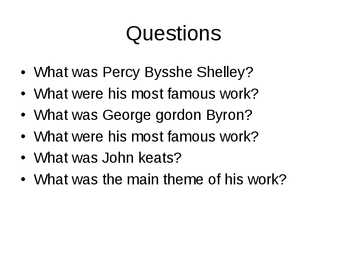
· What was Percy Bysshe Shelley? · What were his most famous work? · What was George gordon Byron? · What were his most famous work? · What was John keats? · What was the main theme of his work? Second Generation Poets · The poets of the second generation: George Gordon Byron, Percy Bysshe Shelley and john Keats. · They lived through the dissillusionment of the post-revolutionary period. · The Britain they knew was highly fearful of the possibility of revolution. Percy Bysshe Shelley (1792-1822) · He was a Poet, a Dramatist, a Essayist and a Novelist · Shelley was born at Field Place in Broadbridge Heath. · The most revolutinary of the Romantic poets. · He was an individualist and idealist · His ideas were anarichic · Many of his poems address social and political issues · He is best remembered for "Ode to the West Wind" and "To a Skylark." George Gordon Byron (1788-1824)
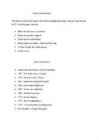
Phonetic SD ("Rhythm And Style") 8. Lexical SD* 9. Syntactic SD* Use lecture notes 10. Graphical means and devices 11. Common literary and common colloquial vocabulary 12. Special literary vocabulary 13. Special colloquial vocabulary 14. Metre in English poetry. Modifications of metre ("Rhythm and Text") 15. Typically English stanzas ("Rhythm and Text") 16. Rhythm in poetry and in prose ("Rhythm and Text") Study independently 17. Varieties of language (I. Galperin "Stylistics") 18. Emotive prose (I. Galperin "Stylistics") 19. Scientific prose style (I. Galperin "Stylistics")
PRONOUNS: instead of "I" the speaker may use: "one", "you" to create a close contact with the reader or listener. In colloquial speech the same effect is achieved by "man", "chap", "fellow". The speaker may use pronouns "he / she" meaning himself as if viewing himself from the distance and focusing more attention on the speaker. The archaic second personal pronoun "thou" and its forms may be used to create an elevated mood in poetry. In prose they may convey historical background. "It", "he", "she" may be involved in personification (e.g. "The Moon smiled her smile."). "We" may be used to denote only a speaker. "We" the Majestic Plural that is used in king or queen's orders or manifesto. The Modest Plural is when "we" is used out of modesty as if involving the audience, and it creates a true to life effect. "They" becomes emotional when used independently
First I am going to talk about Marie Heiberg. She lived 1890-1942. Her first poem collection was ,,Mure-lapse laulud" in translation ,,Problem child's songs". Her talent was noticed, but she didn't have a change to really become famous. She was in a great penury that made her life really though and she had a gentle soul. Thanks to all that in 1919 she was diagnosed with schizophrenia. She isn't really famous poet in Estonia, but I chose her because when you read her poems you can really feel the pain she has been through. Her poems influenced lots of people with their fresh style and deep and painful content. These made people think about depths of life. Next writer I am going to talk about is Elisabeth Aspe. She lived in 1860-1927. She was an early realist, back at that time most people wrote about different things. Critics have said that her works were very interesting in many different ways
sent her to school in Paris. In 1834, Dickens became a political journalist, reporting on parliamentary debate and traveling across Britain by stagecoach to cover election campaigns for the Morning Chronice. His journalism, in the form of sketches which appeared in periodicals from 1833, formed his first collection of pieces Sketches by Boz which were published in 1836 and led to the serialization of his first novel, The Pickwick Papers, in March 1836. On 2 April 1836, he married Catherine Thompson Hogarth (1816 1879), the daughter of George Hogarth, editor of the Evening Chronice. After a brief honeymoon in Chalk, Kent, they set up home in Bloomsbury, where they had ten children. On 9 June 1865, while returning from France with Ternan, Dickens was involved in the Staplehurst rail crash in which the first seven carriages of the train plunged off a cast iron bridge that was being repaired
Literature of the 14th century The highpoint of medieval literature, the best writer of late medieval lived then. William Langland 1332-1376 the last important poet of alliterative verse. His masterpiece "The Vision of Piers Ploughman" how important working hard is, the labour of peasants is the base of the welfare of the people. A passionate protest against social injustice. A time when peasants were slowly rising against their feudal lords. Descriptions of different social classes. Religious mysticism. Two great principles: 1) all men are equal before God; 2) honest labour is dignified. It is a dream allegory
History of English literature Periods: 1. Anglo-saxon or early literature (499 - 1066) 2. Second or Norman or late Medieval period (1066 - 13/14 century) 3. Renaissance or Modern period (13-14 century present) Anglo-Saxon period · All of the literature had its roots in folklore · Texts were orally transmitted, the anglosaxons had no written language · Two types of singers: 1) scop (attached to the royal court, wrote poetry and songs, performed them); 2) gleeman (travelled, mostly sang other peoples' songs, not their own songs; performers of scop songs) · The oldest known song Widsith (The Far Traveller/Wonderer); tells of a gleeman who travels in Europe, of his love of noble deeds, speaks of the shortness of life http://en.wikipedia.org/wiki/Widsith · The other known song Deor's Lament. Can be called the first English lyrics, about 40 lines
The Romantic movement in American literature Romanticism in literature · Romantic · Romanticism is an artistic, literary, and intellectual movement · Influenced by : - Enlightenment - elevated medievalism · In America 1820 Characteristic features · Intuition, instincts, imagination, feelings · Folk art, nature, heroism · Protest against reality · Emphasis on women and children · Dreams · Symbolism and myths Events & Dates · The American Revolution (1776 -1783) · The French Revolution (1789 1799)
They most probably came from Eastern Europe and belonged to the Celtic race and also spoke Celtic. They were primitive hunters- gatherers, farmers. Some Celtic words are still used in modern English, however they are used mostly in place names. For example: · avon river · cumb valley · ford shallow place in the river Ancient Britons had their own religion and priests or druids and temples. In the year 55 BC Britain became a Roman province. Romans were highly developed and had their own language latin, which has also greatly influenced English. The military occupation of the Isles ended in 410 AD. The Romans eventually brought Christianity to Britain. Hadrian's wall on the border of Scotland and England. It began construction in 122 AD. An Anglo-Saxon attack on Rome forced the Romans to leave The British Isles. They were
ANTITHESIS ANTITHESIS means the opposition or the clash of two strongly contrasted ideas combined with syntactic parallels. Contrast is often created by antonyms. NT: A time to be born, and a time to die; a time to plant, and a time to pluck up that which is planted; a time to kill, and a time to heal; a time to break down, and a time to build up; a time to weep, and a time to laugh; a time to mourn, and a time to dance; NT: I am the poet of the body and the poet of the sole. NT: I was his family's devoted friend, and she was my family's secret enemy. CHIASMUS 3 4 Syntactic CHIASMUS (reversed parallelism) means that the word order of one sentence is inverted compared to that of the other sentence or clause
One of the abts/the best was given by Jonathan Swift: ,,Proper words in proper places." In present- day english, the world style is used in about half a dozen basic meanings. 1. the characteristic manner in which a writer expresses his ideas. Some speak about the style of Hemingway, Dickens etc. 2. the manner of expressing ideas, characteristic of a literary movement or period. Style of symbolism, romanticism 3. the use of language to pick a literary genre-comedy, novel, drama, O.D (poetic form) etc. 4. the selective use of language that depends on spheres of human activity fiction, scientific prose, newspapers, official documents, business correspondenc etc. Style bears the stamp of indivual usage, that is every writer has a unique pattern/habit and abilities that form his style. This approach is best illustrated in the well-known victum of the french poet Georges-Louis de Buffon ,,Style is the man himself." Stylistics
The highest peak, Suur Munamägi rises to only 317 metres. High limestone features characterise the north of the country, while the south has a drumlin terrain. The maritime climate is temperate, summers are warm and winters mildly cold, the average annual temperature is 5 degrees Celsius and the average annual precipitation is 550 millimetres. The most important assets of the soil are oil shale, phosphorite and peat. The designation “Aestii” was first mentioned by the Roman historian Tacitus in “Germania” (98 AD). By the end of the first millennium the people of Western Europe referred to the land of our ancestors with the name Estonia (derived from Germanic languages and means East). The Estonians, our Finno-Ugric forefathers settled here in approximately 5,000 BC from northern Russia and the Urals, as fishermen and hunters. They called themselves “rural people”, the term “Estonians” started to spread three
 annaabi.ee