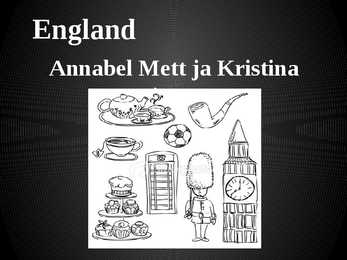
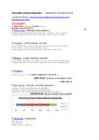
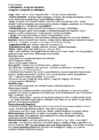
· Distribution: Males: 48,7% Females: 51,3% Climate of England · England has a temperate climate, with mild winters with temperatures not much lower than 0 C, and not much higher than 32 C in summer. Generally, July is normally the warmest month, and February is normally the coldest. Religions in England · 71,75% of Englands population are Christians. · 22,52% is unidentified or non-religious. · Other religious minorities include Muslims which account for 3% of the population. · There are also Jewish, Hindu and Sikh minorities. People Distribution · White:45,082,900 · Asian:2,914,900 · Black:1,447,900 · Mixed:870,000 · Chinese:400,300 · Other:376,100 · Due to disputes about religion, southern Ireland declared independence but northern Ireland remained part of the United Kingdom. Symbols of England Elizabeth II · Queen Elizabeth II was born Princess
Mid-Atlantic states New York, Pennsylvania, New Jersey Virve Kass General East coast of the Atlantic Ocean From -25°C to 30°C Tornadoes 270 294 km2 Population: about 40.8 million History 1524 - Giovanni da Verrazzano European colonists Religious minorities American Revolution 1776- Declaration of Independence 19th century- abolishing slavery Industrial Revolution New York • Capital: Albany • Largest city: New York City • Population: 19,541,453 (2009) • Area: 128 403 km2 Statue of Liberty (1886) Twin towers- 9/11 attacks Liberty Bell Times Square Lucy The Margate Elephant Famous people • Jennifer Aniston • Eddie Murphy
with the baby boom following World War II. Age 15 and over can read and write. Religions Rates and groups The birth rate is 12.91 births/1,000 population (2007 est.).The death rate is 8.55 deaths/1,000 population (2007 est.).Total median age is 39 years. Ethnic groups: Celtic and Latin with Germanic, Slavic, North African (Arab, Berber, Jewish), Indochinese, Black African, Black Carribean and Basque minorities. Overseas departments: black, white, mulatto, East Indian, Chinese, Amerindian. Languages There are a number of languages of France. The French language is by far the most widely spoken and the only official language of France, but several regional languages are also spoken to varying degrees. Other languages are spoken by a substantial percentage of the population due to immigration. In general, there are 5 dialects:
in the language, aswell. For example, there are regions on bigger towns where in the streets I can hear only Russian. most older and middle aged people can speak in russian. Since there are main language in our society, most jobs inquire speaking them, too. Young Russian- Estonians speak both, so they have advantages there. Thirdly, the situation with religions is a diverse. It is a fact that Estonia is the most atheist country in the world. The biggest religious minorities are lutherans, Russian Orthodox. Some people have faith is very important. It is believed that God is the one who forgives them for their sinful. But in our country are not forced religion against, we have freedom of religion. Finally, In my opinion, it is a problem to some extent in every country of tolerance between different races. In particular, a large grudge against the Russians, Estonians, just because of our past.
Rahvastiku andmed analüüsiks: Näidiseks Eesti andmed 2012 The World Factbook - https://www.cia.gov/library/publications/the-world- factbook/geos/en.html GEOGRAPHY: 1) Area: total 551,500 km² )Coastline: 3,427 km PEOPLE and SOCIETY: 3) Ethnic groups: rahvastiku etniline kuuluvus Celtic and Latin with Teutonic, Slavic, North African, Indochinese, Basque minorities overseas departments: black, white, mulatto, East Indian, Chinese, Amerindian 4) Languages: keeled (nimetage suuremad) French (official) 100%, rapidly declining regional dialects and languages (Provencal, Breton, Alsatian, Corsican, Catalan, Basque, Flemish) overseas departments: French, Creole patois, Mahorian (a Swahili dialect) 5) Religions: usundid (nimetage suuremad) Roman Catholic 83%-88%, Protestant 2%, Jewish 1%, Muslim 5%-10%, unaffiliated 4%
and development in support of national security needs. It continues today to be viewed as a premier R&D organization where the best science and engineering is identified, supported, and applied to meet national security requirements. The rapidly changing human resources environment in the United States portends significant changes in the talent pool from which ONR will develop its future work force. In particular, women and ethnic minorities are a growing component of the professional scientific community. It is, therefore, incumbent on ONR to establish effective mechanisms to recruit and retain personnel from these groups and to develop a climate that is conducive to integrating diverse employees into a more productive organization. Because of that, in late 1994, the Office of Naval Research (ONR) asked the National Research Council (NRC) to provide advice on how to ensure diversity in its future
About my intrests now. I learn guitar in X Music School. Guitar, and music in general, is my greatest passion. I find makeing and listening music relaxing. I also have solfedzo and music history lessons in Music School. I'm attending youth choir of my school. Choir singing is very popular in Estonia, because it's big part of our culture. I take part of student representive and drama group ,,X". I'm also participant in several youth projects, which include integrating national minorities and giving information about healthcare. About the sport, I used to take part of swimming trainings, but this year training times don't fit for me, so I'm going to swim and gym on my own twice a week. I'm also into skiing, but this sport can be done only in winter. We have really good skiing tracks in X, so I try to use them as much as I can. My summer-sport is camping. I like all kind of camping trips: on foot, with bike, with canoe. I enjoy camping, because of the wonderful nature of Estonia
Official Bilingualism in Canada is law, defined in the Canadian Charter of Rights and Freedoms, the Official Languages Act, and Official Language Regulations; it is applied by the Commissioner of Official Languages. English and French have equal status in federal courts, Parliament, and in all federal institutions. The public has the right, where there is sufficient demand, to receive federal government services in either English or French, and official language minorities are guaranteed their own schools in all provinces and territories. English and French are the mother tongues of 59.7% and 23.2% of the population respectively, and the languages most spoken at home by 68.3% and 22.3% of the population respectively. 98.5% of Canadians speak English or French (67.5% speak English only, 13.3% speak French only, and 17.7% speak both). English and French Official Language Communities, defined by First Official Language Spoken, constitute 73.0% and 23
finally to Arctic barrens in the far north. The northern Canadian mainland is ringed with a vast archipelago containing some of the world's largest islands. Population Canada is one of the most sparsely populated, with only about 30 million inhabitants. The two biggest ethnic groups are those of British and French extraction. Quebec has a large French speaking majority. There are substantial minorities who speak other European languages, such as German, Scandinavian and Polish. Inuit and Indians in the Northwest and Yukon were the first inhabitants of Canada, the Indians crossing from Asian more than 10 000 years ago, and the Inuit which has distributed all around the Arctic circle. After the First World War, Canada was one of the principal creators of the Commonwealth. Climate Average winter and summer high temperatures across Canada vary depending on the location
stone and tiled roofs. Population: The population of city is of around 400 000. There is no strict number due to inhabitants' travelling spirit. Population is comprised of people coming from different racial and cultural backgrounds. There is no predominant race, the whole population consists of minorities: white, black, métis everyone living togetherpeople from China, India, Africa, America, Europe all over the world. Key language of communication is esperanto. The spirit of cosmopolitanism is in the air. Citizens are open-minded, liberal with anarchic spirit living refusing to follow any conventions. There is no gap between very rich and very poor people.
http://www.vm.ee/?q=et/node/5741 4. Eesti keel ja kultuur maailmas- http://ekkm.einst.ee/keskused/koolid/ 5. Estonia Today- http://docs.google.com/gview?a=v&q=cache:DZtC6cmN- x0J:homepage2.nifty.com/kmatsum/estinfo/vminfo/eng/eestikeel.pdf+Estonian+Scho ols+Abroad+and+Educational+Instituhttp://docs.google.com/gview? a=v&q=cache:DZtC6cmN- x0J:homepage2.nifty.com/kmatsum/estinfo/vminfo/eng/eestikeel.pdf+Estonian+Scho ols+Abroad+and+Educational+Institutions+for+Ethnic+Minorities+in+Estonia&hl=e n&sig=AFQjCNFv1kCc60- O1T2npvZimfLzZ4b4uAtions+for+Ethnic+Minorities+in+Estonia&hl=en&sig=AFQ jCNFv1kCc60-O1T2npvZimfLzZ4b4uA 6. Rahvuskaaslased välismaal- http://www.eesti.ee/rahvuskaaslased/index.php?id=19 7. Alberta's Estonian Heritage http://www.albertasource.ca/abestonians/communities/school.html 8.Eesti elu (foorum)- http://www.eesti.ca/index.php?op=allComments&article=23013&sort=1&offset=0 13
in the 9th century. Alfred the Great defeated the Vikings in 886 and rebuilt the Roman city. In 1016 the Vikings triumphed again ruled until 1042, when Edward the Confessor took over. THE PEOPLE OF LONDON London is a growing city with a populatsion of more than seven million. It is also a multicultural city, as it been since Roman times. Now about a quarter of the capital's inhabitans are members of ethnic minorities. The Irish community The largest nonEnglish group in London is the Irish community. People from Ireland first went to London in large numbers in 1845, when disease killed their potato crops, leading to famine. Many still emigrate there. The city's Irish population in over 250,000, and there are also many people who were born in London but have Irish parents. Pakistanis and Bangladeshis Thousands of Pakistanis and Bangladeshis live in London, mostly in the east.
five years? 4. At what age may citizens vote in Britain: 18, 21 or 25? 5. Name three international organizations to which Britain belongs? 1. 1066 2. 1952 3. every five years 4. 18 5. The Common wealth, European Union and United Nations People 1. How many people (to the nearest million) live in Britain: 23 million, 48 million or 59 million? 2. What percentage of the British population belong to ethnic minorities: 1%, 5.5%, 10.3% or 15%? 3. Which country has the lowest population density (number of people per sq km): England, Wales, Scotland or Northen Ireland? 4. Put the following cities in order of population size (the number on people who live there): Manchester, Cardiff and London! 5. Is the birth rate in Britain: 7.4, 12.3 or 19 live births per 1,000 people? 6. What percentage of the population in Britain is under 16 years of age: 10%, 21% or 32%? 1
people which has allowed them to overcome the odds, gold for the wealth of the country and the golden sunshine, and green for the lush vegetation of the island. · Coat of arms: On the dexter side a West Indian Native Woman holding in the exterior hand a Basket of Fruits and on the sinister side a West Indian Native Man supporting by the exterior hand a Bow all proper. · The motto : "Out of Many, One People" - as tribute to the unity of the different cultural minorities inhabiting the nation. · Capital and largest city: Kingston · Official languages : jamaican English, National language: Jamaican Patois. · Ethnic groups (2011): 92.1% African, 6.1% Mixed, 0.8% Indian, 0.4% Other, 0.7% Unspecified · Religion : 68.9% Christian, 1.1% Rastafarian, 6.5% Other, 2.3% Not stated, 21.3% None · Demonym: Jamaican · Jamaica is a parliamentary democracy and constitutional monarchy, with Queen Elizabeth II serving as the Jamaican monarch
Anderson believes that a nation is a socially constructed community, imagined by the people who perceive themselves as part of that group 46. An ethnic nation- a social group whose members have the following characteristics: – share a sense of common origins; – claim a common and distinctive history and destiny; – possess one or more dimensions of collective cultural individuality; – feel a sense of unique collective solidarity. Ethnic identity in Britain is about minorities. 47. A civic nation- Civic nationalism (also known as liberal nationalism) defines the nation as an association of people who identify themselves as belonging to the nation, who have equal and shared political rights, and allegiance to similar political procedures.[40] According to the principles of civic nationalism, the nation is not based on common ethnic ancestry, but is a political entity whose core identity is not ethnicity. Its people to continue living together.[40]
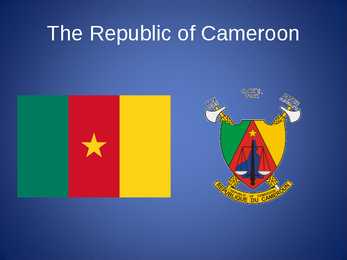
government), to the provincial governors, divisional officers, and urban-council members in large cities) · Cameroon's legal system is largely based on French civil law with common law influences · The judiciary is officially divided into tribunals, the court of appeal, and the supreme court. Politics and Government · Human rights organisations accuse police and military forces of mistreating and even torturing criminal suspects, ethnic minorities, homosexuals, and political activists · The National Assembly makes legislation. The body consists of 180 members who are elected for five-year terms and meet three times per year. Laws are passed on a majority vote. Rarely has the assembly changed or blocked legislation proposed by the president. · President Paul Biya's Cameroon People's Democratic Movement (CPDM) was the only legal political party until December 1990. Numerous ethnic and regional political groups
· õpilaste teadmised seksuaalvähemustest on lünklikud (suurel osal õpilastest ei ole sel teemal välja kujunenud kindlaid seisukohti, millest võib järeldada puudulikku informeeritust). Autorile oli töö kirjutamine huvitav väljakutse. Selle käigus kerkis esile mitmeid uusi küsimusi ja probleeme, mida autor tahaks edasi uurida. 63 Attitudes towards sexual minorities among students Research work Elisabet Arge Grade X Kuressaare Gymnasium Supervisor: Sirje Kereme
20% of the people in Wales speak Welsh and children learn it in Welsh schools. About 70,000 people in Scotland speak Gaelic. For centuries people from overseas have settled in Britain to escape persecution or in search of a better standard of living. they have brought with them their languages, cultures and religions. The most widely spoken minority languages today are from the Asian subcontinent, the other languages include Italian, Spanish, Greek, Turkish and Chinese. The largest ethnic minorities are of Caribbean or African descent (1.2 million), Indians (1.6 million), Pakistani (1 million) and Bangladeshi (0.5 million). 2. Age breakdown In common with most countries in Western Europe, Britain has an ageing population. Under 15 years of age 18% 15-64 years of age 66.3% 65 years of age and over 15.7% The proportion of population of pensionable age is increasing. People are living longer.
issued euro coins and notes is over 704 billion euros. In 1995 on 25th November Estonian prime minister Tiit Vähi signed the Kati-Liis Karu 03.01.2011 application, which requested the accession of Estonia into the European Union. As mentioned before, Estonia joined the European Union in 2004. When "we" signed the contract, we also accepted the simple main terms: stable institutions, that can guarantee the democracy and the protection and respect of human rights and minorities; a functioning market economy and the ability to cope with the pressure of competition and market forces within the EU; ability to meet the obligations of membership, including the support for the goals. Country's administrative system must be capable of applying EU laws and put them to use. According to Vahur Kraft, the leader of Estonian Nordea Bank, the euro creates many new opportunities for the country's economy and the society as a whole.
The asserted desire of the East European countries in the early 1990s, to acquire back their Europeanness and join the EU stipulated the establishment of the accession requirements that were not defined previously. Along with the EU's capacity to absorb new members, the Copenhagen Council in June 1993 stated that: Membership requires that the candidate country has achieved stability of institutions guaranteeing democracy, the rule of law, human rights and respect for and protection of minorities, the existence of a functioning market economy as well as the capacity to cope with competitive pressure and market forces within the Union. Membership presupposes the candidate's ability to take on the obligations of membership including adherence to the aims of political, economic and monetary union. Though the newly enforced Lisbon Treaty does not explicitly quote these criteria it makes a reference to those in the article 49 TEU: "the conditions of eligibility agreed upon by the
There are different types of school in England. The main categories are: Local authority maintained schools (State schools) – free to all children from age 5 to 16, schools provide their pupils with books and equipment for their studies. Independent schools (Private/public schools) – parents pay for their children’s education, these are often boarding schools and in some occasions single-sex, include religious schools and schools for ethnic minorities. The school years in England are split into Key stages: Key Stage 1 Year 1 – Year 2, age 5 to 7 Key Stage 2 Year 3 – Year 6, age 7 to 11 Key Stage 3 Year 7 – Year 9, age 11 to 14 Key Stage 4/GCSE Year 10 – Year 11, age 14 to 16 Sixth Grade/A Level Year 12 – Year 13, age 16 to 18 In Year 6 all the students are required to take National Curriculum tests in reading, writing, mathematics and science
started to consider his other son Musa al-Kazim as their seventh Imam. While the Zaydis consider Zayd ibn Ali, the uncle of Imam Jafar al-Sadiq, as their fifth man. Islam is the second-largest religion and the fastest growing religion in the world. About 13% of Muslims live in Indonesia which is the largest Muslim-majority country in the world. 25% are living in South Asia, 20% in the Middle East, and 15% in Sub-Saharan Africa. Sizable minorities are also found in Europe, China, Russia, and the Americas. Converts and immigrant communities are found in almost every part of the world. In the world there are about 1.6 billion followers of Islam and it makes around 23% of earth's population. Islam's most fundamental concept is a rigorous monotheism, called tawhid. Muslims and Jews repudiate the Christian doctrien of the Trinity and divinity of Jesus, comparing it to polytheism
- Jacques Cartier French; did altogether three expeditions; visited present-day Quebec City and Montreal 6. Immigrants: - From 1760s mostly from France (it was a French colony) - 1760s to the end of the 19th century mostly from the UK (either directly or US Loyalists) - The early 20th century from Continental Europe (Scandinavians, Italians, Ukrainians) - At present visible minorities (coloured people) from developing world. 7. British Columbia has the highest percentage of population of British origin. Quebec has the highest percentage of population of French origin. Also, Ontario has a large number of French-speaking people. 8. Governor General is the representative of the Queen in Canada, who is also appointed by the Queen. The Prime Minister is the real political leader of the country. 9
contacts with ethnic groups living in Romania. Her book is generously dedicated to her `many good friends in Transylvania and beyond Á Rumanians, Magyars, Szekelys, Jews, Gypsies, Saxons, Swabians and Serbs'. The ethnic minorities' cultural behaviour towards the travellers (particularly the Hungarians') tends to be similar to the Romanians'. The Western foreigners, unquestionably regarded as supporters, friends, and confidants, are readily integrated in the community. Throughout their
influence on Received Pronunciation has been stuck to by the media and a gossip about the death of Queen's English in the foreseeable future has been spreading to the detriment of EE speakers: "Reports of its death are silly journalistic exaggerations." (Wells 1998-1999). Tatham allows for the possibility of EE becoming the accent of the majority of English people from various socio-economic groups, while the linguistic minorities from the lowest groups may "use certain features of `Estuary English' in combination with elements of whatever their regional speech might be" (1999/2002). He assumes that Estuary English may take over some of the functions RP has served for years, for example disguising one's origins. He actually thinks that EE may have already become a model for general imitation "for large and influential sections of the young".
Although the Bruce dynasty was successful, David II's lack of an heir allowed his nephew Robert II to come to the throne and establish the Stewart Dynasty. The Stewarts ruled Scotland for the remainder of the Middle Ages. The country they ruled experienced greater prosperity from the end of the 14th century through the Scottish Renaissance to the Reformation. This was despite continual warfare with England, the increasing division between Highlands and Lowlands, and a large number of royal minorities. Modern history In 1603, James VI King of Scots inherited the throne of the Kingdom of England, and became King James I of England, and left Edinburgh for London. With the exception of a short period under the Protectorate, Scotland remained a separate state, but there was considerable conflict between the crown and the Covenanters over the form of church government. After the Glorious Revolution, the abolition of episcopacy and the overthrow of the Roman Catholic James VII by
During October, temperatures usually fall below 15 °C (59 °F) or 10 °C (50 °F) and deciduous trees 15 begin to shed their leaves. By the end of November, temperatures usually range around the freezing point. POPULATION According to the 2001 census, the vast majority of the inhabitants of the Czech Republic are Czech (94.24%). The most numerous national minorities are: Slovaks (1.89%); Poles (0.51%); Germans (0.38%); Ukrainians (0.22%); Vietnamese (0.17%); Hungarians (0.14%); Russians (0.12%); Romani (0.11%); Bulgarians (0.04%); and Greeks (0.03%).[27] According to some estimates, there are actually more than 200,000 Romani people in the Czech Republic. There were 436,116 foreigners residing in the country in October 2009, according to the Czech Interior Ministry, with the largest groups being Ukrainian (132,481), Slovak (75,210),
Environment current issues: air pollution from manufacturing and power plants contributing to acid rain; water pollution from industrial wastes, agricultural chemicals; habitat loss threatens wildlife populations (Central Intelligence Agency, 2012, ISSN 15538133). 2.1.3 People and Society Ethnic groups: Finn 93.4%, Swede 5.6%, Russian 0.5%, Estonian 0.3%, Roma (Gypsy) 0.1%, Sami 0.1% (2006) Languages: Finnish (official) 91.2%, Swedish (official) 5.5%, other (small Sami and Russian speaking minorities) 3.3% (2007) Religions: Lutheran Church of Finland 82.5%, Orthodox Church 1.1%, other Christian 1.1%, other 0.1%, none 15.1% (2006) Population: 5,262,930 (July 2012 est.) Life expectancy at birth: total population: 79.41 years male: 75.94 years, female: 83.02 years (2012 est.) Health expenditures: 11.7% of GDP (2009) Education expenditures: 5.9% of GDP (2007) (Central Intelligence Agency, 2012, ISSN 15538133). 2.1.4 Economic Overview
gab viite kontrollitavuse. Ilmumisaastaks on allika internetis loomise (värskendamise) aas- ta. URL aadressis tavaliselt ei viidata vahetult refereeritavale failile, kui avalehel on olemas üldine info (näiteks struktuuri või indeksite näol) viidatava allika leidmiseks. Kaljapulk, A. 21. sajand – kas haridus internetiülikoolist? [WWW] http://www.eac.ttu.ee/essee2005.airi_kaljapulk.htm (15.06.2005) Teder, J., Golik, M. (2006). Ethnic Minorities and Entrepreneurship in Estonia. 14th Nordic Conference on Small Business Research. Stockholm: 20 p. [http://www.ncsb2006.se/download_title.htm]. Tüür, L. (2003). Kuidas mõista informatsiooni ehk mõtteid targast tulevikuühiskonnast. – Infofoorum, 7. [E-ajakiri] http://www.tlu.ee/~i-foorum/ (12.01.2007) Rahandusministeeriumi 2007–2010 strateegiline arengukava. – Rahandusministeeriumi kodulehekülg. [WWW] http://www.fin
territory to Britain and Spain.Subsequently, most immigrants arrived from Britain, either directly or via US Chinese immigration to British Columbia was extensive in the latter half of C19. In the beginning of 20th century, most immigrants were from Central and Eastern Europe, as well as Scandinavia After World War II,Canada accepted many immigrants from war-torn countries (e.g. Estonia, the Netherlands, and Italy). Since the 1970s, immigrants have mainly been visible minorities from the developing world. Most immigrants currently arrive from South Asia, China, and the Carribean. 7. Which province has the highest percentage of population of British origin? Newfoundland of French origin? New France and One more province that has a large French-speaking population. Québec City 8. Compare the roles of the Governor General and the Prime Minister in Canada. The Governor General is the representative of the monarc and carries out most of the monarch's
gab viite kontrollitavuse. Ilmumisaastaks on allika internetis loomise (värskendamise) aas- ta. URL aadressis tavaliselt ei viidata vahetult refereeritavale failile, kui avalehel on olemas üldine info (näiteks struktuuri või indeksite näol) viidatava allika leidmiseks. Kaljapulk, A. 21. sajand – kas haridus internetiülikoolist? [WWW] http://www.eac.ttu.ee/essee2005.airi_kaljapulk.htm (15.06.2005) Teder, J., Golik, M. (2006). Ethnic Minorities and Entrepreneurship in Estonia. 14th Nordic Conference on Small Business Research. Stockholm: 20 p. [http://www.ncsb2006.se/download_title.htm]. Tüür, L. (2003). Kuidas mõista informatsiooni ehk mõtteid targast tulevikuühiskonnast. – Infofoorum, 7. [E-ajakiri] http://www.tlu.ee/~i-foorum/ (12.01.2007) Rahandusministeeriumi 2007–2010 strateegiline arengukava. – Rahandusministeeriumi kodulehekülg. [WWW] http://www.fin.ee/ (14.01.2008)
But an even larger number of people entered the Netherlands--Europeans and Asians from the former Netherlands Indies dependency (now part of Indonesia); industrial workers from Turkey, Morocco, and other Mediterranean countries; and, more recently, residents of Suriname, also a former Dutch dependency and the Netherlands Antilles. Consequently, the country's population, particularly in the large cities, now includes several ethnic minorities. (3) 1.5 Language The official language is Dutch, but a second official language, Frisian, is spoken by approximately 500,000 people in the province of Friesland. Frisian bears some similarities to English and the Scandinavian languages. Dutch is the language of instruction in schools throughout the Netherlands. (6) 1.6 Interesting facts about Netherlands There are only 1,000 windmills left in Holland, one-tenth the original number.
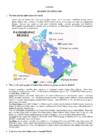
CANADA REVISION QUESTIONS 2010 1. The main physiographic regions of Canada. Canada may be divided into seven physiographic regions: Arctic Lowlands, Cordilleran Region, Interior Plains, Hudson Bay Lowlands, Canadian Shield (Forest Lands), St Lawrence Lowlands and Appalachian Region. Divisions are based on each area's relatively similar physical geography and landforms. Physiographic regionalization is defined here as the process by which regions with relatively homogeneous physical geography are determined 2. Who are the native people of Canada? Into which three groups can they be divided? Canada's constitution specifies three categories of aboriginal peoples: Indian (First Nations), Métis, Inuit. According to Canadian census 2011, 1.4 mln people of Aboriginal origin (4.3%): 852,000 First Nation...
Incubator of antisem, Red Army, rumor. Dispropor # Js killed at beginning, so not as many Js. Pop antisem, J draft-dodging. Not necessarily running away from front, but to E. Most prevalent rumor, part of Tashkent partisans (Uzbekistan). Js disprop among evacuees and refugees beyond Urals. How many? 10-15% SU J. "Js abandoned war effort, while we are fighting on their behalf." Stalin knows country is not enamored of him. National pride, yes; became more robust country, education, minorities rising. Purges had been horrific. Ukrainians still furious after famines 31-33. Old pat and natl imagery, calling to flag, not just hammer and sickle, Great Russian patriotism, Ortho Christian imagery. Old explanations for bad times. Following Battle of Kursk, Ger Army rolled back, 43. SU acquiring old SU territories and more, some rife w antisem, fanned esp by Polish and Romanian interwar regimes. Now have under belts 20 yrs fascism, hyper-natlism, Nazi propaganda. Borders porous
On 12 April 1917, under the pressure of the ever increasing demands for autonomy that the Estonians had been voicing since 1905, the Provisional government issued a decree on the provisional management of the administrative government and local government. Thus, Estonia (North-Estonia) and North- Livonia (South-Estonia) were united into one administrative unit, locally governed and with elements of autonomy included (Estonians were the only nation among all other minorities in Russia to achieve this). The commissar formed the Estonian Provincial Assembly (Diet) -- the first all-Estonian representative body -- and a Land Council as its executive body. The Diet included all the main political parties. With the exception of the Bolsheviks, who propagated the idea of international world revolution, all Estonian parties shared the view that Estonia had to become an autonomous
Peter Ackroyd, Kazuo Ishiguro, Ian McEwan, etc. Two major events: the fall of the Berlin Wall in 1989 and in 2001, the 9/11 terrorist attacks. Post-‐colonial literature; whose history Western written history really is? – the experiences of ethnic minorities are seemingly ignored. The literature of the 2nd and 3rd generation immigrants serves to give voice to the cultural “other” and is aimed at fighting clichés, such as those that emerged after the 9/11 attack. Salman Rushdie, Hanif Kureishi, Andrea Levy, Nadeem Aslam, etc
lagunemisfaas, mälestustefaas • Passionaarsus – looduslik nähtus • S.Huntington: tsivilisatsiooniline vaade 7-9 tsivilisatsioonilist rühmitust. Pinged nende vahel. Areng = võistlus ja konkurents The definition, nomenclature, and even the number of civilizations are somewhat ambiguous in Huntington's works. Civilizations may consist of states and social groups (such as ethnic and religious minorities). Predominant religion seems to be the main criterion of his classification, but in some cases geographical proximity and linguistic similarity are important as well. Using various studies of history, Huntington divided the world into the "major" civilizations in his thesis as such: Western civilization, centered on Western Europe (particularly the European Union) and North America, but also including other European-derived countries such as Australia and New Zealand
But a literature doctored of male-orientated views would be failing in its first requirement, to present a realistic or convincing picture of the world. Moralizing, which includes political correctness, has its dangers. Feminists have argued for positive discrimination as the only way to correct centuries of bias. Nonetheless, the consensus emerging among black Americans is that positive discrimination is counter-productive. Disadvantaged minorities desperately need the odds levelled, but not patronizingly tilted in their favour. Psychoanalysis has little scientific standing, and Lacanian theory is further disputed within the psychoanalytical community itself. Feminism does itself few favours by relying on these supports. A more damaging criticism is the concept of the feminine itself. Does it really exist? There are very real differences in the psychological make-up between the sexes, but testing also indicates what
Marvin Harris (1927 2001) Üks tuntumaid, tähtsamaid teadlasi kultuurantropoloogias. Toetas ja arendas 'kultuurilise materjalismi' teooriaid. Haridus BA Columbia University, 1949 Ph.D. Columbia University, 1953 Välitöö Islas de la Bahia, Brazil (Town and Country in Brazil), 1956 Mozambique (Portugal's African `Wards': A First-Hand Report on Labour and Education in Mozambique), 1958 India, Ecuador, and Africa (Minorities in the New World. Six Case Studies), 1959 publikatsioone (1968) Rise of Anthropological Theory: A History of Theories of Cultures (1977) Cannibals and Kings: The Origins of Culture (1985) Good to Eat: Riddles of Food and Culture (1989) Our Kind: Who We Are, Where We Came from, Where We Are Going Kultuurimaterialism Sotsiaalne käitumine ja sotsiaalsed struktuurid tulenevad materiaalsetest tingimustest ja oludest. Oluline on suhe materiaalsete tingimuste ning populatsiooni tiheduse vahel
confederates had left the experiment. Meta-analyses of studies testing Moscovici's theory have identified three conformity effects: 1) public influence, in which the individuals behavior is influenced by the views of others, 2) direct private influence, where there is a change in the individual's private opinions about the issue discussed by the group and 3) indirect private influence, where the individual's private opinions about related issues change. The influence of minorities is mainly in the form of private agreement rather than public agreement with the opposite pattern in majority influence, but any differences in influence may become from the power or status of the influencer, rather than their position within the group. Discuss factors influencing conformity. Asch's study referred to as the Asch paradigm has been replicated many times. Out of these replications, the factors influencing conformity have been identified.
By contrast, the Spanish population has grown by 8.5 million from 38.8 to 47.3 million people over the same period. The urban population is made up 69% of total population in 2010, with about 3 million people living in Kyiv. 17 Bad news again! Ukrainian population is not only declining, but also aging. 18 It is estimated that 77.8% of the population are Ukrainian and 17.3% are Russian. Minorities include Belarusian, Moldovan, Crimean Tatar, Bulgarian, Hungarian, Romanian, Polish, Jewish and others. The majority of the population is a member of one of the branches of the Orthodox Church (about 84%). Around 10% are Catholic, while 4% are Muslim, represented by Tatar who mostly reside in the Crimea. The labor force involved in the economy in 2011 was 22.09 million people with 15.8%; 18.5% and 65.7% in the agriculture, industry and services sectors, respectively. Official number
2. No part of the present article or Article 28 shall be construed so as to interfere with the liberty of individuals and bodies to establish and direct educational institutions, subject always to the observance of the principle set forth in paragraph 1 of the present article and to the requirements that the education given in such institutions shall conform to such minimum standards as may be laid down by the State. Article 30 In those States in which ethnic, religious or linguistic minorities or persons of indigenous origin exist, a child belonging to such a minority or who is indigenous shall not be denied the right, in community with other members of his or her group, to enjoy his or her own culture, to profess and practise his or her own religion, or to use his or her own language. Article 31 1. States Parties recognize the right of the child to rest and leisure, to engage in play and
 annaabi.ee