Leidsid 33 sarnast õppematerjali, mis on seotud failiga "IPCC summary". Need materjalid aitavad sul teemat sügavamalt mõista.
change, increase, than, north, south, factor, balance, alter, changes, sources, concentration, production, fossil, rise, arctic, globalte, precipitation, observed, northern, asia, southern, inter, average, warming, region, during, decade, continue, ipcc, measure, influence, altering, incoming, outgoing, importance, potential, things, abundance, solarEarth's climate system. Since 1971, 90% of the increased energy has been stored in the oceans, mostly in the 0 to 700m region. Despite the oceans' dominant role in energy storage, the term "global warming" is also used to refer to increases in average temperature of the air and sea at Earth's surface. Since the early 20th century, the global air and sea surface temperature has increased about 0.8 °C (1.4 °F), with about two-thirds of the increase occurring since 1980.Each of the last three decades has been successively warmer at the Earth's surface than any preceding decade since 1850. More than 90% certain that most of global warming was being caused by increasing concentrations of greenhouse gases produced by human activities.In 2010 that finding was recognized by the national science academies of all major industrialized nations. Affirming these findings in 2013, the IPCC stated that the largest driver of global
are also suited to small off-grid applications, sometimes in rural and remote areas, where energy is often crucial in human development.Kenya has the world's highest household solar ownership rate with roughly 30,000 small (20100 watt) solar power systems sold per year. Some renewable energy technologies are criticised for being intermittent or unsightly, yet the market is growing for many forms of renewable energy. Climate change concerns coupled with high oil prices, peak oil and increasing government support are driving increasing renewable energy legislation, incentives and commercialization. New government spending, regulation, and policies should help the industry weather the 2009 economic crisis better than many other sectors. Costs Renewable energy systems encompass a broad, diverse array of technologies, and the current status of these can vary considerably
warming. Global warming, also often referred to as the greenhouse effect, has not always been a problem. However, over the last centuries, since the Industrial Revolution things have changed. Polar regions are melting, species are dying, climate zones are shifting, migration patterns for animals such as polar bears and birds are being disrupted our world as we know it is changing. Some scientists believe that the climate will reach a tipping point, a point at which even a tiny additional increase would throw the system into violent change. We started doing harmful things and only now do we realize what we have done and what we are doing. At this current rate by the middle of next century the Earth's temperature may rise a predicted from 2 to 6 degrees Celsius. This may not seem as much but with the Earth's delicate balance we will have lost several species and habitats. Scientists are worried that soon the effects of what we have done may be irreversible
Margit Tepner k0848752 Sustainability aspects of biofuels 1. Introduction The literature review will discuss the sustainability aspects of biofuels. Food production will be the main concern as it is the most debated issue, but other aspects, such as land use change and water consumption will be also considered as they are essential aspects in the biofuels sustainability criteria. The review will discuss the viability of biofuels based on the current technologies. Second-generation biofuels are not yet commercially viable and therefore will not be discussed; although they could significantly improve the sustainability of biofuels when they break through to the industrial scale. 2. The scale of biofuels production 2.1
We use a lot of energy - in our homes, in businesses, inindustry, and for traveling between all these different places. The industrial sector uses almost one-third of the total energy. The residential and commercial sectors combined use 39 percent of all energy. These two sectors include all 4 types of buildings, such as houses, offices, stores, restaurants, and places of worship. Energy used for transportation accounts for more than a quarter of all energy. Picture 2.1. Share of energy consumed by major selectors of the economy (2007) 2.1 Uses of energy in homes The ability to maintain desired temperatures is one of the most important accomplishments of modern technology. Our ovens, freezers, and homes can be kept at any temperature we choose, a luxury that wasn't possible 100 years ago. Keeping our homes comfortable uses a lot of energy. Over 40 percent of the average home's energy consumption is used for heating
had been just recently discovered at the time 1895. It is energy released by the splitting (fission) or merging together (fusion) of the nuclei of atoms. The conversion of nuclear mass to energy is consistent with the mass-energy equivalence formula E = m.c², in which E = energy release, m = mass defect, and c = the speed of light in a vacuum. Nuclear chemistry can be used as a form of alchemy to turn lead into gold or change any atom to any other atom (albeit through many steps). Radionuclide (radioisotope) production often involves irradiation of another isotope (or more precisely a nuclide), with alpha particles, beta particles, or gamma rays. Iron has the highest binding energy per nucleon of any atom. If an atom of lower average binding energy is changed into an atom of higher average binding energy, energy is given off. What is nuclear fusion? Nuclear fusion is the process by which multiple like-
Tallinn English College Report of Canada 8a Teacher: Merike Sisask Composer: Kärt Kalvet 2010 Canada, Kärt Kalvet 8a Canada General Information Canada is in North America. It's area is 9220970 sq km. Canada's population is 313.612.000 people. Canada is divided into 10 provinces and 3 territories. The capital of Canada is Ottawa. Canada has constitutional monarchy. The head of state in Canada's government is the Queen of England. There are two main languages in Canada: English and French. Canada's curreny is Canadian dollar (1 dollar=100 cents[Can$]). The highest peak of Canada is Mount Logan, 5959 metres. The lowest point is sea level
biosphere, releasing pollutants and greenhouse gases into the air and damaging ecosystems through events such as oil spills. Concern over the depletion of the earth's finite reserves of oil, and the effect this would have on a society dependent on it, is a field known as peak oil. Etymology The word "petroleum" comes from Greek: πέτρα (petra) for rock and Greek: ἔλαιον (elaion) for oil. The term was found (in the spelling "petraoleum") in 10th-century Old English sources. It was used in the treatise De Natura Fossilium, published in 1546 by the German mineralogist Georg Bauer, also known as Georgius Agricola. In the 19th century, the term "petroleum" was frequently used to refer to mineral oils produced by distillation from mined organic solids such as cannel coal (and later oil shale), and refined oils produced from them; in the United Kingdom, storage (and later transport) of
eat three or more slices of brown bread per day, with only a quarter of respondents restricting themselves to one or two slices. Eating fat As regards fat consumption, the majority of the students eat margarine. Four students prefer butter, and another four eat neither. Conclusion It is noticeable that the eating habits of students in their final year at Freedonian Secondary School are not very healthy. Moreover, there are no students who have both breakfast and school lunch, eat more than four slices of brown bread per day, and avoid fat. In this essay, I will discuss whether prevention is better than trying to treat people who are ill and whether or not this is possible in all cases. I will divide the subject into illnesses caused by lifestyle, and illnesses caused by other factors such as genetic factors. First of all, a person's lifestyle can be a major factor in their wellbeing, both physical and mental. People who eat too much
Scotland ! Scotland (Gaelic: Alba) is a country in northwest Europe that occupies the northern third of the island of Great Britain. It is part of the United Kingdom, and shares a land border to the south with England. It is bounded by the North Sea to the east, the Atlantic Ocean to the north and west, and the North Channel and Irish Sea to the southwest. In addition to the mainland, Scotland consists of over 790 islands including the Northern Isles and the Hebrides. Edinburgh, the country's capital and second largest city, is one of Europe's largest financial centres. It was the hub of the Scottish Enlightenment of the 18th century, which saw Scotland become one of the commercial, intellectual and industrial powerhouses of Europe. Scotland's largest city is Glasgow, which was once one of the
complete in 30 hours under aerobic conditions and 48 hours under anaerobic conditions. Bhattacharya and Parkin used anaerobic chemostats to study fate and kinetic effects of sludge and continuous additions of formaldehyde to acetate and propionate enrichment systems. The high reduction of formaldehyde with continuous addition is indicative of biodegradation, since the combination of volatilization, adsorption, and chemical transformation should account for less than 25% of the removal. Up to 80% of the formaldehyde was removed, with biodegradation accounting for 5560%. Sediment and Soil The fate of formaldehyde in soil has not been determined HEALTH EFFECTS Acute toxicity The major acute effects are a result of the irritating properties of formaldehyde. After acute inhalation, irritation of the eyes, nose, throat, and lungs, as well as cellular changes, such as ciliar lesions and cellular swelling in the upper respiratory tract have been observed
Acidity itself is determined based on the pH level of the water droplets. PH is the scale measuring the amount of acid in the water and liquid. The pH scale ranges from 0 to 14 with lower pH being more acidic while a high pH is alkaline; seven is neutral. Normal rain water is slightly acidic and has a pH range of 5.3-6.0. Acid deposition is anything below that scale. It is also important to note that the pH scale is logarithmic and each whole number on the scale represents a 10-fold change. Causes and History of Acid Rain Acid deposition can occur via natural sources like volcanoes and rotting vegetation but it is mainly caused by the release of sulfur dioxide and nitrogen oxide during fossil fuel combustion. When these gases are discharged into the atmosphere they react with the water, oxygen, and other gases already present there to form sulfuric acid, ammonium nitrate, and nitric acid. These acids then disperse over large areas because of wind patterns and fall back
...... Economical....................................................................................................... Dangers of biogas............................................................................................... Future prospects................................................................................................ Conclusion......................................................................................................... Used sources..................................................................................................... Introduction To be honest I got the list of topics after most interesting ones for me were taken. At first I was not very satisfied with my topic but then I realized that this could be actually really interesting thing to make a report of. I chose this particular topic because I have always been interested in green energy. This topic gave me an excellent
Tundra Tundra is the world's youngest biome. It was formed 10 000 years ago. Located at latitudes 55° to 70° North. Almost all tundras are located in the Northern Hemisphere, encircling arctic desert and extending south to the coniferous forests of the taiga. The ecotone (ecological boundary region) between the tundra and the forest is known as the tree line or timberline. Tundra comes from the Finnish word tunturi, meaning treeless plain. It is noted for its frost-moulded landscapes, extremely low temperatures, little precipitation, poor nutrients, and short growing seasons. Dead organic material functions as a nutrient pool. The two major nutrients are nitrogen and phosphorus
Human overpopulation Liis Lukk MJ15 What is overpopulation? • Overpopulation is an undesirable condition where the number of existing human population exceeds the carrying capacity of Earth. • Human overpopulation is among the most pressing environmental issues • Overpopulation can result from an increase in births, a decline in mortality rates, an increase in immigration, or an unsustainable biome and depletion of resources • Human population has been rising continuously since the end of the Black Death, around the year 1350 • The most significant increase has been since the 1950s, mainly due to medical advancements and increases in agricultural productivity • The recent rapid increase in human population over the past three centuries has raised concerns that the planet may not be
MIINA HÄRMA GYMNASIUM Deserts Saudi-Arabia Tartu 2007 Deserts In geography, a desert is a landscape form or region that receives very little precipitation. Generally, deserts are defined as areas that receive an average annual precipitation of less than 250 mm (10 inches). Deserts cover at least one-fourth of the Earth's land surface. Desert biomes can be classified according to several characteristics. There are four major types of deserts: · Hot and dry · Semiarid · Coastal · Cold Location The four major North American deserts of hot and dry deserts are the Chihuahuan, Sonoran, Mojave and Great Basin. Others outside the U.S. include the Southern Asian
ENVIRONMENTAL PROBLEMS Our environment is constantly changing. However, as our environment changes, so does the need to become increasingly aware of the problems that surround it. With a massive influx of natural disasters people need to be aware of what types of environmental problems our planet is facing. Current environmental problems make us vulnerable to disasters and tragedies, now and in the future. Unless we address the various issues seriously we are surely doomed for disaster. Current environmental problems require urgent attention. 1
....7 10. History..........................................................................................................8 11. Conclusion....................................................................................................9 12. References....................................................................................................10 Introduction I chose finland because there are friendly people and beautiful nature. Finland is bigger than Estonia. There lives over 5 milj. people. Finland capital is Helsingi and there lives about 2 milj. people. Highest top is 1328m. Finland is bordersed with Sweden to the west, Russia to the east and Norway to the north. It is the eight largest city in Europe. Most Finns speak Finnish. The second language is Swedish. Finland is rated the sixth most peaceful country in the World. In Finland there are more than 60000 lakes. Capital: Helsinki
The tundra is the world's coldest and driest biomes. The average annual temperature is -28° C. Nights can last for weeks when the sun barely rises during some months in the winter, and the temperature can drop to -70° C. During the summer the sun shines almost 24 hours a day. Summer are usually warm. Average summer temperatures range from 3° to 16°C. TaigaTaiga is the Russian word for forest and is the largest biome in the world. It stretches over Eurasia and North America. The taiga is located near the top of the world, just below the tundra biome. The winters in the taiga are very cold with only snowfall. The summers are warm, rainy, and humid. Some of the animals in the taiga hibernate in the winter, some fly south if they can, while some just cooperate with the environment. GrasslandsGrassland biomes can be found in the middle latitudes. They can have either moist continental climates or dry subtropical climates. There
v= @vD = tper s The power of waves is given by rH O *g2 * h2 *tper W 2 P= @PD = 32 *p mcrl or with the approximation P ~ h2 ä tper . The power is defined per meter of crest length. Exercise: North Atlantic offshore wave conditions Wave climate for the north Atlantic offshore region is given by the table below. The unknown values have to be calculated. 5 Period High Power density Velocity wavelength kW @tD=s @hD=m @PD= @vD= m @lD=m
Topic Australia Tallinn English College 2006 Australia 1 . Introduction The name Australia is derived from the Latin Australis, meaning of the south. In land area, Australia is the sixth largest nation, its territory is 7,686,850 sq km and its population reaches today over 20,5 million people. It is the only nation to govern an entire continent and its outlying islands. Australia's capital is Canberra, the only city with its own territory. It was built in the early 1900s just to be the capital. The official language is English and the official name of Australia is the Commonwealth of Australia.
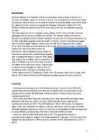
Introduction Estonia, officially the Republic of Estonia (Estonian: Eesti or Eesti Vabariik) is a country in the Baltic region of Northern Europe. It is bordered to the north by Finland across the Gulf of Finland, to the west by Sweden across the Baltic Sea, to the south by Latvia (343 km), and to the east by the Russian Federation (338,6 km). The territory of Estonia covers 45,227 km² and is influenced by a temperate seasonal climate. The Estonians are a Finnic people closely related to the Finns, with the Estonian language sharing many similarities to Finnish. The modern name of Estonia is thought to originate from the Roman historian Tacitus, who in his book Germania (ca. AD 98) described a people called the Aestii. Similarly, ancient Scandinavian sagas
...................................11 3.5 Investments........................................................................ 12 3.6 Current Account.................................................................. 13 3.7 Government Budget Deficit/Surplus............................................14 4. Summary.....................................................................................15 5. Sources....................................................................................... 16 1 Introduction The goal of this paper is to compare the economic performance of Finland, Estonia and Hungary. Comparison of different counties in a constantly changing economic environment is interesting, especially after the economic crisis. The results of the analysis will provide us information which of the countries has done the best in recovering
ago, at the beginning of the 9th millennium BC. Evidence has been found of hunting and fishing communities existing around 6500 BC near the town of Kunda in northern Estonia. Bone and stone artifacts similar to those found at Kunda have been discovered elsewhere in Estonia, as well as in Latvia, northern Lithuania and in southern Finland. The Kunda culture belongs to the middle stone age, or mesolithic period. The end of the Bronze Age and the early Iron Age were marked by great cultural changes. The most significant was the transition to farming, which has remained at the core of Estonian economy and culture. From approximately the 1st to 5th centuries AD, resident farming was widely established, the population grew, and settlement expanded. Cultural influences from the Roman Empire reached Estonia, and this era is therefore also known as the Roman Iron Age. A more troubled and war-ridden middle Iron Age followed with
COMPENDIUM ABOUT PRAGUE Prague is the capital and largest city of the Czech Republic. Nicknames for Prague have included Praga mater urbium/Praha matka mst ("Prague Mother of Cities") in Latin/Czech, Stovzatá Praha ("City of a Hundred Spires") in Czech or Zlaté msto/Goldene Stadt ("Golden City") in Czech/German. Situated on the Vltava River in central Bohemia, Prague has been the political, cultural and economic centre of the Czech state for more than 1100 years. For many decades during the Gothic and Renaissance eras, Prague was the permanent seat of two Holy Roman Emperors and thus was also the capital of the Holy Roman Empire. 4 Today, the city proper is home to about 1.3 million people, while its metropolitan area is estimated to have a population of over 1.9 million.
written in 1814 by Francis Scott Key. There are 6 time zones. From east to west they are: Eastern Standard Time, which is 5 hours behind Greenwich Time, Central Standard Time, Mountain Standard Time, which is 7 hours behind Greenwich Time, Pacific Standard Time. Alaska and Hawaii have their own time zones: Alaska Standard Time and Hawaii Standard Time. Geographical Position The USA lies in the Northern Hemisphere in North America. It covers a big part of the continent and is also the third largest country in the world. The country consists of 50 states, but two of them lie separately. One of them is Alaska, which is near the Arctic Circle. And the other state is Hawaii, which is a group of island is the Pacific Ocean. The USA shares the border with Canada in the north and Mexico in the south. In the east the coast is washed by the Atlantic Ocean and in the west by the Pacific Ocean
their roads, the sights of important cities notably London, and the seeds of Christianity. The Latin way of life villas, arts, language and political organization all vanished, however after the invasions from Northern Europe by the Anglo-Saxons and Jutes from the 5th century onwards. These pagan peoples' were easily converted to Christianity and the preachers from Rome brought with them learning and civilization. Christianity was an important factor in enabling the various kingdoms created by the Nordic invaders to be united in the 9th century. The Vikings first raided England to plunder it, then in the days of Alfred of Wessex. They began to win wide lands `to plow and rule'. In the 10 th century England fell under Danish rule with King Canute finally managing to unite the Anglo-Saxons and Danes at the beginning of the 11 th century. After defeating the Anglo-Saxon king Harold at the
alternative, Sunbutter, especially in China, the United States, the Middle East and Europe. In Russia it is probably the most wide spread snack.[citation needed] It is also sold as food for birds and can be used directly in cooking and salads. Sunflower oil, extracted from the seeds, is used for cooking (but is less cardiohealthy than olive oil), as a carrier oil and to produce biodiesel, for which it is less expensive than the olive product. During the 18th Century, the use of sunflower oil became very popular in Europe, particularly with members of the Russian Orthodox Church because sunflower oil was one of the few oils that was not prohibited during Lent. The cake remaining after the seeds have been processed for oil is used as a livestock feed. Some recently developed cultivars have drooping heads. These cultivars are less
0 (2013 forecast EBRD downward revision from previously projected 2.5%). Official language: Ukrainian (although Russian is widely used in business communication). Currency: Hryvnya (UAH). Government type: republic. Membership: the United Nations, the International Monetary Fund (IMF), the World Bank, the European Bank for Reconstruction and Development (EBRD), the World Trade Organization (WTO), etc. Ukraine is bordered by Russia in the east, the Black Sea in the south, Moldova, Romania, Hungary, Slovakia and Poland in the west, and Belarus in the north. The country is rich in mineral resources: iron ore, coal, manganese, natural gas (shale costly and dangerous to extract), oil, sulfur, graphite, titanium, magnesium, kaolin, nickel, mercury, timber and others. It's commonly known that Ukraine is politically divided between its Western and Eastern regions. Ukraine's geography and history have played an important role in the country's
hu Contributors xiii Christian James Douglas L. Marshall Food Refrigeration and Process Engineering College of Natural and Health Sciences, Research Centre (FRPERC), The Grimsby University of Northern Colorado, Institute of Further and Higher Campus Box 134, Greeley, Colorado Education(GIFHE), HSI Building, Origin 80639 USA. Way, Europarc, Grimsby, North East E-mail: [email protected] Lincolnshire, DN37 9TZ UK. E-mail: [email protected] Leticia Mora Department of Food Science, Instituto de Agroquímica y Tecnología de Alimentos Stephen J. James (CSIC), PO Box 73, 46100 Burjassot Food Refrigeration and Process Engineering
Geography Canada is the world's second largest country in total area after Russia , since it covers nearly 10 million square kilometres, but is one of the most sparsely populated, with only about 34 million inhabitants. The majority of them live within 300 kilometres of Canada's southern border. Much of the rest of Canada is uninhabited or thinly populated, because the country has a rugged terrain and severe climate. Canada extends across the continent of North America, from Newfoundland on the Atlantic coast to British Columbia on the Pacific coast and northward into the Arctic Ocean. Canada shares land borders with the United States to the south and north-west. Canada is a land of great variety. Towering mountains, crystal-clear lakes, and lush, green forests make Canada's far west a beautiful region. Farther inland, fields of wheat and other grains cover Canada's vast prairies
officially the Portuguese Republic, Portuguese: República Portuguesa) is a country located in Southwestern Europe, on the Iberian Peninsula. It is the westernmost country of mainland Europe, and is bordered by the Atlantic Ocean to the west and south and by Spain to the north and east. The Atlantic archipelagos of the Azores and Madeira are Portuguese territory as well. The country is named after its second largest city, Porto, whose Latin name was Portus Cale. SETTLEMENT The land within the borders of the current Portuguese Republic has been continuously settled since prehistoric times
The UK contains a number of small islands. The largest islands that belong to the United Kingdom are the Isle of Man in the Irish Sea and the Isle of Wight which lies off of England's southern coast. The largest groups of islands are the Shetland Islands, the Orkney Islands and the Hebrides. Geographical Position The UK is situated in the Northern Hemisphere. The United Kingdom is bordered by the Atlantic Ocean in the west, the North Sea in the east, the Norwegian Sea in the north, and the English Channel, also known as La Manche, in the south and it also separates the country from the continent of Europe. The neighbours of the United Kingdom are Iceland in the north-west, Norway in the east and France in the south. Britain also has many dependant territories which are scattered throughout the world and are the remains of the huge former British Empire. Today Britain assists them, but they may become independent whenever they wish
 annaabi.ee