Leidsid 33 sarnast õppematerjali, mis on seotud failiga "Forest Bioenergy". Need materjalid aitavad sul teemat sügavamalt mõista.
forest, wood, fuels, biomass, bioenergy, benefits, introduction, based, living, biofuel, environmental, economic, outline, body, diferent, products, usage, fossil, dominant, accounts, supply, fast, growing, species, mainly, nordic, sources, recycled, forms, electricity, heat, solid, liquid, ethanol, diesel, conclusion, exist, seppo, anttiHow to produce bioenergy from agricultural resources without harming the environment Jürgen Aosaar Jaak-Albert Metsoja Ahto Oja BOVA cource on biogas from biomass March 3-7 2008 Tartu Deciduous tree species on abandoned agricultural land Current situation • The long term development plan of the Estonian energy industry foresees a reduction in the use of fossil fuels and an increase in the share of biofuels: by the year 2010 renewable energy must account for 5.1% of total energy consumption Current situation (2) • In Estonia we have abandoned arable land about 400 000 ha, part of it is overgrowing naturally, and another part has been afforested • For short-rotation forestry in Estonia, ecologically and economically the most suitable tree is probably grey alder, which is a highly productive and soil improving species
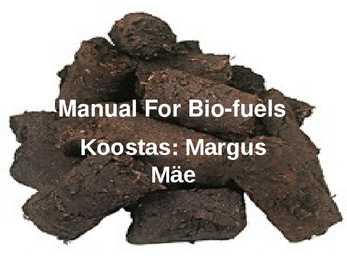
Manual For Biofuels Koostas: Margus Mäe Introduction This book told me a lot of practical uses of solid biofuels and peat compustion technologies in estonia and baltic sea countries. The hole technological chain from production to flue gas cleaning is brought to reader ´s. Also the energy policy and reguierment for users is shown. Properties of boifuels and peat In the boiler plants of Baltic Sea countries a wide range of various woodbased fuels are burned. To some extent also straw and other biomass based fuels are used. All these fuels are considered as renewables and according to the international agreement the CO2 emitted by the combustion of these fuels is not listed as a greenhouse gas. Wood, in particular the shell of wood cells, consists mainly from cellulose, lignin and hemicellulose. Due to the high carbon and hydrogen content, the lignin has higher calorific value than cellulose and hemicellulose
...............5 2. Energy Types 2.1. Wind Energy.......................................................................................................6 2.1.1. Annual Generation........................................................................................7 2.1.2. Growth and cost trends................................................................................8 2.1.3. Theoretical potential.....................................................................................9 2.1.4. Benefits of wind energy................................................................................10 2.2. Solar Energy........................................................................................................11 2.2.1 Development, deployment and economics................................................12 2.3. Hydroenergy.......................................................................................................13 2.4. Geothermal Energy.........................................
5 Geothermal power plants..........................................................................................45 13.6 Geothermal heat pumps............................................................................................ 46 13.7 Geothermal energy and the environment..................................................................46 BIOMASS............................................................................................................................46 14.1 Wood and wood waste..............................................................................................47 14.2 Municipal solid waste, landfill gas, and biogas........................................................48 14.3 Biofuels - ethanol and biodiesel............................................................................... 48 2 14.4 Biomass and the environment..........................................
Margit Tepner k0848752 Sustainability aspects of biofuels 1. Introduction The literature review will discuss the sustainability aspects of biofuels. Food production will be the main concern as it is the most debated issue, but other aspects, such as land use change and water consumption will be also considered as they are essential aspects in the biofuels sustainability criteria. The review will discuss the viability of biofuels based on the current technologies. Second-generation biofuels are not yet commercially viable and therefore will not be discussed; although they could significantly improve the sustainability of biofuels when they break through to the industrial scale. 2. The scale of biofuels production 2.1. Drivers of biofuels production Lal (2010) stated that "three inter-connected challenges face humankind in the 21st century": food security, climate change, and energy security
Tartu Miina Härma gymnasium Biogas The source of future energy Report Tartu 2010 Table of Contents Introduction......................................................................................................... What is biogas?................................................................................................... Producing process............................................................................................... Nowadays............................................................................................................
Renewable energy Meriliin Lend Estonian University of Life Sciences Tartu 2013 Topics Renewable energy Solar energy Wind energy Hydroelectric power Geothermal energy Biomass energy Renewable energy Renewable energy comes from sources that naturally renew, or will not run out in our lifetimes. Includes sunlight, wind, water, geothermal heat and various forms of biomass. Renewable energy cannot be exhausted and is constantly renewed. Does not harm the environment. Saves money. Solar energy Solar energy is the technology used to harness the sun's energy and make it useable. Every hour the sun beams onto Earth more than enough energy to satisfy global energy needs for an entire year. Solar energy use has surged at about 20 percent a year over the past 15 years, thanks to rapidly falling prices and gains in efficiency. Solar energy is inexhaustible.
considered more valuable, and waste incineration is not popular. In Romania, DH consumption was reduced by one-half. Distribution losses are enormous. New less polluting plants are needed. Consortia from established DH countries could offer DH systems from fuel to customer if local policies facilitate DH development. Introduction This paper describes barriers to district heating (DH) in various parts of Europe and to Swedish involvement in district-heating business abroad. The paper is based on a report called "District Heating in Europe: Barriers to overcome for Swedish export" , which was prepared for The Swedish District Heating Association. The losses by energy conversion in Europe are of the same magnitude as the European heat demand and consist mainly of heat that is wasted by electricity generation . District heating is a means to utilise such surplus heat to cover heat demand. District heating can utilise the heat from electricity generation in combined heat and power
characterization (mainly in terms of porosity and permeable structures). It is refined and separated, most easily by boiling point, into a large number of consumer products, from petrol (or gasoline) and kerosene to asphalt and chemical reagents used to make plastics and pharmaceuticals. Petroleum is used in manufacturing a wide variety of materials, and it is estimated that the world consumes about 88 million barrels each day. The use of fossil fuels such as petroleum can have a negative impact on Earth's biosphere, releasing pollutants and greenhouse gases into the air and damaging ecosystems through events such as oil spills. Concern over the depletion of the earth's finite reserves of oil, and the effect this would have on a society dependent on it, is a field known as peak oil. Etymology The word "petroleum" comes from Greek: πέτρα (petra) for rock and Greek: ἔλαιον (elaion) for oil
given to oil and gas sector. Oh and the wind has to blow. Hydropower Power to the Water · By using earth's · 90% energy water cycles and efficient compared running water used to natural gas threw mostly dams being 50% to provide energy. efficient. · Hydropower is · The only problem about 1/3 the cost is, you need water. of using fossil fuels and about 1/6 the cost of natural gas. Biofuels · Using natural I Love you Plants materials to turn into fuel or forms of combustible energy. · Which is mostly plants and plant products Cost Efficient? · A study done by OSU So much for the love.... · Going to biofuels would be like adding a new gas tax. About 25 cents. · And it is not proven to reduce green house gases and may even produce more of them.
................................................................10 Disadvantages of nuclear power generation:.................................................................................10 Conclusion..........................................................................................................................................12 References..........................................................................................................................................13 Introduction What is nuclear power? Nuclear power is any nuclear technology designed to extract usable energy from atomic nuclei via controlled nuclear reactions. The most common method today is through nuclear fission, though other methods include nuclear fusion and radioactive decay. All utility-scale reactors heat water to produce steam, which is then converted into mechanical work for the purpose of generating electricity or propulsion. In 2007, 14% of the world's electricity came from nuclear power
3 million. Other major cities include Montreal (3.3 million people), Vancouver (1.8 million people). Located in the southeast corner of the nation, Ottawa is the nation's capital. Relief Canada is a vast country comprised of a multitude of very different landscapes: Atlantic provinces, the Appalachians, St. Lawrence and Great Lakes lowlands, Canadian Shield, The Prairies, mountain ranges and high plateaus of the Canadian Cordillera, and northern Canada. Climate Canada's climate varies wildly based on geography, from perma-frost in the north to four distinct seasons towards the equator. In this region the temperature can climb up to 35 degrees Celsius in the summer and descend to a chilly -25 degrees Celsius during winter. Canada's climate and environment are one of the main reasons that Canada is such a succesful country. The blend of natural resources and climate sustains us. The seasons dictate the look of
Of all of the dioxins and furans, one, 2,3,7,8tetrachloropdibenzo dioxin (2,3,7,8 TCDD) is considered the most toxic. · PCBs were produced commercially in large quantities until production was stopped in 1977. . Emission sources Dioxins are mainly produced as unwanted byproducts of industrial processes and there is no intentional production or use. They can also to a small extent be formed naturally in forest fires or volcanic activity. Examples of activities resulting in dioxin emissions are waste incineration, burning fuels (wood, coal or oil), chlorine bleaching of pulp and paper and chlorinated pesticides manufacturing. Burning of many materials containing chlorine, such as plastics and wood treated with pentachlorophenol also produce dioxins. According to a study in the context of the Stockholm Convention, the main sources for emissions of dioxins to air in EU25 are
objective is to look into factors that influence this balance. Natural conditions and cultural impact could be considered as the variables that correlate the most with the activity and composition of microflora, hence some of the natural and cultural factors will be looked into a little more in detail. Definition, composition and importance of microflora Saunders Comprehensive Veterinary Dictionary (2007) cited by the online medical dictionary (2013) defines living microorganisms as that small that they can be seen only with a microscope and that maintain a more or less constant presence in a particular area that includes bacteria, viruses, protozoa and fungi. Soil microflora more specifically, consists the following microorganisms (Bhatt et al. 2013): 1. Bacteria a) Heterotrophic bacteria, eg. symbiotic and non - symbiotic N2 fixers, ammonifier, cellulose decomposers, denitrifiers b) Autrotrophic bacteria, eg
Admittedly- used for saying that you admit something is true, especially when this makes your main idea weaker Affordable- cheap enough for ordinary people to afford Agricultural- relating to farming Alcoves- a small area in a room that is created by building part of one wall further back than the rest of the wall Ample- enough, and often more than you need Attic- the room in a house under the roof Bedsit- a room that you rent that is used for both living and sleeping in Brick pillars- Bungalow- a house that is all on one level Caravan- BRITISH a vehicle that people can live and travel in on holiday. Caravans are usually towed (=pulled) by a car. The American word is trailer Carpenter- someone whose job is to make things from wood, or to repair things that are made of wood Cellar- a room under a building, below the level of the ground, usually used for storing things Compatible- ideas or systems that are compatible can exist together
1. Which are the main cornerstones of EU-Russia cooperation? Which have been the main developments and success stories in this partnership in 2000-2012? Which side is more interested? The main cornerstones of the EU and Russia relations are the trade and energy relations. One biggest breakthrough has been gas pipeline Nord Stream. Russia is the third biggest trade partner of the EU and is the main importer of gas and crude oil. The economic benefits are the biggest cornerstones of the relations. Cooperation between Russia and the European Union progressively strengthens in foreign policy and security issues, in combating illegal migration, organised crime and terrorism. The main achievement of recent years, which can be hardly overestimated, is the understanding increasingly gaining ground that partnership between Russia and the EU is one of the cornerstones of maintaining stability and prosperity not only in Europe, but world-wide.
Estonia joined the World Trade Organization in 1999. A sizable current account deficits remains, but started to shrink in the last months of 2008 and is expected to do so in the near future. In the fourth quarter of 2008, the average monthly gross wage in Estonia was 13,117 kroons (838, US$1,066.5). Estonia is nearly energy independent supplying over 90% of its electricity needs with locally mined oil shale. Alternative energy sources such as wood, peat, and biomass make up approximately 9% of primary energy production. Estonia imports needed petroleum products from Western Europe and Russia. Oil shale energy, telecommunications, textiles, chemical products, banking, services, food and fishing, timber, shipbuilding, electronics, and transportation are key sectors of the economy. The ice-free port of Muuga, near Tallinn, is a modern facility featuring good transshipment capability, a high-capacity grain elevator, chill/frozen storage, and
41. pest remains/not totally eradicated; slow to work/AW; labour intensive/AW; reintroduction often needed; predator may eat crop; risk of migration; risk to other organisms/mutation/predation of other species; max 2 [2] 42. pollination; maintain biodiversity; benefits to food chain/food for other organisms; max 2 [2] 43. increased profit for farmers/shops; no residues on food; no pesticides; less use of inorganic fertilizers; less risk of pollution; benefits to soils structure and quality; benefits to biodiversity;
1. Ökoloogiateaduse uurimisobjektid Ecology (from Greek: , "house"; -, "study of") is the scientificstudy of the relation of living organisms to each other and their surroundings.[1] Ecology includes the study of plant and animalpopulations, plant and animal communities and ecosystems. Ecologists study a range of living phenomena from the role of bacteria in nutrient recycling to the effects of tropical rain forest on the Earth's atmosphere. Autökoloogia on ökoloogia haru, mis tegeleb organismide keskkonnanõudluste ja keskkonna- suhete uurimise ja kirjeldamisega. Demökoloogia ehk populatsiooniökoloogia (Schwerdtfeger 1963: 1314) on ökoloogia haru, mis uurib organismide populatsioone ja nende keskkonnaoludest johtuvat dünaamikat. Sünökoloogia on ökoloogia haru, mis tegeleb liikidevaheliste suhetega ökosüsteemides,
about 1.7% of total U.S. natural gas consumption . Of the 412 Bcf, 13 Bcf were used as feedstock, and 399 Bcf were burned as fuel. · Electricity is also used to manufacture plastics. In 2010, about 65 billion kilowatt-hours were used, equal to about 1.7% of total U.S. electricity consumption. Only about 1% of the total U.S. petroleum consumed in 2010 was used to generate electricity. Biopolymers are polymers produced by living organisms; in other words, they are polymeric biomolecules. Since they are polymers, biopolymers contain monomeric units that are covalently bonded to form larger structures. There are three main classes of biopolymers, classified according to the monomeric units used and the structure of the biopolymer formed: 1. polynucleotides (RNA and DNA), which are long polymers composed of 13 or more nucleotide monomers; 2. polypeptides, which are short polymers of amino acids; and 3
Introduction (slide 2) In this presentation I'd like to give a brief overview of clay bricks. I'll speak about 15min to allow time for questions at the end. Firstly clay bricks are known for centuries as one of the most solid and reliable structural elements is set to play a role in reducing global warming. Apart form the many benefits obtained from using clay bricks in construction, such as their durability, insulation properties and aesthetic qualities, recent findings show that they also produce less carbon emissions than any other masonry material. History (slide 3) In more detail the earliest bricks were dried bricks, meaning they were formed from clay- bearing earth or mud and dried usually in the sun until they were strong enough for use. The
In 1999, The Body Shop created four new business units in the UK, Europe, the Americas and Asia, shifting its operational and management structure out to the regions. 2001 saw the first The Body Shop® customer reward scheme launched in the US. It became so popular it's now in key markets globally, known as Love Your BodyTM customer scheme with customers rewarded by 10% off their purchases, free gifts and a birthday present, as well as other members-only benefits. The Body Shop branches into South Africa in June 2001, via New Clicks Holdings as The Body Shop direct franchisee in South Africa. New Clicks has a strong commitment to corporate social responsibility through its New Clicks Foundation. During 2002, The Body Shop ran a global campaign with Greenpeace International on promoting renewable energy, which culminated in the presentation of over six million customer signatures at the World Summit for Sustainable Development in Johannesburg
FIND OUT 5 WAYS HOW TO STOP DEFORESTATION. 7. Ocean Acidification: It is a direct impact of excessive production of CO2. 25% of CO2 produced by humans. The ocean acidity has increased by the last 250 years but by 2100, it may shoot up by 150%. The main impact is on shellfish and plankton. Acid Rain: Acid rain occurs due to the presence of certain pollutants in the atmosphere. Acid rain can be caused due to burning of fossil fuels or erupting volcanoes or rotting vegetation which release sulphur dioxide and nitrogen oxides into the atmosphere. Acid rain is a known environmental problem that can have serious effect on human health, wildlife and aquatic species. FIND OUT 5 WAYS HOW TO REDUCE OCEAN ACIDIFICATION AND 5 WAYS THAT WOULD HELP TO PREVENT ACID RAIN POLLUTION. 8. Water Pollution: Clean drinking water is becoming a rare commodity. Water is becoming an economic
can be identified. Hence refraction can help wave energy developments because re- searchers can build their WECs at the most cost-effective sites. Usually the most preferable sites due to concentration from this physical effect are the headlands of a coastline, what can be seen by in the next figure [Muel2015]. 10 Concentration effects due to refraction Due to concentration effects caused by refraction a shore based wave power plant should be located at headlands. Potential of wave energy The World Energy Council (WEC, 1999) has estimated a conservative number of 2000 TWh/y as potential for electricity generation out of wave energy. Other authors estimate that worldwide waves store up to ten millions TWh/y of energy. But the currently installed capacity is only a few megawatts (3 MW in 2009). Only about five companies offer commercial technology (2010). Twenty to thirty
Referaat Railgun Table of contents Introduction......................................................................................................................................3 1.What a railgun basically is............................................................................................................4 1.1History of railguns...................................................................................................................4 1.2Theory behind it......................................................................................................................5 1.3How a railgun works...............................................................................................................6 1.4How a railgun would work on a military ship in the future....................................................8 3. Research advances so far.............................................................................................................9
First, a general overview on the countries will be given. After, economic indicators (real GDP growth rate, inflation, unemployment, household consumption, investment, current account, government budget and deficit) of the three countries will be compared to draw a conclusion. Keywords GDP, inflation, unemployment, household consumption, investment, current account, government budget, deficit, surplus Table of contents 1 Introduction .......................................................................................1 2 Country Specs ....................................................................................1 2.1 Finland ...................................................................................1 2.1.1 Background ..................................................................1 2.1.2 Geography ............................
Crucially for Ukraine's survival, between 2001 and 2008, as metals and chemicals prices boomed on the back of fast international economic growth while the price of gas imported from Russia remained low, terms of trade improved by 50 percent. Monetization also helped to drive this boom, as the ratio of credit to GDP grew extremely fast--from 7 to almost 80 percent over just several years. 7 In less than a decade, Ukraine leaped from an economy not based on money to having a banking sector comparable in relative size to that of many well-established market economies. Credit was at last available, and not only from state-controlled and other politically connected banks, but from reputable foreign banks channeling easy international liquidity to Ukraine as they did to other emerging economies. From 2000 to 2007, Ukraine's real growth averaged 7.4 percent and was thus very similar to Russia's
include the battery, and the space in the box for the charger was empty. I am now in Wondercity, and I am not returning to Freetown, so I need to get the missing parts here. I would be grateful if you could arrange for the parts to be sent to me. I attach a copy of the receipt for your information. I look forward to hearing from you. Yours faithfully, Introduction This report looks at the dietary habits of twenty students in their final year at Freedonian Secondary School. The report is based on the students' responses to the questionnaire administered by the school's doctor. Meals The survey have revealed that the students do not have enough meals. Only eight of those questioned eat before school, and half of them have their midday meal at school. Worryingly, as few as four students have both breakfast and school lunch. Still more disturbing is the fact that an alarming proportion--approximately onethird--of the students have neither. Eating brown bread
Agency in Iran. Along with these public space programs, many companies produce technical tools and components such as spaceships and satellites. Some known companies involved in space programs include Lockheed Martin, Northrop Grumman, EADS, and Boeing. These companies are also involved in other areas of aerospace such as the construction of aircraft. Many countries have air transport companies, such as Air France and Air India. Biotechnology-Biotechnology is technology based on biology, especially when used in agriculture, food science, and medicine. United Nations Convention on Biological Diversity defines biotechnology as:[1] Any technological application that uses biological systems, living organisms, or derivatives thereof, to make or modify products or processes for specific use. Biotechnology is often used to refer to genetic engineering technology of the 21st century,
Make references to other sources (Police officials believe that…) Give examples, not personal thoughts (expressive intake of alcohol can damage liver) if you use statistics, be sure of the source! Avoid clichéd introductions, make it more original (hook) Consistent personal pronoun use (if you use “we” or “you”, do it throughout the essay) Punctuation (NB! When joining 2 simple sentences, use “;”, NO COMMA BEFORE “THAT” Paragraph 1: introduction Hook (question, interesting observation, unique scenario, quote and surprising statistics) to capture the reader’s interest. Connecting information Clear thesis statement (the points/point of view that you will discuss/explain in length in the later paragraphs) In other words, the reader, having read the introduction, should know exactly what to expect in the body of the essay. DO NOT bring in any new thoughts later! Paragraph 5: Conclusion
FINLAND Report Johan Mähar Tartu 2008 Contents p. 1. Introduction....................................................................................................1 2. Nature and geography.....................................................................................2 3. Position and size.............................................................................................2 4. Climate............................................................................................................3 5. Flora and fauna....................................
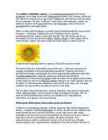
Flower formation 1. The first stage of the 3. The flower is nearly flower formation 2. The flower is still covered, completely exposed but faces the sun Introduction Taste is tops, but health and nutrition rank high for consumers who want foods that are as good for them as they are good to eat. Sunflower oil and kernels meet that challenge with their combination of health benefits and flavor. From phytochemicals and important vitamins and minerals to convenience of size and cost effectiveness, the amazing sunflower kernel is a powerhouse compared to no other! And one need look no further than NuSun oil for a healthy, trans-free alternative to hydrogenated oils and shortenings. While the vibrant, strong sunflower is a recognized worldwide for its beauty, it is also an important source of food. Sunflower oil is a valued and healthy vegetable
odorless powder that is insoluble in cold water or alcohol. It consists of two types of molecules: the linear and helical amylose and the branched amylopectin. Depending on the plant, starch generally contains 20 to 25% amylose and 75 to 80% amylopectin by weight. Glycogen, the glucose store of animals, is a more highly branched version of amylopectin. In industry, starch is converted into sugars, for example by malting, and fermented to produce ethanol in the manufacture of beer, whisky and biofuel. It is processed to produce many of the sugars used in processed foods. The biggest industrial non-food use of starch is as an adhesive in the papermaking process. Starch can be applied to parts of some garments before ironing, to stiffen them. Mixing most starches in warm water produces a paste, such as wheatpaste, which can be used as a thickening, stiffening or gluing agent. Slide 3 Starch is the major component of natural food, sometimes taking about 70% of the mass.
 annaabi.ee