 50 punkti
Autor soovib selle materjali allalaadimise eest saada 50 punkti.
50 punkti
Autor soovib selle materjali allalaadimise eest saada 50 punkti.
 ~ 17 lehte
Lehekülgede arv dokumendis
~ 17 lehte
Lehekülgede arv dokumendis
 2011-05-16
Kuupäev, millal dokument üles laeti
2011-05-16
Kuupäev, millal dokument üles laeti
 12 laadimist
Kokku alla laetud
12 laadimist
Kokku alla laetud
 0 arvamust
Teiste kasutajate poolt lisatud kommentaarid
0 arvamust
Teiste kasutajate poolt lisatud kommentaarid
 Onueedu
Õppematerjali autor
Onueedu
Õppematerjali autor
.....................................................................................................................................58 16.5 How Does Natural Gas Impact the Environment? .................................................. 58 PETROLEUM (OIL)......................................................................................................... 59 17.1 Where Do We Get Our Oil?..................................................................................... 59 17.2 What Fuels Are Made From Crude Oil?...................................................................60 17.3 How Does Oil Impact The Environment?................................................................60 3 ENERGY STORY Once upon a time, in a town not far away, there was an 8th grader who was afraid of the dark. Her name was Jules. She was also afraid of the quiet, and of the cold. So she always
4¢/kWh. Though in some G8 nations the cost can be significantly higher at 7.88p (~15¢/kWh).Achieving further cost reductions as indicated in the table below requires further technology development, market deployment, an increase in production capacities to mass production levels,and of the establishment of an emissions trading scheme and/or carbon tax which would attribute a cost to each unit of carbon emitted; thus reflecting the true cost of energy production by fossil fuels which then could be used to lower the cost/kWh of these renewable energies. Type 2001 energy costs Wind 48 ¢/kWh Solar photovoltaic 25160 ¢/kWh Solar thermal 1234 ¢/kWh
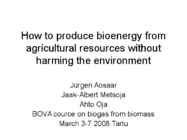
How to produce bioenergy from agricultural resources without harming the environment Jürgen Aosaar Jaak-Albert Metsoja Ahto Oja BOVA cource on biogas from biomass March 3-7 2008 Tartu Deciduous tree species on abandoned agricultural land Current situation • The long term development plan of the Estonian energy industry foresees a reduction in the use of fossil fuels and an increase in the share of biofuels: by the year 2010 renewable energy must account for 5.1% of total energy consumption Current situation (2) • In Estonia we have abandoned arable land about 400 000 ha, part of it is overgrowing naturally, and another part has been afforested • For short-rotation forestry in Estonia, ecologically and economically the most suitable tree is probably grey alder, which is a highly productive and soil improving species
characterization (mainly in terms of porosity and permeable structures). It is refined and separated, most easily by boiling point, into a large number of consumer products, from petrol (or gasoline) and kerosene to asphalt and chemical reagents used to make plastics and pharmaceuticals. Petroleum is used in manufacturing a wide variety of materials, and it is estimated that the world consumes about 88 million barrels each day. The use of fossil fuels such as petroleum can have a negative impact on Earth's biosphere, releasing pollutants and greenhouse gases into the air and damaging ecosystems through events such as oil spills. Concern over the depletion of the earth's finite reserves of oil, and the effect this would have on a society dependent on it, is a field known as peak oil. Etymology The word "petroleum" comes from Greek: πέτρα (petra) for rock and Greek: ἔλαιον (elaion) for oil
Figure 3. Global biodiesel production projection (USDA, 2012). Biodiesel is mainly produced in Europe, but production in other countries is expected to increase. In Europe and the US, biofuels have been boosted with the government's goals to source certain percentage of transport fuel from biofuels and therefore biofuels production is heavily subsidised. For example, in the EU, by 2020, 10% of energy used in transport should come from biofuels. In the USA, there is a fixed quantity of renewable fuels that must be consumed each year. By 2015, it must be 15 billion gallons, and 36 by 2022. In the USA, the legislation also requires to source fuels from advanced biofuels. Babcock (2008) has stated that, in the future, biofuels production will be determined by the level of crude oil prices and public Margit Tepner k0848752 policy incentives. So far, policy incentives have been key drivers of biofuels' production in Europe and the USA. Figure 4
Nowadays Waste management business Sterecycle owns patented technologies that are capable of recycling and recovering up to 80 per cent of waste typically produced by a household. Rarbach cited oil major Shell's tie up with Cosan as being one of the most notable strategic partnerships that has taken place last year. The $12bn joint venture will see the pair produce and sell sugar, energy and ethanol from sugarcane, and distribute fuels for transportation and industry from the companies' integrated distribution and retail networks in Brazil. Through the deal, Shell strengthened its whole business in biofuel and bioethanol. Sterecycle was debating whether to list in Canada or in its domestic market on the AIM exchange in London. French chemical company Rhodia's subsidiary Rhodia Energy Services has launched two biogas projects in China and Vietnam, it said on Thursday. Rhodia
The losses by energy conversion in Europe are of the same magnitude as the European heat demand and consist mainly of heat that is wasted by electricity generation . District heating is a means to utilise such surplus heat to cover heat demand. District heating can utilise the heat from electricity generation in combined heat and power (CHP) plants. District heating can also use other heat sources that are difficult to use for individual buildings, such as unrefined biomass fuels, heat from waste incineration and industrial surplus heat. The latter may, for example, be a by-product from production of automotive biofuel. District heating can provide cheap energy to consumers by using low-cost energy sources, such as wood, waste and surplus heat. Many of these resources can be of local origin and promote local business and industry. The main advantages with district heating are high security of supply through utilisation of
· PCBs were produced commercially in large quantities until production was stopped in 1977. . Emission sources Dioxins are mainly produced as unwanted byproducts of industrial processes and there is no intentional production or use. They can also to a small extent be formed naturally in forest fires or volcanic activity. Examples of activities resulting in dioxin emissions are waste incineration, burning fuels (wood, coal or oil), chlorine bleaching of pulp and paper and chlorinated pesticides manufacturing. Burning of many materials containing chlorine, such as plastics and wood treated with pentachlorophenol also produce dioxins. According to a study in the context of the Stockholm Convention, the main sources for emissions of dioxins to air in EU25 are Residential combustion (~ 30%) Open burning of waste (backyard burning) (~15%) Wood preservation (~15%) Iron and steel industry (~ 8%)
 annaabi.ee











Kõik kommentaarid