Leidsid 33 sarnast õppematerjali, mis on seotud failiga "Estonian political parties". Need materjalid aitavad sul teemat sügavamalt mõista.
party, reform, founded, social, economic, political, parties, ideas, such, parliament, democracy, market, equality, ansip, patria, publica, conservative, merged, christian, 8000, members, seats, previous, democratic, liberalism, joined, centre, claims, formation, strong, middle, class, income, raise, soldiers, iraq, savisaar, greens, points, programmeUniversity of Tartu Faculty of Social Sciences and Education Institute of Government and Politics Marie Allikmaa The strategies of creating a dominant party the case of United Russia Tartu 2011 After the collapse of USSR in 1991, many observers expected Russia to develop into a competitive party system. Yet, the reality quickly challenged this view. The developments of party politics in post-Soviet Russia have accurately been described in terms of a pendulum effect, as in the 2000s, Russia's party system did finally begin to take for, but with a remarkable twist. Following the break of one-party rule, Russia's party system became strongly fragmented - during the 1995 parliamentary elections, 43 parties competed for popular votes (McFault 1996: 90)
Estonia joined the World Trade Organization in 1999. A sizable current account deficits remains, but started to shrink in the last months of 2008 and is expected to do so in the near future. In the fourth quarter of 2008, the average monthly gross wage in Estonia was 13,117 kroons (838, US$1,066.5). Estonia is nearly energy independent supplying over 90% of its electricity needs with locally mined oil shale. Alternative energy sources such as wood, peat, and biomass make up approximately 9% of primary energy production. Estonia imports needed petroleum products from Western Europe and Russia. Oil shale energy, telecommunications, textiles, chemical products, banking, services, food and fishing, timber, shipbuilding, electronics, and transportation are key sectors of the economy. The ice-free port of Muuga, near Tallinn, is a modern facility featuring good
The Estonian Green Party Green Party History The Estonian Green Party is a political party and follower of the political activity of Estonian Green Movement (EGM), which was formed in 1988 during a massive movement against the Soviet Union's plans to start exploitation of huge phosphorite deposits on NorthEastern part of Estonia EGM was one of the first independent political popular movement in Estonia under Soviet rule. The party Estonian Greens (EG) was formally registered in March 1992 (precessor EGM was registered as party on 20.09.1989) after merger of EGM political wing and EGP. It had approximately 250 members and 3 regional branches. In the 1992 general elections, the Greens were only able to scrape 2.6% of the vote and one deputy to the 101strong Riigikogu (Parliament). Estonian Greens Today After joining the EU (European Union) on May 2004 along
Estonian history between 1710-1850 and 1850-1918 Contents Contents.................................................................................................................................. 2 17101850.............................................................................................................................. 3 Population and social structure........................................................................................ 4 Serfdom and the intensifying manorial economy ............................................................. 4 Influences of Pietism and the Moravian Brethren............................................................. 5 Enlightenment and enlightened absolutism...................................................................... 6 18501918..................................
At the beginning of the 19th century Napoleon started his invasions to The Russian Empire. The czar at that time was Alexander I. Napoleon made a big mistake with attacking Russia in the winter, because the army was not used to the merciless climate. Napoleon's army had to retreat and go back to France. The whole world understood now how powerful and strong the Russian empire was ( " I n v a s i o n o f r u s s i a , " ) . Russian empire became more industrialized and the political system stronger and stronger. The country increased its areas. The government was extremely conservative. By the 20th century people noticed that a czar is not the best choice any more. The next ruler Nicholas started to make some changes in the country ( " H i s t o r y a n d c u l t u r e , " ) . These changes brought together the working class which gave a start to the Social Democratic party. In 1905 Nicholas was forces to accept with the new reforms. Later the Social
ERLE MAIDO TAAB11 Report Purpose The purpose of this report is to give an overview of Estonian population, political factors, technological factors, economic factors and the trends in Estonian economy compared to Germany and to briefly discuss Estonian business environment. Estonian population The total population of Estonia is 1 313 271 according to Statistics Estonia, of which 69.1% are Estonians, 25.1% Russians, 4.9% of which are of different nationalities for example Ukrainians, Belarusians and Finns. Rest are of unknown nationality. 68.5% of population speaks Estonian as a mother language, 29.6% speaks Russian as a mother language and 0
A highly mechanized agricultural sector employs no more than 4% of the labor force but provides large surpluses for the food-processing industry and for exports. The Netherlands, along with 11 of its EU partners, began circulating the euro currency on 1 January 2002. The country continues to be one of the leading European nations for attracting foreign direct investment. Economic growth slowed considerably in 2001-02, as part of the global economic slowdown, but for the four years before that, annual growth averaged nearly 4%, well above the EU average. (3) 1.4 Population The great majority of inhabitants of the Netherlands are Dutch. They are mainly descended from Franks, Frisians, and Saxons. Most residents of Friesland Province are Frisian, a distinct cultural group with its own language. Fearing overpopulation, the government encouraged Dutch emigration after World War II (1939-1945), and some 500,000 people left. But an even
European Union Exam 1949 France, UK and the Benelux countries decide to set in place a Council of Europe. 1951 Treaty of Paris signed by the Six (Belgium, France, Germany, Italy, Luxembourg, Netherlands), establishing the European Coal and Steel Community (ECSC). 1957 Treaties of Rome establish the European Economic Community (EEC) and the European Atomic Energy Community (Euratom). 1959 July, seven countries of the Organisation for European Economic Co- operation (OEEC) – Austria, Denmark, Norway, Portugal, Sweden, Switzerland and the UK – decide to establish a European Free Trade Association (EFTA). 1960 Creation of European Free Trade Association 1961 UK applies to join the Community. 1962 The Parliamentary Assembly changes its name to the European Parliament. 1965 The Treaty merging the executives of the three Communities (ECSC, EEC, Euratom) is signed in Brussels; enters into force on July 1, 1967. Empty chair crisis 1966
1956 Coloured voters removed from common roll. 1948 `Apartheid' state based on idea of `separate development'. Contested control of the state In South Africa, different population groups made conflicting claims to self-government (i.e. democratic rule). Nationalism is the doctrine that nations are entitled to self-government. (Hague & Harrop, p.9) Afrikaner Nationalism : Talking here about different types of nationalism: cultural&political NP: Founded 1912 Advocated policies designed to advance Afrikaner interests: Language parity (which would enable Afrikaners to get jobs in the state bureaucracy) Using state resources to to redress white poverty , Apartheid Cultural nationalism - promotion of language, culture (eg the Broederbond) Political nationalism - expressed by the National Party (NP) Right-wing nationalism - fascist influenced movements (AWB)
year. This extreme degree of inequality is due to the right of inheritance at present vested in the legal institution of property. Large individual fortunes are, for the most part, made up of inherited property. The rich, as a class, are born with silver spoon in their mouths and the economic privileges that they enjoy were not acquired by the possession or exercise of great talents, but by the accident of birth. Social inequality. The apparatus of social hierarchy is amazingly complete. It is manifest in the Court with its great expense and elaborate display; the country house with its ancient associations and dependent village; the segregation of a group of schools (ironically called ,,public" schools) to provide each new generation with the manners and habits of ruling class; the clubs and social life of London; the columns of ,,Society" gossip in the newspapers and
Kerli Uue 10.r The Republic of Estonia Estonia is a democratic parliamentary republic divided into 15 counties. The capital and largest city is Tallinn. Estonia's neighbours are Latvia, Russia and Finland. The parliment is named ,,The Riigikogu." The Estonian parliament has 101 members and influences the governing of the state primarily by determining the income and the expenses of the state. The Riigikogu elects and appoints several high officials of the state, including the President of the Republic. The Parliament of Estonia is elected by people for a four year term by proportional representation. The Government of Estonia is formed by the Prime Minister of Estonia, nominated by the president and approved by the parliament
barbarians. 406-7 barbarians begin invasion Legacy- new types of animals, plants; miles, feet, inches-roman measurements;christianity; Roman basilica in curches; reading, writing; buildings, roads Christianity in Roman Britain Until 4th C christians were persecuted 313 AD Emperor Constantine legalised christianity 380 AD Emperor Theodosius I made it the official religion of the empire Paganism had been eclipsed but continued to pose a political, religious challenge Boudicca Queen of Iceni people of Eastern England, led an uprising against Roman forces Prasutagus(ruler) was first allowed to rule when romans conquered England, after his death, romans decided to rule Iceni and flogged Boudicca and raped her daughters 60-62 AD Iceni rebelled, Boudicca´s warriors defeated Roman Ninth Legion, destroied capital-Colchester Finally Boudicca was defetated, she poisoned
Neighboring countries include Iraq, Israel, Jordan, Lebanon, and Turkey. The geography of Syria is primarily semiarid and desert plateau with a double mountain belt in the west. The government system is a republic under authoritarian regime. The chief of state is the President and the head of government is the Prime Minister. Syria has a mixed economy in which there is limited private freedom but the economy remains highly controlled by the government. Syria is a member of the Council of Arab Economic Unity (CAEU). Two-thirds of Syria is desert; the other third is part of the Fertile Crescent along the Mediterranean coast. About 80 percent of the population lives in that fertile region. The total population of Syria is a little over 13 million. Half the people live in cities, 4 million in Damascus alone. Arabic is the official language of the Syrian Arab Republic and the language is spoken by nearly all Syrians. French is the second-most- common language
illiterate people. It is known that they established separate kingdoms: the Saxons settled in the South and West, the Angles in the East Anglia, Mercia, Northumbria and the Jutes in Kent. They probably thought of themselves as separate peoples, but they shared a common language and similar customs. *The 7 Anglo-Saxon kingdoms The first of the Anglo-Saxon kingdoms, which was popularly known as the Heptarchy (or the Seven Kingdoms), was founded in the latter half of the 5th century. Englan was divided into seven ancient kingdoms: Northumbria, Mercia, East Anglia, Essex, Kent, Sussex and Wessex. The period supposedly lasted until the kingdoms began to consolidate into larger units, but the actual events marking this transition are debatable. *St Patric and the Christianization of Ireland was a Christian missionary and is the patron saint of Ireland. Legend says that Patrick tought the Irish about the concept of the
Komisjoni president (Donald Tusk) - Määrab üldise poliitilise suuna ja prioriteedid, ei pea läbirääkimis õigusaktide üle ega võta neid vastu - Kohtub 2x poole aasta jooksul - Konsensus - Pesident 2,5 a - Loodi 1973 - ELi eesmärkide ja prioriteetide seadmise eest vastutav organ - 1992 Maastrichti leping – EC ametlik staatus - 2009 Lissaboni leping – saab üheks ELi institutsioonidest European Parliament - 1957 Treaty of Rome - Ainuke kuhu valitakse liikmed st esindab rahvast - Lgislative – seadused; absoluute majority hääletamine - Ei saa algatada eelnõusid vaid hääletab Euroopa Komisjoni esitatud eelnõud üle - 1992 Maastrichti ja 1997 Amsterdami leping muutsid EP seadusandlikuks parlamendiks - Õigus anda seadusandlikke akte - Rahandusalased volitused - Järelvalve täidesaata võimu üle
In the 8th century most of the Iberian Peninsula was conquered by Moorish invaders professing Islam, who were later expelled by the Knights Templar. During the Christian Reconquista, Portugal established itself as an independent kingdom from León in 1139, claiming to be the oldest European nation-state. In the 15th and 16th centuries, as the result of pioneering the Age of Discovery, Portugal expanded western influence and established the first global empire, becoming one of the world's major economic, political and military powers. In addition, the Portuguese Empire was the longest-lived of the modern European colonial empires, spanning almost 600 years, from the capture of Ceuta in 1415 to the handover of Macau in 1999 and grant of sovereignty to East Timor in 2002. The empire spread throughout a vast number of territories that are now part of 53 different sovereign states. However, the country's international status was greatly reduced during the 19th
Priests, deacons and lay ministers cooperate and assist their bishop(s) in shepherding a flock. Vicar/ priest is a representative, deputy or substitute; anyone acting "in the person of" or agent for a superior (compare "vicarious" in the sense of "at second hand"). Linguistically, vicar is cognate with the English prefix "vice", similarly meaning "deputy". Minister In Christianity, a minister is someone who is authorized by a church, or other religious organization, to perform functions such as teaching of beliefs; leading services such as weddings, baptisms or funerals; or otherwise providing spiritual guidance to the community. The term is taken from Latin minister ("servant", "attendant"), which itself was derived from minus ("less").[1] In Catholic churches, the concept of a priesthood is emphasised. In Protestant churches, the title usually refers to a member of the ordained clergy who leads a congregation or participates in a
About 310 reservations 55,7 million acres Unevenly distributed Tribal sovereignty (iseseisvus) Poverty and unemployment · Indian citizenship Act of 1924 Granted citizenship to 300,000 indigenous people, to friendly tribes State support was limited Absorb Indians into the mainstream Didn't have the right to vote · Trail of Broken Treaties of 1972 Took place in 1972 Cross-country protest by American Indian organizations Intended to bring attention to American Indian issues such as treaty rights, living standards, and inadequate housing. Huge media coverage "20-Point Program" · Present situation 1 Reservations situated west of the Mississippi 1% of the population Minority group, less privileged Social problems Self-awareness Mixture of old and new HOW GOVERNMENT ACTS NOW- gives natives money and near Las Vegas the right to own casinos to compensate injustice and taking away land. II First Settlements
Nearly all Australians live in the southeast of the continent and in the southwestern part of Western Australia. In these parts the soil and climate is suitable for farming. 50% of Australians live in the biggest cities, 20% in other towns and 30% in farms and stations. 98% of Australians are of British descent but people from other parts of the world have emigrated to Australia. Such as: Greeks, Turks, French, Italians, Russians, Chinese, Dutch, Poles etc. 8. The Native Australians Aboriginies probably came to Australia from Indonesia 50,000 years ago. Aboriginies were nomads. They respected their ancestors, traditions and sacred places. Some places like Uluru, were sacred because they were associate with the ,,dreamtime", the time when the Earth was formed and cycles of life and nature were begun. There were more than 600 tribes who spoke different dialects
over South Estonia. In 1219 Denmark conquered Northern Estonia. About a century later, in 1346 Denmark sold its territory to Germany. By the 1500s German nobles owned much of Estonia's land. After the Livonian War (1558-1583) the northern part of Estonia went under Swedish control, the southern part belonged to Poland and the islands to Denmark. Only in1629 the whole mainland Estonia became subject to Sweden. Under Swedish rule the University of Tartu was founded in 1632 and also the oldest school working on the same premises was founded in Tallinn (GAG).After the Northern War (1700-1721) Estonia became a province of Russia. During that period the gentry of Baltic-German origin prevailed in Estonia. They kept estates in Estonia until 1919. Under Russian rule the Palace of Kadriorg was built and the park was laid out. The National Awakening in the middle of the 19th century brought rapid advances in
and eventually invade Great Britain from the late 4th century onwards, either displacing, absorbing, or destroying the native Celtic peoples there. 6. The Anglo-Saxon invasion Germanic invasions 410-1066 5th cent. A-S soon had the s-east of the country in their grasp. A-S were pagan when they came to br. A-S had little use for towns and cities but had great effect on the countryside, where thay introduced new farming methods and founded thousand self-sufficient villages. 1 7.The Anglo-Saxon Chronicle The Anglo-Saxon Chronicle is a collection of annals in Old English chronicling the history of the Anglo-Saxons. The annals were initially created late in the 9th century, probably in Wessex, during the reign of Alfred the Great. Multiple manuscript copies were made and distributed to monasteries
thought he had reached India. Many now prefer to call themselves First Nations, though many still call themselves Indians in everyday conversation. They are still legally categorized by the Canadian Government under the Indian Act as Status Indians. Those who have lost their legal status are called Non-Status Indians. Prime Minister Pierre Trudeau tried to get rid of the Indian Act, but First Nations political groups insisted on keeping it, because it defines their special status. The Inuit are the people who originally lived in the Arctic. Their language is Inuktitut, but it has several dialects the differ considerably from place to place. The Métis, are the group of people who resulted from the mixing of European and Native men and women. The Métis developed a unique culture that included elements of both European and Native ways and artifacts (clothes, tools, means of travel, etc.)
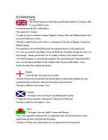
THE U.K Different Parts The United Kingdom is a short way of saying the United Kingdom of Great Britain and Northern Ireland. The UK is the political name for those countries which share a parliament in London. All of them were at one time independent kingdoms with their own monarch. Now they are all part of the same kingdom and share the same monarch. The UK consists of Northern Ireland, Scotland, England and Wales. The peoples of these countries are British subjects; they hold British passports and therefore their nationality is British. The british Isles is the geographical name for all the islands off the west coast of Europe.
States apply international regulations to national regulations and they have to be in accordance with each other, the states can always specify these regulations. Therefore, PIL regulates people indirectly. Another unique feature: domestic law sources have a clear pyramid (top to bottom: constitution, laws, individual contracts, they cannot contradict each other) and all sources are written. In PIL there is no such hierarchy, but there are primary sources (all are equally important) and secondary sources and all are not written. Primary sources: written documents (int treaties, conventions, declarations etc), international customary law (legally binding), fundamental principles (legally binding). PIL= system of (legally binding) norms and principles, written or customary, regulates the conduct of states and intergovernmental international organizations. Also known as International
Northern Ireland * the population is about 60,000,000 people, the population density is 242 people/sq km * its coasts are washed by the Atlantic Ocean, the North Sea, the English Channel, the Celtic Sea, Saint George's Channel, and the Irish Sea. It is linked to France by the Channel Tunnel * the United Kingdom is a constitutional monarchy. The current monarch is Queen Elizabeth II, who is also the Queen and Head of State of fifteen other Commonwealth Realms, such as Canada, Australia, New Zealand and Jamaica. England: * it has 50 cities, the capital city is London * despite of the density of population and the high degree of urbanisation, England has many unspoilt rural and coastal areas which have been placed under protection * the flag is called the Saint George's Cross Scotland: * the biggest cities are Glasgow and Edinburgh (the capital)
1. The Queen’s official title. Elizabeth the Second, by the Grace of God, of the United Kingdom of Great Britain and Northern Ireland and of Her other Realms and Territories Queen, Head of the Commonwealth, Defender of the Faith. 2. The Queen’s working day. Starts after breakfast. Reads the newspapers which are prepared by the Press Secretary, and a report on the previous day’s proceedings in the Parliament and the letters she receives. Also phone calls. Once a month she attends the Privy Council in order to give Royal Assent to various items of government legislation. Discusses domestic matters with the Master of the Household. Towards the end of the day, there is always another pile of official papers and reports waiting to be read or acted upon. The business on constitutional monarchy never ends. 3. Who is the present heir to the throne
became the northern border of the empire, although the army held the Antonine Wall in the Central Lowlands for two short periods--the last of these during the time of Emperor Septimius Severus from 208 until 210. The extent of Roman military occupation of any significant part of Scotland was limited to a total of about 40 years, although their influence on the southern section of the country occupied by Brythonic tribes such as the Votadini and Damnonii would still have been considerable. A replica of the Pictish Hilton of Cadboll Stone. Medieval period The Kingdom of the Picts (based in Fortriu by the 6th century) was the state which eventually became known as "Alba" or "Scotland". The development of "Pictland", according to the historical model developed by Peter Heather, was a natural response to Roman imperialism. Another view places emphasis on the Battle of Dunnichen, and the reign of Bridei m
Number of Words 1616 NOTE: The ESSAY should be 1500 words in length. Student signature - Alex Callaghan Date - 24/04/2014 Critically evaluate Locke's theory of limited government The end of law is not to abolish or restrain, but to preserve and enlarge freedom. For in all the states of created beings, capable of laws, where there is no law there is no freedom. John Locke Although John Locke is not the progenitor of social contract theory and is not by any means the last philosopher to wrestle with this concept, his views on fiduciary power, majority consent and limited government have been instrumental in western political thought from the time of the publication of his Two treatises of government to the present day. Locke's writings refute the notions both of the divine right of kings and absolute government by arguing that peoples' destiny should be determined by majority will
a bankrupt person. a member of the Riigikogu or member of a rural municipality or city council; a member of a political party; EXAMS AND The notary public Judicial training To solve two cases Sworn advocate’s TRAININGS TO contest (written The judge’s To pass an assistant exam BE PASSED test and oral exam) examination interview Be sworn Candidate service advocate’s
to commit a crime (kuritegu läbi viima) - breaking a law, usually given out by the goverment fine (trahv) - certain sum of money person pays for breaking a law corruption (korruptsioon) - dishonest or unethincal conduct by a person entrusted with a position of authority suspension (kõrvaldamine) - form of punisment that people recieve for violating rules and regulations Civil Action (tsiviilhagi) - lawsuit between two private parties prosecution (süüdistus) - the institution and carrying on of legal proceeding against a person injury (vigastus) - an act or event that causes someone/something no longer to be fully healthy claim (nõudeõigus) - to apply for compensation or to inherit something prison (vangla) - residence for incaretaking criminals majority (enamus) - greater amount of the group public opinion (avalik arvamus) - collective opinion of many people on same issue, problem etc.
deployable). · 17.09.1991 Estonia became a memeber of the United Nations. · 1993 was established European Union. · 2004 Estonia joined with European Union. Estonian participation in NATO operations Estonia engaged in different operations from 1995. Estonia strongly supports NATO's open-door policy and closer cooperation with NATO partner states. In addition to greater participation, Estonia increases its contribution to sharing reform experience. Estonia supports states which pursue Euro-Atlantic structures in preparation for a membership and is ready to provide guidance and support. Each state needs a different approach but everyone has to be also very active itself in developing and applying a cooperation policy. Estonia's experience of joining NATO can be useful for several states. At this point of time Estonia supports Georgia, Ukraine, Serbia, Montenegro and Macedonia. Purpose of NATO
The centrepiece of Northern Ireland's geography is Lough Neagh, at 151 square miles (392 km²) the largest freshwater lake both on the island of Ireland and in the British Isles, and the third largest lake in Western Europe. A second extensive lake system is centred on Lower and Upper Lough Erne in Fermanagh. Northern Ireland don't have an official flag any more nor a coat of arms. Due to the division of the population along ethnic, religious and political lines, a wide variety of flags can be seen flying from lampposts and private houses across Northern Ireland. Government. The British Constitution is an unwritten constitution, not being contained in a single legal document. England and Wales have no criminal or civil code. It is case law there. It contains two main principles the rule of law (nobody can escape from the law) and the supremacy of Parliament (in theory the Parliament can do whatever it wishes)
Head of state Head of state is Queen Elizabeth II, who is queen of United Kingdom and also queen is Australia. In practice, Governor General performs her functions in queen's absence. Since 1989 Bill Hayden has been the Governor General Government Australia is constitutional monarchy, based on liberal democratic tradition. In practice Australia is parliamentary democracy. The power in the country is put to life by Parliament. Parliament is consists of The House Of Representatives and The Senat. The House of Representatives consists of 150 members. The party with the majority provides the Prime Minister, who also forms the Government. Today the power is divided by three parties: The Australian Labour Party, the Liberal Party and National Party. The Senat's membership is wider, it comprises 12 senators from each state and 2 from each territory. Senators are elected for six year terms.
 annaabi.ee