https://quizlet.com/388172484/inka-test-flash-cards/?
i=25w06u&x=1jqY&fbclid=IwAR1qQksMLyeDlPJwkOTW_Fq18r1xJUkZrlbt6nX49ZocC
_ojSaZoykYBJXk
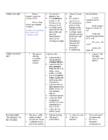
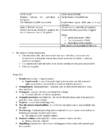
Prosecutor, judge, sworn advocate, notary
NOTARY
JUDGE
PROSECUTOR
SWORN
ADVOCATE/
ATTORNEY-AT-
LAW
WHAT DO THEY
DO?
A notary public of the
common law is a
public officer
constituted by law to
serve the public in
non-contentious
matters usually
concerned with
estates, deeds, powers-
of-attorney, and
foreign and
international business.
A notary's main
functions are to
administer oaths and
affirmations, take
affidavits and statutory
declarations, witness
and authenticate the
execution of certain
classes of documents,
take acknowledgments
of deeds and other
conveyances, protest
notes and bills of
exchange, provide
notice of foreign
drafts, prepare marine
or ship's protests in
cases of damage,
provide
exemplifications and
notarial copies, and
perform certain other
official acts depending
on the jurisdiction
A judge presides over
a courtroom, hearing
evidence, making
decisions on motions.
The judge is
responsible for
assuring the law is
followed and carried
out in every case.
Judges also read
through court
documents and may
research legal issues.
The prosecutor has
three main tasks:
to investigate
crimes,
to decide whether
or not to
instigate (põhjustama,
kaasa tooma) legal
proceedings
to appear in court
Attorney at law or
attorney-at-law,
usually abbreviated in
everyday speech to
attorney, is the
preferred term for a
practising lawyer in
certain jurisdictions
REQUIREMENTS –
Be EU citizen
A citizen who:
A citizen:
Be competent
WHO CAN BE?
Have a
master’s degree in
science of law
Have a clean
record (no criminal
charges)
In check and Germany
they need to EU
citizens as well
Has master’s
degree in law
Has
proficiency (oskus) in the
Estonian at the
advanced level
is of high moral
character and has
the abilities and
personal
characteristics
necessary for
working as a judge
at least 21 years
old
Has master’s
degree in law
Has proficiency
(oskus) in the
Estonian at the
advanced level
is of high moral
character and has
the abilities and
personal
characteristics
necessary for
working as a
prosecutor
is professional.
(teovõimeline)
Live in
Estonia or be EU
citizen
Have master’s
degree in science of
law
Write and
speak Estonian at least
at C1 level
Be honest and
moral
At least 24-
years old
WHO CANNOT
BE?
The person
who has
convicted a
criminal
offence
A person who:
a person who is
convicted of a
criminal offence;
a person who has
been
removed
from the office of
judge, notary
public or bailiff;
a person
expelled
from (tagandatud)
the Estonian Bar
Association;
a person who has
been released from
public service for
a disciplinary
offence;
a bankrupt person.
a member of the
Riigikogu or
member of a rural
municipality or
city council;
a member of a
political party;
a person who
has been
removed from
the bar
EXAMS AND
TRAININGS TO
BE PASSED
The notary public
contest (written
test and oral exam)
Candidate service
(test in the middle)
Judicial training
The judge’s
examination
To solve two cases
To pass an
interview
Sworn advocate’s
assistant exam
Be sworn
advocate’s
assistant for at
Notary exam
least 3 years
Sworn advocate’s
exam
HOW MANY
MEMBERS IN
THE…
THE CHAMBER OF
NOTARIES
All current notaries
ESTONIAN
ASSOCIATION OF
JUDGES
224 members of
association
4 of them are
honourable
members
THE GENERAL
ASSEMBLY OF
PROSECUTORS
All the current
prosecutors
ESTONIAN BAR
ASSOCIATION
HOW MANY OF
THEM IN
ESTONIA
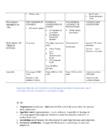
92 notaries
242 judge’s position in
total:
150 in County
court
28 in
Administrative
Court
19 in Supreme
Court
Over 20 000 in
germany
191 prosecutors
In Germany
Around 1100 sworn
advocates
Around … sworn
advocate’s assistants
SALARY
On average 16 000
euros.
Depends on the
number of clients.
From 3 380 to 4 225
euros
From 2 202 to 5 243
euros
Usually more than
1000 euros
Depends on the
number of clients
In germany they take only to exams to enter the general assembly of prosecutors, bar of
association, chamber of notaries or association of judges
31 - 32
1. Original court (maakohus) -
trial court, the first level of the court, where the cases are
tried; county court
2. Appellate court (ringkonnakohus) – courts, which are responsible for hearing and
reviewing appeals from legal cases that have already been heard in a trial-level or
another lower court.
3. Jurisdiction (jurisdiktsioon)- the official power to make legal decisions and judgements.
4. To exercise jurisdiction - to apply the official power to make legal decisions and
judgements
5. Amount of a claim – the sum of money
a. Main claim 2000 euros
b. And final claim 4000 euros
6. Probate - the legal process of deciding if a person's will has been made correctly and if
the information it contains is correct
7. Divorce - an official or legal process to end a marriage
a. Custody for mothers
b. Fathers need to pay
alimony
c. Visitation right for fathers
– külastusõigus isale
8. Canon law - ecclesiastical law, especially (in the Roman Catholic Church) that laid
down by papal pronouncements
a. Ecclesiastical – kiriku-, kiriklik, kristlik
b. Papal – paavstilik, paavstiga seonduv
c. Pronouncement - väljakuulutamine
9. Will (land)- used to talk about what is going to happen in the future, especially things
that you are certain about or things that are planned
a. Begueath testament
b. Testament dispositions – testamentlikud korraldused
c. Holograph form – testament peab olema kõik käsitsi kirjutatud
10. Single judge – only one judge, who has the right to decide; the term, which refers to the
lowest court within the judicial system
11. Respondent (kostja/vastaja/respondent)
vs appellant - a person who answers a request
for information
12. Matrimonial matters – relating to the state of being married
13. Guardianship - the state or duty of being a person who has the legal right and
responsibility of taking care of someone who cannot take care of himself or herself
14. Adoption – your legal duty to take care of the children
a. the action or fact of adopting or being adopted (adoptive parents - lapsendajad)
15. Affiliation (liitumine/ kuuluvus) - the process officially attaching or connecting sb to an
organization; connection to political party, religional group or something else;
the man
is legally related to the child
a. Paternity cases – isaduse tõestamine
16. Illegitimate child (vallaslaps) - a child who is born to parents who are not married to
each other
a. Bastard, love child
17. Adjudicate (otsust langetama) - to make a formal judgement on a disputed matter
a. – settle a little dispute
18. Leave (luba)
- time allowed away from work for a holiday or illness
a. To grant a leave – give sb the permission
19. Litigate (kohut käima, süüdistust nõudma) - to ask for a disagreement to be discussed in
a court of law so that a judgment can be made that must be accepted by both sides in the
argument
20. To award damages - to order one party in a dispute to compensate another party for a
loss or injury.
21. Personal injury - physical injury inflicted to a person's body, as opposed to damage to
property or reputation
Classification of the court
There are two different kind of courts:
The court of first instance – the court, where a case is first heard
The appellate court – the higher court, where to it is possible to appeal a case for
reconsideration of the decision of the original court
o
Appeal to the higher court to reconsideration
1. Country, administer,
2. Circuit court (ringkonna kohus),
3. Supreme court (riigikohus)
THERE IS NO COURT ABOVE IT – THE HIGHEST
European court of justice – deals with the matters, where it is about the EU law
Classifying courts according to their functions
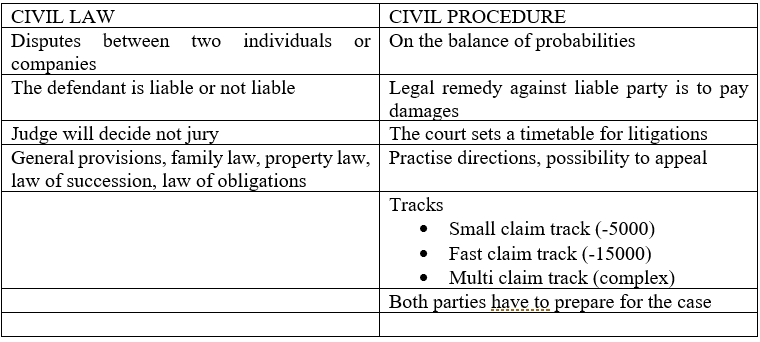
The courts of civil jurisdiction
o Civil actions take place between two or more individuals in dispute, it is a
responsibility of the civil court to adjudicate, to give judgement FAIRLY
o Provide remedy for the wronged party
o To solve the disputes between individuals or companies
o Only single judge NO JURY
o Possibility to appeal
o Both parties have to prepare for the case
o Penalty – usually the wronged party needs to pay damages
o Liable or not liable – we won’t talk about guilt
o Structure – 5 parts (law of property, family property etc)
The courts of criminal jurisdiction
o Criminal actions take place between the state and a individual, it is the aim of a
criminal court to determine whether the accused person has committed a crime and
punish the wrongdoer
o It is important to ensure the safety of the society and that only the guilty are punished
o Guilty or not guilty
Terms 33-3
1.
Remedy (korvamine) - a legal reparation
a. Legal remedy - a way of using the legal system to make sure that someone's
rights are not taken away from them; courts are asked to provide it
2. Wronged party (kannatanud pool) - someone, who has been treated unfairly or in an
unaccepted way
3. Wrongdoer - a person who does something bad or illegal
a. Criminal, offender, tort feasor, perpetrator
4. Wrongful conviction (valesüüdistus) - the fact of officially being found to be guilty of a
particular crime, proves erroneus
5. To prove - to show that something is true
6. Own the balance of probabilities - In a civil trial, one party's case is more probable than
the other
7. Fair hearing - A judicial proceeding that is conducted in such a manner as to conform to
fundamental concepts of justice and equality
a. The judge has to be impartial, unbiest
8. Domestic violence (koduvägivald) - violent treatment of family members
a. Battery, domestic unbiased
9.
Shoplifting (varastamine) - the action of stealing goods from a shop while pretending to
be a customer
10. Aggrieved party (kannatanud pool) – a person, who has suffered harm such as injury,
financial loss, or damage to property
11. Final decision (viimane otsus) - a judgment disposing of the case before the court; after
the judgment (or an appeal from it) is rendered all that remains is to enforce the judgment
a. The decision of Estonian Supreme Court is final decision
12. Appointment (ametisse nimetamine) - an act of assigning a job or position to someone
13.
Conflict of interest (huvide konflikt) - a situation in which the concerns or aims of two
different parties are incompatible (kokkusobimatu)
14. Collection of evidence (kogutud tõendid) - compilation of proof, confirmation
a. Admissible evidence
15. To drop charges (süüdistust tagasi võtma) - no longer officially accuse someone of a
crime
16. Overburdened criminal system (ülekoormatud kriminaalsüsteem) - criminal justice
system with excessive unsolved caseloads
Criminal law
Criminal offences
o Summary offences – väärtegu
Tried without a jury
Minor crimes
Magistrates court
o Indictable offences
Serious crimes (murder)
Crown court
About criminal code, penal code
State against individual
When in arrest, you can ask for a bail
PUBLIC LAW
Set crimes have set punishments
Criminal proceedings
o Adversarial justice (cross-examination)
o Burden of proof is on the prosecution (beyond reasonable doubt, because of the
punishments)
o Disclosure of material (alibis, witnesses)
o Speeches
o Prosecutor brings charges to court
Criminal court
-
a court that has jurisdiction to try and punish offenders against criminal law
-
guilty beyond reasonable doubt
-
to punish the wrongdoer and avoid wrongful conviction
-
fair hearing
-
only admissible evidence
-
State vs defendant
-
Sabina – need of giving information
-
three types of criminal offences:
o summary
less serious offences
e.g. minor motoring offences
in the magistrate courts
without a jury
three lay magistrate or a stipendiary magistrate
the magistrate reaches a verdict
can be appealed
defendant is sent a summon (kohtukutse)
o indictable
most serious offences
e.g. murder, manslaughter, rape, arson (süütamine)
begins in the magistrate court
prima facie - based on the first impression; accepted as correct until
proved otherwise.
If a prima facie case is established, a full trial will take place in the
Crown Court
A judge and a jury of twelve ordinary people
The magistrate reaches a verdict
Can be appealed
o Triable
Serious or less serious crimes
E.g. burglary, theft
In the magistrate or in the Crown court
Prosecution
-
criminal offence ->
-
sb brings a prosecution
o even if this person has no particular interest in this case
-
prosecutions can be brought by the police
o collect evidence
o they make a decision to go on with a case or not
o gives evidences to prosecutor
-
a prosecutor needs to be sure if there are enough evidences
-
the investigation of crime and its prosecution are separate
-
the decision to prosecute
-
being heard in court
Civil court
-
no jury
-
jurisdiction is limited by the type of the case
-
action takes place between two parties – plaintiff and defendant
-
on the balance of probabilities
-
provide remedy for wronged party
-
no criminal action
Terms 33-34
1. discretion - (kaalutlusõigus) the freedom to decide what should be done in a particular
situation (the right of discretion)
2. to administer an informal caution to sb - an oral warning given by a police officer and
does not count towards a criminal record.
3. the decision rests with a court – after explaining a case, it is time for the judge or jury
to decide and to reach a verdict
4. The power is vested in sb (võim kuulub kellegile) – sb has the ability to influence or
control what people do or think
5. Lack of uniformity – a group of people do not agree on sth
6. Proximate or harmonize laws – to make different rules suitable for each other
7. To issue of formal warning -
8. Motoring offence - (sõiduki juhtimisest põhjustatud kuritegu) a committed crime which
concerns driving
9. Excess of jurisdiction - (jurisdiktsiooni ületamine) court's acting beyond the limits of its
power
10. To conduct a preliminary inquiry (juurdlus) - (eeluurimise korraldamine) to enforce
an initial questioning that occurs at the demand of an accused wherein a judge screens
the proposed criminal charge against the available evidence; procedure before the trial
11. To discharge the case - type of sentence imposed by a court whereby no punishment is
imposed
12. To pass a sentence – (karistust määrama) to officially say in a court of law what a
criminal’s punishment will be Syn
: Serve/pronounce a sentence
13. Summary offence - (väärtegu) a crime in some common law jurisdictions that can be
proceeded against without discussion or a legal process, without the right to a jury trial
and/or indictment
14. Indictable offence - (kuritegu) an offence which the government can opt to cause trial
by a more formal process than by summary process
15. Triable either way - (hagetav mõlemat moodi) a crime that may be tried either as an
indictable offence or a summary offence
16. To insist on trial by a jury - (nõudma kohtuprotsessi vandekohtu osalusega) to demand
a hearing in a court, where a group of people who have been chosen to listen to all the
facts has a jurisdiction; only criminal cases have a jury
17. Summons - court order, which commands you to come to a court as one of a parties
18. Subpoena – court order, which commands you to come to a court as a witness
Classification of offences
CRIMINAL OFFENCES – the offender damages the victim’s legal rights. Legal rights are
fundamental values such as
life, health, and freedom, but also
material values and intellectual
property.
1. Felony - kuritegu
a. The most serious
b. It may be property and person crimes
c. E.g. murder, rape, kidnapping, armed robbery and grand theft, arson (süütamine),
manslaughter (tapmine), tax evasion (maksudest kõrvalehoidmine), treason
(riigireetmine)
d. The degree of felonies:
i. First-degree felonies – arson, rape, murder, kidnapping, treason
ii. Second-degree felonies – arson, manslaughter, drug manufacturing or
distribution, child pornography, child molestation (lapse kuritarvitamine)
iii. Third- and fourth-degree felonies – pornography, involuntary
manslaughter, burglary (murdvargus), larceny (vargus), assault and battery
(kallaletung koos vägivallaga)
e. Incarceration (vangistus)
2. Misdemeanor - süütegu
a. Less serious than felonies
b. E.g. aggravated assault (beating sb with a baseball bat); simple battery (slapping
sb in the face)
c. Incarceration (vangistus) – maximum sentence is 12 months
d. Can cause felony
3. Infraction
a. Less serious than misdemeanor
b. No incarceration, punished by fines – can be paid without going to court
c. E.g. exceeding a speed limit, operating a business without proper license,
d. Can cause felony or misdemeanor
1. Summary (or simple) offences
2. Minor indictable offences
3. Major indictable offences
In Estonia:
-
criminal offences
o the first and the second degree
-
misdemeanor
7. nov – case brief
Terms 33-34:
1. Employer - a person, company, or organization that pays people to work for them:
2. Employee - someone who is paid to work for someone else
3. Welfare system - (heaolusüsteem) a system that allows the government of a country to
provide social services such as healthcare, unemployment benefit, etc. to people who
need them, paid for by taxes
4. Unjustified dismissal - (vallandamine) the situation in which an employer wrongfully
makes someone leave their job permanently
5. Benefit - (kasu) a helpful or good effect, or something intended to help
6. Expert assessors - (eksperthindajad) people who are professionally qualified with
knowledge in a subject, especially a group of experts asked to advise a court of law on
that subject
7.
Court panel (kohtukoosseis) - (kohtukoosseis) set of judges who sit together to hear a
cause of action
8. Judicial review – aim of this is reconsidering
9. To exceed statutory powers – to do more than allowed
10.
A legal aid - (õigusabi) a system of providing free advice about the law and practical
help with legal matters for people who are too poor to pay for it
11.
Commercial dispute - (kaubandusvaidlus) any material conflict or claim in any respect
arising out of or in connection with an account or any other transaction related thereto,
which dispute relates to an account
12. Supplier of goods - (hüvede pakkuja) person, company, or organization that sells or
supplies something such as
13. Third party – (kolmas pool) a person who is not a party to a contract or a transaction,
but has an involvement
14. Natural justice - (tavaõigus) principles, procedures, or treatment felt instinctively to be
morally right and fair
15. Award – (otsus) a decision after consideration; a judicial sentence; the decision of
arbitrators on a matter submitted to them
16.
Trade association - (ametiühing) an association of people or companies in a business or
trade, organized to promote their common interests
17.
Deposit - (tagatisraha) a sum payable as a first instalment on the purchase of something
or as a pledge for a contract, the balance being payable later
18. Access to justice - (õiguskaitse kättesaadavus) formal ability to appear in court; a right to
seek and obtain legal aid
19. Disputing parties - people, business entities, organisations, or states involved in a
disagreement
20. Law enforcement – system by which some members of society act in an organized
manner to enforce the law by discovering, deterring, rehabilitating, or punishing people
who violate the rules and norms governing that society.
21. Negotiation - the process of discussing something with someone in order to reach an
agreement with them, or the discussions themselves
22. Commercial transactions – (äritehing) an occasion when someone buys or sells
something related to business
23. Reinstate –
24. Dismiss – fire sb
25. Labor law/employer law
26. To waive sth – to give up sth (loobuma õigusest)
27. Remuneration - töötasu
28.
Salary – teenistuja töötasu
29. Wage –
30. Reinstate – tööle ennistaga, tagasi võtma
31. Forensic expert – kohtuekspert
32. Solve or settle the dispute
Tribunal
-
Taking place in informal court; outside the court system
-
Work permanently
-
Two main forms of extra-court adjudication
o Tribunal
o Arbitration
-
Over 50 different types of tribunals
-
Limited jurisdiction
-
Regulates relationships between social groups such as employers and employees or
between the state and the citizens
-
Faster and cheaper than courts
-
Employee may claim e.g. ehat the dismissal was not legal
-
Lower than the courts – inferior to the courts
-
Specialist courts
Arbitration:
-
Is a private means of adjudication
-
Arbitrator - it is important to find a person, who is going to make decision; they have
registers for that
-
Arranged and agreed between two parties involved
-
Used in many different situations
o From the resolution of complex commercial disputes to minor disagreements
between suppliers of goods
-
The arbitrator is most likely to be someone with expertise in the area
-
The arbitrator is bound to apply the law accurately, but may within the boundaries of
natural justice, adopt whatever procedures he likes
-
The judgement of an arbitrator is known as an award
-
Fast, low costs, flexible, informal
-
Poor quality service
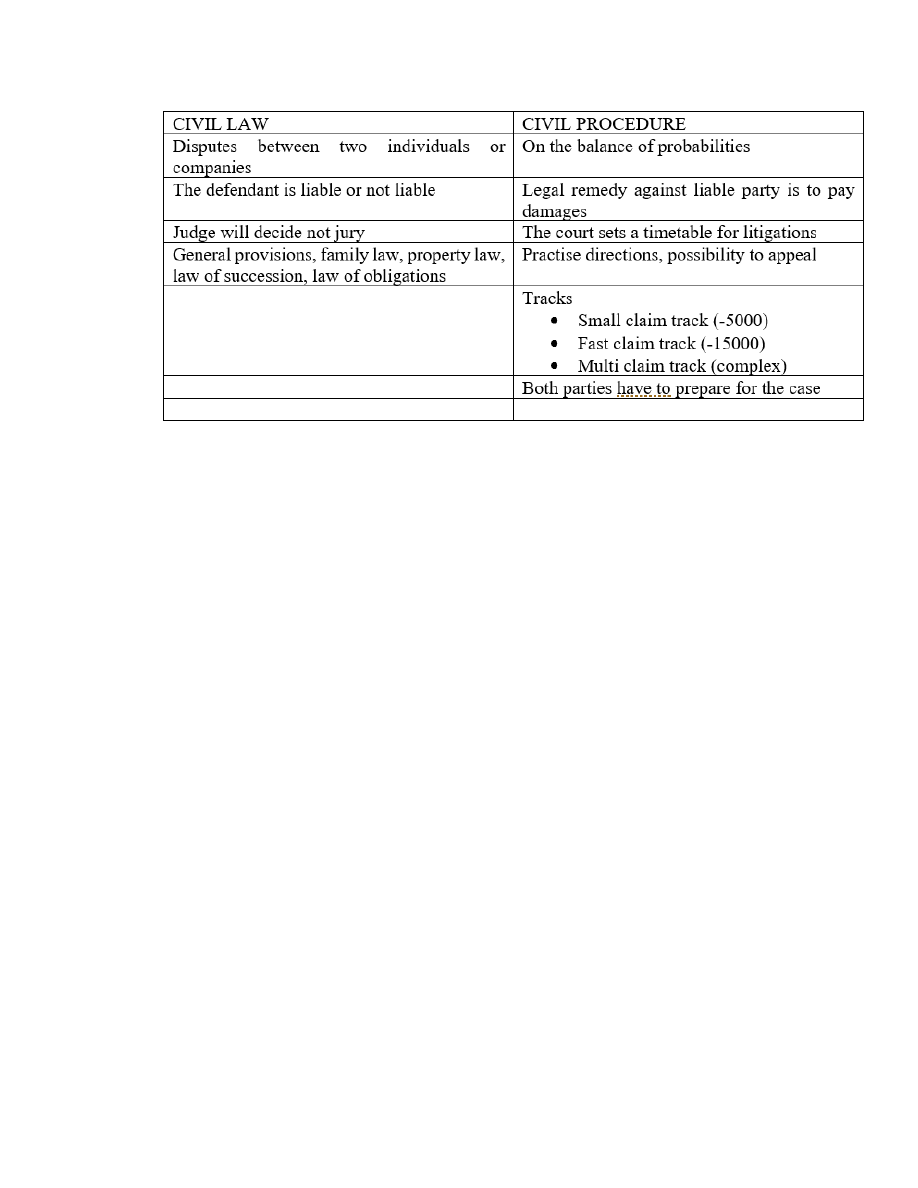
Pg 37, 38, 39, 40
Columns about civil law and its procedure
Pg 57-61
Rule of law - õigusriik
 50 punkti
Autor soovib selle materjali allalaadimise eest saada 50 punkti.
50 punkti
Autor soovib selle materjali allalaadimise eest saada 50 punkti.
 ~ 13 lehte
Lehekülgede arv dokumendis
~ 13 lehte
Lehekülgede arv dokumendis
 2021-04-22
Kuupäev, millal dokument üles laeti
2021-04-22
Kuupäev, millal dokument üles laeti
 7 laadimist
Kokku alla laetud
7 laadimist
Kokku alla laetud
 0 arvamust
Teiste kasutajate poolt lisatud kommentaarid
0 arvamust
Teiste kasutajate poolt lisatud kommentaarid
 Kalli Kolberg
Õppematerjali autor
Kalli Kolberg
Õppematerjali autor
 annaabi.ee












Kõik kommentaarid