 50 punkti
Autor soovib selle materjali allalaadimise eest saada 50 punkti.
50 punkti
Autor soovib selle materjali allalaadimise eest saada 50 punkti.
 ~ 5 lehte
Lehekülgede arv dokumendis
~ 5 lehte
Lehekülgede arv dokumendis
 2015-11-26
Kuupäev, millal dokument üles laeti
2015-11-26
Kuupäev, millal dokument üles laeti
 3 laadimist
Kokku alla laetud
3 laadimist
Kokku alla laetud
 0 arvamust
Teiste kasutajate poolt lisatud kommentaarid
0 arvamust
Teiste kasutajate poolt lisatud kommentaarid
 Lennu123
Õppematerjali autor
Lennu123
Õppematerjali autor
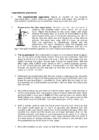
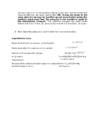
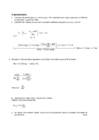
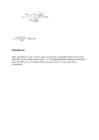
Aim of the work The determination of the concentrations of acid and base solutions through titration. Used compounds HCl solution with an unknown concentration. NaOH solution with a known accurate concentration, indicators phenolphthalein (ff/pp) and methyl red (mp/mr). Equipment Conical flasks (250 cm3), 2 burettes (25 cm3), pipette (10 cm3). Procedure A. Determining the concentration of a hydrochloric acid solution through titration 1. To determine the concentration of the acid solution take the NaOH solution with a known concentration (the standard solution) and pour it into the burette (α in figure 2.2). See that there are no air bubbles near the tip. Fill the burette until the 0-point of the scale. When measuring the level of the solution keep your eyes at the same level with the liquid level. The lower edge of the liquid level has to be at the 0 calibration mark (see figure 2.1). Work solutions are
Aim Determination of total and carbonate hardness of tap water using titration technique. Eliminating total hardness with a Na+ ion-exchange softener. Reagents 0.1 M hydrochloric acid, 0,025 M and 0,005M trilon-B solution, buffer solution (NH4Cl + NH3∙H2O), indicators methyl red (mr) or methyl orange (mo) and chromogen black ET-00. Apparatus Conical flasks (250 ml, 500 ml), measuring cylinder (25 cm 3), burette (25 cm3), pipettes (100 cm3). Experimental Procedure A Determination of carbonate hardness 1. Rinse the 100 cm3 pipette 2...3 times with a small amount of the test water. Wash the conical flask with distilled water. Pipette 100 cm 3 of the test water and transfer it into the conical flask, add 3...4 drops of indicator mo or mr. 2. Prepare the burette – remove any air bubbles from the nozzle and fill with 0.1 M hydrochloric acid till zero (The lower meniscus has to coincide with the scales 0-notation). 3. Titrate with a 0.1 M hydrochloric acid solution, while swi
Aim of the work Creating a solution from solid compounds, separating compounds from mixtures using their differences in solubility, determining the percentage of table salt in a sand-salt mixture. Used compounds Solid sodium chloride in a mixture with sand, dried to a constant weight at 105ºC. Equipment Beaker, glass rod, funnel, conical flask, measuring cylinder (250 cm 3), hydrometer, filter paper. 1) In a conical flask, dissolve the NaCl from a previously weighed sand-salt mixture. To do that, add about 50 cm3 of distilled water to the mixture. Stir the solution with a glass rod and then filter it. For filtration, fold the filter paper in half twice. Cut one corner for the filter paper to distribute evenly to the wall of the funnel (see Figure Figure 1.1 2.1 figure 1.1). Place the filter paper into the funnel, wet it with distilled water and press it fi
Zn 2 e ¿ Next, insert the copper wire into the same solution in the centrifuge tube, ensuring that it will not touch the zinc granule. Observe whether any hydrogen evolves on the copper surface? Explain, why copper did not react with diluted hydrochloric acid! Adding copper wire doesnt make H extract. Copper is less active than H. H starts to extract when connect copper wire to Zinc, because zinc corrodes when connected to more active metal. Now put the copper wire into contact with the zinc and observe whether hydrogen will evolve on the copper surface. By putting copper and zinc into contact with each other in the solution of hydrochloric acid (an electrolyte), you have created a galvanic pair. Zinc as the metal with more negative potential will be the anode and copper, with more positive potential, the cathode. Which of the two metals will dissolve (corrode)? Write the chemical equations of the
The aim of the experiment To determine the molar mass of carbon dioxide in three different ways; 1) using the Ideal Gas Law equation, 2) using the molar volume of a gas at NTP, 3) using the relative density to air Equipment CO2 tank, a flask with a rubber stopper (300 cm 3), technical balance, measuring cylinder (250 cm3), thermometer, barometer. Method 1. Determine the mass (m1= mflask+stopper+air) of the dry flask with a rubber stopper by weighing on a technical balance. Draw a line on the flask at the bottom edge of the stopper in order to measure the volume of the flask in step 5. 2. Fill the flask with carbon dioxide gas. Direct the gas from the CO 2 tank into the flask for about 7-8 minutes. The tip of the hose has to be in the bottom but not very closely against the bottom. Otherwise it may happen that all of the CO 2 will exit from other branches of the hose bundle. 3. Seal the flask quickly and weigh again for the mass (m2=mflask+sto
oil between the bearings. The crosshead bearing transmits the full gas load from the piston to the connecting rod and crankshaft. The crosshead is designed as a center part with a bearing journal fitted at each end, on which the guide shoes are fitted. The crosshead bearing cap is provided with a cutout for assembling the piston rod with the crosshead. The crosshead bearing is provided with bearing shells, which are lined with a white metal layer. The piston rod is fitted into a groove in the top of the crosshead and secured by means of four screws. A bracket on the crosshead supports the telescopic pipe, which supplies lubricating and cooling oil to the crosshead, crankpin and piston. The outlet pipe is fitted to the opposite end of the crosshead. The outlet pipe slides within a slotted pipe inside the engine frame, and from there the oil is led through a control device for
INSTITUTO POLITECNICO DO PORTO INSTITUTO SUPERIOR DE ENGENHARIA DO PORTO CHEMICAL ENGINEERING DEPARTMENT PORTUGAL Marvin Üürike Tallinn University of Technology Faculty of Chemical and Materials Technology Department of Chemical Engineering Estonia ERASMUS PROJECT STUDY OF THE HEAT TRANSFER COEFFICIENT IN A HELICAL COIL Supervisor: Albina Ribeiro Porto 2015 2 Abstract The following work investigates overall heat transfer coefficient of a helical coil and how it changes in different situations. The variables investigated were flow rate inside a submerged helical coil and agitation of the bath. To investigate the change in heat transfer coefficient in different situations, a simple experiment was set up. It consisted of a rectangular isolated tank, which was filled with water, submerged ste
1. (a) (i) gene length of DNA; codes for a (specific), polypeptide / protein / RNA; max 1 allele alternative form of a gene; found at a, locus / particular position on, a chromosome; max 1 (ii) assume allele refers to coat colour allele (coat colour) gene / alleles, only on X chromosome; A no (coat colour), gene / allele, on Y chromosome male cats, XY / only have one X chromosome; males have only one (coat colour) allele / cannot have two (coat colour) alleles; need black and orange alleles for tortoiseshell colour; 2 r r w w (b) parental genotypes C C × C C ; r w gametes C , C ; F1 genotypes and pheno
 annaabi.ee










Kõik kommentaarid