Leidsid 33 sarnast õppematerjali, mis on seotud failiga "The Moon Is Down". Need materjalid aitavad sul teemat sügavamalt mõista.
orden, work, coal, novel, resistance, killed, including, force, production, order, mayor, captain, moon, several, real, first, works, road, occupation, europe, them, both, begin, death, locallexuthor, best, 20th, century, wrote, prize, grapes, wrath, novella, five, books, novels, stories, later, characters, lives, widettack, east, went, hollywood· 1620 a boat called MayFlower · 1630 Boston was established · 1636 Harvard University · 1773 Boston Teaparty · 1775 War of Independence · 1776 4 July Declaration of Independence · First President George Washington Christopher Columbus Christopher Columbus (1451-1506) was an Italian explorer who sailed across the Atlantic Ocean in 1492, hoping to find a route to India (in order to trade for spices). He made a total of four trips to the Caribbean and South America during the years 1492-1504. He discovered America in 1492. I Indian sun, they pray for fan. J we hate Jews, they are fools. K Bush is okey, because he is not gay. L Americans are large, they eat much. M Mc`Donalds is good, there is a lot of food. N is for Nigga who pulled the trigger. O is for Osama who wears pyjamas. P is for Pamela who likes camera.
well as a vigorous social campaigner. Considered one of the English language's greatest writers, he was acclaimed for his rich storytelling and memorable characters, and achieved massive worldwide popularity in his lifetime. Charles Dickens was born in Landport, Portsmouth in Hampshire, the second of eight children to John Dickens n 7 February 1812. The 12-year-old Dickens began working ten hour days in a Warren's boot-blacking factory. In May 1827, Dickens began work in the office of Ellis and Blackmore as a law clerk. At the age of seventeen, he became a court stenographer and, in 1830, met his first love, Maria Beadnell. Maria's parents disapproved of the courtship and effectively ended the relationship when they sent her to school in Paris. In 1834, Dickens became a political journalist, reporting on parliamentary debate and traveling across Britain by stagecoach to cover election campaigns for the Morning Chronice.
the literature method no 1 in america · Naturalism appealed American authors because they found it very right to describe what was going on in the turn of century in America · They wanted something fresh, new · They were disgusted by romantics · Showed the harsh tone in moral life · Refleced the development of science · Period of intense urbanisation, the city is in the center of the novel, often · New characters were businessmen, salesman, immigants, poor farmers · These characters were in new settings, skyscrapers, departments store, apartment building, ghetto, stockyard (cattle, cows were slaughtered), commercial trust · Their world is not one of culture or high moral standards · For these new writers controlling new american social experience · Naturalists offered a view that questioned the belief that now was a conscious and
especially by Thomas Paine in "The Age of Reason" and by Thomas Jefferson in his short Jefferson Bible from which all supernatural aspects were removed. Benjamin Franklin was influential in America, England, Scotland, and France, for his political activism and for his advances in physics. The American Dream is a national ethos of the United States, a set of ideals in which freedom includes the opportunity for prosperity and success, and an upward social mobility achieved through hard work. In the definition of the American Dream by James Truslow Adams in 1931, "life should be better and richer and fuller for everyone, with opportunity for each according to ability or achievement" regardless of social class or circumstances of birth. The idea of the American Dream is rooted in the United States Declaration of Independence which proclaims that "all men are created equal"
crossed the ocean in search of new opportunities or to escape the poverty and intolerance. Their writings were matter-of-fact accounts of life in America, which explained colonisation to Englishmen back in the homeland. An example of this form of writing is John Smith's A True Relation of Virginia, which is widely recognized to be the first example of Am lit. The early years of colonisation produced a mass of utilitarian writings including biographies, accounts of voyages, diaries, sermons, pamphlets. Much of the material addressed the problems of Church and State. There were few examples of fiction, poetry or drama. Anne Bradstreet of Massachusetts published some lyrical poems of high literary quality (1650) and Edward Taylor, who was born in England but lived in Boston, wrote some poetry in the style of John Donne and the metaphysical poets. All 17 th cent
Holloway might not have hastened the onset of his literary life. She ruled the boarding house with fire and brimstone and Kipling was often beaten by her and her son. "Then the old Captain died, and I was sorry, for he was the only person in that house as far as I can remember who ever threw me a kind word."--ibid. Kipling soon learned to read and found solace in literature and poetry, voraciously turning to the magazines and books his parents sent him including Daniel Defoe's Robinson Crusoe. Wilkie Collins' The Moonstone and works by the likes of Ralph Waldo Emerson and Bret Harte also left an indelible impression on Kipling. Respite from the Holloway household was gained when he spent one month a year in London with his mother's kindly sister Aunt Georgie and her husband, pre-Raphaelite painter Edward Burne Jones and their children. Those months of December were a veritable paradise to Kipling; North End House was
Language, the Department of Russian Literature, the Department of Russian Literature of XX century, and the Department of Russian Folklore. The core curriculum includes courses in the history of Russian literature (from Kievan Rus times to the present) and folklore, modern Russian , Old Slavonic, the history of the Russian language and Russian dialectology, etc. The Department of Russian Literature of XX century in Russian literature explore (from 1890s to the present), including works of Russian emigrants abroad and nonRussian writers in Russia proper. Curriculum at the Division of Russian as a Foreign Language is similar to the one of the Division of the Russian Language and Literature, with additional stress laid on foreign languages, the theory and methods of teaching Russian as a foreign language, and area studies. Division of Theoretical and Applied Linguistics aims at giving students profound knowledge in the field of linguistic theory
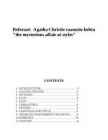
................... 4 3. PICTURES.............................................................. 5 4. PLOT....................................................................... 6 5. PLOT....................................................................... 7 6. CHARACTERS...................................................... 8 7. SETTING................................................................ 9 8. LANGUAGE AND STYLE................................... 9 9. WHOM DO I RECCOMEND THIS NOVEL........ 9 10. SUMMARY........................................................... 10 11. SOURCES.............................................................. 11 INTRODUCTION The Mysterious Affair at Styles is a detective novel by Agatha Christie. It was written in 1916 and was first published by John Lane in the USA in October 1920 and in the UK by The Bodley Head (John Lane's UK company) on January 21 1921.
surname is uncertain. Conan Doyle's father was an artist, as were his paternal uncles (one of whom was Richard Doyle), and his paternal grandfather John Doyle. Conan Doyle was sent to the Roman Catholic Jesuit preparatory school St. Mary's Hall, Stonyhurst, at the age of eight. He then went on to Stonyhurst College, but by the time he left the school in 1875, he had rejected Christianity to become an agnostic. From 1876 to 1881 he studied medicine at the University of Edinburgh, including a period working in the town of Aston (now a district of Birmingham). While studying, he also began writing short stories; his first published story appeared in Chambers's Edinburgh Journal before he was 20. Following his term at university, he served as a ship's doctor on a voyage to the West African coast. He completed his doctorate on the subject of tabes dorsalis in 1885. In 1882, he joined former classmate George Budd as his partner at a medical practice in
Plantagenets began the challenge the King's absolute power, which resulted in King John being forced to sign Magna Carta in 1215. It consisted of long list of limitations to the King's power and it gave more power to the origins of Parliament. The origins of Parliament are to be found in the reign of John's successor, Henry III. It was a meeting of the King and his Barons and servants at which various administrative and financial problems were discussed. In order to make it easier to put the decisions taken into practice, each Shire had to elect a number of knights to attend at these meetings at report the decisions to their Shires. Edward I continued this experiment and in 1295 called a parliament that became known as the Model Parliament. The House of Commons as a separate Chamber resulted from the unofficial meeting of these knights and burgesses. The person chosen to speak for these commoners in Parliament became known as the speaker.
He was defeated at the battle of Naseby, captured and imprisoned. It took them four years to decide what to do with them. They decided to behead him in 1649. After his beheading the Commonwealth or Cromwell's republic was created. However, the government was too severe and it fell in 1660. The Commonwealth abolished the House of Lords, the Anglican Church and Scotland went under Cromwell's rule. 1653 it became a dictatorship. The army was used to retain law and order. The country strictly observed Puritan beliefs no celebration of Christmas or Easter, no games on Sunday. Cromwell died in 1658, his son was his successor, but fucked up. In 1660 Charles II was invited to return to the throne. He was a good and judicious diplomat. Was Catholic yet allowed both Puritans and Catholics to follow their beliefsystems. The first political parties were founded during that time: The Whigs and The Tories.
him home and instating Cassio as his replacement, Othello goes over the edge, striking Desdemona and then storming out. That night, Othello is upset and ignores Desdemona's excuses. Later, Othello tells Desdemona to wait for him in bed and to send Emilia away. Iago's plan is going as planned. Iago instructs Rodrigo to ambush Cassio, but Rodrigo misses his mark and Cassio wounds him instead. Iago wounds Cassio back and runs away. Othello hears Cassio's cry, assuming that Iago has killed him. Lodovico and Gratiano enter to see what the commotion is about. Iago enters shortly thereafter and flies into a pretend rage as he discovers Cassio's assailant Rodrigo, whom he murders. Cassio is taken to have his wound dressed. Meanwhile, Othello stands over his sleeping wife in their bedchamber, preparing to kill her. Desdemona wakes asserting her innocence, but Othello ignores her. Emilia enters with the news that Rodrigo is dead
His most famous writings are Alice's Adventures in Wonderland and its sequel Through the LookingGlass, as well as the poems "The Hunting of the Snark" and "Jabberwocky", all examples of the genre of literary nonsense. He is noted for his facility at word play, logic, and fantasy, and there are societies dedicated to the enjoyment and promotion of his works and the investigation of his life in many parts of the world, including the United Kingdom, Japan, the United States, and New Zealand. Family Dodgson's family was predominantly northern English, with Irish connections. Conservative and High Church Anglican, most of Dodgson's ancestors were army officers or Church of England clergymen. His greatgrandfather, also Charles Dodgson, had risen through the ranks of the church to become a bishop. His
Every man kills the thing he loves. The death of Wilde is the end of decadence in English literature. Late Victorian novel, Thomas Hardy. Modernism, James Joyce. Realism continued to flourish in England throughout the second half of the 19th century. Late Victorian novel. Took influence from continental Europe, e.g. Emile Zola. Concern for the social role of women – the heroines broke the conventional roles of Victorian women by supporting suffrage, smoking and adopting a more “rational” dress, also
policies of governments. Yet it has never had a chronicler. It badly needs one. It has been estimated that cryptanalysis saved a year of war in the Pacific, yet the histories give it but passing mention. Churchill's great history of World War II has been cleaned of every single reference to Allied communications intelligence except one (and that based on the American Pearl Harbor investigation), although Britain thought it vital enough to assign 30,000 people to the work. The intelligence history of World War II has never been written. All this gives a distorted view of why things happened. Furthermore, cryptology itself can benefit, like other spheres of human endeavor, from knowing its major trends, its great men, its errors made and lessons learned. I have tried in this book to write a serious history of cryptology. It is primarily a report to the public on
· Life lacks purpose Science: Albert Einstein-general theory of relativity had a huge impact on culture as well. Everything is relative. Philosophy: Henri Bergson (French) came to challenge the immediate experience ad intuition are more significant than rationalism and science for understanding reality. Opposition to materialism and positivism. Opposition to abstract, untested theories &ideologies. Friedrich Nietzsche ,,God is dead"-through explaining and putting forward theories had killed Christian god. The essence of Freudian theory: the process in the human psyche Superego-society, conscience, morals, traditions, religion, a moral censor Ego-rational behavior, motivation, self-identification, conscious decisions Id-instincts, natural responses, the pleasure principle, aggressive instincts, the death wish Influence: In art and literature, Freud's theories influenced surrealism . Like psychoanalysis,
Pope said no. Then Henry decleared himself the head of English church to get divorce. Catherine was sent to live in countryside and brought up Mary, who was also a Catholic. Next wife was Anne Bolyn, daughter of a knight. They had daughter called Elizabeth l. Time went by and Henry had to get rid of Anne, she was sent to tower accused of treason (riigi reetmine) and executed. Henry was free, needed another wife. Had six wives together. 1 died, 1 survived, 2 divorced, 2 killed. Henry had a son, was a king Edward Vl, died very young. Henry was a talented musican and scholar, spent much money on it. Soon he had spent all savings his father had collected, he needed money. He understood that monasteries had become useless. So he closed them, took away the riches dissolution of monasteries. When henry quarreled with the Pope, made England independent of Rome. Beginning of the Anglican church. Henry died 1547, only son came to throne Edward Vll, was too
Irish and Scottish missionaries were spreading Christianity in Anglo-Saxon England during the 6th centurie. The Latin term Scotti refers to the Gaelic-speaking people of Ireland and the Irish who settled in western Scotland. *The Venerable Bede Bede was a Christian monk, he was the most learned man in Europe at that time. He is remembered mainly for his "Ecclesiastical History of the English People." This five volume work records events in Britain from the raids by Julius Caesar to the arrival of the first missionary from Rome. Bede's writings are considered the best summary of this period of history ever prepared. Some have called it "the finest historical work of the early Middle Ages." *The coming ofe the Angles, Saxons, Jutes, Frisians to Britain Very little is known about the first several hundred years of the Anglo-Saxon era, primarily because the invaders were an illiterate people
Teir country- Caledonia- Pictland The Scots, Hibernia Raiders, Celts living in Ireland/Hibernia Migrated to Scotland Raided Roman Britain After Kenneth McAlpin united Scotland all inhabitants became Scots The Venerable Bede A monk in the Northumbrian monastery of Jarrow In 731 ,,The Great Ecclesiastical History of the English People"- overshaows all other sources of 7th, early 8th C Well-founded scraps of tradition, first work of history, where AD system is used Angles, Saxons, Jutes. Frisians 430´s onwards, Germans settlers arrived in large numbers. Anglo-Saxon invasions in 499 The Saxons- Saxon country to South and West The Angles- Angulus to East Anglia, Jutes in Kent Same culture as southern Scandinavia, Germany, northern France 600 they had founded their 7 kingdoms The Anglo-Saxon kingdoms Kent-JUtes, Essex, Sussex, Vessex- Saxons
Taken at the Flood "There is a Tide" redirects here. "There is a Tide" is also the name of a short story by Larry Niven, set in the Known Space universe. Taken at the Flood is a work of detective fiction by British writer Agatha Christie, first published in the US by Dodd, Mead and Company in March 1948 under the title of There is a Tide...[1] and in the UK by the Collins Crime Club in the November of the same year under Christie's original title.[2] The US edition retailed at $2.50[1] and the UK edition at eight shillings and sixpence (8/6).[2] It features her famous Belgian detective, Hercule Poirot, and is set in 1946. 1 Plot summary
He had lands in Britain & France. Then the government was the monarch, a person, not a place. He had more land than any pervious king. After his marriage to Eleanor of Aquitaine, he also ruled the lands south of Anjou. His empire stretched from the Scottish border to the Pyrenees. England provided most of its wealth, but the heart was Anjou. Henry II began to regain royal control. During the war some barons had become very powerful. He pulled down some of their castles. He tried to restore law & order. He wanted the same kind of justice to be used everywhere. He appointed his own judges to travel around the country. They dealt with crimes & disagreements over poverty. Serious offences were tried in the king's court. At first they had no special knowledge or training. They were trusted to use common sense. By the end of the 12th cent. They had real knowledge & experience of the law which became known as ,,common law", based on custom, comparison, previous cases & decisions
............................................................................................ My Opinion............................................................................................................................... Orson Scott Card He was born on the 24th of August, 1951 in Richland, Washington. Card's writing career began primarily as a poet, studying at Brigham Young University. During his studies as a theatre major, he began "doctoring" scripts, adapting fiction for theatre production, and finally writing his own one-act and full-length plays. Later he has worked both as a freelancer and a contracted writer. He first wrote the short story "Ender's Game" while working at the BYU press. Ender's Game and its sequel Speaker for the Dead were both awarded the Hugo Award and the Nebula Award, making Card the only author (as of 2008) to win both of science fiction's top prizes in consecutive years. Card continued the series with seven books, which divide into "Shadow"
during the period of Romanticism. He believed that spiritual reality lies hidden behind the visible world of the senses and he attempted to create a symbolic language to represent his spiritual visions. He began printing his own illustrated poems in colour in 1787. The first example was Songs of innocence(1789). Towards the end of his life, he joined a circle of younger artists who appreciated his remarkable powers. It was not until the late 19th century that Blake's work achieved general attention. He was extremely prolific and his prints, illustrations, and paintings can be found in several important public collections in England and the USA. Agatha Christie · Agatha Christie (1890-1976)was an English detective story writer.As an extraordinarily popular author, Christie wrote over 80 books, most of them featuring one of her two famous detectives; Hercule Poirot, an egotistical Belgian,
observing the writings of the men with whom he worked. When Mr. Auld discovered this, he strongly disapproved, saying that if a slave learns to read, he would become dissatisfied with his condition and desire freedom; Frederick later referred to this as the first anti-abolitionist speech he had ever heard. In 1833, Capt. Auld took Douglass back from his brother after a dispute ("as a means of punishing Hugh", Douglass says). Dissatisfied with him, Thomas Auld then sent Douglass to work for Edward Covey, a poor farmer who had a reputation as a "slave-breaker," where Douglass was whipped regularly. 3 Sixteen-year-old Frederick was indeed nearly broken psychologically by his ordeal under Covey, but finally rebelled against the beatings and fought back. Covey lost out on a confrontation with Frederick and never tried to beat him again. This incident was kept
The Squire is his young son who has curly hair, is high-spirited and wears a white-sleeved gown embroidered with red flowers who also thinks he is a typical courtly lover. Most of the clerics are ridiculed. E.g. the Monk doesn't pray, he hunts. He is fat, doesn't fast a lot, rides a good horse and is richly dressed. He is still presented in good nature. The Parson is poor but is rich of holy thought and work. The Student rides an extremely lean horse, is poor, dresses threadbare his clothes are shabby because he spends all his money on books. He represents the spirit of learning. The Shipman represents many of his countrymen, other sailors, including pirates, who were making a name for England as a powerful maritime nation. o They each tell a story suitable for their class, different genres. The Knight a
In about 500 BC came the people whose homeland was near the Rhine River. These were the Celts. The Roman invasion began in 43AD. The Romans were highly organized conquerors. They built good roads, baths and bridges. The Romans stayed in the British Isles up to the 5th century. The remarkable thing about the Romans is that, despite their long occupation of Britain, they left very little behind. Most of the villas and temples the impressive network of roads and the cities they founded, including Londinium, 4 were soon destroyed. The next invaders were the Anglo-Saxons. They came from nowadays Germany, Holland and Denmark. In 1066 the last successful invasion was made by French-speaking Normans. French became the language of the ruling class, Latin was the written language. By the 14th century, however, English began to replace both French and Latin, but the English
the Roman invasion, Iron Age Britain already had cultural and economic links with Continental Europe, but the invaders introduced new developments in agriculture, urbanization, industry and architecture, leaving a legacy that is still apparent today. Historical records beyond the initial invasion are sparse, although many Roman historians mention the province in passing. Most of the knowledge of the period stems from archaeological investigations and especially epigraphic evidence. The invasion force in AD 43 was led by Aulus Plautius.It is not known how many Roman legions were sent; only one legion, the II Augusta, commanded by the future emperor Vespasian, is directly attested to have taken part. The IX Hispana,the XIV Gemina (later styled Martia Victrix) and the XX are attested in 60/61 during the Boudican Revolt, and are likely to have been there since the initial invasion. However, the Roman army was flexible, with units being used and moved whenever necessary, so this is not certain
Report Title: ,,Frankenstein'' Author: Mary Shelley Genre: Novel Setting (time): 19th century Setting (place): North Pole, Europe (Switzerland, Scotland, England) Tone: magical, dark, mysterious, ghostly Themes: love, loneliness, science, human tendency Introduction Frankenstein was first published in March, 1818. This book is also known as The Modern Prometheus. Frankenstein is one of the most popular works of gothic horror and science fiction literature and it is considered to be one of the best known novels of English Romanticism. Characters
Philip Larkin’s Poetry: Themes, Form, Style, Imagery and Symbolism Author: Sandra Olivares González Tutor: Jesús Marín Calvarro Degree in English Studies, English Department, Faculty of Philosophy and Letters, University of Extremadura Cáceres, 29th January 2016 Philip Larkin’s Poetry: Themes, Form, Style, Imagery and Symbolism The aim of this work is to obtain some characteristics of the poetry of Philip Larkin, such us the origin of his themes, the way in which he writes his poems and the symbolism he uses (which is a very controversial topic because some assume that he does use it, while some others say that he uses it in an ironic way). In this work we tried to make a revision on the vision of Larkin through the studies that had been made on him, and on the basis of it we can say, that the voice of Larkin still clearly contemporary
Joseph Rudyard Kipling was a British author and poet. He was born on 30 December 1865 in Bombay, in India which was part of the British Empire then. he is best known for his works of fiction The Jungle Book (1894) (a collection of stories which includes Rikki-Tikki-Tavi), Kim (1901) (a tale of adventure), many short stories, including The Man Who Would Be King (1888); and his poems, including Mandalay (1890), Gunga Din (1890), and If-- (1910).He is regarded as a major "innovator in the art of the short story"; his children's books are enduring classics of children's literature; and his best works speak to a versatile and luminous narrative gift. Kipling was one of the most popular writers in English, in both prose and verse, in the late 19th and early 20th centuries. In 1907, he was awarded the Nobel Prize in Literature, making him the first English
* the flag is called the Saint George's Cross Scotland: * the biggest cities are Glasgow and Edinburgh (the capital) * Stirling has been an important settlement in Scotland for over 800 years * the flag is called the Saint Andrew's Cross Wales: * the biggest cities are Cardiff, Swansea and Newport * these cities depended for their growths on surrounding mines and metal production, which started during the days of the Industrial Revolution * the flag is of Wales bears a Red Dragon (it is not represented on the Union Jack) Northern Ireland: * the capital city is Belfast * 54% of people regard themselves as Protestants and 42% as Roman Catholics * the flag is called the Saint Patrick's Cross 2) History Prehistoric Britain, Roman Britain, Anglo-Saxon, Danish, Norman invasions (...-1066):
British authors from the United Kingdom, which includes England, Scotland, Northern Ireland, Wales, the Channel Islands, and Isle of Man Includes early works written in Gaelic, Welsh, and Latin, works in Old, Middle, and Modern English, each of which represents a different period Full of great works British works in Latin Venerable Bede He lived between 673 and 735 AD The greatest of all the AngloSaxon scholars He's the earliest English historian, whose work has shed light on a period of English history that would have otherwise been unknown ,,The Father of English History" Wrote / translated about 40 books on almost every area of knowledge, i.e. nature, astronomy, and poetry His best known work is "The Ecclesiastical History of the English People" Starting with the Roman invasion in the 5th century, he recorded the history of the English up to his own day Old English Cædmon ,,The Father of English Hymn"
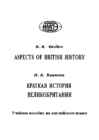
Подготовлено на факультете лингвистики. The book contains an overview of the most important events in British history – from the first documented invasions of the island to the formation and fall of the British colonial empire. A series of exercises will help to remember the subject matter, practise the vocabulary and contribute to skills work. The book is intended for the Humanities students. Вавилов Н.А., 2008 3 4 Contents 5 ПРЕДИСЛОВИЕ Настоящее пособие содержит краткий очерк истории Великобритании от первых документально засвидетельствованных событий, имевших место на
 annaabi.ee