 50 punkti
Autor soovib selle materjali allalaadimise eest saada 50 punkti.
50 punkti
Autor soovib selle materjali allalaadimise eest saada 50 punkti.
 ~ 9 lehte
Lehekülgede arv dokumendis
~ 9 lehte
Lehekülgede arv dokumendis
 2009-10-13
Kuupäev, millal dokument üles laeti
2009-10-13
Kuupäev, millal dokument üles laeti
 10 laadimist
Kokku alla laetud
10 laadimist
Kokku alla laetud
 0 arvamust
Teiste kasutajate poolt lisatud kommentaarid
0 arvamust
Teiste kasutajate poolt lisatud kommentaarid
 RaileL.
Õppematerjali autor
RaileL.
Õppematerjali autor
Scotlan History The history of Scotland begins around 10,000 years ago, when humans first began to inhabit Scotland after the end of the Devensian glaciation, the last ice age. Of the Stone Age, Bronze Age, and Iron Age civilization that existed in the country, many artifacts remain, but few written records were left behind.People lived in Scotland for at least 8,500 years before recorded history dealt with Britain. The written history of Scotland largely begins with the arrival of the Roman Empire in Britain, when the Romans occupied what is now England and Wales, administering it as a Roman province called Britannia. To the north was territory not governed by the Romans -- Caledonia, by name. Its people were the Picts. From a classical historical viewpoint Scotland seemed a peripheral country, slow to gain advances filtering out from the Mediterranean fount of civilisation, but as knowledge of
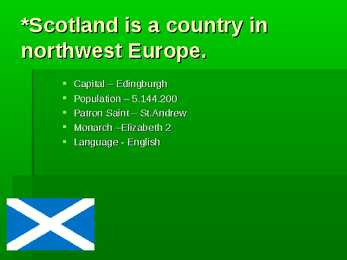
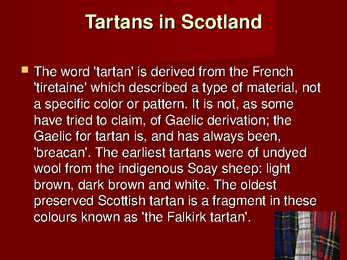
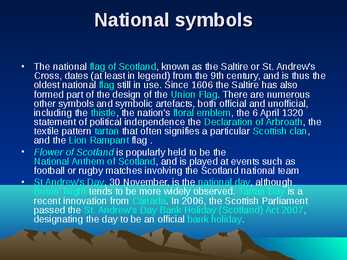
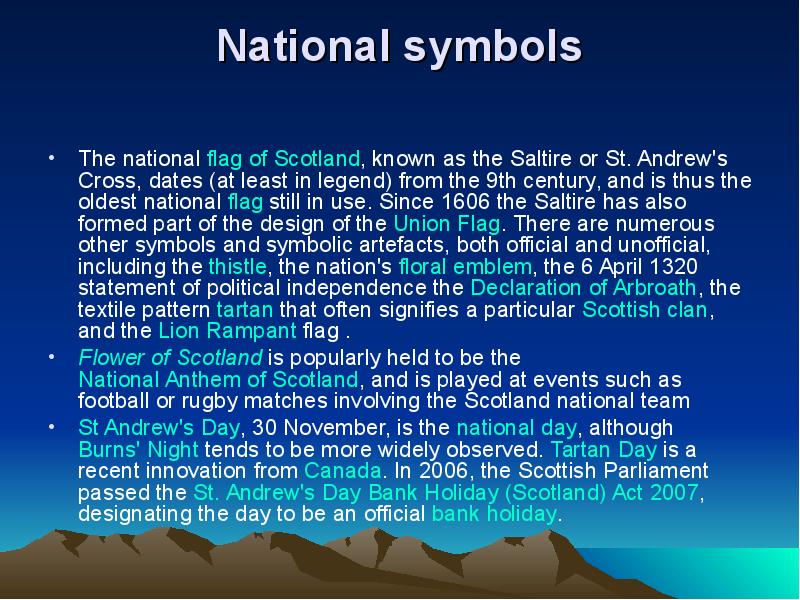
Scotland Overview Flag-Saltire Royal Standard of Scotland Edinburgh, Glasgow First Minister Alex Salmond 78,387km² 5,222,100 St Andrew History Picts (Celtic tribe) Romans named scotland Caledonia The Scots Queen Mary was forced to abdicate the Scottish throne in 1567. National Symbols Thistle Declaration of Arbroath Tartan Bagpipes Kilt Honours of Scotland Crown, Sword and sceptre are from late fifteenth and early sixteenth century. Crown was made in 1540. Pope Julius II presented the sword to King James IV in 1507. The sceptre was made in 1494 and was presented to King James IV by Pope Alexander VI Honours of Scotland Language Have spoken Pictish, Scottish Gaelic similar Norse, Norman- to Irish, it is French and Brythonic recognised as an
Population: 5, 055, 000 National emblem: the thistle Capital: Edinburgh National flower: the bluebell Islands: About 790 National instrument: bagpipes Lakes: the best- known is Loch Ness, famous for National dish: haggis Nessie, its mythical monster Scotland is also famous for: whisky, kilts and sheep · One of the four constituent nations which form the UK · They have their own money, system of law, history, stamps, deep- rooted customs, traditions and ancient language- Gaelic · Most people speak the Scottish dialect becoming endangered language · Weather unpredictable · Breathtaking scenery Scottish Industries · Traditional -coal mining, steel production, shipbuilding
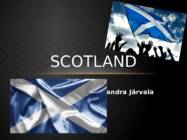
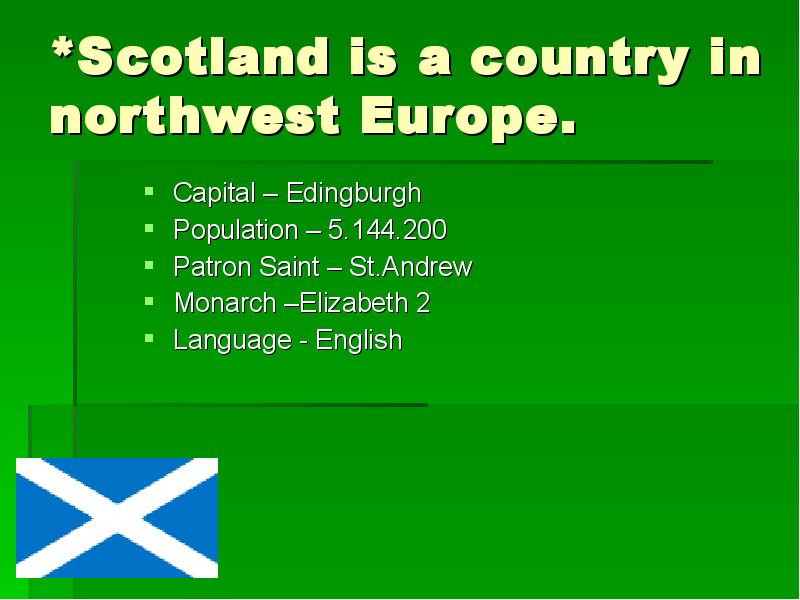
SCOTLAND Sandra Järvala GEOGRAPHY & POPULATION · Scotland is a country that is part of the United Kingdom and coers the northern third of the Island of Great Britain. · The Scotland capital city is Edinburgh. MAJOR CITIES · The largest city is Glasgow. Glasgow has a population of 598,830. The city has an area of 175.5 km ². · Aberdeen, Dundee, Paisley, East Kilbride and Livingston are are also large cities. · There is a Glasgow bus tours for tourists SCOTLAND FLAG · The Flag of Scotland, also known as Saint Andrew's Cross or the Saltire, is the national flag of Scotland. · Scottish flag is blue · On the flag is a white X-shaped cross. NATIONAL SYMBOLS
..................18 2.3 Results of the questionnaire 1...............................................................................................23 During the first questionnaire 30 students of the 9th and 10th class of Gymnasium were questioned about the British national symbols...........................................................................23 Surprisingly, according to the results, more than 50 percent of students are aware of the national flags of Great Britain, Scotland, Northern Ireland and Wales. As can be seen, quite a lot of children also know the name of the Great Britain flag. However, almost all of the students have no idea about other names of the British flags, as well as about the patron saints. In addition, almost 90 percent of students are also unaware about the national holidays..........23 All things considered, we see that there is a need for students to pay more attention to
Scotland ! Scotland (Gaelic: Alba) is a country in northwest Europe that occupies the northern third of the island of Great Britain. It is part of the United Kingdom, and shares a land border to the south with England. It is bounded by the North Sea to the east, the Atlantic Ocean to the north and west, and the North Channel and Irish Sea to the southwest. In addition to the mainland, Scotland consists of over 790 islands including the Northern Isles and the Hebrides. Edinburgh, the country's capital and second largest city, is one of Europe's largest financial centres. It was the hub of the Scottish Enlightenment of the 18th century, which saw Scotland become one of the commercial, intellectual and industrial powerhouses of Europe. Scotland's largest city is Glasgow, which was once one of the
Report of SCOTLAND Maiki Joakit 10. klass 2008 Etymology Scotland is from the Latin Scoti, the term applied to Gaels. The Late Latin word Scotia (land of the Gaels) was initially used to refer to Ireland. By the 11th century at the latest, Scotia was being used to refer to (Gaelic-speaking) Scotland north of the river Forth, alongside Albania or Albany, both derived from the Gaelic Alba. The use of the words Scots and Scotland to encompass all of what is now Scotland became common in the Late Middle Ages. History Repeated glaciations, which covered the entire land-mass of modern Scotland, have destroyed any traces of human habitation that may have existed before the Mesolithic period. It is believed that the first post-glacial groups of hunter-gatherers arrived in Scotland around 12,800 years ago, as the ice sheet retreated after the last glaciation. Groups of settlers began building the first known permanent houses on Scottish soil around 9,500
Outstanding figures in British literature Eva Martina Põder 11.b British literature Refers to all literature produced by British authors from the United Kingdom, which includes England, Scotland, Northern Ireland, Wales, the Channel Islands, and Isle of Man Includes early works written in Gaelic, Welsh, and Latin, works in Old, Middle, and Modern English, each of which represents a different period Full of great works British works in Latin Venerable Bede He lived between 673 and 735 AD The greatest of all the AngloSaxon scholars He's the earliest English historian, whose work has shed light on a period of English history that would have otherwise been unknown
 annaabi.ee








Kõik kommentaarid